
Ready to run the code? See the quick start: prepare data → train → evaluate.
Code and reproduction resources
- Complete code: datawhalechina/agentic-rl-lab/experiments/retool
- Training script: experiments/retool/train.py
- SwanLab: Complete training records
- Paper: ReTool: Reinforcement Learning for Strategic Tool Use in LLMs
- PyTRIO documentation: https://docs.pytrio.com/docs
- What is PyTRIO? Introduction on Zhihu
- PyTRIO Skill:SwanHubX/pytrio-skill
This is the fifth chapter in my series reproducing ten reinforcement learning algorithms.
Earlier chapters cover:
- Chapter 0: RL loss functions
- Chapter 1: GRPO
- Chapter 2: OPD
- Chapter 3: Search-R1 for the price of a drink
- Chapter 4: OPSD for the price of a meal
This time the tool does computation: ReTool lets the model decide when to write Python, and what to calculate, within a long mathematical reasoning process.
In plain language:
The model works through a problem, runs code when calculation becomes difficult, and is graded only on its final answer. It learns when a calculator helps through outcomes.
The initial pipeline check cost about as much as two coffees.
I first ran a 20-step trial to verify the loop. Its bill was:
训练会话(20 step):  ¥22.89   (4.34M prefilling / 1.66M train / 1.77M sample)
AIME25 评测 × 2:     ¥4.16 + ¥4.61   (Base、Step 20)
合计:                ¥31.66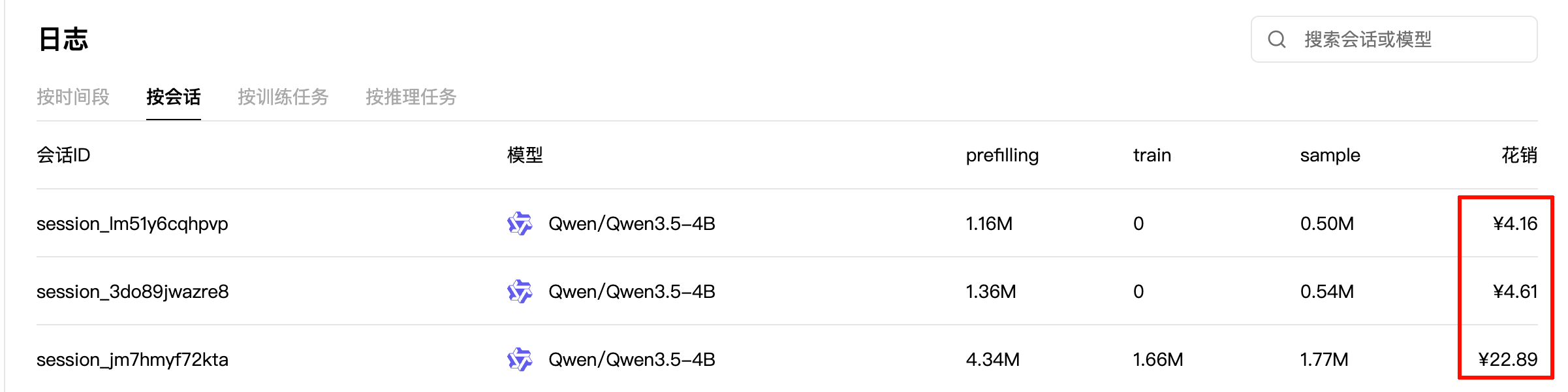
At the time, a Luckin coffee cost roughly 13–16 yuan, or 26–32 for two. That comparison describes the small trial used to decide whether to continue.
Behavior already changed during those 20 steps:
correct(前 10 步均值 → 后 10 步均值):  0.289 → 0.389
code_calls:                              1.24 → 1.72
degenerate group(整组无梯度):           0
Evaluation also improved over the same interval. The later results section expands this figure; first compare Base with Step 20:
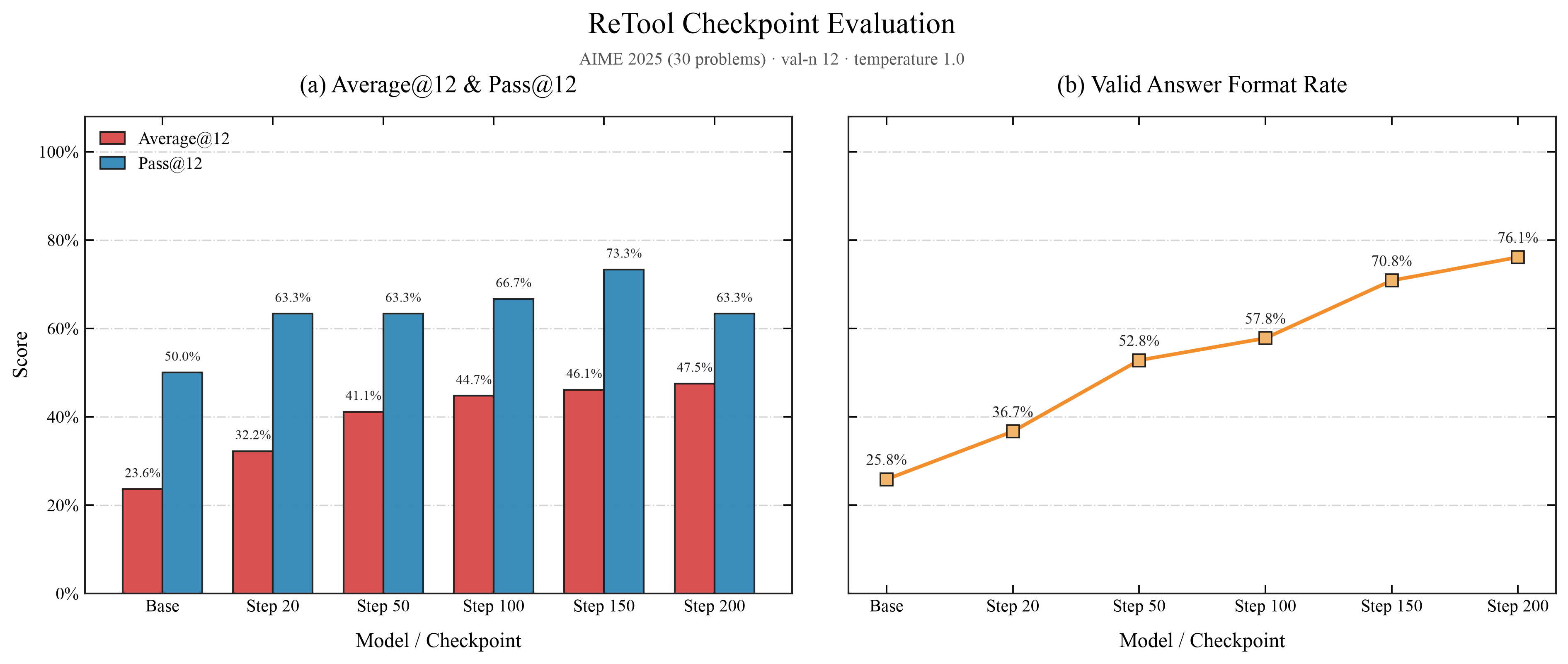
Base Model:  Average@12 23.61% · Format 25.83%
Step 20:     Average@12 32.22% · Format 36.67%
After that check, I used the same configuration for a complete 200-step training run:
训练会话(200 step): ¥224.44 (48.67M prefilling / 15.97M train / 15.84M sample)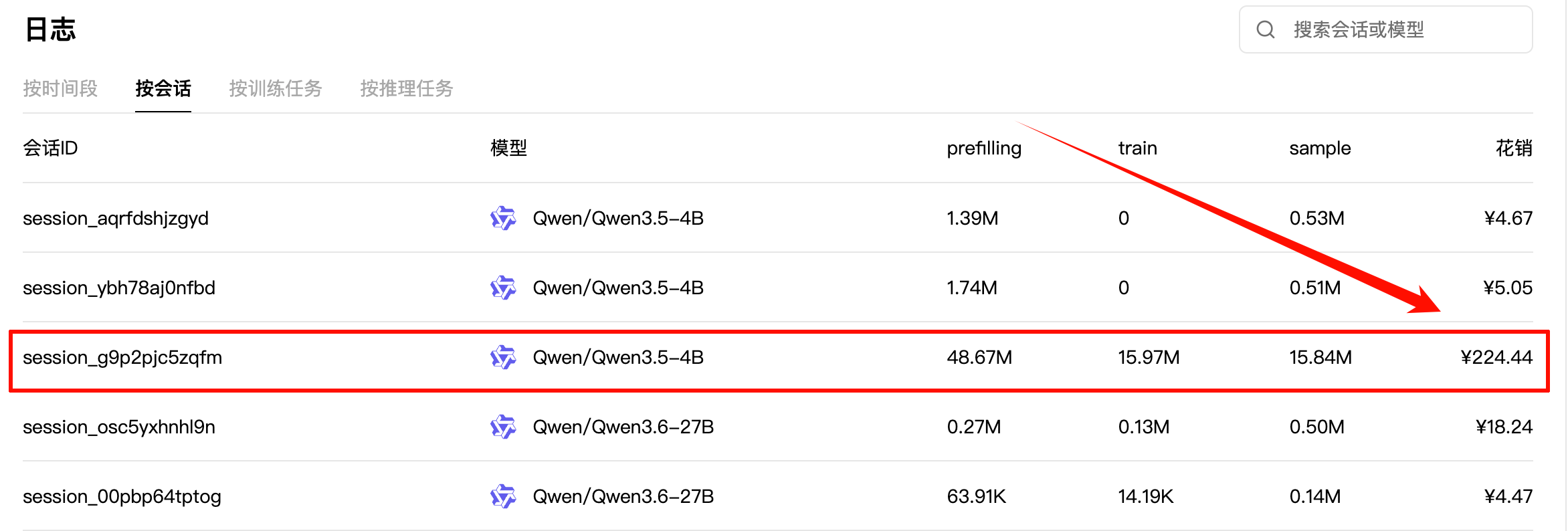
Evaluation is separate: Base plus 5 checkpoints gives 6 AIME25 evaluations, each with 30 questions and 12 samples per question, costing about ¥4–5 each in this experiment.
The attributable costs together are:
训练(验证跑 + 200 步轨迹):  ¥22.89 + ¥224.44 = ¥247.33
评测(截图中 4 次):           ¥18.49   (另有 2 次未入镜,每次约 ¥4~5)
Where does ReTool come from?
ReTool is work released by ByteDance's Seed team in April 2025, titled:
ReTool: Reinforcement Learning for Strategic Tool Use in LLMs
It addresses a direct problem.
Long-chain reasoning improves mathematical performance, but purely textual reasoning must perform complex calculations internally. Roots, high-degree equations or large enumerations can introduce unnoticed arithmetic errors during a long solution.
ReTool allows the model to write code during reasoning. Two central settings are:
- Code-interlaced rollout: pause generation at code, execute it in a sandbox, append stdout/stderr to context and continue. Interpreter-output tokens do not enter the loss.
- Outcome-only reward: reward a correct final answer, without rewarding code use itself. When and how often to use code is learned through results.
The paper also includes cold-start SFT on code-interlaced demonstrations, an asynchronous SandboxFusion sandbox and KV-cache reuse. This reproduction distinguishes what it retains from what it omits.
How did we reproduce it?
The implementation retains the central algorithm around three components:
- Tool protocol (
protocol.py): declare the interpreter as a native model tool, define the system prompt and parse<tool_call>. - Local execution sandbox (
sandbox.py): execute each snippet in a fresh Python subprocess with timeouts and resource limits. - Outcome reward (
reward.py): check mathematical equivalence of the final\boxed{}answer, scoring +1 / −1.
The multi-turn rollout state machine, group advantages and PyTRIO loop reuse the framework verified in earlier chapters.
The architecture diagram shows the budgets and hard limits for each stage:
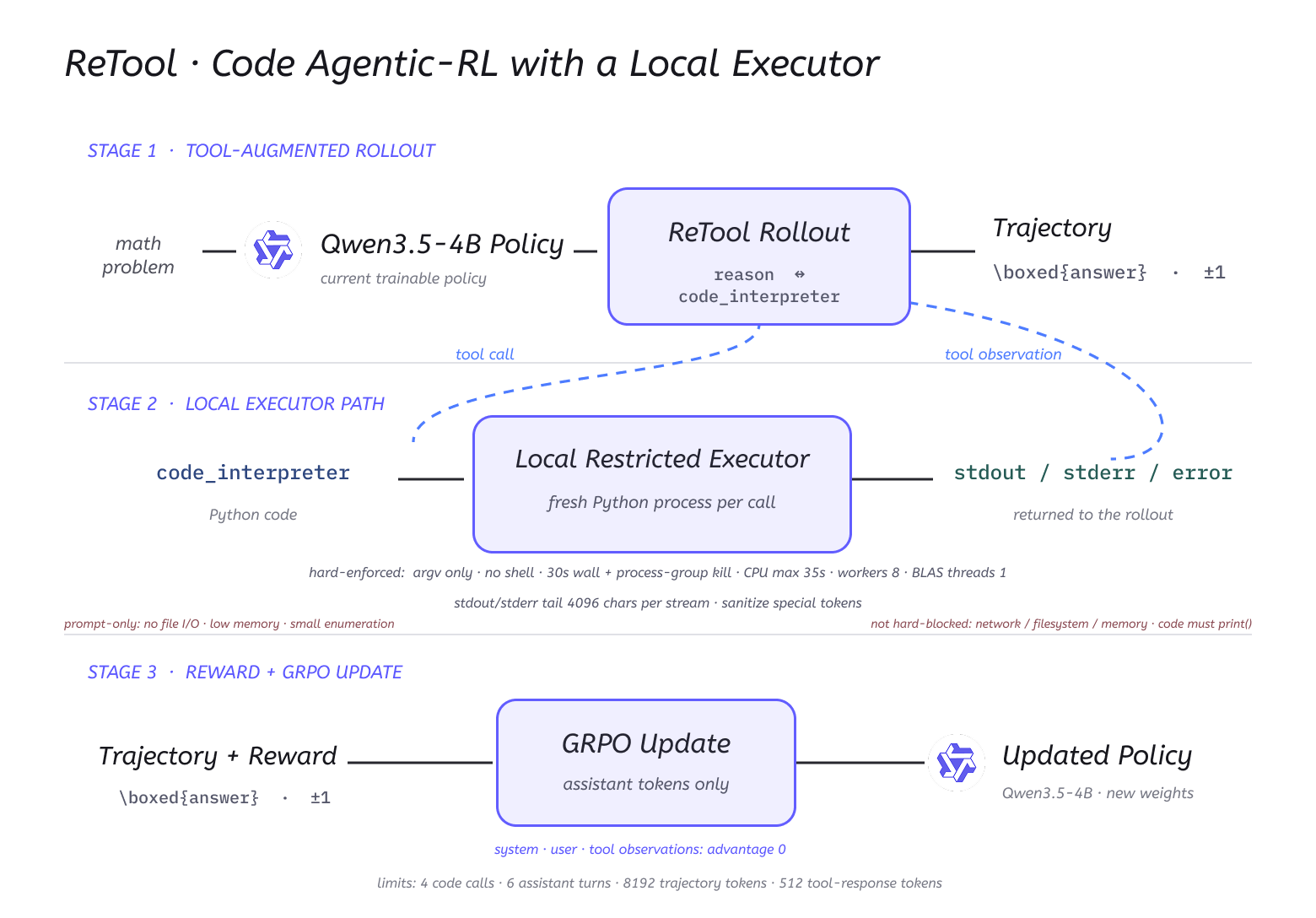
Key decisions are:
- Use the native tool protocol. Code is sent through Qwen's
<tool_call>format, and stdout/stderr returns in arole: "tool"message. This provides code-interlaced interaction without adding tokens or changing the tokenizer and chat template. - Skip cold-start SFT and train Base directly with RL. This is the largest omitted stage. In the base-model smoke test, 2 questions × 8 trajectories yielded an
87.5%tool-use rate (14/16),85.4%valid-call rate and mixed rewards within groups, enough to test RL without teaching the format first. - Match strict answer checking: inspect the final 300 characters, extract the last
\boxed{}, and usemath_verifyfor equivalence. Correct scores +1; incorrect or malformed scores −1. - Use PyTRIO's built-in
ppo, with bounds0.8 / 1.28, corresponding to the recipe's ε_low=0.2 / ε_high=0.28, or DAPO Clip-Higher.
Experimental results
Evaluation fixes AIME25's 30 questions and 12 samples per question. Base and every checkpoint share the same configuration:
temperature = 1.0
top_p = 0.7
val_n = 12(每题 12 次采样)
轨迹预算 = 8,192 tokens(与训练一致)
模式 = retool(启用 code 工具)
Results across one 200-step training run are:
| Model / checkpoint | Average@12 | Pass@12 | Format | Mean code calls | Mean turns |
|---|---|---|---|---|---|
| Qwen3.5-4B Base | 23.61% | 50.00% | 25.83% | 1.69 | 2.69 |
| Step 20 | 32.22% | 63.33% | 36.67% | 1.37 | 2.37 |
| Step 50 | 41.11% | 63.33% | 52.78% | 1.70 | 2.70 |
| Step 100 | 44.72% | 66.67% | 57.78% | 1.66 | 2.66 |
| Step 150 | 46.11% | 73.33% | 70.83% | 2.43 | 3.43 |
| Step 200 | 47.50% | 63.33% | 76.11% | 1.98 | 2.98 |
The metrics mean:
- Average@12: the proportion correct among 360 generations, estimating single-sample accuracy.
- Pass@12: the proportion of 30 questions answered correctly at least once across 12 samples.
- Format: the proportion of generations with a valid
\boxed{}answer.
Step 200 versus Base:
Average@12:  23.61% → 47.50%  (+23.89 个百分点)
Pass@12:     50.00% → 63.33%  (+13.33 个百分点)
Format:      25.83% → 76.11%  (+50.28 个百分点)
Correct generations increase from 85 to 171. Questions answered correctly at least once increase from 15 to 19, with a peak of 22 at Step 150.
Across this run, Average@12 increases at every evaluated checkpoint and Format doubles. However, 30 questions, one training run and no multi-seed study cannot establish a stable reproduction of the paper's gains. Pass@12 falls from 73.33% at Step 150 to 63.33% at Step 200, illustrating the variability of this small evaluation.
The 8,192-token trajectory budget truncates some long AIME reasoning and limits format completion. The paper uses a 16k budget.
Reproduction configuration
The trial and 200-step run share the same configuration apart from --max-steps:
| Item | This implementation |
|---|---|
| Base Model | Qwen/Qwen3.5-4B |
| Training | LoRA rank 32 through the PyTRIO training client |
| Training data | BytedTsinghua-SIA/DAPO-Math-17k → datasets/train.jsonl |
| Per step | 8 questions × group size 8 = 64 trajectories |
| Turn budget | max_code_calls=4, max_assistant_turns=6 |
| Token budget | Trajectory ≤ 8,192; assistant turn ≤ 1,024; tool output ≤ 512 |
| Sampling | Temperature 1.0, top_p 1.0 |
| Sandbox | Local subprocess, 30s timeout, 8 workers |
| Optimizer | Adam, lr 4e-5, β (0.9, 0.95) |
| Loss | ppo,clip 0.8 / 1.28 |
| Advantage | Within-group centering; observation tokens receive 0 |
| Checkpoints | Every 50 steps in the full run; every 5 in the trial |
| Seed | 42 |
The official recipe uses train_batch_size=512, n_resp_per_prompt=16, max sequence length 16384, max_turns=8 and actor lr 1e-6; the paper fully trains Qwen2.5-32B. We use smaller budgets and LoRA. The released code also reduces incorrect-answer penalties according to tool turns (score = min(0, score + (num_turns - 2) / 2 * 0.1)). This differs from the paper's outcome-only description; this reproduction follows the paper and omits that shaping.
The ReTool training loop in detail
One training step can be divided into seven parts.
Step 1: prepare math questions with verifiable answers
prepare_data.py follows the recipe's BytedTsinghua-SIA/DAPO-Math-17k, exporting question + answer JSONL:
{"id": "40f50547-...", "question": "The points $P,$ $Q,$ and $R$ are represented by ...", "answer": "3", "data_source": "math_dapo"}The original DAPO prompt includes an "Answer:" wrapper. We remove it to avoid conflicting with the \boxed{} protocol.
Step 2: declare the interpreter as a native tool
protocol.py declares one tool through the chat template's tools argument:
"name": "code_interpreter",
"parameters": {"code": "The Python code to be executed."}
The system prompt specifies the task, available tool and invocation format. It also states code constraints: finish within seconds, use little memory, avoid file I/O, bound enumeration, print results and assume stateless execution. The template fixes enable_thinking=False. The original paper's base model has no thinking-mode switch; its long reasoning is ordinary generated text. The official reproduction also reports poor code use and training behavior with Qwen3 thinking mode.
Step 3: branch and continue trajectories
In rollout.py, the first request uses num_samples=group_size to create 8 trajectories. Later requests continue each branch independently. Generation pauses at <tool_call>; after execution, build_next_prompt appends assistant closing tokens and the tool observation to the actual sampled tokens, then generation resumes.
Continuation keeps the original token sequence without text↔token re-encoding. The official implementation reports that irreversible re-encoding can cause collapse around 100 steps and NaN gradient norms; this design avoids that mismatch.
Step 4: execute code locally
sandbox.py replaces SandboxFusion with local subprocess execution, avoiding a separate cloud-sandbox service:
python -B -c <code>   # 每次调用起全新进程
list 形式 argv        # 无 shell、无脚本文件、天然无状态
30s wall-clock 超时    # os.killpg 杀死整个进程组
RLIMIT_CPU            # 内核级 CPU 时间兜底
stdout/stderr 截断     # 单次回包最多 512 tokens
Two details follow the official approach. The final nonempty line receives automatic print() handling, and tool output is sanitized before entering context. Printed special tokens such as <|im_end|> would otherwise corrupt observation structure.
Step 5: reward only the final answer
reward.py uses strict final-answer checking consistent with compute_score(strict_box_verify=True):
取回答最后 300 个字符 → 提取最后一个 \boxed{} → math_verify 数学等价
对 +1 / 错 −1(找不到合法 \boxed{} 也算错)
Code use itself receives no reward. The tool policy develops through outcome rewards.
Step 6: retain observations as context and mask their loss
Sandbox stdout/stderr remains visible to the model but is not model-generated. When train.py builds a Datum, observation positions receive zero advantage:
advantages_by_token.extend([0.0] * len(delta_observation))
advantages_by_token.extend(
    [trajectory.advantage] * len(turn.completion_tokens)
)
Only assistant-generated tokens are optimized.
Step 7: center group advantages and make one PPO update
For the 8 trajectories of a question, assign_group_advantages centers rewards within the group and separately records degenerate groups. In the 8-question batches of this run, this did not eliminate all gradients. The full batch then receives one update:
loss_fn="ppo",
loss_fn_config={"clip_low_threshold": 0.8, "clip_high_threshold": 1.28}
Micro-batches use dynamic packing. Before submission, advantages are scaled by sample proportions so accumulated gradients match a global sample mean.
Two implementation pitfalls appeared during development:
- Qwen3.5's template strips assistant content and splits text containing
</think>into reasoning/content fields. Locating the assistant boundary by rerendering actual output therefore fails.build_next_promptuses placeholder content for canonical boundary calculations; the added segment depends only on the tool message. - Unsanitized tool output can corrupt observation structure, as described in Step 4. This was caught during review.
SwanLab training records
Rewards, correctness, code calls, trajectory lengths and sandbox diagnostics are recorded in SwanLab.
Reward curves across 200 steps:
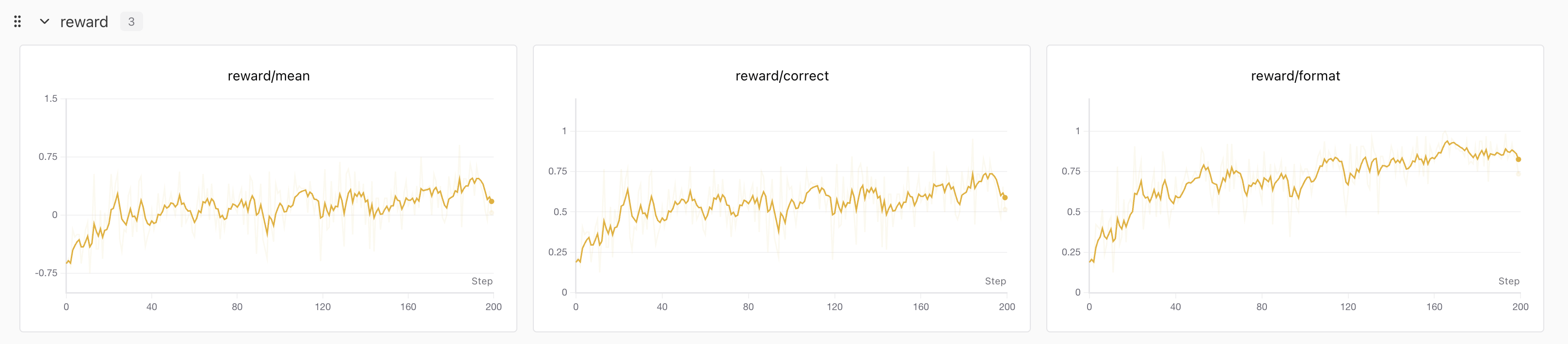
reward/mean:    -0.5 → +0.3
reward/correct:  0.2 → 0.6
reward/format:  0.25 → 0.85
Rollout behavior:
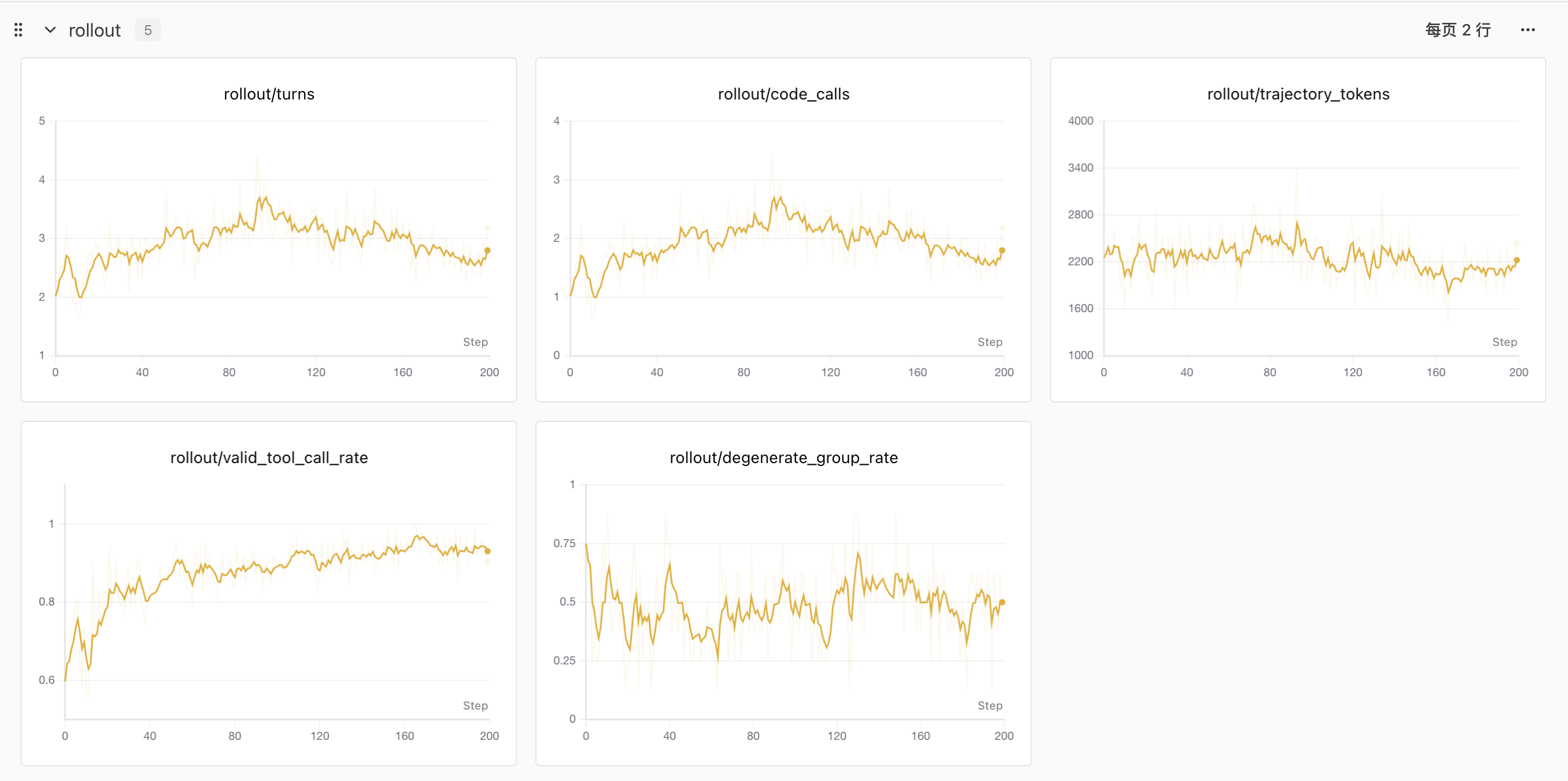
rollout/valid_tool_call_rate:  0.6 → 0.95    # 模型越调越规范
rollout/code_calls:            1.0 → 2.0     # step 90 附近峰值约 2.6
rollout/turns:                 2.0 → 2.8
rollout/trajectory_tokens:     稳定在 ~2,200 # 训练分布上 8k 预算宽裕
rollout/degenerate_group_rate: 缓降           # 无零梯度灾难
Sandbox diagnostics:
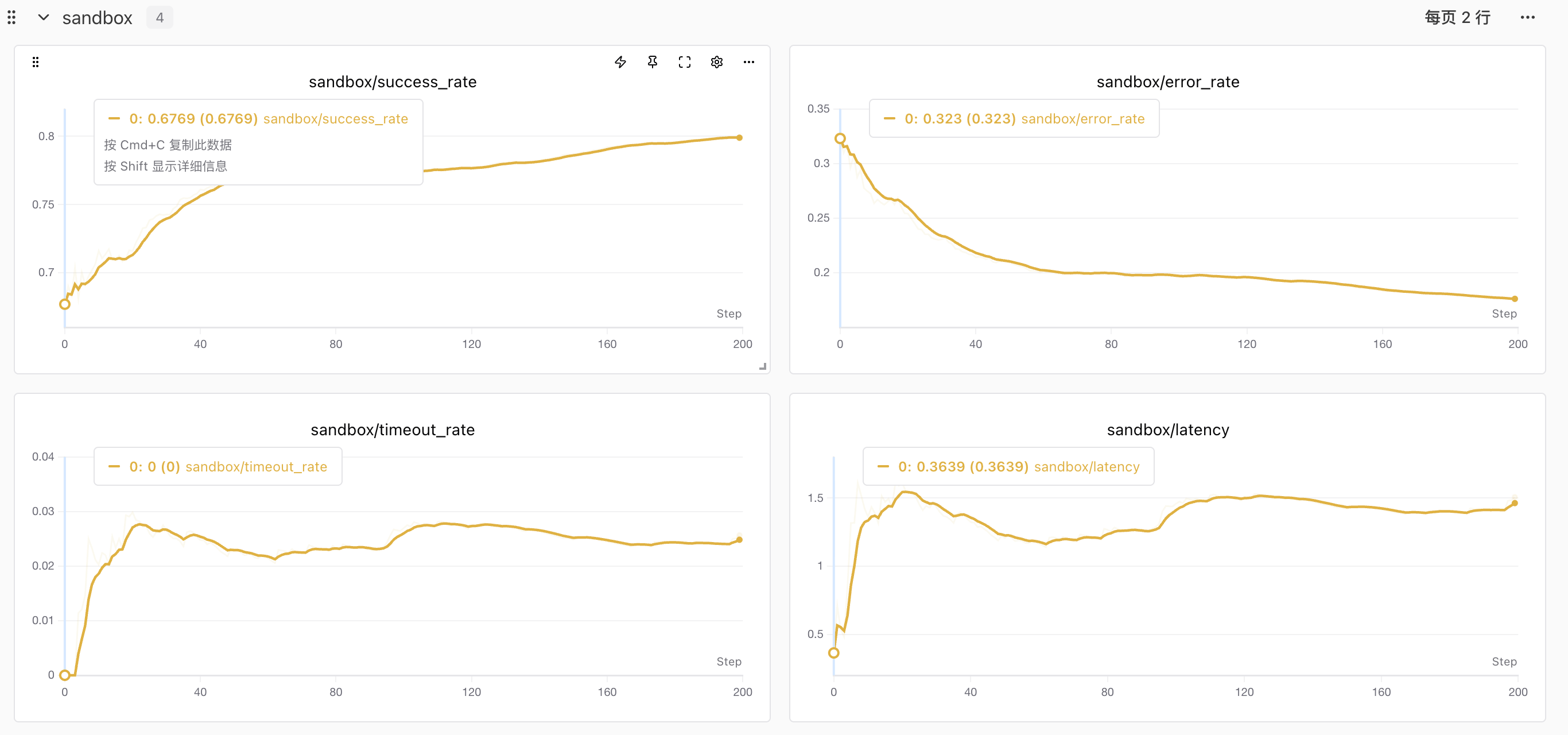
sandbox/success_rate:  0.68 → 0.80
sandbox/error_rate:    0.32 → 0.18   # 模型写的代码越来越能跑
sandbox/timeout_rate:  稳定在 2~3%
sandbox/latency:       0.36s → 1.4s  # 代码变复杂,执行时间自然变长
The curves show increasingly valid calls (0.6 → 0.95), a roughly halved execution-error rate and improving correctness (0.2 → 0.6). Together they are consistent with better tool invocation, executable code and useful calculations. Truncation under the 8k budget remains a limitation for long reasoning and final-answer formatting.
Running this reproduction
1. Install and log in
git clone https://github.com/datawhalechina/agentic-rl-lab.git
cd agentic-rl-lab

uv sync
trio login
swanlab login
The local machine needs a CPU environment. PyTRIO handles remote sampling and LoRA training; the interpreter runs in local subprocesses.
2. Download and prepare training data
uv run python experiments/retool/prepare_data.pyThe script downloads BytedTsinghua-SIA/DAPO-Math-17k and exports:
experiments/retool/datasets/
├── raw/dapo-math-17k.parquet   # 原始数据
├── train.jsonl                  # 训练集(question + answer)
└── dev.jsonl                    # 50 条开发集
3. Run the 20-step trial
uv run python experiments/retool/train.py \
    --max-steps 20 \
    --save-every 5 \
    --run-name retool-qwen35-4b-step20
The documented 20-step run showed increasing correctness and code calls, with no degenerate groups, providing an initial pipeline check.
4. Run 200 training steps
uv run python experiments/retool/train.py \
    --max-steps 200 \
    --save-every 50 \
    --run-name retool-qwen35-4b-step200
Every 50 steps, save a resumable state and sampler weights for sampling/evaluation.
5. Evaluate Base and checkpoints
# Base Model
uv run python experiments/retool/eval.py \
    --mode retool \
    --val-n 12 \
    --temperature 1.0 \
    --top-p 0.7 \
    --output experiments/retool/eval-results/aime25-retool-base.jsonl

# checkpoint(填入训练日志里的 trio:// 路径)
uv run python experiments/retool/eval.py \
    --mode retool \
    --val-n 12 \
    --temperature 1.0 \
    --top-p 0.7 \
    --model-path trio://<your_sampler_weights_path> \
    --output experiments/retool/eval-results/aime25-retool-step200.jsonl
Evaluation also supports --mode text, disabling tools for a text-only baseline.
6. Plot checkpoint comparisons
Once eval-results/ contains Base and checkpoint JSONL files:
uv run python experiments/retool/analysis.pyThe figure is written to experiments/retool/images/checkpoint_avg_pass_format.png.
Reproduction boundaries
- 8k trajectory budget versus 16k in the paper: a major budget reduction. Long AIME reasoning can be truncated, and Format reaches roughly 76% in this run. A larger budget is a useful next experiment.
- Local subprocess limits are not a cloud-sandbox boundary:
python -c, a 30s timeout andRLIMIT_CPUhandle many accidental loops and timeouts. File I/O restrictions rely on the prompt, and memory limits on macOS are unreliable. This implementation is not intended for unattended execution of untrusted code. - Cold-start SFT is skipped: Qwen3.5-4B's initial tool-use rate made that workable here; another base model may require it.
- No dual-clip: PyTRIO's built-in
ppodoes not expose the recipe'sclip_ratio_c=10.0, which is omitted. - Evaluation scope: 30 questions × 12 samples, one training run and one seed. Pass@12 can vary by one or two questions at this scale.
Summary
This reproduction mainly adds the tool protocol, a local sandbox and outcome rewards, while the multi-turn trajectories, GRPO advantages and training loop reuse implementations from earlier chapters. The 20-step validation run cost ¥31.66 and the full 200-step training run cost ¥224.44; AIME25 Average@12 rose from 23.61% to 47.50%.
The behavioral changes during training deserve more attention than the scores: the model first learns to call the tool properly, then writes code that runs, and only gradually makes that code more helpful for solving problems. The 8K trajectory budget and the single training run remain the main limitations of the current results.
References
Paper and official implementation
- Jiazhan Feng et al. ReTool: Reinforcement Learning for Strategic Tool Use in LLMs, 2025.
- verl
recipe/retool, official reproduction - Volcengine veRL reproduction guide
- swordfaith/ReTool-SFT-multi-turn, cold-start data