自一致性:Choice
为审核决策添加一种不确定的结果,并把标签一致性与自动动作的占比进行比较。
本实战指南取一条处于临界状态的用户帖子,在其上运行一套审核评分准则 15 次,并检查每次的答案在多次重复之间是否保持不变。每项检查都是一个 Choice,因此每个答案都是从固定集合中选出的一个标签。在审核流水线中,这个标签就是路由决策:删除还是保留、升级还是自动解决、发往威胁队列、垃圾队列还是通用队列。当标签在一次次运行之间摇摆时,同一条帖子就会无缘无故地被路由到不同的地方。
评分准则由 8 个 Choice 问题组成,每次运行就是一次回答全部 8 个问题的调用。我们在每个条件下重复 15 次——条件指一个模型加一项设置——并绘制返回的每一个标签。
条件如下:
非推理 LLM
claude-haiku-4-5和gpt-5.4-mini,分别在 temperature0和 API 默认值下运行。推理 LLM
gpt-5.5和claude-opus-4-8,它们没有 temperature 旋钮。TypeSafe:对这 8 个
Choice问题发起一次system_one调用,每次调用都带一个全新的uid字段(一次性唯一值),与 noul 实战指南中的设置一致。
需要关注的:即便在单个条件内部,选中的标签也可能翻转——TypeSafe 也不例外——而且各条件之间彼此不一致。
在本次运行中,各 LLM 分布设置复现其多数标签的比例在 87.5% 到 100% 之间,而 TypeSafe 为 90.8%。TypeSafe 的平均概率波动低于六个 LLM 分布条件中的五个;temperature 0 下的 Haiku 波动更小。接近的概率仍可能导致路由变化:TypeSafe 在 8 个问题中有 2 个发生了翻转。
在应用层决策上,我们还要求最高概率至少达到 0.60;否则结果为 uncertain,转入人工审核。这样 TypeSafe 的一致性升至 99.2%,其中 74.2% 的答案带有自动标签。我们会展示原始输出,并对 LLM 概率条件应用同样的阈值,让弃权和变化保持可见。
环境准备
pip install anthropic openai matplotlib ipython 'cooksafe>=0.2.0,<0.3.0'然后设置 TYPESAFE_API_KEY、ANTHROPIC_API_KEY 和 OPENAI_API_KEY。本次运行在生产 API 上使用 jev-latest,采样日期为 2026-09-11。
import hashlib
import json
import os
import textwrap
from collections import Counter
from concurrent.futures import ThreadPoolExecutor
from pathlib import Path
from secrets import token_hex
from statistics import mean

from time import perf_counter

import anthropic
import matplotlib
import matplotlib.pyplot as plt
import numpy as np
from cooksafe import JsonCache, make_playground_link
from IPython.display import Markdown, display
from matplotlib.colors import ListedColormap
from openai import OpenAI
from typesafe_sdk import Choice, TypeSafeClient

matplotlib.use("Agg")  # headless render

BASE_MODELS = [
    "claude-haiku-4-5",
    "gpt-5.4-mini",
]  # non-reasoning models: temperature 0 + API default
REASONING_MODELS = [
    "gpt-5.5",
    "claude-opus-4-8",
]  # reasoning models: think first, no temperature
TYPESAFE_MODEL = "jev-latest"  # the TypeSafe model
NUM_SAMPLES = 15  # repeated post+rubric calls per condition
MIN_CHOICE_PROBABILITY = 0.60  # illustrative automatic-action threshold

LLM_PRICES = {  # $ per 1M tokens (input, output); prices + model ids as of 2026-07, see README
    "claude-haiku-4-5": (1.00, 5.00),
    "gpt-5.4-mini": (0.75, 4.50),
    "gpt-5.5": (5.00, 30.00),
    "claude-opus-4-8": (5.00, 25.00),
}
TYPESAFE_PRICE = (0.042, 0.00)  # Historical TypeSafe rate, as of 2026-08

anthropic_client = anthropic.Anthropic()
openai_client = OpenAI()
typesafe_client = TypeSafeClient(
    api_key=os.environ["TYPESAFE_API_KEY"],
    base_url="https://api.typesafe.ai",
    timeout=30.0,
)
状态:一条处于临界状态的用户帖子(JSON 格式)
下面的帖子是刻意设计成骑墙的。语言激烈且带侮辱性,一部分针对某个人,一部分针对观点和社区。它带有一条站外邀请(把人引到另一个站点的链接),账号已有一条前科,还有四条用户举报,而类似威胁的措辞从头到尾都没有说得清楚明白。
这里不存在一个显而易见的唯一答案,而这正是要点:细微的措辞差异不应随机地把同一条帖子在执法路径之间来回挪动。
LLM 在提示词中拿到的是 json.dumps(POST)。TypeSafe 则直接拿到 Python 字典。
POST = {
    "post_id": "P-88213",
    "author": {
        "user_id": "u/4471",
        "account_age_days": 38,
        "prior_strikes": 1,
        "followers": 210,
    },
    "context": {
        "surface": "public reply",
        "in_reply_to": "another user defending a game patch",
        "community": "r/gamedebates",
    },
    "content": {
        "text": (
            "Are you seriously this dense? Anyone who defends that patch is a complete clown and "
            "should be embarrassed to even post here. People like you are what's ruining this "
            "community and honestly you need to be dealt with. Come say it to my face, invite's "
            "right here. Keep it up and I'll end your whole channel."
        ),
        "has_link": True,
        "link_domain": "discord.gg",
        "language": "en",
    },
    "reports": {"user_reports": 4, "report_reasons": ["harassment", "spam", "threat"]},
}
评分准则:8 个 Choice 问题
每个问题都有一个 key、一行指令和一个固定的标签集合。同一问题内的标签互斥(恰好一个适用),且每个标签都附带一句简短描述。TypeSafe 返回选中的 choice 加上标签上的 probabilities 分布。LLM 被要求使用相同的标签集合,从而保证每一行都可比。
QUESTIONS = {
    "category": (
        "What is the single most applicable content-policy category for this post?",
        {
            "None": "No policy violation of any kind.",
            "Harass": "Insults or demeans a person, with no threat of harm and no protected-class attack.",
            "Hate": "Attacks a person or group over a protected characteristic (race, religion, gender, ...).",
            "Violence": "Makes a credible threat of harm or incites violence against someone.",
            "Spam": "Unsolicited promotion or link spam, with no personal attack.",
            "Sexual": "Sexual or adult content.",
        },
    ),
    "primary_risk": (
        "What is the primary moderation risk that should drive triage for this post?",
        {
            "Harassment": "Personal attack or targeted abuse is the main risk.",
            "Violence": "A threat of harm or intimidation is the main risk.",
            "LinkAbuse": "External-link or off-platform coordination risk is the main risk.",
            "AccountHistory": "Prior account history or repeat behavior is the main risk.",
            "LowRisk": "No meaningful moderation risk is present.",
        },
    ),
    "target": (
        "Who or what is the content primarily directed at?",
        {
            "None": "Not directed at anyone in particular.",
            "Person": "Directed at one specific individual.",
            "Group": "Directed at a protected group or class.",
            "Platform": "Directed at the community or platform itself, not a person.",
        },
    ),
    "action": (
        "What enforcement action should be taken on this post?",
        {
            "Allow": "Leave the post up with no action.",
            "Warn": "Leave the post up but attach a warning label.",
            "Remove": "Remove the post, but do not penalize the account.",
            "Strike": "Remove the post and add a strike to the account.",
            "Escalate": "Take no automated action; hold for a human decision.",
        },
    ),
    "queue": (
        "Which single moderation queue should own this post?",
        {
            "Auto": "Auto-resolve; no human queue needed.",
            "General": "General moderation queue.",
            "Threat": "Threat / violence response queue.",
            "Spam": "Spam and platform-abuse queue.",
            "TSLead": "Trust-and-safety lead / senior queue.",
        },
    ),
    "link_handling": (
        "How should any external link or off-platform invite in the post be handled?",
        {
            "Allow": "Leave the link in place.",
            "RmLink": "Strip or disable the link but keep the post.",
            "Brigade": "Treat the link as coordinated brigading and action it as abuse.",
            "Escalate": "Send the link to a specialist to assess before acting.",
        },
    ),
    "review_path": (
        "Who should make the final call on this post?",
        {
            "Auto": "Automated action; no human review.",
            "Human": "A frontline human moderator makes the call.",
            "Senior": "A senior or specialist reviewer is required.",
            "Legal": "Route to legal or law-enforcement escalation.",
        },
    ),
    "severity": (
        "What is the overall severity of this post?",
        {
            "None": "No violation.",
            "Low": "Rude or dismissive, but essentially harmless.",
            "Medium": "Personal harassment with no clearly credible threat.",
            "High": "Harassment together with a threat that could be read as credible.",
        },
    ),
}
我们的提问方式
每次 LLM 调用都是一条提示词,其中包含 json.dumps(POST)、全部 8 个问题以及每个允许的标签。答案格式有两种。在分布模式下,模型为每个问题返回一个 JSON 对象,并给每个标签一个概率。在单选模式下,它为每个问题返回一个裸标签,我们的分析会把全部概率质量放到该标签上。
TypeSafe 调用则是对同一帖子、同样 8 个 Choice 问题发起的一次 system_one 请求,为每个问题返回一个分布。
每次查询还带一个全新的 uid——一个一次性唯一值,它在每次运行时变化,而帖子与评分准则保持不变。它出现在 LLM 提示词中,也作为额外字段出现在 TypeSafe 状态里。这一设置无法把对该无关字段的敏感度、与完全相同请求本来就会出现的波动区分开来。
每个辅助函数都返回答案、估算成本和往返延迟。
def argmax_label(values: list, labels: list[str]) -> str | None:
    """The label with the most probability mass, or ``None`` if any value is missing or
    non-numeric -- a partially parsed distribution never yields a confident-looking pick."""
    numeric = [_numeric_value(value) for value in values]
    if any(value is None for value in numeric):
        return None
    return labels[int(np.argmax(numeric))]


def choice_decision_with_uncertainty(values: list, labels: list[str]) -> str | None:
    """Abstain below the action threshold; retain invalid results as parse failures."""
    label = argmax_label(values, labels)
    if label is None:
        return None
    probabilities = [float(value) for value in values]
    if any(value < 0 or value > 1 for value in probabilities):
        return None
    return label if max(probabilities) >= MIN_CHOICE_PROBABILITY else "uncertain"


def choice_decision_annotation(values: list, labels: list[str]) -> str:
    """Show the application decision and top probability in a heatmap cell."""
    decision = choice_decision_with_uncertainty(values, labels)
    if decision is None:
        return ""
    probability = max(float(value) for value in values)
    probability_text = f"{probability:.2f}".removeprefix("0")
    return f"{decision} {probability_text}"


def _numeric_value(value: object) -> float | None:
    """A finite numeric value, or ``None`` if the model emitted something unusable."""
    try:
        numeric = float(value)
    except (TypeError, ValueError):
        return None
    return numeric if np.isfinite(numeric) else None


def parse_distribution(raw: object, labels: list[str]) -> list[float]:
    """Map a model's already-parsed per-question reply to per-label probabilities, in label order
    (distribution-mode answers left un-normalized).

    A single-pick reply is a single label string -> all the mass on that exact label; a
    distribution-mode reply is a dict read label by label. Anything that doesn't match a known label
    or isn't a finite number is left NaN -- we report the gap rather than massaging the reply (e.g.
    stripping an echoed description) to make it fit."""
    if isinstance(raw, str):  # single-pick mode: a single chosen label
        if raw in labels:
            return [1.0 if label == raw else 0.0 for label in labels]
        return [float("nan")] * len(labels)
    if not isinstance(raw, dict):
        return [float("nan")] * len(labels)
    return [
        value if (value := _numeric_value(raw.get(label))) is not None else float("nan")
        for label in labels
    ]


def rubric_prompt(mode: str, sample_index: int, rubric_hash: str) -> str:
    """The post + all questions (with their label sets) in one prompt; ``mode`` picks the format.

    ``mode="dist"`` asks for a probability distribution over each question's labels; the single-pick
    mode (``mode="single"``) asks for a single label per question. The uid line combines
    ``rubric_hash`` (which rubric version) with ``sample_index`` and a random token, so every repeat
    is a distinct, independent draw and two different rubrics never share a nonce."""
    lines = []
    for key, (instructions, choices) in QUESTIONS.items():
        labels = "\n".join(f"     {label}: {desc}" for label, desc in choices.items())
        lines.append(f"- {key}: {instructions}\n   labels:\n{labels}")
    exclusivity = (
        "\n\nEach question's labels are mutually exclusive: exactly one applies. If a post could "
        "arguably fit more than one, pick the single most severe / most specific label per the "
        "label descriptions."
    )
    if mode == "single":
        answer_format = (
            "\n\nFor each question, pick exactly ONE label.\nRespond with ONLY a JSON object "
            "mapping each question's key to one of that question's bare labels (the label only, "
            "not its description), with one entry per question."
        )
    else:
        answer_format = (
            "\n\nFor each question, give a probability distribution over that question's labels "
            "(values 0.00-1.00 that sum to 1).\nRespond with ONLY a JSON object mapping each "
            "question's key to an object mapping that question's bare labels (the label only, "
            "not its description) to probabilities, with one entry per question."
        )
    return (
        f"uid: {rubric_hash}:{sample_index}:{token_hex(4)}\n\n"
        f"Document (a reported user post):\n{json.dumps(POST, indent=2)}\n\nQuestions:\n"
        + "\n".join(lines)
        + exclusivity
        + answer_format
    )


def _cost(prices: tuple[float, float], input_tokens: int, output_tokens: int) -> float:
    return input_tokens / 1e6 * prices[0] + output_tokens / 1e6 * prices[1]


def _call_llm(model: str, prompt: str, temperature: float | None):
    """One LLM call -> (text, cost_usd, latency_s), routed by model name."""
    reasoning = model in REASONING_MODELS
    started = perf_counter()
    if model.startswith("claude"):
        kwargs = {
            "model": model,
            "max_tokens": 4096,
            "messages": [{"role": "user", "content": prompt}],
        }
        if reasoning:
            kwargs["thinking"] = {"type": "adaptive"}
        elif temperature is not None:
            kwargs["temperature"] = temperature
        response = anthropic_client.messages.create(**kwargs)
        text = next((b.text for b in response.content if b.type == "text"), "")
        usage = (response.usage.input_tokens, response.usage.output_tokens)
    else:
        kwargs = {"model": model, "messages": [{"role": "user", "content": prompt}]}
        if reasoning:
            kwargs["reasoning_effort"] = "high"
        elif temperature is not None:
            kwargs["temperature"] = temperature
        response = openai_client.chat.completions.create(**kwargs)
        text = response.choices[0].message.content
        usage = (response.usage.prompt_tokens, response.usage.completion_tokens)
    return text, _cost(LLM_PRICES[model], *usage), perf_counter() - started


# All samples (LLM and TypeSafe) are cached to ``json_cache.json``, which ships with the cookbook, so
# re-rendering is instant and reproduces the published numbers with no API spend. ``sample_index``
# seeds the uid buster and is part of the cache key, so each of the NUM_SAMPLES repeats is its own
# entry and its own independent draw, not one draw replayed. Delete ``json_cache.json`` to re-sample
# everything live.
json_cache = JsonCache(Path("json_cache.json"))


def _rubric_fingerprint() -> str:
    """Short digest of everything that shapes the prompt/rubric: the state and every question's
    text and label set. Passed into the cached calls below so that editing the post or any question
    changes the cache key and forces a fresh sample, instead of silently serving a stale answer that
    was generated for the old wording."""
    payload = json.dumps([POST, QUESTIONS], sort_keys=True, default=str)
    return hashlib.sha256(payload.encode()).hexdigest()[:12]


RUBRIC_HASH = _rubric_fingerprint()


@json_cache
def _call_typesafe(sample_index: int, rubric_hash: str, model: str):
    """Return distributions, token usage, latency, and model metadata for one call.

    ``rubric_hash`` and ``model`` prevent reuse across rubric or model changes.
    Preserve the returned model because an alias can resolve to a different version later.
    """
    questions = {
        key: Choice(instructions=instructions, criteria=choices)
        for key, (instructions, choices) in QUESTIONS.items()
    }
    started = perf_counter()
    response = typesafe_client.system_one(
        model=model,
        state={"uid": f"{rubric_hash}:{sample_index}:{token_hex(4)}", "post": POST},
        questions=questions,
    )
    distributions = {}
    for key, (_instructions, choices) in QUESTIONS.items():
        probabilities = dict(response.answers[key].probabilities)
        distributions[key] = [
            probabilities.get(label, float("nan")) for label in choices
        ]
    return (
        distributions,
        response.usage.input_tokens,
        response.usage.output_tokens,
        perf_counter() - started,
        {"requested_model": model, "response_model": response.model},
    )


@json_cache
def ask_llm_rubric(
    model: str,
    mode: str,
    temperature: float | None,
    sample_index: int,
    rubric_hash: str,
):
    """One LLM rubric query -> (per-question label distributions keyed by question key, cost_usd,
    latency_s); NaNs if the reply doesn't parse.

    ``mode="dist"`` parses 8 label distributions; the single-pick mode (``mode="single"``) parses 8
    single labels and puts all the mass on each. ``rubric_hash`` goes into the prompt's uid nonce
    (and so the cache key), so an edited state/rubric busts the cache instead of serving a stale
    answer."""
    prompt = rubric_prompt(mode, sample_index, rubric_hash)
    text, cost, latency = _call_llm(model, prompt, temperature)
    # Peel a single ```json ... ``` fence (claude-haiku-4-5 sometimes adds one despite "ONLY a JSON
    # object").
    stripped = text.strip()
    if stripped.startswith("```"):
        stripped = stripped[stripped.find("\n") + 1 :] if "\n" in stripped else ""
        if stripped.rstrip().endswith("```"):
            stripped = stripped.rstrip()[: -len("```")]
    try:
        raw = json.loads(stripped)
    except (ValueError, json.JSONDecodeError):
        raw = {}
    if not isinstance(raw, dict):
        raw = {}
    distributions = {
        key: parse_distribution(raw.get(key), list(choices))
        for key, (_instructions, choices) in QUESTIONS.items()
    }
    return distributions, cost, latency
实验条件
实验矩阵
| 模型组 | 模型 | 分布 (t=0) | 分布(默认) | 单选 (t=0) |
|---|---|---|---|---|
| 非推理模型 | claude-haiku-4-5 | ✓ | ✓ | ✓ |
| 非推理模型 | gpt-5.4-mini | ✓ | ✓ | ✓ |
| 推理模型 | gpt-5.5 | — | ✓ | — |
| 推理模型 | claude-opus-4-8 | — | ✓ | — |
| TypeSafe | jev-latest (typesafe_choice) | — | ✓ | — |
✓表示用 15 次重复测试过的条件;—表示未测试的组合。“默认”列不传入 temperature 参数:非推理模型使用 API 默认值,推理模型和 TypeSafe 在没有 temperature 设置的情况下运行。
单选条件为每个问题返回一个标签。
人们常建议用 temperature
0来获得可重复性,因此将它与 API 默认值进行比较。
每个条件抽取 NUM_SAMPLES = 15 次重复。每次重复都有自己的缓存键,算作一次独立抽样;缓存(json_cache.json)随实战指南一起提供,因此重新渲染会复用它,不产生任何 API 调用。删除该缓存即可重新实时采样。
CONDITIONS = []
for (
    model
) in BASE_MODELS:  # non-reasoning models: dist at t=0 / default, then a single-pick variant
    for temp_value, temp_label in ((0, "0"), (None, "default")):
        CONDITIONS.append(
            {
                "label": f"{model} t={temp_label}",
                "model": model,
                "temp": temp_value,
                "mode": "dist",
            }
        )
    CONDITIONS.append(
        {
            "label": f"{model} single-pick t=0",
            "model": model,
            "temp": 0,
            "mode": "single",
        }
    )
CONDITIONS += [  # reasoning models: one distribution condition each
    {
        "label": f"{model}-reasoning",
        "model": model,
        "temp": None,
        "mode": "dist",
    }
    for model in REASONING_MODELS
]
LABELS = [condition["label"] for condition in CONDITIONS]
TYPESAFE_LABEL = "typesafe_choice"
ALL_LABELS = [*LABELS, TYPESAFE_LABEL]

runs: dict[
    str, list
] = {}  # label -> NUM_SAMPLES samples of {question key: distribution}
stats: dict[str, list] = {}  # label -> NUM_SAMPLES (cost_usd, latency_s) pairs
with ThreadPoolExecutor(max_workers=16) as pool:
    futures = {
        condition["label"]: [
            pool.submit(
                ask_llm_rubric,
                condition["model"],
                condition["mode"],
                condition["temp"],
                sample_index,
                RUBRIC_HASH,
            )
            for sample_index in range(NUM_SAMPLES)
        ]
        for condition in CONDITIONS
    }
    for label, sample_futures in futures.items():
        results = [future.result() for future in sample_futures]
        runs[label] = [result[0] for result in results]
        stats[label] = [(result[1], result[2]) for result in results]

# TypeSafe samples are drawn sequentially, after the LLM pool has closed, so each call's latency is a
# clean round trip rather than one measured under the 16-way LLM thread contention.
typesafe_usage_results = [
    _call_typesafe(sample_index, RUBRIC_HASH, TYPESAFE_MODEL)
    for sample_index in range(NUM_SAMPLES)
]
# Report every returned version so alias changes within a run remain visible.
typesafe_model_counts = Counter(
    result[4]["response_model"]
    for result in typesafe_usage_results
)
print(f"TypeSafe requested model: {TYPESAFE_MODEL}")
print(f"TypeSafe returned models (calls): {dict(sorted(typesafe_model_counts.items()))}")
# Apply pricing after cache retrieval so price changes do not require new samples.
typesafe_results = [
    (distributions, _cost(TYPESAFE_PRICE, input_tokens, output_tokens), latency)
    for distributions, input_tokens, output_tokens, latency, _metadata in typesafe_usage_results
]
typesafe_runs = [result[0] for result in typesafe_results]
stats[TYPESAFE_LABEL] = [(result[1], result[2]) for result in typesafe_results]TypeSafe requested model: jev-latest
TypeSafe returned models (calls): {'jev-1.13.0': 15}成本 + 速度(每次评分准则查询)
下面的成本使用“环境准备”一节中的历史价格假设,包括 TypeSafe 的 speed_latest 费率。它们并非经过核实的 jev-latest 价格,也不是当前的计费金额。
一行就是一次完整的 8 问题评分准则调用。time/call 和 cost/call 取 15 次调用的平均值,vs ts_choice 各列则以 TypeSafe 的数字为分母。LLM 在 16 路线程池中运行。
typesafe_cost = mean([cost for cost, _latency in stats["typesafe_choice"]])
typesafe_latency = mean([latency for _cost, latency in stats["typesafe_choice"]])
name_w = max(len(name) for name in ALL_LABELS) + 2  # fit the longest condition label
# Stack comparison headers so the relative speed and cost columns can stay narrow.
print(
    f"{'':<{name_w + 31}}{'speed vs':>11}{'cost vs':>11}\n"
    f"{'condition':<{name_w}}{'calls':>7}{'time/call':>11}{'cost/call':>13}"
    f"{'ts_choice':>11}{'ts_choice':>11}"
)
for name in ALL_LABELS:
    costs, latencies = zip(*stats[name])
    cost = mean(costs)
    latency = mean(latencies)
    print(
        f"{name:<{name_w}}{len(costs):>7}{latency * 1000:>9.0f}ms"
        f"{'$' + format(cost, '.6f'):>13}"
        f"{format(latency / typesafe_latency, '.1f') + 'x':>11}"
        f"{format(cost / typesafe_cost, '.1f') + 'x':>11}"
) speed vs cost vs
condition calls time/call cost/call ts_choice ts_choice
claude-haiku-4-5 t=0 15 3853ms $0.003498 33.8x 76.1x
claude-haiku-4-5 t=default 15 3860ms $0.003494 33.8x 76.0x
claude-haiku-4-5 single-pick t=0 15 992ms $0.001527 8.7x 33.2x
gpt-5.4-mini t=0 15 2293ms $0.002299 20.1x 50.0x
gpt-5.4-mini t=default 15 1986ms $0.002164 17.4x 47.1x
gpt-5.4-mini single-pick t=0 15 826ms $0.000936 7.2x 20.3x
gpt-5.5-reasoning 15 12978ms $0.041255 113.7x 897.4x
claude-opus-4-8-reasoning 15 10376ms $0.028375 90.9x 617.2x
typesafe_choice 15 114ms $0.000046 1.0x 1.0x在本次运行中,typesafe_choice 的平均往返延迟为 114ms。在上述并发设置下,各 LLM 条件的单次调用耗时介于 826ms 到 13.0 秒之间。
图表:以热力图呈现每个样本的决策
读图方法:
外层行分组:问题。
内层行:条件。
列:一次完整的评分准则调用。
单元格文字:应用层决策加上最高标签上的概率。
单元格颜色:标签在该问题中的位置,因此一行从头到尾同色意味着每次决策都相同。
灰色
uncertain:最高概率低于0.60,该案例转入人工审核。斜纹
n/a:回复未能解析出可用的标签(解析失败)。空白行只是间隔。
单选条件保留其返回的标签:它们不提供不确定性估计。
GAP = 1  # blank spacer row(s) between question blocks
HEAT_LABELS = ALL_LABELS
rows_per_block = len(HEAT_LABELS)  # rows per question block
pooled_runs = {
    **runs,
    TYPESAFE_LABEL: typesafe_runs,
}

row_index_values, row_text, row_labels, blocks = [], [], [], []
for question_index, (question_key, (question_text, choices)) in enumerate(
    QUESTIONS.items()
):
    labels = list(choices)
    if question_index:  # blank spacer rows (NaN -> rendered white) separate the blocks
        row_index_values.extend([np.nan] * NUM_SAMPLES for _ in range(GAP))
        row_text.extend([[""] * NUM_SAMPLES for _ in range(GAP)])
        row_labels.extend([""] * GAP)
    blocks.append((len(row_index_values), question_key, question_text))
    for label in HEAT_LABELS:
        values_by_sample = [
            pooled_runs[label][sample][question_key] for sample in range(NUM_SAMPLES)
        ]
        picks = [
            choice_decision_with_uncertainty(values, labels) for values in values_by_sample
        ]
        row_index_values.append(
            [
                10 if pick == "uncertain" else labels.index(pick) if pick in labels else np.nan
                for pick in picks
            ]
        )
        row_text.append(
            [choice_decision_annotation(values, labels) for values in values_by_sample]
        )
        row_labels.append(label)

heatmap_matrix = np.array(row_index_values, dtype=float)
# Reserve gray for abstentions while concrete-label colors remain local to each question.
cmap = ListedColormap([*plt.get_cmap("tab10").colors, "#dddddd"])
cmap.set_bad(
    "white"
)  # NaN cells (spacer rows AND unparseable replies) render white here...

fig, ax = plt.subplots(figsize=(15, 0.33 * len(row_index_values) + 1))
ax.imshow(heatmap_matrix, cmap=cmap, vmin=0, vmax=10, aspect="auto")
for row in range(heatmap_matrix.shape[0]):
    is_spacer_row = row_labels[row] == ""  # blank separator between question blocks
    for col in range(heatmap_matrix.shape[1]):
        label_text = row_text[row][col]
        if label_text:
            ax.text(
                col,
                row,
                label_text,
                ha="center",
                va="center",
                fontsize=5.7,
                family="monospace",
                color="black",
            )
        elif (
            not is_spacer_row
        ):  # ...but an unparseable reply gets a hatched "n/a", not blank white
            ax.add_patch(
                plt.Rectangle(
                    (col - 0.5, row - 0.5),
                    1,
                    1,
                    facecolor="#e8e8e8",
                    edgecolor="#b0b0b0",
                    hatch="////",
                    linewidth=0,
                )
            )
            ax.text(
                col,
                row,
                "n/a",
                ha="center",
                va="center",
                fontsize=5,
                family="monospace",
                color="#b30000",
            )

ax.set_xticks(range(NUM_SAMPLES))
ax.set_xticklabels(range(1, NUM_SAMPLES + 1), fontsize=7)
ax.set_xlabel("rubric query")
ax.set_yticks(range(len(row_labels)))
ax.set_yticklabels(row_labels, fontsize=7)
ax.tick_params(length=0)
for edge in ("top", "right", "left", "bottom"):
    ax.spines[edge].set_visible(False)

# outer level of the multi-index: the question key, printed once per block and centered, with the
# question text wrapped right under it
y_axis_transform = ax.get_yaxis_transform()
for start, question_key, question_text in blocks:
    center = start + (rows_per_block - 1) / 2
    ax.text(
        -0.2,
        center - 0.7,
        question_key,
        transform=y_axis_transform,
        ha="right",
        va="center",
        fontsize=8,
        fontweight="bold",
    )
    ax.text(
        -0.2,
        center + 0.1,
        textwrap.fill(question_text, 34),
        transform=y_axis_transform,
        ha="right",
        va="top",
        fontsize=6,
        style="italic",
        color="gray",
    )

ax.set_title(
    f"Every sample's decision + top probability; gray = uncertain (< {MIN_CHOICE_PROBABILITY:.2f})\n"
    f"(rows = question x condition, {NUM_SAMPLES} columns)",
    pad=12,
)
fig.tight_layout()
display(fig)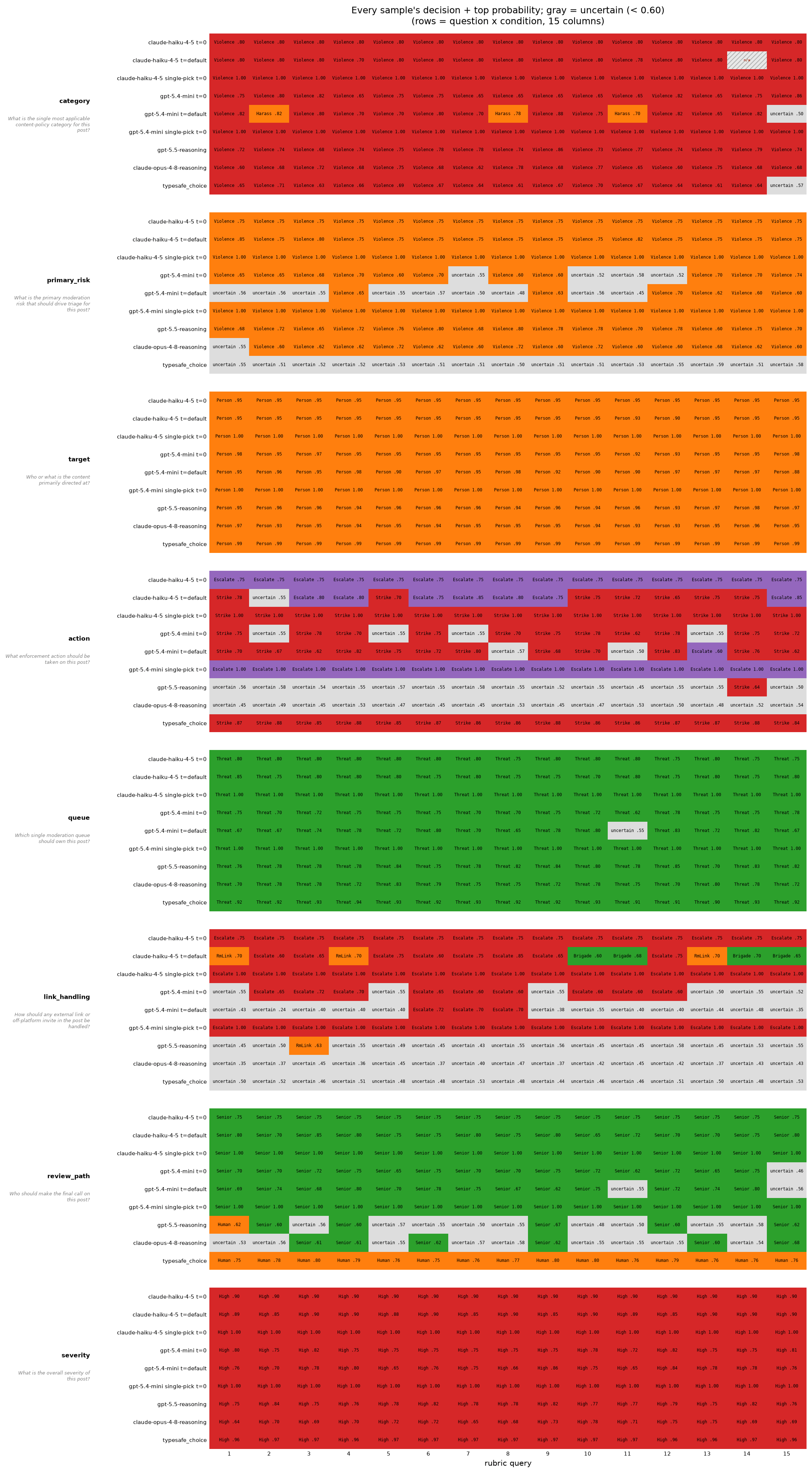
较明确的问题保持稳定:target 全部读作 Person,severity 全部读作 High。临界问题则在各条件间分裂:category、primary_risk、action、review_path 和 link_handling。有些条件在自己内部的 15 次重复中也会翻转。在引入弃权机制之前,TypeSafe 在 primary_risk 上更换过最高标签(Harassment 11 次,Violence 4 次),在 link_handling 上也是(RmLink 8 次,Brigade 7 次)。这两行现在全程显示 uncertain,因为它们的最高概率低于 0.60。
概率标准差
这里考察的是完整的概率向量,而不只是选中的标签。对每个条件,我们收集每个问题的全部 15 个分布,计算每个标签的概率在重复之间的标准差(即它每次运行移动多少),再把这些标准差在所有标签和问题上取平均。我们还会报告单个标签的最大标准差,并把解析失败单独计数。
表中将每个输出概率的 LLM 条件与 TypeSafe 进行对比。单选行被排除在外,因为它们输出的是硬标签而非概率分布。
def probability_std_stats(samples: list) -> tuple[float, float, float]:
    """Mean label std dev, max label std dev, parse-failure rate."""
    label_stds = []
    parse_failures = []
    for question_key in QUESTIONS:
        arr = np.array(
            [sample[question_key] for sample in samples],
            dtype=float,
        )
        parse_failures.extend(np.isnan(arr).any(axis=1).tolist())
        label_stds.extend(np.nanstd(arr, axis=0).tolist())
    return (
        float(np.nanmean(label_stds)),
        float(np.nanmax(label_stds)),
        float(np.mean(parse_failures)),
    )


PROBABILITY_OUTPUT_LABELS = [
    condition["label"] for condition in CONDITIONS if condition["mode"] == "dist"
] + [TYPESAFE_LABEL]
probability_std_by_label = {
    label: probability_std_stats(pooled_runs[label])
    for label in PROBABILITY_OUTPUT_LABELS
}
typesafe_mean_std = probability_std_by_label[TYPESAFE_LABEL][0]

print(
    f"{'condition':<{name_w}}{'mean prob std':>15}{'max prob std':>14}"
    f"{'parse fail':>12}{'x TypeSafe':>12}"
)
for label in PROBABILITY_OUTPUT_LABELS:
    mean_std, max_std, parse_failure_rate = probability_std_by_label[label]
    relative_std = mean_std / typesafe_mean_std
    print(
        f"{label:<{name_w}}{mean_std:>15.4f}{max_std:>14.4f}"
        f"{parse_failure_rate:>11.0%}{relative_std:>12.2f}x"
)condition mean prob std max prob std parse fail x TypeSafe
claude-haiku-4-5 t=0 0.0012 0.0221 0% 0.12x
claude-haiku-4-5 t=default 0.0516 0.3150 1% 5.29x
gpt-5.4-mini t=0 0.0312 0.0905 0% 3.20x
gpt-5.4-mini t=default 0.0543 0.2303 0% 5.56x
gpt-5.5-reasoning 0.0305 0.1047 0% 3.12x
claude-opus-4-8-reasoning 0.0245 0.0693 0% 2.52x
typesafe_choice 0.0098 0.0515 0% 1.00x在本次运行中,TypeSafe 的平均概率标准差为 0.0098,单标签最大标准差为 0.0515。temperature 0 下的 Haiku 平均标准差更低,为 0.0012。其余五个 LLM 概率条件介于 0.0245 到 0.0543 之间,约为 TypeSafe 均值的 2.5x 到 5.6x。当两个标签接近时,很小的变化仍可能切换最高标签。
图表:带不确定结果的决策一致性
当最高概率低于 0.60 时返回 uncertain。对每个输出概率的条件和每个问题,统计最常见的应用层决策(包括 uncertain),再除以全部 15 次抽样。解析失败计为不一致。每根柱子是该得分在全部 8 个问题上的平均值,并按一致性从高到低排列。
单选 LLM 条件被排除,因为它们不提供不确定性估计。
# Compute policy decisions and agreement once for both this chart and the comparison table.
decisions_by_condition = {}
policy_agreement_by_condition = {}
for label in PROBABILITY_OUTPUT_LABELS:
    decisions = [
        [
            choice_decision_with_uncertainty(sample[key], list(choices))
            for sample in pooled_runs[label]
        ]
        for key, (_instructions, choices) in QUESTIONS.items()
    ]
    decisions_by_condition[label] = decisions
    shares = [
        max(Counter(value for value in row if value is not None).values(), default=0)
        / NUM_SAMPLES
        for row in decisions
    ]
    policy_agreement_by_condition[label] = mean(shares)

# Sort by the measured agreement, keeping TypeSafe's color independent of its rank.
bar_labels = sorted(
    PROBABILITY_OUTPUT_LABELS, key=policy_agreement_by_condition.__getitem__, reverse=True
)
rates = [policy_agreement_by_condition[label] for label in bar_labels]

fig_bar, bar_ax = plt.subplots(figsize=(7, 0.45 * len(bar_labels) + 1))
positions = range(len(bar_labels))
bar_ax.barh(
    list(positions),
    rates,
    color=["#2b8cbe" if label == TYPESAFE_LABEL else "#fe9929" for label in bar_labels],
    alpha=0.85,
)
for label, position, rate in zip(bar_labels, positions, rates):
    marker = "*" if label == "claude-haiku-4-5 t=0" else ""
    bar_ax.text(
        rate + 0.01, position, f"{rate:.1%}{marker}", va="center", fontsize=8, color="gray"
    )
bar_ax.set_yticks(list(positions))
bar_ax.set_yticklabels(bar_labels, fontsize=8)
bar_ax.invert_yaxis()  # first condition on top
bar_ax.set_xlim(0, 1.08)
bar_ax.set_xticks(np.linspace(0, 1, 6))
bar_ax.set_xlabel("decision agreement across 15 re-runs (mean over 8 questions)")
for edge in ("top", "right", "left"):
    bar_ax.spines[edge].set_visible(False)
bar_ax.tick_params(length=0)
fig_bar.suptitle("Decision agreement including uncertain outcomes", y=1.0)
# Keep the caveat inside the exported chart so it travels with the 100% annotation.
fig_bar.text(
    0.01,
    0.01,
    "* Haiku t=0: 100% repeatability does not imply correctness.\n"
    "  This experiment does not measure accuracy.",
    fontsize=8,
)
fig_bar.tight_layout(rect=(0, 0.11, 1, 1))
display(fig_bar)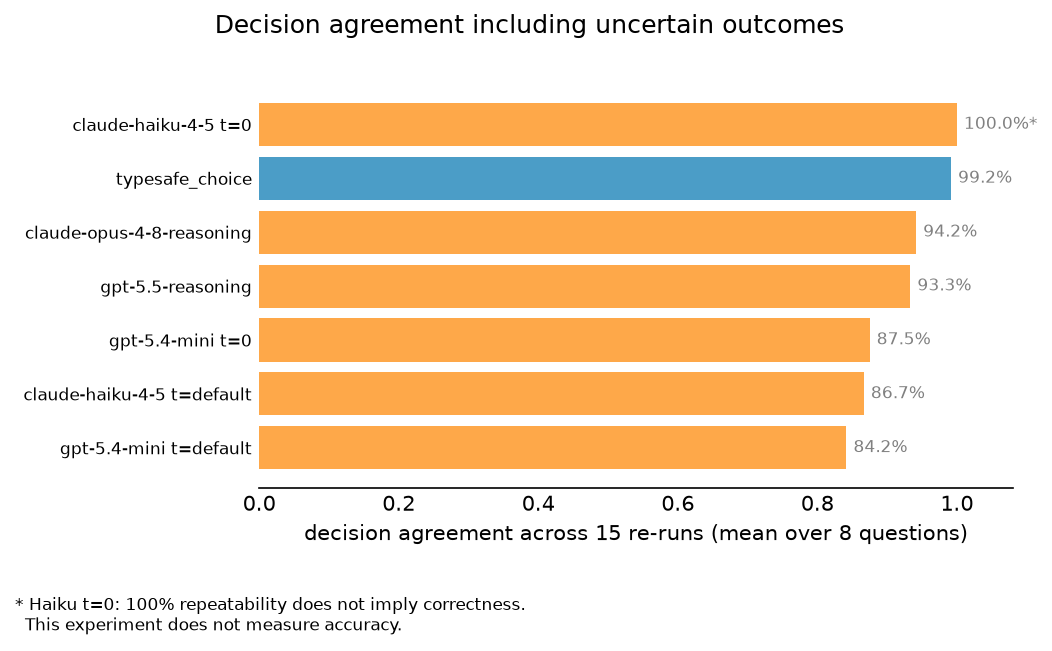
在同一 0.60 规则下,temperature 0 的 Haiku 得到 100%。TypeSafe 得到 99.2%,其余 LLM 条件落在 84.2% 到 94.2% 之间。TypeSafe 在 25.8% 的答案上返回 uncertain,并在其余 74.2% 上自动执行;temperature 0 的 Haiku 从不弃权。这些百分比只衡量可重复性。下表将原始一致性与弃权率同本图中的策略一致性并列展示。
让不确定的概率产生不确定的决策
很小的概率变化就能让两个接近的标签互换。应用不必按胜出标签执行:当最高概率低于 0.60 时返回 uncertain,把该案例交给人工。恰好等于 0.60 时,选择最高标签。这里使用的是返回的概率,而不是 API 单独的 confidence 字段,并且不会增加任何模型调用。
该阈值只是一个示例性的应用策略,不是经过校准的保证,也不是为最大化本次运行的一致性而挑选的阈值。生产环境的阈值应结合带标注的样本、错误动作的成本以及人工审核的成本来选取。
我们对每个输出概率的条件应用同一规则。单选 LLM 回复没有概率估计;其人工合成的 one-hot 向量无法度量不确定性,因此被排除在一致性图表和表格外。
def agreement_rate(samples: list) -> float:
    """Mean over questions of the raw plurality label's share across all NUM_SAMPLES draws.

    Parse failures count against agreement because a failed route is not a repeated decision.
    """
    shares = []
    for question_key, (_instructions, choices) in QUESTIONS.items():
        labels = list(choices)
        picks = [
            argmax_label(samples[sample][question_key], labels)
            for sample in range(NUM_SAMPLES)
        ]
        picks = [pick for pick in picks if pick is not None]
        if not picks:
            shares.append(0.0)
            continue
        top = Counter(picks).most_common(1)[0][1]
        shares.append(top / NUM_SAMPLES)
    return mean(shares) if shares else float("nan")


# Keep failures separate from abstentions and count conflicting concrete actions per question.
print(
    f"{'condition':<{name_w}}{'raw agree':>12}{'policy agree':>14}"
    f"{'uncertain':>12}{'automatic':>12}{'conflicts':>11}"
)
for label in PROBABILITY_OUTPUT_LABELS:
    decisions = decisions_by_condition[label]
    flat = [value for row in decisions for value in row]
    uncertain_rate = mean(value == "uncertain" for value in flat)
    automatic_rate = mean(value not in (None, "uncertain") for value in flat)
    conflicts = sum(
        len({value for value in row if value not in (None, "uncertain")}) > 1
        for row in decisions
    )
    print(
        f"{label:<{name_w}}{agreement_rate(pooled_runs[label]):>11.1%}"
        f"{policy_agreement_by_condition[label]:>13.1%}{uncertain_rate:>11.1%}"
        f"{automatic_rate:>11.1%}{conflicts:>11}"
)condition raw agree policy agree uncertain automatic conflicts
claude-haiku-4-5 t=0 100.0% 100.0% 0.0% 100.0% 0
claude-haiku-4-5 t=default 87.5% 86.7% 0.8% 98.3% 2
gpt-5.4-mini t=0 99.2% 87.5% 12.5% 87.5% 0
gpt-5.4-mini t=default 90.8% 84.2% 22.5% 77.5% 2
gpt-5.5-reasoning 90.0% 93.3% 30.8% 69.2% 1
claude-opus-4-8-reasoning 92.5% 94.2% 33.3% 66.7% 0
typesafe_choice 90.8% 99.2% 25.8% 74.2% 0policy agree 把 uncertain 计为一种决策;解析失败计为不一致。automatic 是所有答案中选择了具体标签的占比。conflicts 统计在重复之间出现不止一个具体标签的问题数量,忽略弃权。这些指标描述的是可重复性以及应用执行动作的频率,而不是动作是否正确。
TypeSafe 的一致性从 90.8% 升至 99.2%。答案中有 25.8% 为不确定,74.2% 为自动。primary_risk 和 link_handling 在每一次重复中都是不确定;category 在 Violence 和 uncertain 之间交替,有些重复越过动作阈值,有些没有。没有任何问题产生过两个不同的具体 TypeSafe 标签。这些都说明不了准确性或优越性:temperature 0 的 Haiku 在这里达到了 100% 一致,且零弃权。
# Show every TypeSafe decision while retaining the top probability behind it.
policy_decisions = decisions_by_condition[TYPESAFE_LABEL]
policy_values = []
for row, (_key, (_instructions, choices)) in zip(policy_decisions, QUESTIONS.items()):
    labels = list(choices)
    policy_values.append([
        10 if value == "uncertain" else labels.index(value) if value is not None else np.nan
        for value in row
    ])
policy_cmap = ListedColormap([*plt.get_cmap("tab10").colors, "#dddddd"])
policy_cmap.set_bad("white")
fig_policy, ax_policy = plt.subplots(figsize=(13, 4))
ax_policy.imshow(policy_values, cmap=policy_cmap, vmin=0, vmax=10, aspect="auto")
for row_index, key in enumerate(QUESTIONS):
    for sample_index in range(NUM_SAMPLES):
        decision = policy_decisions[row_index][sample_index]
        probability = max(typesafe_runs[sample_index][key])
        ax_policy.text(sample_index, row_index, f"{decision or 'n/a'}\n{probability:.2f}",
                       ha="center", va="center", fontsize=6)
ax_policy.set_yticks(range(len(QUESTIONS)), list(QUESTIONS))
ax_policy.set_xticks(range(NUM_SAMPLES), range(1, NUM_SAMPLES + 1))
ax_policy.set_xlabel("rubric query")
ax_policy.set_title(
    "TypeSafe application decisions: gray means uncertain "
    f"(top probability < {MIN_CHOICE_PROBABILITY:.2f})"
)
fig_policy.tight_layout()
display(fig_policy)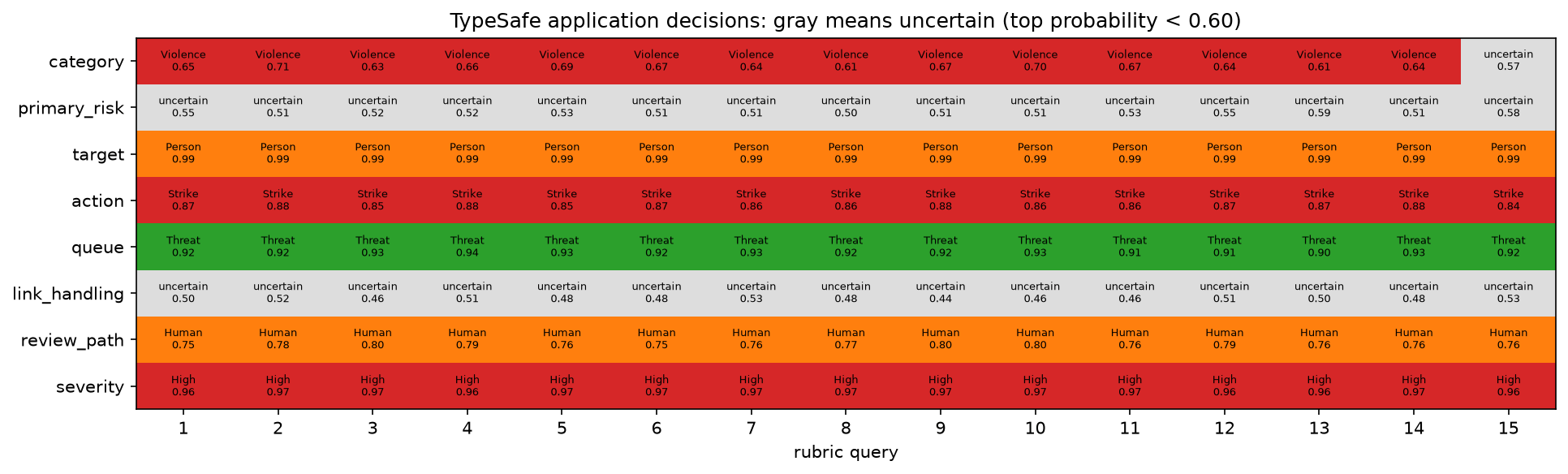
这一策略并不会让模型变成确定性的。弃权可以把相互竞争的标签统一成同一种人工审核结果,但接近 0.60 的概率仍可能在具体标签与 uncertain 之间移动。概率统计和表格中的 raw agree 列报告的仍然是原始模型输出。
在 TypeSafe Playground 中打开
下面的链接会在 Playground 中打开同一帖子和评分准则:一条帖子、同样的 8 个 Choice,以及 TypeSafe jev-latest。
playground_link = make_playground_link(
    {"post": POST},
    {
        key: Choice(instructions=instructions, criteria=choices)
        for key, (instructions, choices) in QUESTIONS.items()
    },
    models=[TYPESAFE_MODEL],
)
display(
    Markdown(
        f"🔗 [Open this post + rubric in the TypeSafe playground]({playground_link})"
    )
)