
Project Introduction
Project Overview
Torch-RecHub is a flexible and easily extensible recommendation system framework built using PyTorch. It aims to simplify the research and application of recommendation algorithms, providing common model implementations, data processing tools, and evaluation metrics.

Features
- Modular Design: Easy to add new models, datasets, and evaluation metrics.
- Based on PyTorch: Leverage PyTorch's dynamic graph and hardware acceleration capabilities across CPU, NVIDIA CUDA GPU, AMD ROCm GPU, and Huawei Ascend NPU.
- Rich Model Library: Includes various classic and cutting-edge recommendation algorithms.
- Standardized Process: Provide unified data loading, training, and evaluation processes.
- Easy to Configure: Adjust experiments through Python constructor arguments and the command-line options exposed by example scripts.
- Reproducibility: Aims to ensure the reproducibility of experimental results.
- Easy to Extend: Decouple model training from model definition, without the concept of a base model.
- Native Functions: Use PyTorch's native classes and functions as much as possible without excessive customization.
- Concise Model Code: Facilitate beginners' learning while adhering to the ideas of academic papers.
- Other Features: For example, support negative sampling, multi-task learning, etc.
Overall Architecture
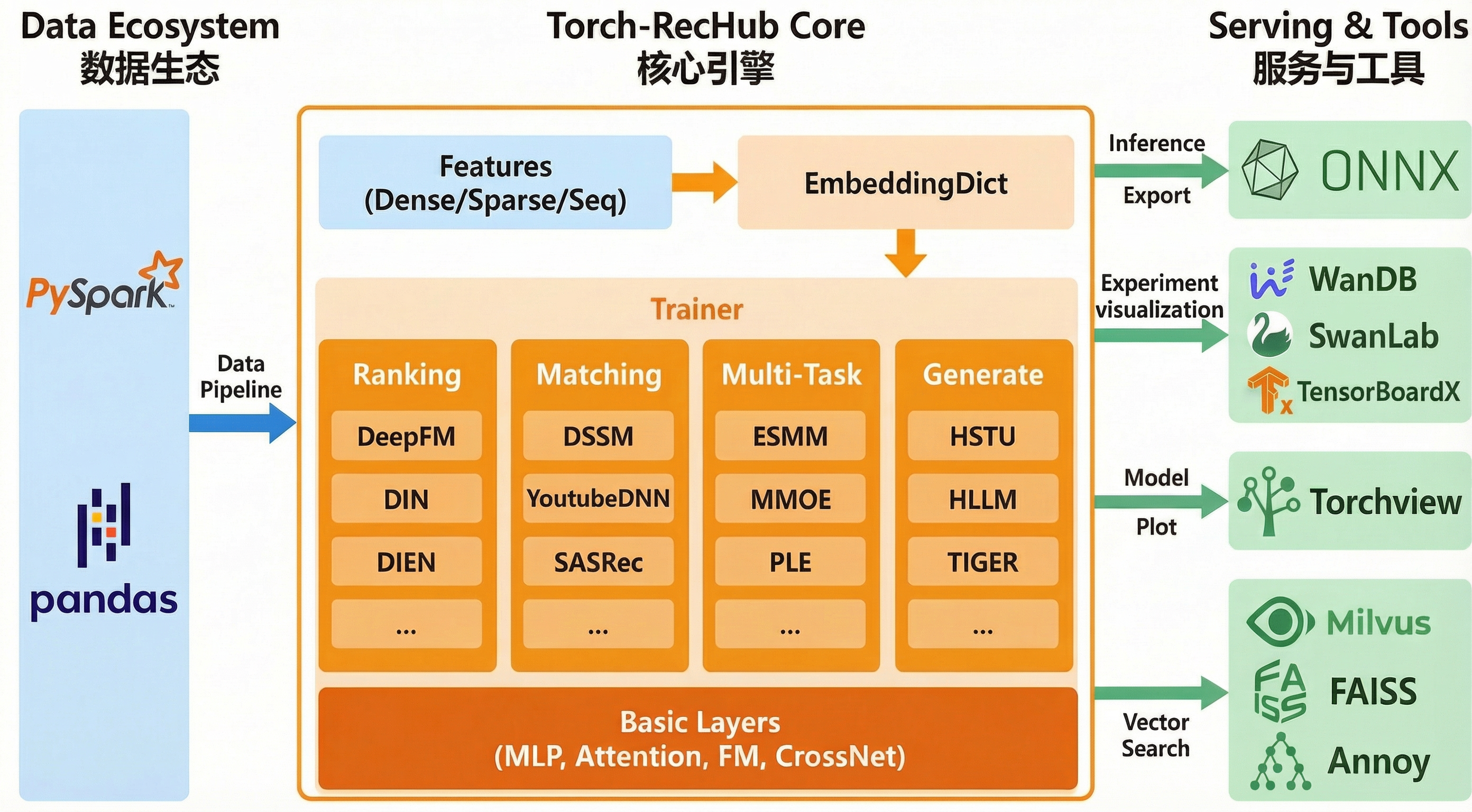
Core Components
Torch-RecHub adopts a modular design, dividing the core functions of recommendation systems into multiple components:
1. Feature Processing
Handles different types of features, including dense features, sparse features, and sequence features.
See Feature Definitions for details.
2. Data Pipeline
Responsible for data loading, preprocessing, and generating dataloaders, supporting data processing for ranking and matching models.
See Data Pipeline for details.
3. Model Library
Implements various recommendation models, including ranking models, matching models, multi-task models, and generative recommendation models.
See Model Library for details.
4. Training & Evaluation
Provides a unified training interface, supporting model training, evaluation, prediction, and ONNX export.
See Training & Evaluation for details.
5. Development Tools
Provides various utility functions, such as ONNX export, model visualization, callbacks, and loss functions.
See Development Tools for details.
Supported Models
Ranking Models - 13 exported classes
- DeepFM, WideDeep, DCN, DCNv2, DIN, DIEN, BST, AFM, AutoInt, FiBiNet, DeepFFM, FatDeepFFM, EDCN
Matching Models - 12 exported classes
- DSSM, YoutubeDNN, YoutubeSBC, MIND, SINE, GRU4Rec, SASRec, NARM, STAMP, ComirecDR, ComirecSA, FaceBookDSSM
Multi-Task Models - 5
- ESMM, MMoE, PLE, AITM, SharedBottom
Generative Recommendation - 4
- HSTU, HLLM, RQ-VAE, TIGER
Quick Start
To get started with Torch-RecHub, see the Quick Start page to learn how to install the framework and run your first example.
Production Deployment
Torch-RecHub supports exporting trained models to ONNX format for production deployment. See Production Deployment for details.
Community Contribution
We welcome all forms of contributions! See the Contributing Guide for detailed contribution guidelines.
FAQ
If you encounter issues, see the FAQ page or submit an Issue on GitHub.