
Chapter 4: The Wisdom of Linearity (Traversal and Search)
Mr. Pallas's Cat's Warm Welcome
After understanding the boundaries of reasoning, let's return to the domain of the computable and explore the simplest yet most fundamental search strategies. When we face the unknown, there are two basic attitudes: the thoroughness of checking one by one, or the intelligence of exploiting structure. Today, we explore the wisdom of searching.
Core Question: What Is the Strategy for Navigating the Unknown?
It was a morning in Kangle Garden, the thin mist over the Pearl River not yet fully lifted. In the study of the Black Stone House, Mr. Pallas's Cat was organizing the bookshelves. Sunlight streamed through the arched windows, casting warm patches of light on the red-brick walls. Outside, the kapok blossoms had all fallen, and new leaves were unfolding on the branches.
Piglet walked in carrying a stack of newly arrived books. "Professor, where should these books go?"
Little Seal looked up. "Wait, let me see... Introduction to Algorithms, Computational Complexity, Gödel: A Life... we need a good classification system."
Mr. Pallas's Cat set down the book in his hands and smiled. "You've raised an excellent question. When we face a pile of unordered objects — whether books, information, or life choices — how do we efficiently find what we're looking for?"
Piglet piled the books on the table. "The simplest way is to check them one by one!"
"That's linear search," Mr. Pallas's Cat nodded. "Check each one in turn, ensuring nothing is missed. But what if we have very, very many books?"
Little Seal thought for a moment. "If the books are arranged in some order — say, alphabetically by the author's surname — we could use a smarter method."
"Exactly," said Mr. Pallas's Cat. "That's binary search. The core issue we explore today is: what is the strategy for navigating the unknown?"
He walked to the whiteboard and wrote two words:
Thoroughness — Intelligence
"When we search for something," Mr. Pallas's Cat explained, "there are two basic strategies:
- Thorough search: check every possibility to ensure nothing is missed (linear search)
- Intelligent search: use structural information to locate the target quickly (binary search)
"These two strategies represent two different cognitive attitudes, and correspond to two different time costs."
Linear Search: The Cost of Thoroughness
Piglet picked up a book. "Suppose I want to find Introduction to Algorithms in this pile. If the books are unsorted, I can only check them one by one."
"Let's formalize this problem," said Mr. Pallas's Cat, writing on the whiteboard:
Problem: In an array arr with n elements, find the target value target. Linear Search Algorithm:
for i from 0 to n-1:
    if arr[i] == target:
        return i  # found — return the index
return -1         # not found
"The time complexity of this algorithm is O(n)," said Mr. Pallas's Cat. "In the worst case, all n elements must be checked."
Little Seal added: "But its advantage is simplicity and universality. Whether the array is sorted or not, whatever the element type, linear search works."
"Yes," Mr. Pallas's Cat nodded. "Linear search embodies an attitude of thorough cognition: assuming no structure, relying on no shortcuts — just honestly checking every single possibility."
Mr. Pallas's Cat's Commentary
The philosophy of linear search is radical honesty. It does not assume the world has structure, does not expect shortcuts — it simply explores every possibility systematically and patiently. This attitude is necessary in certain situations — when the world is indeed disordered, or when we know nothing about its structure.
A Variant of Linear Search: The Sentinel Technique
Piglet frowned. "But Professor, each loop iteration checks both i < n and arr[i] == target — can we optimize that?"
"Good question," said Mr. Pallas's Cat. "There is a clever optimization: the sentinel technique."
He wrote the improved version on the whiteboard:
# Append the target value at the end of the array as a sentinel
arr.append(target)
i = 0
while arr[i] != target:
    i += 1
if i < n:  # check whether we really found it (not just stopped at the sentinel)
    return i
else:
    return -1
"Now each loop only needs to check one condition," Mr. Pallas's Cat explained. "Although the asymptotic complexity is still O(n), the constant factor is smaller. This is a micro-optimization within the framework of thoroughness."
Advanced: Algorithmic Analysis of Linear Search
Though simple, linear search has some interesting mathematical properties:
- Expected number of comparisons: if the target value is uniformly distributed in the array, an average of (n+1)/2 comparisons are needed
- The cost of success vs. failure: finding the target takes (n+1)/2 comparisons on average; confirming its absence takes n comparisons
- Optimality proof: for an unsorted array, linear search is the optimal comparison-based algorithm — any deterministic algorithm requires at least n comparisons in the worst case
- Randomized version: randomly shuffling the array order can avoid worst-case inputs (e.g., the target always being at the end)
These analyses tell us: when facing completely unordered data, linear search is not only the simple choice, but also the theoretically optimal choice (in the worst case).
Binary Search: The Power of Intelligence
"Now, let's consider another scenario," said Mr. Pallas's Cat. "Suppose the books are arranged alphabetically by author surname. How do we find Introduction to Algorithms?"
Little Seal answered immediately: "First look at the middle book. If the author's surname comes before the middle book's author, search the left half; if after, search the right half. Repeat this process."
"Exactly binary search," said Mr. Pallas's Cat, drawing the algorithm on the whiteboard:
def binarySearch(arr, target, left, right):
    if left > right:
        return -1  # not found

    mid = floor((left + right) / 2)

    if arr[mid] == target:
        return mid  # found
    elif arr[mid] < target:
        return binarySearch(arr, target, mid+1, right)  # search the right half
    else:
        return binarySearch(arr, target, left, mid-1)   # search the left half
Piglet's eyes lit up. "Each time the search range is halved! That way you find it really fast!"
"Yes," said Mr. Pallas's Cat. "Binary search has a time complexity of O(log n). For a million books, linear search needs at most a million checks, while binary search needs only about 20."
He listed the comparison on the whiteboard:
| Number of Books | Linear Search (worst) | Binary Search (worst) |
|---|---|---|
| 10 | 10 checks | 4 checks |
| 100 | 100 checks | 7 checks |
| 1,000 | 1,000 checks | 10 checks |
| 1,000,000 | 1,000,000 checks | 20 checks |
"The difference is exponential," Mr. Pallas's Cat emphasized. "Binary search embodies an attitude of intelligent cognition: exploiting the structural information of the world to make informed leaps."
Mr. Pallas's Cat's Commentary
The philosophy of binary search is intelligent leaping. It assumes the world has order, and uses that order to locate the target quickly. But this intelligence has a prerequisite: the data must be sorted. If the world is disordered, binary search is not only ineffective — it may even produce wrong results.
A Variant of Binary Search: Finding the Insertion Point
Little Seal thought for a moment. "Professor, what if the target value isn't in the array, but we need to know where it should be inserted?"
"That's an important variant of binary search," said Mr. Pallas's Cat. "Finding the insertion point."
He wrote the algorithm:
def findInsertionPoint(arr, target):
    left = 0
    right = len(arr)

    while left < right:
        mid = floor((left + right) / 2)

        if arr[mid] < target:
            left = mid + 1
        else:
            right = mid

    return left  # insertion position
"This variant is useful in many practical applications," Mr. Pallas's Cat explained. "Such as maintaining sorted lists, implementing dictionaries, database indices, and so on."
Advanced: The Mathematical Principles and Edge Cases of Binary Search
Binary search seems simple, but it has many subtle details:
- Midpoint calculation:
mid = (left + right) // 2can overflow (for extremely large arrays). The safe way ismid = left + (right - left) // 2 - Loop invariant: the correctness of binary search depends on a loop invariant — the target value (if it exists) is always within the interval
[left, right] - Termination condition: the choice between
while left <= rightandwhile left < rightdepends on the specific problem - Finding upper/lower bounds: finding the first position equal to the target vs. the last position equal to the target requires different boundary handling
These details reflect the rigor of algorithm design. An apparently simple binary search, if the boundary handling is not done right, can lead to infinite loops or incorrect results.
Orthogonal Computation Graphs: Seeing the Decision Tree of Search
Mr. Pallas's Cat turned on the projector, and two neat computation graphs appeared on the screen.
Linear Search: Sequential Thoroughness
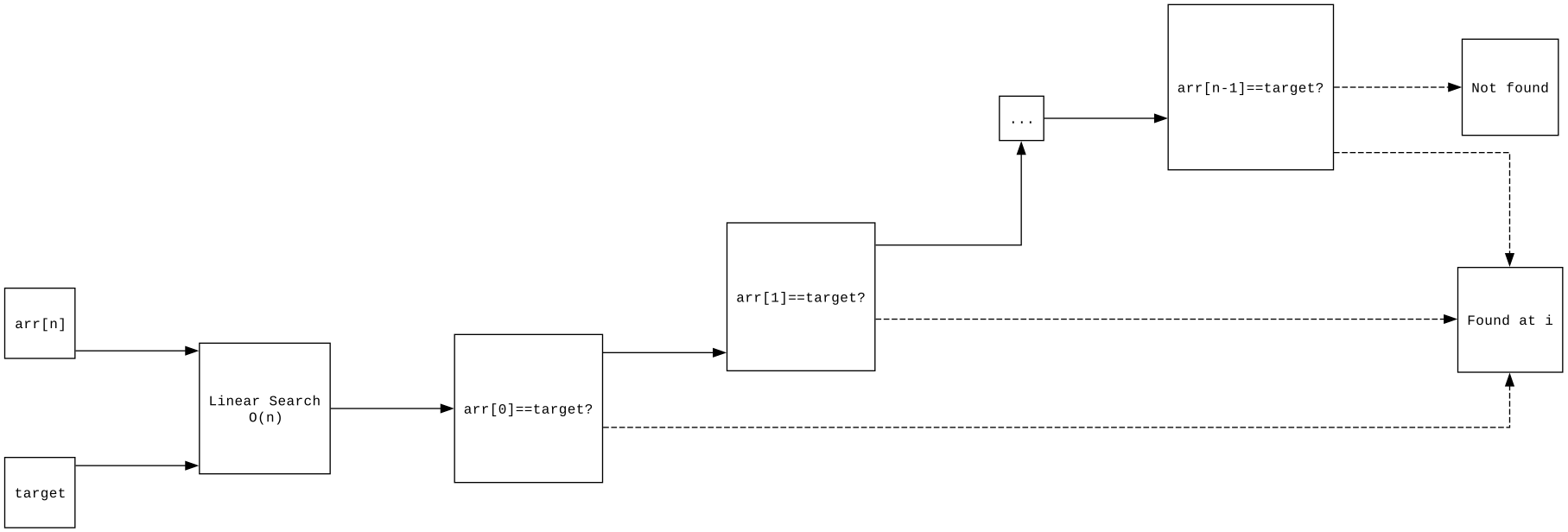
"This is the orthogonal computation graph for linear search," said Mr. Pallas's Cat, pointing at the left-hand diagram. "The input array and target value enter from the left, pass through a series of sequential checks, and finally produce the result."
Piglet stared at the diagram. "All the check nodes are at the same level, connected by straight lines — like inspecting products one by one on an assembly line!"
Binary Search: Logarithmic Intelligence
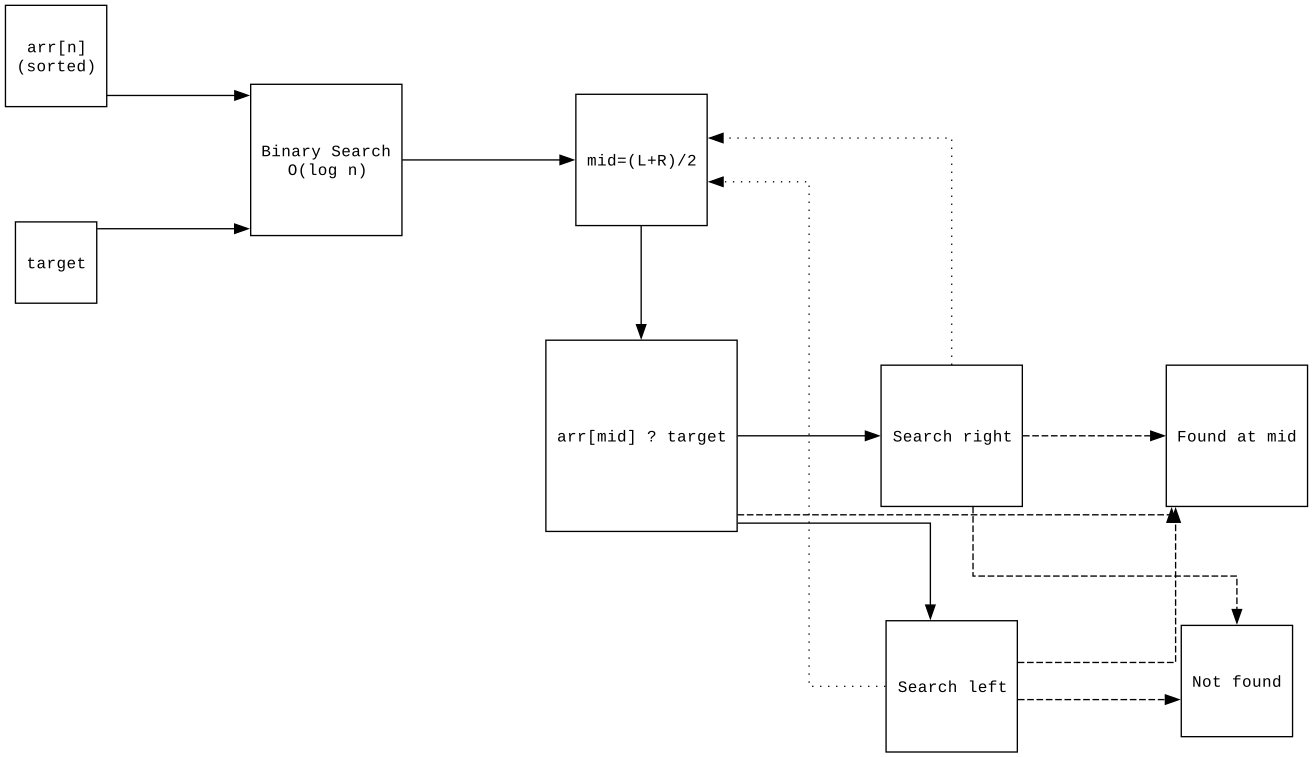
"This is the orthogonal computation graph for binary search," said Mr. Pallas's Cat, pointing at the right-hand diagram. "The input sorted array and target value pass through midpoint calculation and comparison, branching into left and right search directions."
Little Seal studied the layered structure of the diagram carefully. "Binary search has multiple layers, and the decision lines branch out — like an upside-down tree! This tree-like structure reflects its logarithmic complexity."
"Exactly," said Mr. Pallas's Cat. "Linear search's decisions are linear, sequential — all checks at the same level. Binary search's decisions are logarithmic, tree-like — with multiple levels and branching. This visual comparison reveals the essential difference between the two strategies."
"This is the power of orthogonal computation graphs," Mr. Pallas's Cat summarized. "They tell us in visual language: the choice of search strategy determines the shape of the computation path."
Mental Model: Sequential Processing vs. Divide-and-Conquer
Mr. Pallas's Cat returned to his seat and took a sip of tea. "Let's summarize today's most important mental model: sequential processing and divide-and-conquer."
He drew a comparison table on the whiteboard:
| Feature | Sequential Processing (Linear Search) | Divide-and-Conquer (Binary Search) |
|---|---|---|
| Cognitive attitude | Thorough, systematic, patient | Intelligent, leaping, efficient |
| Precondition | No structural assumptions needed | Requires sorted structure |
| Time cost | O(n) | O(log n) |
| Space cost | O(1) | O(log n) recursion stack |
| Suitable scenarios | Unordered data, small-scale data | Ordered data, large-scale data |
| Philosophical implication | Agnosticism about the world | Knowability and orderliness of the world |
"These two models are not opposed," Mr. Pallas's Cat explained. "Rather, they are complementary cognitive tools. A wise thinker knows when to use thoroughness and when to use intelligence."
The Search Strategy Selection Matrix
Little Seal asked: "Professor, in practical problems, how do we choose a search strategy?"
Mr. Pallas's Cat drew a selection matrix on the whiteboard:
Will there be multiple queries?
    ├── No: data scale is small -> linear search (simple and direct)
    │    └── data scale is large -> consider sorting cost
    │
    └── Yes: need to build an index structure
         ├── Static data -> sort then binary search
         ├── Dynamic data -> balanced binary search tree
         └── Approximate search -> hash table (discussed in a later chapter)
"This selection framework tells us," said Mr. Pallas's Cat, "that there is no best algorithm — only the most suitable algorithm. The choice depends on:
- Data characteristics: sorted or unsorted? Static or dynamic?
- Query patterns: single query or multiple queries?
- Resource constraints: prioritize time or space?
- Accuracy requirements: exact match or approximate match?"
Mr. Pallas's Cat's Commentary
The choice of search strategy reflects our degree of understanding and our expectations about the world. If we know nothing about the world, linear search is the honest choice; if we believe the world has order, binary search is the efficient choice. True wisdom lies in knowing: which situation are we in?
Code Practice: Implementing Search Algorithms in Python
"Let's use code to compare linear search and binary search," said Mr. Pallas's Cat. "From theory to practice, from time complexity to actual performance."
Linear Search Implementation
def linear_search(arr, target):
    """Linear search: check each element one by one

    Problem description:
        Find a target value in an array and return its index.
        Return -1 if the target value does not exist.

    Algorithm idea:
        1. Start from the first element of the array
        2. Check each element in turn to see if it equals the target value
        3. If found, return the current index
        4. If all elements have been checked without a match, return -1

    Key features:
        - Works for both sorted and unsorted arrays
        - Simple and intuitive to implement
        - Worst case requires checking all elements

    Parameters:
        arr: array (may be sorted or unsorted)
        target: the target value to search for

    Returns:
        the index of the target value in the array, or -1 if not found

    Time complexity: O(n) — worst case requires checking n elements
    Space complexity: O(1) — uses only constant extra space

    Examples:
        >>> linear_search([3, 1, 4, 1, 5], 4)
        2
        >>> linear_search([3, 1, 4, 1, 5], 6)
        -1
    """
    for i, value in enumerate(arr):
        if value == target:
            return i
    return -1

def linear_search_with_count(arr, target):
    """Linear search (with comparison count tracking)

    Returns: (index, number of comparisons)
    """
    count = 0
    for i, value in enumerate(arr):
        count += 1
        if value == target:
            return i, count
    return -1, count
Binary Search Implementation (Iterative)
def binary_search_iterative(arr, target):
    """Binary search (iterative): quickly locate the target using sorted order

    Problem description:
        Find a target value in a sorted array and return its index.
        Return -1 if the target value does not exist.

    Algorithm idea (divide-and-conquer):
        1. Initialize left and right pointers at the two ends of the array
        2. Loop while left <= right:
           a. Compute the middle position: mid = (left + right) // 2
           b. If arr[mid] == target, found — return mid
           c. If arr[mid] < target, target is on the right — move left to mid+1
           d. If arr[mid] > target, target is on the left — move right to mid-1
        3. If the loop ends without finding, return -1

    Key features:
        - Requires the array to be sorted
        - Each comparison halves the search range
        - Much more efficient than linear search (logarithmic vs. linear)

    Precondition: the array must be sorted (ascending or descending)

    Parameters:
        arr: a sorted array (usually ascending)
        target: the target value to search for

    Returns:
        the index of the target value in the array, or -1 if not found

    Time complexity: O(log n) — each comparison halves the search range
    Space complexity: O(1) — uses only constant extra space

    Examples:
        >>> binary_search_iterative([1, 3, 5, 7, 9], 5)
        2
        >>> binary_search_iterative([1, 3, 5, 7, 9], 6)
        -1
        >>> binary_search_iterative([], 5)
        -1

    Note:
        - If the array has duplicate elements, the returned index may not be the first occurrence
        - For a descending array, the comparison logic must be adjusted
    """
    left, right = 0, len(arr) - 1

    while left <= right:
        mid = left + (right - left) // 2  # prevents overflow

        if arr[mid] == target:
            return mid
        elif arr[mid] < target:
            left = mid + 1  # search the right half
        else:
            right = mid - 1  # search the left half

    return -1

def binary_search_iterative_with_count(arr, target):
    """Binary search (iterative, with comparison count tracking)

    Returns: (index, number of comparisons)
    """
    left, right = 0, len(arr) - 1
    count = 0

    while left <= right:
        count += 1
        mid = left + (right - left) // 2

        if arr[mid] == target:
            return mid, count
        elif arr[mid] < target:
            left = mid + 1
        else:
            right = mid - 1

    return -1, count
Binary Search Implementation (Recursive)
def binary_search_recursive(arr, target, left=0, right=None):
    """Binary search (recursive): embodies divide-and-conquer thinking

    Parameters:
        arr: a sorted array
        target: the target value to search for
        left: left boundary of the search range
        right: right boundary of the search range

    Returns:
        the index of the target value in the array, or -1 if not found

    Time complexity: O(log n)
    Space complexity: O(log n) (recursion stack depth)
    """
    if right is None:
        right = len(arr) - 1

    # Base case: search range is empty
    if left > right:
        return -1

    # Compute the middle position
    mid = left + (right - left) // 2

    # Compare and recurse
    if arr[mid] == target:
        return mid
    elif arr[mid] < target:
        return binary_search_recursive(arr, target, mid + 1, right)
    else:
        return binary_search_recursive(arr, target, left, mid - 1)
Search Algorithm Performance Comparison Experiment
import time
import random

def search_performance_experiment():
    """Compare the performance of different search algorithms"""

    print("Search Algorithm Performance Comparison Experiment")
    print("=" * 50)

    # Test data sizes
    sizes = [1000, 10000, 100000, 1000000]

    for size in sizes:
        print(f"\nData size: {size}")

        # Generate test data
        sorted_data = list(range(size))
        target_in_middle = size // 2  # target in the middle
        target_not_exist = -1  # nonexistent target

        # Test 1: search in a sorted array (target exists)
        print(f"  Test 1: find an existing target in a sorted array (position {target_in_middle})")

        # Binary search
        start = time.time()
        idx1 = binary_search_iterative(sorted_data, target_in_middle)
        time1 = time.time() - start

        # Linear search
        start = time.time()
        idx2 = linear_search(sorted_data, target_in_middle)
        time2 = time.time() - start

        print(f"    Binary search: {time1:.6f}s, result: {idx1}")
        print(f"    Linear search: {time2:.6f}s, result: {idx2}")
        print(f"    Speed ratio: {time2/time1:.1f}x" if time1 > 0 else "    Speed ratio: infinite")

        # Test 2: search in a sorted array (target does not exist)
        print(f"  Test 2: find a nonexistent target in a sorted array")

        # Binary search (target does not exist)
        start = time.time()
        idx3 = binary_search_iterative(sorted_data, target_not_exist)
        time3 = time.time() - start

        # Linear search (target does not exist)
        start = time.time()
        idx4 = linear_search(sorted_data, target_not_exist)
        time4 = time.time() - start

        print(f"    Binary search: {time3:.6f}s, result: {idx3}")
        print(f"    Linear search: {time4:.6f}s, result: {idx4}")
        print(f"    Speed ratio: {time4/time3:.1f}x" if time3 > 0 else "    Speed ratio: infinite")

        # Test 3: search in an unsorted array
        print(f"  Test 3: search in an unsorted array (requires sorting first)")

        # Generate unsorted data
        unsorted_data = list(range(size))
        random.shuffle(unsorted_data)
        target = random.randint(0, size - 1)

        # Approach A: sort first, then binary search
        start = time.time()
        sorted_copy = sorted(unsorted_data)  # O(n log n)
        idx_a = binary_search_iterative(sorted_copy, target)  # O(log n)
        time_a = time.time() - start

        # Approach B: direct linear search
        start = time.time()
        idx_b = linear_search(unsorted_data, target)  # O(n)
        time_b = time.time() - start

        print(f"    Sort + binary search: {time_a:.6f}s, result: {idx_a}")
        print(f"    Direct linear search: {time_b:.6f}s, result: {idx_b}")

        # Decision analysis
        if time_a < time_b:
            print(f"    Conclusion: sorting first then searching is faster (by {time_b-time_a:.6f}s)")
        else:
            print(f"    Conclusion: direct linear search is faster (by {time_a-time_b:.6f}s)")

# Run the performance experiment
search_performance_experiment()
Search Strategy Selection Framework
def search_strategy_selection(data_size, query_count, is_sorted, memory_constraint):
    """Search strategy selection framework

    Parameters:
        data_size: size of the data
        query_count: number of queries
        is_sorted: whether the data is already sorted
        memory_constraint: memory constraint (MB)

    Returns:
        recommended search strategy
    """
    print("\n" + "=" * 50)
    print("Search Strategy Selection Framework")
    print("=" * 50)

    print(f"Problem characteristics:")
    print(f"  Data size: {data_size}")
    print(f"  Query count: {query_count}")
    print(f"  Already sorted: {is_sorted}")
    print(f"  Memory constraint: {memory_constraint}MB")

    print("\nStrategy analysis:")

    # Compute the time complexity of various strategies
    # Simplified estimate: assume each operation takes 1 unit of time

    linear_time = data_size * query_count  # O(n * q)

    if is_sorted:
        binary_time = query_count * (data_size.bit_length())  # O(q * log n)
        print(f"  1. Binary search: O(q log n) ≈ {binary_time} units of time")
    else:
        # Sort first, then binary search
        sort_time = data_size * (data_size.bit_length())  # O(n log n) sorting
        binary_time = query_count * (data_size.bit_length())  # O(q log n) searching
        total_sorted_time = sort_time + binary_time
        print(f"  1. Sort then binary search: O(n log n + q log n) ≈ {total_sorted_time} units of time")

    print(f"  2. Linear search: O(nq) ≈ {linear_time} units of time")

    # Strategy recommendation
    print("\nStrategy recommendation:")

    if query_count == 1:
        print("  - Single query -> linear search is usually simpler")
        if not is_sorted:
            print("  - Note: for a single query, the cost of sorting may exceed the benefit")

    elif query_count > 1 and is_sorted:
        print("  - Multiple queries + already sorted -> binary search is the best choice")
        expected_speedup = linear_time / binary_time if binary_time > 0 else float('inf')
        print(f"  - Expected speedup: {expected_speedup:.1f}x")

    elif query_count > 1 and not is_sorted:
        print("  - Multiple queries + unsorted -> consider sorting first then binary search")
        # Compare the two strategies
        if total_sorted_time < linear_time:
            speedup = linear_time / total_sorted_time
            print(f"  - Sort + binary search is {speedup:.1f}x faster than linear search")
        else:
            print("  - Query count is not high enough; direct linear search may be faster")

    # Memory considerations
    if memory_constraint < 10:  # tight memory
        print("\nMemory considerations:")
        print("  - When memory is tight, avoid algorithms that need extra storage")
        print("  - Binary search (iterative) only requires O(1) extra space")
        print("  - Mergesort requires O(n) extra space; consider in-place sorting algorithms")

    print("\nMr. Pallas's Cat's wisdom summary:")
    print("1. Linear search: embodies a thorough cognitive attitude — simple and universal")
    print("2. Binary search: embodies an intelligent cognitive attitude — requires sorted data")
    print("3. Strategy choice depends on: data characteristics, query patterns, resource constraints")
    print("4. Sometimes, sorting first then searching is more efficient than direct linear search")

# Apply the strategy selection framework
print("\n" + "=" * 50)
print("Search Strategy Selection Examples")
print("=" * 50)

# Example 1: phone number lookup system
print("\nExample 1: Phone Number Lookup System")
search_strategy_selection(
    data_size=10000,      # 10,000 contacts
    query_count=1000,     # 1,000 queries per day
    is_sorted=True,       # already sorted by name
    memory_constraint=100 # 100 MB memory
)

# Example 2: temporary data lookup
print("\nExample 2: Temporary Data Lookup")
search_strategy_selection(
    data_size=100,        # 100 temporary data items
    query_count=1,        # only one query
    is_sorted=False,      # unsorted
    memory_constraint=10  # 10 MB memory
)
Boundary Testing and Algorithmic Rigor
def boundary_test_suite():
    """Boundary test suite: test search algorithms under various edge cases"""

    print("\n" + "=" * 50)
    print("Boundary Test Suite")
    print("=" * 50)

    test_cases = [
        # (description, array, target, expected result)
        ("Empty array", [], 5, -1),
        ("Single element (exists)", [5], 5, 0),
        ("Single element (does not exist)", [5], 3, -1),
        ("Two elements (target at start)", [2, 5], 2, 0),
        ("Two elements (target at end)", [2, 5], 5, 1),
        ("Two elements (target does not exist)", [2, 5], 3, -1),
        ("Multiple elements (target at start)", [1, 3, 5, 7, 9], 1, 0),
        ("Multiple elements (target in middle)", [1, 3, 5, 7, 9], 5, 2),
        ("Multiple elements (target at end)", [1, 3, 5, 7, 9], 9, 4),
        ("Multiple elements (target does not exist, within range)", [1, 3, 5, 7, 9], 4, -1),
        ("Multiple elements (target does not exist, below min)", [1, 3, 5, 7, 9], 0, -1),
        ("Multiple elements (target does not exist, above max)", [1, 3, 5, 7, 9], 10, -1),
        ("Duplicate elements (find first)", [1, 2, 2, 2, 3], 2, 1),  # binary search may not return the first
    ]

    print("Testing binary search (iterative):")
    passed = 0
    total = len(test_cases)

    for desc, arr, target, expected in test_cases:
        result = binary_search_iterative(arr, target)
        status = "✓" if result == expected else "✗"
        if status == "✓":
            passed += 1

        # Special case for duplicate elements: binary search may return any matching position
        if desc == "Duplicate elements (find first)":
            if result in [1, 2, 3]:  # finding any '2' is correct
                status = "✓"
                if status == "✓":
                    passed += 1

        print(f"  {status} {desc}: arr={arr}, target={target}, result={result}, expected={expected}")

    print(f"\nPass rate: {passed}/{total} ({passed/total*100:.1f}%)")

    print("\nAlgorithmic rigor essentials:")
    print("1. Empty array handling: is the left > right condition handled correctly?")
    print("2. Single-element array: is the mid calculation correct?")
    print("3. Boundary conditions: does the loop continue when left = right?")
    print("4. Overflow issue: mid = (left + right) // 2 may overflow; use left + (right - left) // 2")
    print("5. Duplicate elements: binary search may not return the first match; special handling is needed")

# Run the boundary tests
boundary_test_suite()

print("\n" + "=" * 50)
print("Search Algorithm Reflection Questions:")
print("1. If the data is a linked list rather than an array, is binary search still applicable? Why?")
print("2. When data is frequently inserted/deleted, which search strategy should be chosen?")
print("3. What are the pros and cons of the recursive vs. iterative versions of binary search?")
"Through this code," Mr. Pallas's Cat summarized, "we have not only learned two search algorithms, but also understood the strategy for navigating the unknown. Linear search embodies a thorough cognitive attitude; binary search embodies an intelligent cognitive attitude. True wisdom lies in knowing: which situation are we in?"
Key Takeaways
Mr. Pallas's Cat's Summary: Two Wisdoms for Navigating the Unknown
- Linear search: embodies a thorough cognitive attitude; O(n) time complexity; simple and universal; suitable for unsorted or small-scale data
- Binary search: embodies an intelligent cognitive attitude; O(log n) time complexity; requires sorted data; suitable for large-scale data
- Strategy selection: choose the right strategy based on data characteristics, query patterns, and resource constraints — there is no absolute best
- Cognitive framework: sequential processing (linear) vs. divide-and-conquer (logarithmic) — two fundamental modes of thinking
- Practical wisdom: sometimes, sorting first then searching (O(n log n) + O(log n)) is more efficient than direct linear search (O(n)) — it depends on the number of queries
Mr. Pallas's Cat's Reflection Questions
Hands-On Exploration (for Piglet)
Algorithm implementation: implement linear search and binary search separately. Test their performance on sorted arrays, unsorted arrays, and at different data scales. Record the differences between actual running time and theoretical analysis.
Boundary testing: design test cases to check the edge-case handling of binary search: empty array, single-element array, target at the start, target at the end, target not present, etc. Experience the importance of algorithmic rigor.
Real-world application: when searching for a contact in your phone's address book, which search strategy does the phone use? Observe the real-time suggestions in the search box and guess the implementation principle behind them.
Historical Investigation (for Little Seal)
Algorithm origins: where did the idea of binary search first appear? Consult historical literature to see whether similar "halving search" ideas existed in antiquity (e.g., the Chinese "method of halving" for computing square roots).
Complexity evolution: from linear search to binary search, and later to hash tables, B-trees, skip lists — how did search algorithms evolve alongside advances in computer hardware and the growth of data scales?
Cultural impact: how has "dichotomous thinking" influenced Western philosophy and scientific methodology? (Hint: Descartes' "analytic-synthetic" method.)
Integrated Reflection
Philosophical reflection: the "thoroughness" of linear search and the "intelligence" of binary search reflect two epistemological attitudes. In scientific exploration, when should we "check one by one," and when can we "make bold assumptions"?
Ethical consideration: in information retrieval systems, fast search can lead to filter bubbles — the system only shows us content we might like. How can we balance efficiency and diversity?
Creative exercise: design a "search fable" — use a story to explain the difference between linear search and binary search. (Hint: compare them to two ways of finding a book in a library.)
Limit challenge: if the data is partially sorted (e.g., a rotated sorted array), how would you modify the binary search algorithm? What cognitive situation in the real world does this correspond to?
Coming Up Next
The afternoon sunlight filtered through the banyan leaves, casting dappled shadows on the floor of the Black Stone House. The sound of a ship's horn drifted from the Pearl River, long and distant.
Piglet was testing the performance of different search algorithms on his computer, timing data flickering across the screen. Little Seal was drawing search decision trees on the whiteboard, trying to understand the mystery of logarithmic growth.
"Today we started from 'the strategy for navigating the unknown,'" Mr. Pallas's Cat said, tidying the tea set. "We explored the thoroughness of linear search and the intelligence of binary search."
Little Seal put down his pen. "Professor, what if the data is dynamically changing — new books constantly being added, old ones removed? Is binary search still applicable?"
Mr. Pallas's Cat smiled. "Good question. That calls for more complex data structures, such as balanced binary search trees."
Piglet looked up. "And hash tables! I remember hash table lookup is even faster — O(1) time!"
"Yes," Mr. Pallas's Cat nodded. "But hash tables come with their own costs and limitations. In the next chapter, we'll explore greedy algorithms — a decision strategy that seems simple but is full of wisdom."
"Greedy?" Piglet asked curiously. "Like always picking the biggest coin?"
"Something like that," said Mr. Pallas's Cat. "A greedy algorithm makes the locally optimal choice at each step, hoping these choices will lead to the globally optimal solution. But sometimes, this 'shortsighted' strategy fails..."
Outside the window, the bell of Kangle Garden rang out, startling a flock of white doves into flight. The doves traced graceful arcs through the sky, as if searching for the way home.
Piglet's note: I tested linear search and binary search. Finding a target among a million sorted numbers: linear search averaged 0.5 seconds; binary search took only 0.00001 seconds! A 50,000x difference! The theoretical logarithmic growth is that astonishing in reality.
Little Seal's note: I looked up the history of binary search and found that John von Neumann mentioned a similar idea as early as 1946, but the first published binary search algorithm appeared in 1949. Sometimes, even the formalization of a simple idea takes time.
Mr. Pallas's Cat's closing words: Remember, the choice of search strategy reflects the depth of your understanding of the problem. Thoroughness has its value; intelligence has its prerequisites. Knowing when to use which strategy is the mark of mature algorithmic thinking. We'll take it slow — understanding is what matters most.