
Chapter 10: The Simplest Perception (The Neuron)
Mr. Pallas's Cat's Warm Welcome
We spent nine chapters crossing from discrete logic into continuous vector space, witnessing the refinement of thought. Today, we begin a new journey: imitating the simplest perceptual unit of life. If we break down the mysteries of thought to their most basic components, what will we discover? Starting from the simplest neuron, let us explore how machines learn to "perceive" the world.
Core Question: Where Does Perception Come From?
"Professor," Piglet stared at the data flickering on his computer screen, "I've been wondering — how does our brain perceive the world? For example, how can I 'see' that this tea is hot, 'smell' its fragrance, 'taste' its flavor?"
It was a deep-autumn morning in Kangle Garden at Sun Yat-sen University. Morning mist shrouded the red-brick buildings. In the Black Stone House study, wisps of steam rose from the gongfu tea set, and the wall clock ticked away the passage of time. Outside the window, a few sparrows hopped among the branches of the banyan tree, chirping about the new day.
By the window, Little Seal looked up from A Brief History of Neuroscience. "That's a profound question. Historically, the study of perception dates back to ancient Greece. Aristotle divided perception into five basic senses, but modern science tells us that perception is a complex interaction of neurons."
Mr. Pallas's Cat gently set down the teapot and smiled. "You've raised a fundamental question. Perception, at its essence, is the transformation and transmission of information. Today, we start from the simplest perceptual unit — the neuron."
Life's Design: From Biological Neurons to Mathematical Models
Piglet walked to the whiteboard and drew a simple cell structure.
"Professor, biological neurons have dendrites to receive signals, axons to transmit signals, synapses to connect to other neurons... but what is a 'neuron' in a computer?"
Little Seal added: "Historically, in 1943, McCulloch and Pitts proposed the first artificial neuron model. They simplified the neuron into a computational unit: receive inputs, compute a weighted sum, and if it exceeds a threshold, 'fire.'"
Mr. Pallas's Cat nodded: "Yes, this is the core of what we explore today: how to capture the essential function of biological neurons through mathematical abstraction."
He walked to the whiteboard and drew a simplified diagram:
Input signals -> Weighted sum -> Activation function -> Output signal"Biological neurons involve complex chemical and electrophysiological processes," Mr. Pallas's Cat explained. "But we extract only the most critical parts: weighted summation and threshold activation."
Piglet studied the diagram carefully: "So an artificial neuron is a simplified version of a biological neuron? Like a flashlight is a simplified version of the sun?"
"A fine analogy," Mr. Pallas's Cat smiled. "We're not trying to fully replicate life, but to capture its functional essence. Like how airplanes imitate the flight principles of birds without replicating every feather."
The Arithmetic of Neurons: The Story of Weights and Bias
Outside, the sunlight grew stronger, casting striped shadows through the louvered windows onto the red-brick floor.
"Professor," Piglet pointed at the formula on the whiteboard, "how exactly do you compute this 'weighted sum'?"
Mr. Pallas's Cat wrote the formula on the whiteboard:
"Look at this formula," he said. "
Little Seal mused: "Weights... like the degree of importance we assign to different senses? Visual signals are usually more important than auditory ones?"
"Exactly," Mr. Pallas's Cat nodded. "Weights allow a neuron to selectively attend to important information. And
Piglet thought: "Bias is like... the height of a threshold? A low threshold means easy activation; a high threshold needs a stronger signal?"
"Good intuition," Mr. Pallas's Cat said approvingly. "In biological neurons, this corresponds to cell excitability. Some neurons fire easily; others require stronger stimulation."
Matrices: The Mathematical Language of Dense Connections
Piglet looked at the formula and suddenly had a question: "Professor, if a neuron has 100 inputs, this formula gets very long. In a computer, how do we compute it efficiently?"
Mr. Pallas's Cat walked to the whiteboard and drew a table. "Good question. When connections become dense, we need a compact representation — matrices."
He drew a simple example on the whiteboard:
Input vector x = [x₁, x₂, x₃]   Weight vector w = [w₁, w₂, w₃]

Weighted sum z = w₁x₁ + w₂x₂ + w₃x₃
"But in computing," Mr. Pallas's Cat continued, "we typically process multiple samples at once. Then the input becomes a matrix, and the weights also become a matrix. Matrix multiplication can compute the weighted sum for all samples in one operation."
Little Seal looked up from his math book: "A matrix is like... a structured table? Where both rows and columns carry meaning?"
"Yes," Mr. Pallas's Cat nodded. "Matrices are the mathematical tool for representing linear transformations. In neural networks, the weight matrix represents the connection strengths between neurons."
He wrote the matrix form on the whiteboard:
where:
is the input matrix (each row is a sample, each column a feature) is the weight vector (treated as a column matrix) is the output vector (weighted sum for each sample)
Piglet studied the formula carefully: "This dot product notation... is that matrix multiplication? How do you compute it?"
"Matrix multiplication has clear rules," Mr. Pallas's Cat explained. "For a vector dot product: multiply corresponding elements and sum:
"For matrix multiplication," he continued, "
Little Seal mused: "This is like... batch processing? Computing weighted sums for multiple samples at once?"
"Exactly," Mr. Pallas's Cat smiled. "Matrix multiplication allows neural networks to process data in parallel, which is key to the efficient operation of deep learning."
Piglet thought further: "Can matrices also represent connections between multiple neurons?"
"A good extension question," said Mr. Pallas's Cat. "When we have multiple neurons, weights become a matrix
He wrote the forward propagation formula for a multi-layer network on the whiteboard:
"This is how neural networks are actually represented in code," Mr. Pallas's Cat summarized. "Matrices are the compact representation of dense connections, and matrix multiplication is the core operation of forward propagation."
Activation Functions: From Continuous to Discrete
Mr. Pallas's Cat drew an S-shaped curve on the whiteboard.
"The result of the weighted sum
Piglet stared at the curve: "This S-shaped function... it maps large positive numbers close to 1, large negative numbers close to 0, with a smooth transition in between?"
"Yes," Mr. Pallas's Cat explained. "This is the sigmoid function:
Little Seal took a math book from the shelf: "Historically, the sigmoid function was used to describe population growth in the 19th century. It's fascinating how the same mathematical tool can describe such different phenomena."
"The unity of mathematics is awe-inspiring," said Mr. Pallas's Cat. "But now, let's look at the complete computation process of this 'perceptual unit.'"
Orthogonal Computation Graphs: Seeing the Computation Flow of a Neuron
Mr. Pallas's Cat turned on the projector, and a neat computation graph appeared on the screen.
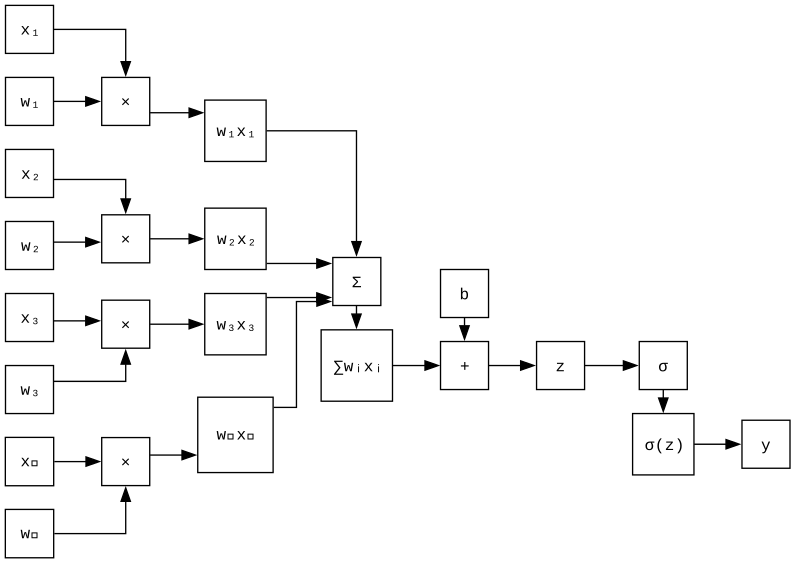
"This is the orthogonal computation graph for a neuron," Mr. Pallas's Cat said, pointing. "Input signals
Piglet studied the right-angle lines in the diagram carefully: "This graph is so neat! Left to right, like an assembly line."
"Orthogonal computation graphs let us 'see' the flow of computation," Mr. Pallas's Cat explained. "Right-angle lines emphasize structural regularity; the left-to-right layout matches the order of data processing."
Little Seal mused: "Each node is a computation unit, and the connecting lines represent data flow... this visualization helps us understand the concrete computation behind abstract formulas."
"Yes," said Mr. Pallas's Cat. "In the graph, you can see:
- Input layer: raw signals
- Weighted sum layer: each input multiplied by its corresponding weight
- Summation and bias: weighted sum plus bias
- Activation layer: final output through the sigmoid function"
Piglet looked seriously at the computation graph: "So a neuron is a 'micro decision-maker'? It receives multiple types of information, weighs them, and then decides whether to 'speak'?"
"A concise summary," Mr. Pallas's Cat smiled. "A neuron is indeed an information integration and decision unit. It uses weights to represent the importance of different information, bias to adjust the decision threshold, and the activation function to make the final judgment."
Mental Model: The Threefold Abstraction — From Perception to Decision
Little Seal took a cognitive science book from the shelf. "Professor, this reminds me of the 'perception-decision-action' model in psychology."
"Good connection," said Mr. Pallas's Cat. "The artificial neuron realizes a mathematical abstraction of this model."
He wrote the mental models on the whiteboard:
Mental Model: The Threefold Abstraction of Perception
- Feature extraction: weights
encode the "degree of attention" to input features - Evidence integration: the weighted sum
integrates the "strength" of all evidence - Probabilistic decision: the activation function
converts evidence strength into "firing probability"
"These three abstractions," Mr. Pallas's Cat explained, "correspond to different cognitive levels of perceptual decision-making."
Piglet thought: "So if we train a neuron to recognize 'circles,' the weights will learn to attend to edge curvature features, and the bias will learn the threshold of 'how circular is circular enough'?"
"Exactly," Mr. Pallas's Cat answered. "The training process adjusts weights and bias so the neuron outputs near 1 for 'circle' images and near 0 for 'square' images."
Little Seal mused: "This raises a crucial question: how does a neuron 'learn' the correct weights and bias?"
Mr. Pallas's Cat smiled. "Good question. But today we first understand how a neuron 'works'; in the next chapter, we explore how it 'learns.'"
Key Takeaways
Mr. Pallas's Cat's Summary: The Wisdom of the Neuron
- The power of mathematical abstraction: the artificial neuron captures the essential functions of biological neurons — weighted summation and threshold activation — embodying the scientific methodology of "simplify to understand"
- The semantics of weights and bias: weights encode feature importance; bias adjusts the activation threshold; together they determine the neuron's "perceptual preference" and "decision style"
- The bridging role of activation functions: the sigmoid function converts continuous evidence strength into discrete firing probability, realizing the cognitive leap from "how much evidence" to "whether to believe"
- The value of computational visualization: orthogonal computation graphs concretize abstract formulas, helping us understand the information flow and computation steps inside a neuron
- The perception-decision framework: the neuron realizes the three-step cognitive model of "feature extraction – evidence integration – probabilistic decision," laying the foundation for complex neural networks
Code Practice: Implementing a Neuron in Python
"Let's use Python code to practice the computation of a neuron," said Mr. Pallas's Cat. "Code not only helps us understand abstract mathematical formulas, but also lets us 'run' this simplest perceptual unit."
Single Neuron Implementation
import numpy as np
import matplotlib.pyplot as plt

class SimpleNeuron:
    """The simplest perceptual neuron"""

    def __init__(self, num_inputs):
        """Initialize the neuron

        Parameters:
            num_inputs: number of input features
        """
        # Randomly initialize weights, bias starts at 0
        self.weights = np.random.randn(num_inputs) * 0.01
        self.bias = 0.0

    def sigmoid(self, z):
        """Sigmoid activation function"""
        return 1 / (1 + np.exp(-z))

    def forward(self, inputs):
        """Forward pass: compute the neuron's output

        Parameters:
            inputs: input feature vector

        Returns:
            neuron output (between 0 and 1)
        """
        # Weighted sum: z = w1*x1 + w2*x2 + ... + wn*xn + b
        z = np.dot(self.weights, inputs) + self.bias

        # Through activation function
        activation = self.sigmoid(z)
        return activation, z

    def describe(self):
        """Describe the neuron's parameters"""
        print(f"Neuron parameters:")
        print(f"  Weights: {self.weights}")
        print(f"  Bias: {self.bias}")
        print(f"  Input dimension: {len(self.weights)}")

# Create and test a neuron
print("Single Neuron Test:")
print("=" * 50)

# Create a neuron with 3 inputs
neuron = SimpleNeuron(3)
neuron.describe()

# Test data: three input features
test_inputs = [0.5, -0.2, 0.8]
activation, z_value = neuron.forward(test_inputs)

print(f"\nInput features: {test_inputs}")
print(f"Weighted sum z = {z_value:.3f}")
print(f"Activation output = {activation:.3f}")
print(f"Interpretation: {activation*100:.1f}% probability of firing")
Visualizing the Neuron's Decision Boundary
def visualize_neuron_decision(neuron):
    """Visualize a neuron's decision boundary (2D input case)"""
    # Generate grid data
    x1 = np.linspace(-2, 2, 100)
    x2 = np.linspace(-2, 2, 100)
    X1, X2 = np.meshgrid(x1, x2)

    # Calculate activation value for each point
    Z = np.zeros_like(X1)
    for i in range(X1.shape[0]):
        for j in range(X1.shape[1]):
            inputs = np.array([X1[i, j], X2[i, j]])
            activation, _ = neuron.forward(inputs)
            Z[i, j] = activation

    # Visualization
    plt.figure(figsize=(12, 5))

    # Subplot 1: activation probability heatmap
    plt.subplot(1, 2, 1)
    contour = plt.contourf(X1, X2, Z, levels=20, cmap='RdBu_r')
    plt.colorbar(contour, label='Activation probability')
    plt.xlabel('Feature x₁')
    plt.ylabel('Feature x₂')
    plt.title('Neuron Activation Probability Heatmap')

    # Draw decision boundary (activation probability = 0.5)
    plt.contour(X1, X2, Z, levels=[0.5], colors='black', linewidths=2)

    # Subplot 2: 3D surface plot
    plt.subplot(1, 2, 2, projection='3d')
    surf = plt.gca().plot_surface(X1, X2, Z, cmap='RdBu_r',
                                 alpha=0.8, linewidth=0, antialiased=True)
    plt.colorbar(surf, label='Activation probability', shrink=0.5)
    plt.xlabel('Feature x₁')
    plt.ylabel('Feature x₂')
    plt.title('Neuron Activation Surface (3D)')

    plt.tight_layout()
    plt.savefig('/tmp/neuron_decision_boundary.png', dpi=150, bbox_inches='tight')
    plt.close()

    print("Decision boundary visualization saved to /tmp/neuron_decision_boundary.png")

# Create a 2D-input neuron for visualization
print("\nNeuron Decision Boundary Visualization:")
print("=" * 50)

visual_neuron = SimpleNeuron(2)
visual_neuron.weights = np.array([0.5, -0.3])  # manually set weights for easy observation
visual_neuron.bias = 0.2

print(f"Neuron weights: {visual_neuron.weights}")
print(f"Neuron bias: {visual_neuron.bias}")

visualize_neuron_decision(visual_neuron)

# Test various points
test_points = [
    ([1.0, 1.0], "Quadrant I (upper right)"),
    ([1.0, -1.0], "Quadrant IV (lower right)"),
    ([-1.0, 1.0], "Quadrant II (upper left)"),
    ([-1.0, -1.0], "Quadrant III (lower left)"),
    ([0.0, 0.0], "Origin")
]

print("\nActivation probabilities at different positions:")
for point, description in test_points:
    activation, z = visual_neuron.forward(point)
    print(f"  {description} {point}: z={z:.2f}, activation probability={activation:.2f}")
Perceptron Implementation: A Simple Classifier
class Perceptron:
    """Perceptron: the earliest neural network model (1958)"""

    def __init__(self, num_inputs):
        """Initialize the perceptron

        Parameters:
            num_inputs: number of input features
        """
        self.weights = np.random.randn(num_inputs)
        self.bias = 0.0
        self.learning_rate = 0.1

    def step_function(self, z):
        """Step function: the perceptron's activation function"""
        return 1 if z >= 0 else 0

    def predict(self, inputs):
        """Predict the class of the input

        Parameters:
            inputs: input feature vector

        Returns:
            0 or 1 classification result
        """
        z = np.dot(self.weights, inputs) + self.bias
        return self.step_function(z)

    def train(self, training_data, labels, epochs=100):
        """Train the perceptron (perceptron learning algorithm)

        Parameters:
            training_data: list of training data
            labels: corresponding label list (0 or 1)
            epochs: number of training epochs
        """
        errors_history = []

        for epoch in range(epochs):
            total_error = 0

            for inputs, target in zip(training_data, labels):
                # Forward pass
                prediction = self.predict(inputs)

                # Calculate error
                error = target - prediction
                total_error += abs(error)

                # Update weights and bias (if prediction is wrong)
                if error != 0:
                    self.weights += self.learning_rate * error * np.array(inputs)
                    self.bias += self.learning_rate * error

            errors_history.append(total_error)

            # If all samples are classified correctly, stop early
            if total_error == 0:
                print(f"Perfect classification achieved at epoch {epoch+1}")
                break

        return errors_history

# Perceptron training demo
print("\nPerceptron Training Demo:")
print("=" * 50)

# Create simple linearly separable dataset: AND logic
X_train = [
    [0, 0],  # input 1
    [0, 1],  # input 2
    [1, 0],  # input 3
    [1, 1]   # input 4
]

y_train = [0, 0, 0, 1]  # AND logic: only output 1 when both inputs are 1

print("Training data (AND logic):")
for i, (x, y) in enumerate(zip(X_train, y_train)):
    print(f"  Sample {i+1}: input={x}, target output={y}")

# Create and train perceptron
perceptron = Perceptron(num_inputs=2)
errors = perceptron.train(X_train, y_train, epochs=20)

print(f"\nTrained weights: {perceptron.weights}")
print(f"Trained bias: {perceptron.bias}")

# Test the perceptron
print("\nTesting the perceptron:")
for inputs in X_train:
    prediction = perceptron.predict(inputs)
    expected = 1 if inputs == [1, 1] else 0
    print(f"  Input {inputs} -> Prediction {prediction} (expected {expected})")

# Visualize the training process
plt.figure(figsize=(8, 4))
plt.plot(range(1, len(errors)+1), errors, marker='o', linewidth=2)
plt.xlabel('Training epoch')
plt.ylabel('Classification errors')
plt.title('Perceptron Training Process: Error Count Decreases with Epochs')
plt.grid(True, alpha=0.3)
plt.savefig('/tmp/perceptron_training.png', dpi=150, bbox_inches='tight')
plt.close()

print("\nTraining process visualization saved to /tmp/perceptron_training.png")
"Remember," Mr. Pallas's Cat summarized, "the neuron is both the basic unit of perception and the starting point of learning. It uses concise mathematics to realize complex cognitive functions: weighted summation captures feature importance, and the activation function implements probabilistic decision-making. When we understand how a single neuron works, we lay the foundation for understanding entire neural networks. Most importantly, the neuron is not merely a computational tool — it is a window through which we understand how intelligence emerges from simple units."
Mr. Pallas's Cat's Reflection Questions
Hands-On Exploration (for Piglet)
- Neuron experiment: modify the neuron code above, trying different weight and bias values. Observe how the decision boundary changes. What do the magnitude and sign of weights each affect?
- Activation function comparison: implement other activation functions (ReLU, tanh). Compare their effects on neuron output. When is sigmoid more appropriate than ReLU?
- Perceptron limitation: try to learn XOR logic with a perceptron. Why does it fail? What does this reveal? (Hint: examine the decision boundary.)
Historical Investigation (for Little Seal)
- Tracing the origins: research the historical background of the 1943 McCulloch-Pitts neuron model. Which disciplines inspired them? (Neuroscience, mathematical logic, cybernetics.)
- Rosenblatt's perceptron: study Frank Rosenblatt's 1958 perceptron. How did the scientific community react at the time? Why did perceptrons experience a "winter"?
- Cross-disciplinary connection: compare the similarities and differences between biological and artificial neurons. What did we borrow from biological systems? What did we simplify?
Integrated Reflection
- Philosophical reflection: if intelligence can emerge from combinations of simple neurons, what does this imply about the nature of "consciousness" and "intelligence"?
- Ethical challenge: when we use mathematical models to simulate cognitive functions, what "anthropomorphic" traps should we avoid? How do we distinguish "simulation" from "replication"?
- Creative exercise: design an "emotion neuron," using weights and bias to represent sensitivity to signals of joy, sadness, anger, etc. How would you set the parameters?
- Challenge problem: prove that a single neuron can only learn linearly separable problems. How does this relate to the function of the cerebral cortex?
Coming Up Next
The fragrance of tea filled the Black Stone House; the afternoon sun was warm and tranquil.
"Today we explored the simplest perceptual unit," said Mr. Pallas's Cat. "A single neuron is like a solitary scout — it can make simple judgments, but true intelligence requires cooperation."
Piglet asked curiously: "Cooperation? Like neurons connecting into a network?"
"Yes," Mr. Pallas's Cat explained. "In the next chapter, we'll explore how error becomes the ladder of progress. When a neuron makes a mistake, how does it adjust itself? This is the story of backpropagation."
Little Seal flipped through his notebook. "This introduces a key breakthrough in deep learning. Historically, how was the backpropagation algorithm rediscovered?"
Mr. Pallas's Cat smiled. "We'll take it slow. See you in the next chapter."
Piglet's note: I trained a perceptron to learn AND logic — it achieved perfect classification in just 4 epochs! But it completely failed at XOR, no matter how I trained it. I looked it up and learned that a single-layer perceptron can only solve linearly separable problems. It's like trying to cut a watermelon with a flat plane — some patterns just can't be separated. Sometimes, recognizing limitations is more important than blindly persisting.
Little Seal's note: I researched the history of the McCulloch-Pitts neuron and was amazed that it was born during WWII (1943). The context was an intersection of cybernetics and cryptography. Most fascinatingly, they used the neuron model to prove the Turing-completeness of neural networks — theoretically, a neural network can compute any computable function. A simple model, with profound implications.
Mr. Pallas's Cat's closing words: The neuron teaches us the first lesson about intelligence: complexity arises from simplicity. From simple weighted summation to complex cognitive functions, what lies between is layers and connections. When we understand this basic unit, we hold the bricks with which to build the entire edifice of intelligence. On this path, patience is more important than cleverness, and understanding more valuable than memorization. We'll take it slow — understanding is what matters most.