
L08 · Demonstration Acquisition Methods
Part 1 of L08: this page compares where robot demonstrations come from. Return to the lesson overview or continue to the scripted expert.
A demonstration is produced, not merely found
A robot-learning demonstration is a time-ordered example of behavior for a task. It usually connects observations, actions, task context, and an outcome, but the device or process used to collect it may produce something quite different. A teleoperator produces controller commands. Kinesthetic teaching produces robot motion under physical guidance. A human video may contain no robot action at all.
The important first question is therefore not “Which method makes the best dataset?” It is:
What signal does this method produce, what does it cost to collect, and what must happen before a robot can learn from it?
The routes below are complementary rather than mutually exclusive.
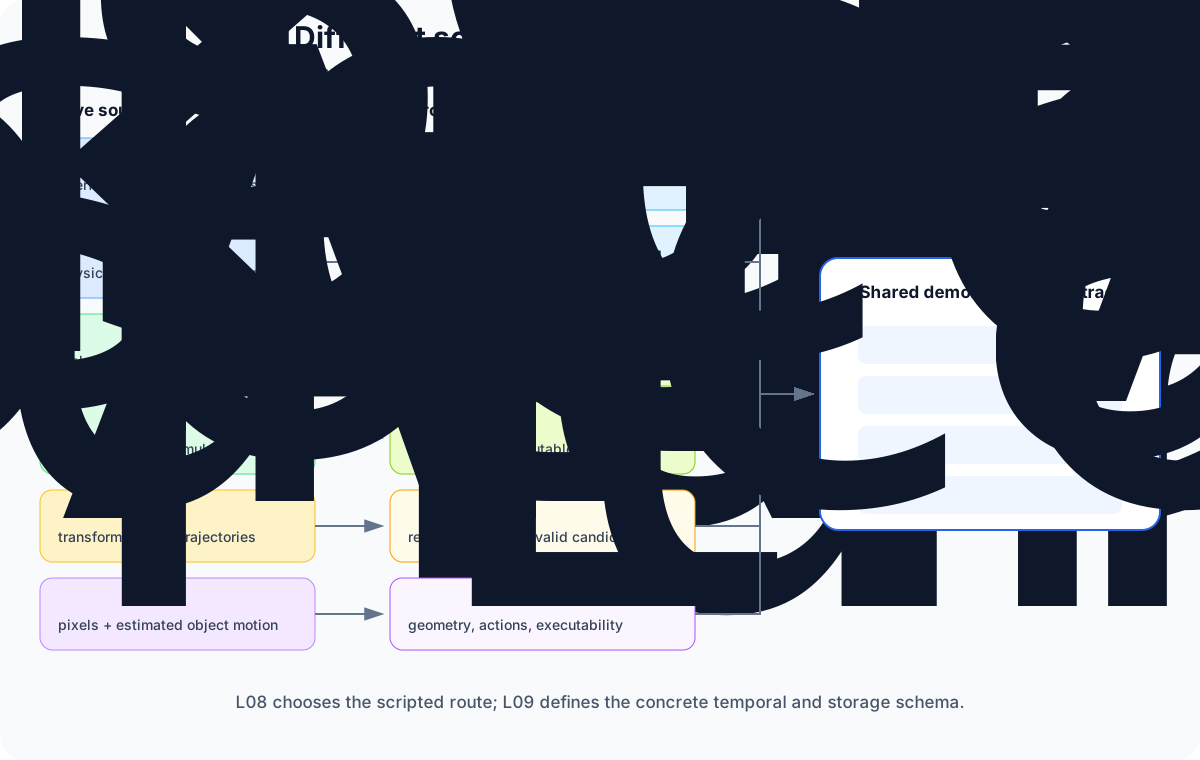
Course-authored schematic. The shared interface is a conceptual handoff to L09, not a claim that the native sources already have one schema.
Compare native signals before formats
| Route | Who or what produces behavior? | Native signal | Necessary adaptation |
|---|---|---|---|
| Teleoperation | A person operates a leader arm, handheld device, VR interface, or other controller | Interface commands, robot state, and sensor observations | Calibrate the control mapping; synchronize commands and observations |
| Kinesthetic teaching | A person physically guides a robot | Joint or end-effector trajectory plus available sensor readings | Convert compliant teaching motion into a safe, replayable action representation |
| Scripted expert | A program selects targets and motion primitives from task state | Reproducible commands, simulator state, task identity, and computable outcome | Make phase logic, failure handling, and recorder hooks explicit |
| Privileged learned teacher | A learned controller acts with simulator-only state or rewards | Teacher actions and privileged simulation state | Restrict the learner's observations; distill or recollect executable actions |
| Automatic augmentation | A system transforms and replays seed demonstrations | Candidate trajectories under changed objects, poses, or scenes | Re-execute candidates and reject physically invalid or unsuccessful episodes |
| Human-video transfer | A person acts in ordinary or instrumented video | Images and estimated hand, body, or object motion | Recover geometry, map embodiments, infer robot actions, and test executability |
This separation prevents a common category error. A camera video, a Cartesian leader trajectory, and a nine-joint command vector may all describe “the same task,” but they cannot be concatenated into one training table without a representation and alignment step.
Six acquisition routes
Teleoperation: direct human task knowledge
In teleoperation, a person closes the control loop through an interface. A leader arm can make joint-space or Cartesian correspondence intuitive. A keyboard or gamepad can issue discrete or incremental commands with little specialized hardware, while VR, motion capture, and handheld interfaces track the operator more directly without requiring a mechanically similar leader. Whole-body interfaces can also include base and bimanual motion. ALOHA and GELLO are well-known examples of the lower-cost hardware direction, while Mobile ALOHA extends the idea to mobile bimanual tasks.
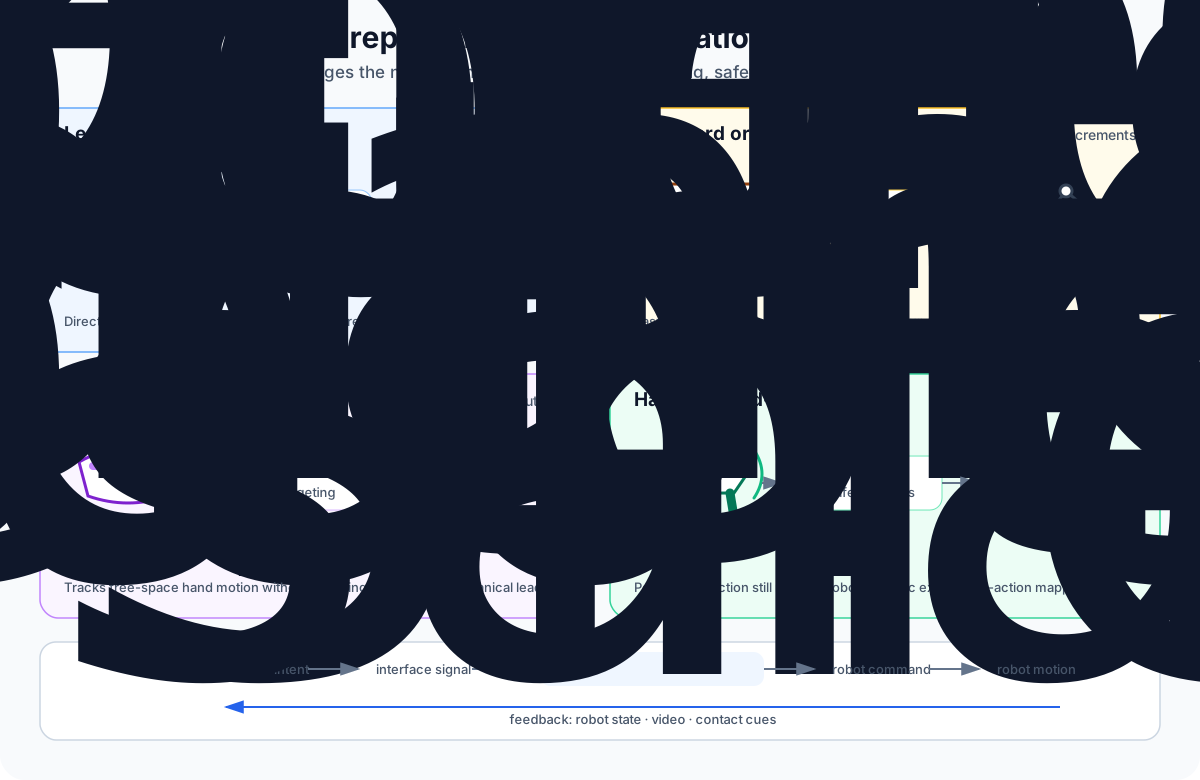
Course-created schematic. The panels compare the native command and required mapping of four representative interfaces; they are not a ranking of control quality, and real systems can combine several of them.
The main advantage is behavioral relevance: the operator can react to contact, recover from small mistakes, and demonstrate a strategy in the real task environment. The main costs are operator time, calibration, fatigue, variable skill, and the need to audit synchronization and failed demonstrations. A better interface can improve collection quality, but it does not remove those data-quality questions.
Use teleoperation when human judgment and contact-rich recovery matter more than fully automatic scale, or when a small number of high-value examples can seed later collection stages.
Kinesthetic teaching: guide the robot itself
Kinesthetic teaching lets a person move a compliant or backdrivable robot through the desired trajectory. It can be the shortest path from an idea to a few robot-native trajectories because the teacher and learner share the same embodiment.
In practice, the robot first enters a manufacturer-supported hand-guiding, gravity-compensation, or compliant-control mode. The teacher then holds the arm or end effector and guides it through the motion; this does not mean pulling against active brakes or a stiff position controller.
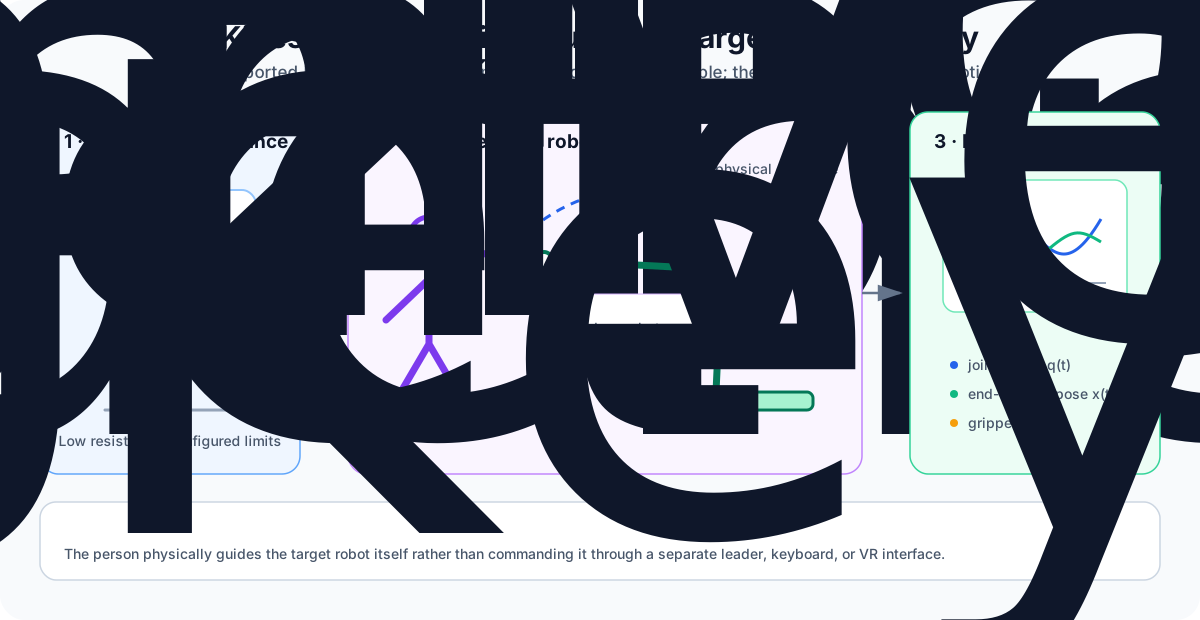
Course-created schematic. Unlike teleoperation, the person physically guides the target robot itself. Joint states and end-effector poses come directly from that robot; gripper events or mode changes may still need a button, pedal, or separate annotation.
That convenience brings constraints. The robot must support safe physical guidance; the teacher may not reproduce the forces or velocities needed during autonomous execution; and collecting many diverse episodes remains labor intensive. It is strongest for quick trajectory teaching in a bounded workspace, not as a universal path to internet-scale data.
Scripted experts: encode task structure directly
A scripted expert converts known task state into a sequence of goals and motion primitives. In simulation it is reproducible, easy to instrument, and cheap to rerun after the script exists. Every phase can emit a label and every episode can be checked by a programmatic success predicate.
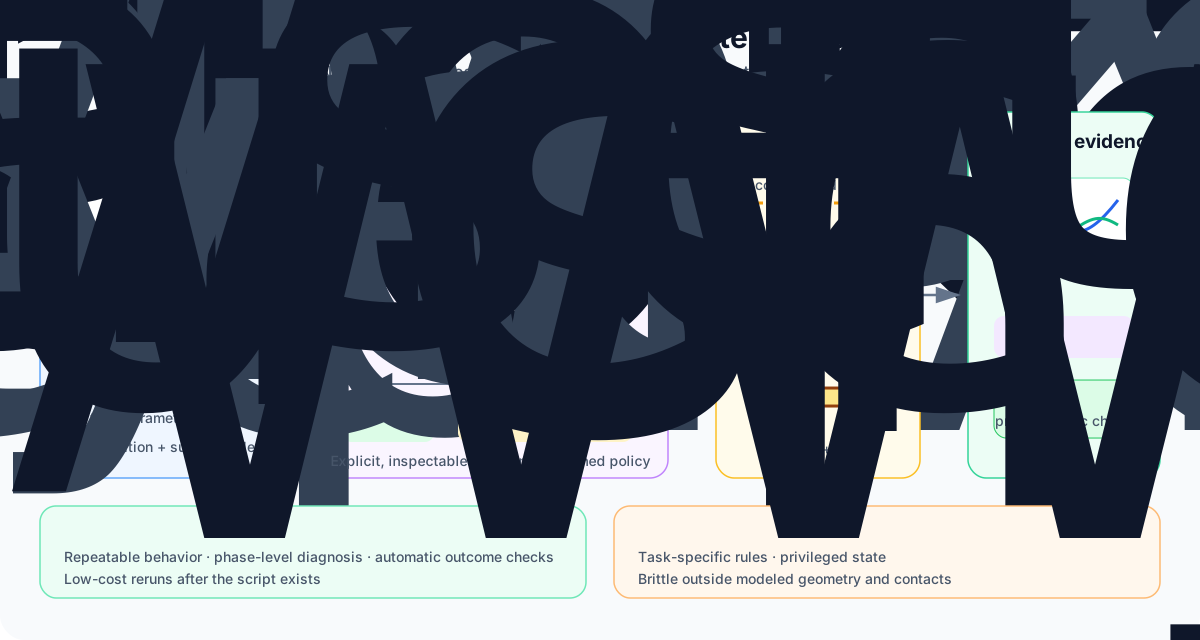
Course-created schematic. The script—not a person issuing each command or a policy learned beforehand—selects the phase, subgoal, primitive, and transition rule. The phase names in the figure are deliberately generic; the scripted-expert article shows one task-specific pick-and-place implementation of this pattern.
Its weakness is the knowledge it assumes. A script may depend on object poses, task-specific grasp profiles, or simulator state unavailable to a deployed policy. Rules that work for a structured pick-and-place task can become brittle under visual ambiguity, deformable objects, unmodeled contact, or long-horizon recovery.
Use a scripted expert when geometry and success are explicit and the goal is a clear, reproducible starting point. That is exactly the L08 setting.
Privileged learned teachers: automate richer behavior
A reinforcement-learning or model-based teacher can use simulator state, rewards, and many parallel trials to acquire behavior that would be awkward to write as a fixed state machine. Once trained, the teacher can generate many rollouts across controlled variations.
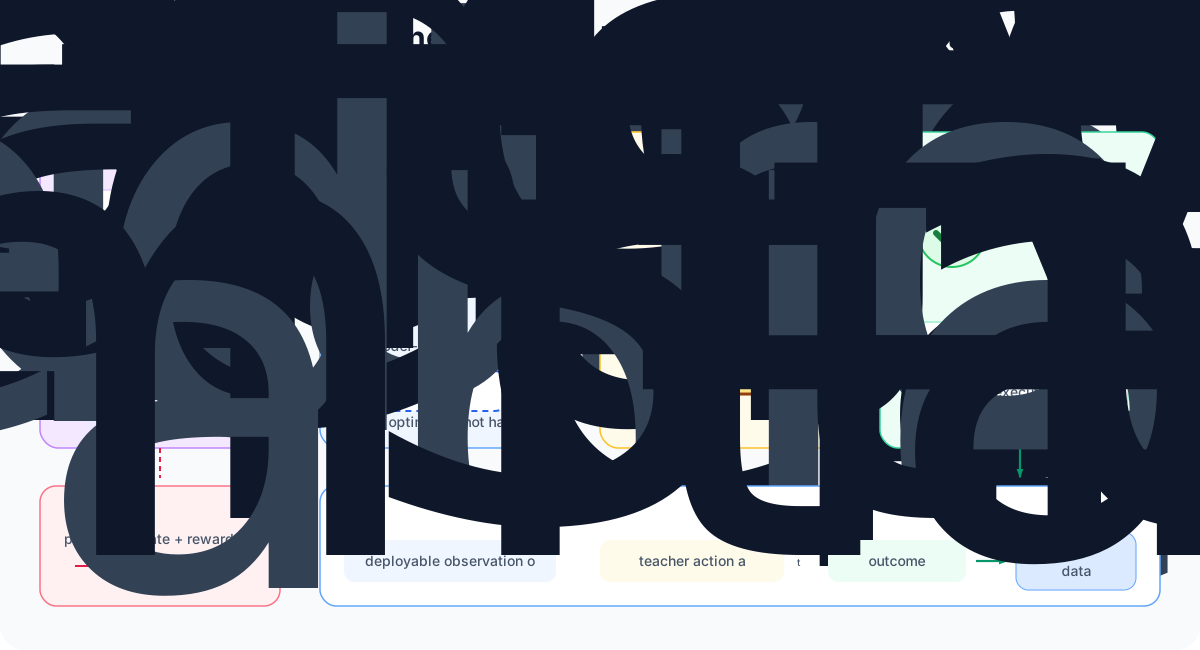
Course-created schematic. “Privileged” means that the teacher may use exact simulator signals unavailable at deployment; “learned” means that optimization, rather than a handwritten phase program, produces its behavior. The exported demonstration pairs executed teacher actions with observations the student can actually receive.
The automation is not free: reward and environment design, training compute, teacher validation, and distribution coverage all become part of acquisition. If the teacher sees privileged state, its action can supervise a student, but the student must still act from the observations available at deployment.
This route is attractive when a fixed script is too brittle but simulation can provide reliable state, objectives, and repeatable trials.
Automatic augmentation: scale trusted seeds
Systems such as MimicGen transform pieces of successful demonstrations into new scene configurations, then execute the generated trajectory in simulation to obtain additional episodes. The important word is execute: a transformed trajectory is only a candidate until contact and task outcome have been checked.
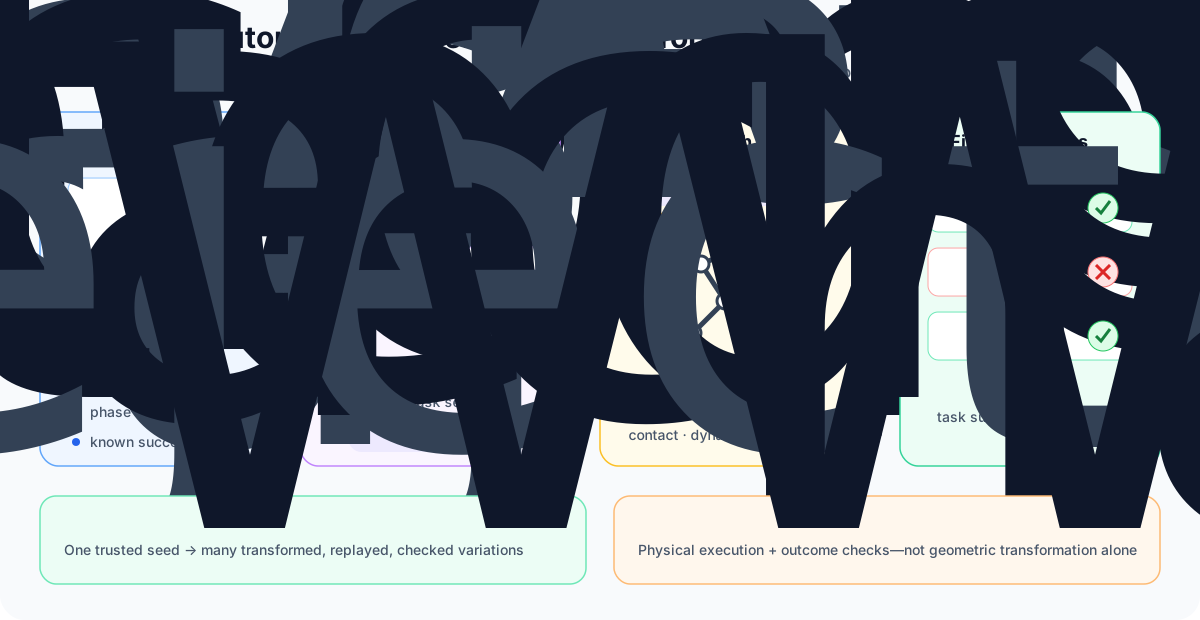
Course-created schematic. Transformation provides scale, while physical replay and outcome filtering preserve validity. Simply copying or warping a trajectory does not make the result a successful demonstration.
Augmentation can expand object-pose and scene coverage without asking a human to demonstrate every combination. Its coverage is still shaped by the seed demonstrations, the transformation assumptions, and the task segments that can be reused. Poor seeds or invalid transformations can scale failure just as efficiently as success.
Use augmentation when a small set of demonstrations already captures the task structure and the environment supports automatic replay and outcome checking.
Human-video transfer: broad behavior, indirect control
Ordinary human video offers enormous diversity in objects, environments, and task semantics. Instrumented first-person capture, as explored by work such as UMI and EgoMimic, narrows the gap by estimating trajectories or using an interface whose motion can be related to a robot end effector.
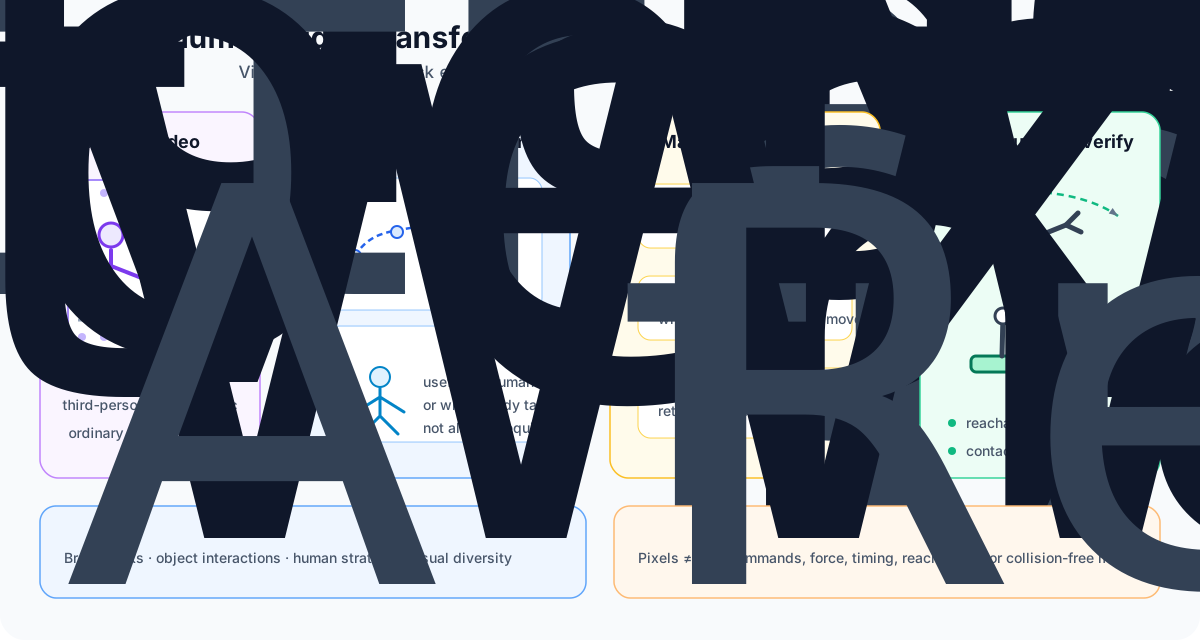
Course-created schematic. A full-body skeleton is one possible intermediate representation, especially for humanoid or whole-body tasks. Tabletop manipulation often relies more directly on hand or wrist motion, object tracks, contact events, and object-relative geometry.
The remaining embodiment gap is fundamental. Pixels do not directly specify a robot's joint command, gripper force, timing, or collision-free path. Viewpoint, scale, occlusion, hand morphology, and contact all affect the conversion. A retargeted motion must therefore be checked for robot reachability and physical execution before it becomes a robot demonstration.
Human video is especially useful for task diversity, representation learning, and high-level motion proposals. Robot-native data remains important for grounding those proposals in an embodiment and control interface.
Advantages, limits, and suitable uses
| Route | Main advantage | Main limitation | Strong fit |
|---|---|---|---|
| Teleoperation | Human strategy and online recovery in the real task | Hardware mapping and human collection cost | Complex, contact-rich real tasks |
| Kinesthetic teaching | Intuitive robot-native trajectories | Hardware and scale constraints | Quick teaching in a bounded workstation |
| Scripted expert | Reproducible, explainable, automatically checkable | Task-specific assumptions and privileged state | Structured simulation tasks |
| Privileged learned teacher | Automated behavior across richer variation | Teacher training, reward design, and transfer gap | Large simulation campaigns |
| Automatic augmentation | Expands coverage from a small seed set | Limited by seed quality and transform validity | Related tasks with replayable success checks |
| Human-video transfer | Broad task and scene diversity | Missing robot actions and physical correspondence | Semantic priors and cross-embodiment research |
Cost and quality are not single numbers. For example, a teleoperated episode may be expensive in human time but valuable because it contains recovery. A scripted episode may be inexpensive to repeat but narrow because every run inherits the same task assumptions. The right comparison depends on what the next learner needs.
The recent direction is a mixture, not a winner
Recent systems increasingly combine acquisition routes instead of treating one as a universal replacement for the others.
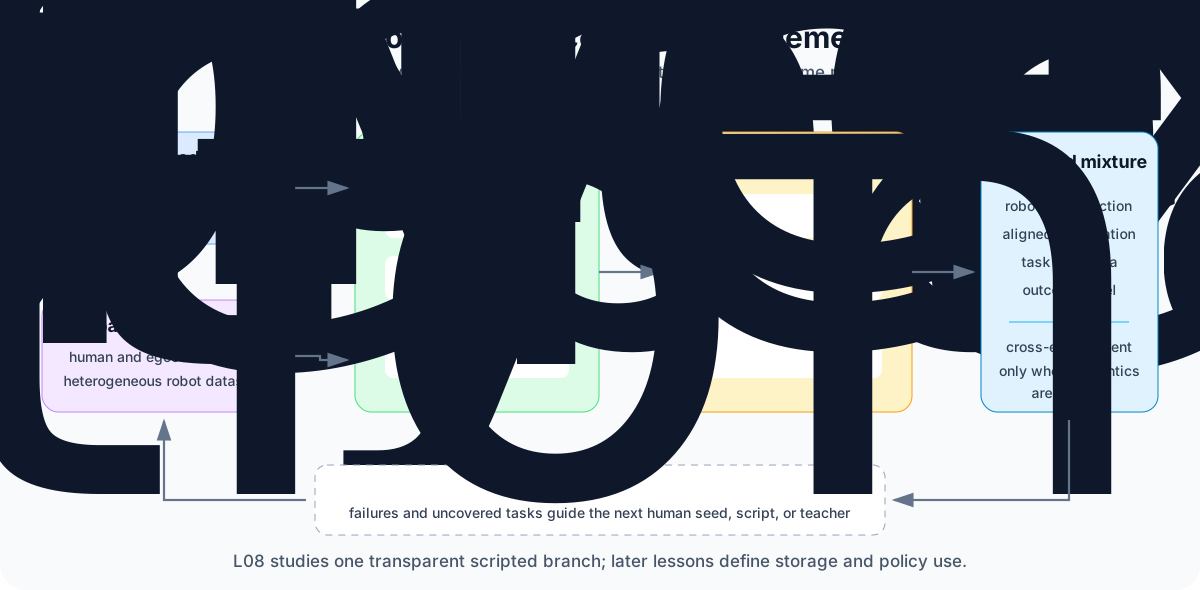
Course-authored schematic based on the cited project and paper directions; it is a conceptual map, not a chronology or performance ranking.
Three developments make the combination especially useful:
- Lower-friction human collection. Low-cost leader devices, mobile or bimanual rigs, portable end-effector interfaces, and immersive control aim to collect useful behavior outside one fixed laboratory setup.
- Scaling and aggregation. Simulation experts and seed-based generation multiply controlled episodes, while projects such as DROID and Open X-Embodiment show why data from many scenes, institutions, tasks, or robot embodiments needs explicit normalization and metadata.
- Broader visual experience. Egocentric and other human video can add task and scene diversity, but robot-native execution and outcome checks are still needed to bridge from visual behavior to controllable action.
A practical hybrid pipeline might collect a small set of careful human demonstrations, expand suitable parts in simulation, reject failures with task checks, and mix the accepted data with broader robot datasets. Human video can inform representation or task understanding without being mislabeled as joint-level supervision.
This lesson stops at acquisition logic. L09 will define the concrete temporal and storage contract. L12 will later explain how a policy consumes a prepared dataset.
Choose with a task-first decision frame
For any proposed source, ask:
- Native signal: does it provide robot actions, measured states, images, object motion, or only a task-level example?
- Environment: is it collected on the target robot, another embodiment, in simulation, or from human activity?
- Scale and coverage: what human time, hardware, simulation, or training cost is paid for each additional task variation?
- Physical validity: is the motion executed on a robot or simulator, or must it still be retargeted and replayed?
- Outcome: can success be labelled automatically, or does it require review or another model?
- Adapter: what calibration, action conversion, synchronization, or filtering is required before recording?
These questions lead directly to the L08 choice. The banana-to-bowl task has known object poses, a configured Franka, available IK and path planning, and a computable containment result. A scripted expert therefore provides a small, transparent starting point whose phases can be inspected before L09 records many episodes.
Checkpoints
- Why is an RGB video not already equivalent to a robot action trajectory?
- Which route offers the clearest automatic success labels in the current simulated task, and what assumptions make that possible?
- Why must an automatically augmented trajectory be replayed rather than accepted solely because its geometric transform succeeded?
- What does cross-embodiment aggregation add, and which differences still require normalization?
- Give one task for which teleoperation is a better starting point than a scripted expert, and explain the trade-off.
Summary
- Demonstration sources differ first in their native signals, not merely in file format.
- Human-guided methods contribute task judgment and recovery but require hardware, calibration, and collection effort.
- Scripted and learned simulation experts scale repeatable behavior but depend on task structure, privileged state, and reliable outcome checks.
- Automatic augmentation scales seeds only after physical replay and success filtering.
- Human video broadens task coverage but needs embodiment mapping and robot execution evidence.
- Current data strategies increasingly combine these strengths. L08 chooses a scripted expert because the current task is structured, observable, and automatically checkable.
Continue to The Scripted Pick-and-Place Expert.
Sources
- Argall et al., “A Survey of Robot Learning from Demonstration”, Robotics and Autonomous Systems, 2009 — foundational terminology and demonstration interfaces.
- Zhao et al., “Learning Fine-Grained Bimanual Manipulation with Low-Cost Hardware”, 2023 — ALOHA and low-cost bimanual teleoperation.
- Wu et al., “GELLO: A General, Low-Cost, and Intuitive Teleoperation Framework for Robot Manipulators”, 2023.
- Fu et al., “Mobile ALOHA: Learning Bimanual Mobile Manipulation with Low-Cost Whole-Body Teleoperation”, 2024.
- Chi et al., “Universal Manipulation Interface: In-The-Wild Robot Teaching Without In-The-Wild Robots”, 2024.
- Khazatsky et al., “DROID: A Large-Scale In-The-Wild Robot Manipulation Dataset”, 2024.
- Open X-Embodiment Collaboration, “Open X-Embodiment: Robotic Learning Datasets and RT-X Models”, 2023.
- Mandlekar et al., “MimicGen: A Data Generation System for Scalable Robot Learning using Human Demonstrations”, 2023.
- Kareer et al., “EgoMimic: Scaling Imitation Learning via Egocentric Video”, 2024.