
L10 · Dataset Anatomy and Imitation Learning 101
Course status: the bilingual lectures and notebooks are complete. The English and Chinese notebooks both passed the CPU-only readback path against the same two-episode dataset produced by L09, so L10 is
cpu-verified. The lab opens local data, decodes a few stored frames, and constructs training targets without initializing Genesis, allocating a model, or starting training. No example dataset is downloaded implicitly. If the local input is missing, record it in L09 or pointRG101_L10_DATASET_ROOTat a compatible copy. GPU is not required for this lab;gpu-recommendedremains the hardware label for its place in the broader data-to-policy workflow.
Where this lesson fits
L09 produced persistent, aligned episodes from the scripted expert. A readable dataset is necessary, but it is not yet a training argument. Before choosing a policy, we need to know what the files mean, what one returned sample contains, where episode boundaries live, and how a future-action target stays inside one episode.
L09: aligned frames + committed episodes + H.264/PyAV persistence
  ↓
L10: dataset anatomy + decoded samples + statistics + episode split
     + behavior-cloning targets + action chunks
  ↓
L11: controlled changes to the data distribution
  ↓
L12: ACT / SmolVLA training and checkpoint reload
  ↓
L13: closed-loop task evaluation
L10's output is not a trained model. It is an auditable dataset report, a non-overlapping set of train/eval episode IDs, one real behavior-cloning sample, and one future-action chunk with an explicit boundary mask.
Before starting, you should be able to:
- explain why L09 records
(observation_t, action_t)before advancing the simulator; - distinguish a commanded nine-dimensional joint target from measured robot state;
- identify the fixed
worldview and eye-in-handwristview; and - locate the exact dataset directory created by L09.
A focused 90-minute route
| Time | Topic | Learner output |
|---|---|---|
| 0–10 min | Input identity and evidence boundary | Resolve one exact local dataset and state what L10 can prove |
| 10–25 min | Metadata, tabular data, and media | Explain the three storage layers and locate logical episode boundaries |
| 25–40 min | Raw rows and decoded samples | Read one multimodal sample and distinguish HWC metadata from CHW tensors |
| 40–52 min | Statistics, units, and normalization | Diagnose channel ranges without treating statistics as proof of coverage |
| 52–64 min | Episode-level train/eval split | Produce disjoint episode IDs and recognize trajectory leakage |
| 64–78 min | Behavior cloning and action chunks | Construct a same-episode (H, 9) target with a padding mask |
| 78–86 min | ACT and SmolVLA data contracts | Explain task conditioning and the camera-key adapter |
| 86–90 min | Diagnostics and one-variable exercise | Separate data checks, offline loss, and closed-loop success |
Learning objectives
By the end of L10, you should be able to:
- explain how recorded robot demonstrations are organized into a dataset for imitation learning;
- inspect a real dataset and summarize what has been verified—and what remains unknown—before training;
- explain how behavior cloning turns expert demonstrations into learning targets while preserving trajectory structure; and
- distinguish offline action-prediction quality from closed-loop task success.
Start with the evidence boundary
The word "dataset" can hide several distinct claims. L10 keeps them separate:
| Evidence | What it establishes | What it does not establish |
|---|---|---|
| Metadata opens | schema, counts, path templates, task and episode records are readable | Parquet rows or videos are present and decodable |
| Numeric rows open | state, action, timestamps, and indices can be read | the camera streams match those rows |
| Two videos decode | selected world and wrist frames are visible | every frame is correct or the views are sufficient for learning |
| Statistics are finite | the stored aggregates can support diagnostics and preprocessing | broad coverage, absence of bias, or generalization |
| Train/eval IDs are disjoint | the split does not share whole episodes | enough data for stable model selection |
| One action chunk is valid | the reader respects its shape and episode boundary | a policy can learn or execute the chunk successfully |
The normal path therefore checks metadata before paying video-decoding cost, then samples visual evidence instead of decoding the whole dataset merely to plot numeric features.
A robot dataset is not a bag of independent images
An image classifier often treats examples as approximately interchangeable. Here, neighboring rows belong to an ordered physical rollout:
episode e:
  (observation_0, action_0),
  (observation_1, action_1),
  ...,
  (observation_T-1, action_T-1)
Each observation combines measured robot state, two synchronized camera views, and a task context. The action is the expert command paired with that decision time. Adjacent frames share scene geometry, object placement, camera content, and most of their trajectory history. Treating them as independent rows would lose the structure needed for honest splitting and future-action targets.
Three layers of one LeRobot dataset
The on-disk dataset is easiest to reason about as three related layers:
| Layer | Typical contents | Question it answers |
|---|---|---|
| Metadata | info.json, stats.json, task rows, episode rows, path templates | What is this dataset, which fields exist, and where are its episodes? |
| Tabular data | Parquet columns for state, action, timestamps, and indices | What numerical values belong to each decision time? |
| Media | MP4 files for world and wrist | What did each camera see at that time? |
An abbreviated layout is:
<dataset-root>/
├── meta/
│   ├── info.json
│   ├── stats.json
│   ├── tasks.parquet
│   └── episodes/.../*.parquet
├── data/.../*.parquet
└── videos/
    ├── observation.images.world/.../*.mp4
    └── observation.images.wrist/.../*.mp4
The ellipses matter. LeRobot may shard many logical episodes into storage chunks. A Parquet or MP4 file chunk is a storage unit, while an episode is a task trajectory with index and timestamp boundaries. Never infer episode identity from filenames alone; use episode metadata and the row's episode_index.
LeRobotDatasetMetadata can inspect the first layer without decoding video. LeRobotDataset later joins a tabular row, the task lookup, and requested video timestamps into a sample.
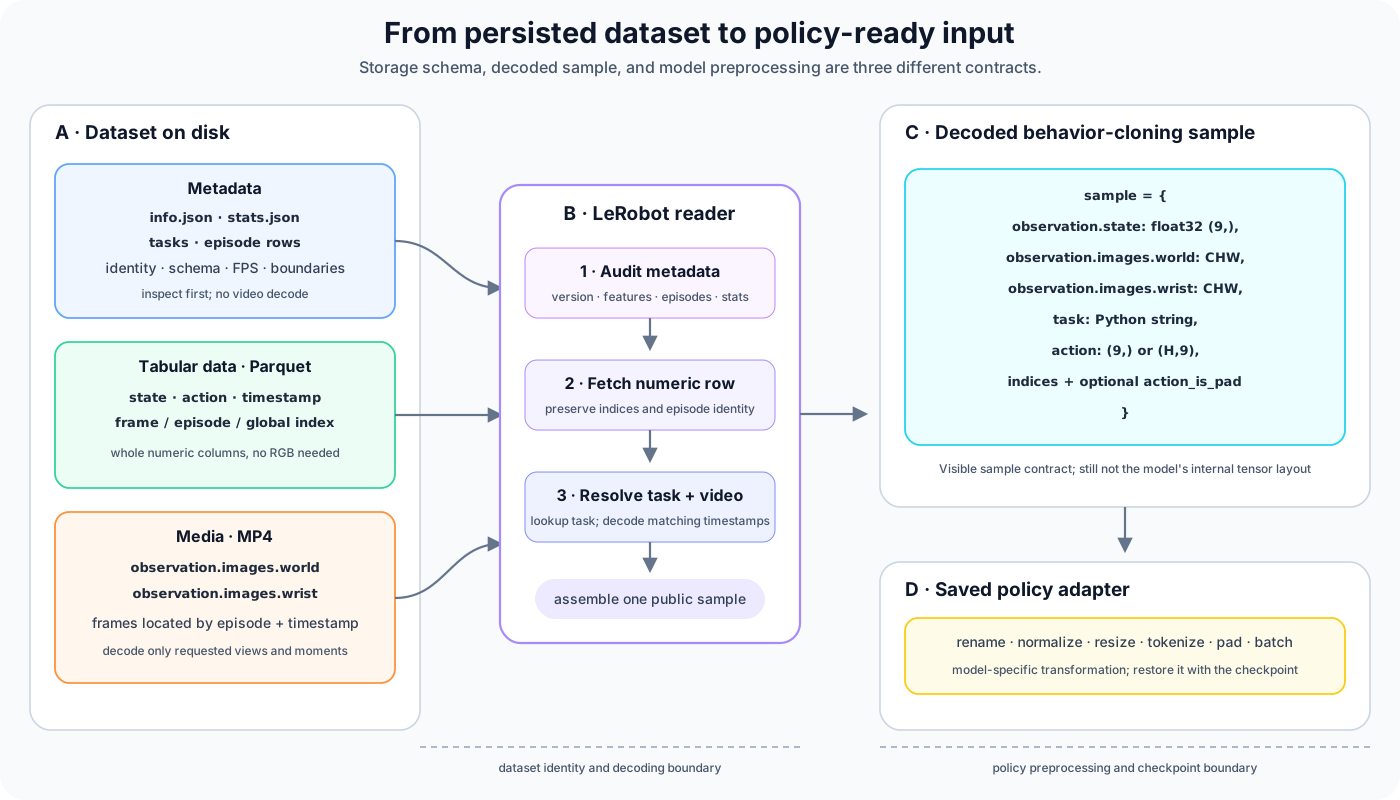
Course-created diagram. It separates persistent storage, the public decoded sample, and model-specific preprocessing rather than treating them as one representation.
Identity and schema come before values
Resolve one exact local root
The logical repository ID and local filesystem root are different pieces of identity. local/l09_banana_demo can describe the dataset while DATASETS_DIR / "l09_banana_demo" selects a concrete local copy.
The companion notebook resolves its input in this order:
RG101_L10_DATASET_ROOT, when explicitly set;- otherwise
DATASETS_DIR / "l09_banana_demo"; - no recursive search for another dataset; and
- no implicit Hub download or fabricated fallback dataset.
It checks meta/info.json before constructing the LeRobot reader because the library itself may try to fetch missing local content. Failing early makes a mistyped path distinguishable from an unavailable network artifact.
After that explicit preflight, metadata-only inspection is small and direct:
from lerobot.datasets.lerobot_dataset import LeRobotDatasetMetadata

metadata = LeRobotDatasetMetadata(repo_id, root=dataset_root)
print(metadata.total_episodes, metadata.total_frames, metadata.fps)
print(metadata.features)
The first report should include the resolved root, logical repo ID, codebase_version, FPS, episode/frame/task counts, and feature keys. A result without this identity is hard to reproduce and easy to attribute to the wrong dataset.
Four user features, five automatic fields, and task lookup
L09 declared four user features:
| Key | Stored schema | Course meaning |
|---|---|---|
observation.state | float32, (9,) | measured positions for seven arm and two finger joints |
action | float32, (9,) | commanded joint-position targets in the same name order |
observation.images.world | video, (H, W, 3) | fixed global view |
observation.images.wrist | video, (H, W, 3) | moving eye-in-hand view |
LeRobot owns five bookkeeping fields:
| Key | Meaning |
|---|---|
timestamp | logical time within the episode |
frame_index | zero-based position within that episode |
episode_index | logical episode identity |
index | global row identity across the dataset |
task_index | integer reference into the task table |
The writer receives task text alongside each frame, but the tabular row stores task_index. On read, LeRobot looks up that integer in meta/tasks.parquet and adds a Python task string to the sample. task is therefore part of the learner-visible sample without being a fifth user-declared tensor feature.
For this course, state and action names must match the shared robo_genesis.record_dataset.JOINT_NAMES order. Shape (9,) alone is not enough: swapping two joints produces a shape-correct but semantically wrong training target.
Raw row, decoded sample, and policy input are different
The same camera observation has at least three useful representations:
| Boundary | Example representation | Intended use |
|---|---|---|
| Metadata | video shape (120, 160, 3) in HWC order | describe stored frame geometry |
| Decoded sample | torch.float32 tensor (3, 120, 160) in CHW order | inspect or pass through the data pipeline |
| Policy adapter | renamed/resized/normalized/batched tensor | satisfy one policy's internal contract |
HWC and CHW are not contradictory shapes; they describe different layers. For display, a decoded CHW tensor can be moved to CPU and transposed back to HWC. That display conversion is not a substitute for the policy's saved preprocessor.
The distinction also determines how to read efficiently:
- use the Parquet-backed table for whole-episode state/action curves;
- use
ds[i]only for the samples whose video frames you need; - use
with_format(None)before constructing NumPy arrays from Hugging Face columns; and - if a returned value is already a tensor, use
value.detach().cpu().numpy()rather than assuming it lives on the CPU.
Calling ds[i] across every frame just to collect state vectors would also decode both videos at every index. The result may be numerically correct, but it hides unnecessary work and confuses tabular access with multimodal sample assembly.
Use the full reader only when the task lookup or images are required:
from lerobot.datasets.lerobot_dataset import LeRobotDataset

dataset = LeRobotDataset(
    repo_id,
    root=dataset_root,
    episodes=[0],
    video_backend="pyav",
)
sample = dataset[0]  # joins the row, task text, and requested camera frames
Read both views at matched moments
The camera names encode physical roles:
worldis fixed, so it preserves global robot–object–bowl layout;wristmoves with the hand, so it provides local evidence near approach, grasp, lift, and release.
The lab decodes start, middle, and end samples from one episode and presents a 2×3 montage. Each column must use the same episode, frame, and timestamp for both cameras. This checks synchronization and view identity better than one undated screenshot.
Visible progress across the montage proves that those stored frames can be read and interpreted. It does not prove that a policy will attend to the right view, that either camera covers every failure mode, or that the episode is sufficient training data.
Read the actual codec and backend metadata
The verified L09 dataset uses H.264 video and is reopened through PyAV. Do not copy an older slide's AV1 claim or confuse a codec with the decoder backend. Inspect the current dataset, then pass video_backend="pyav" on this course's explicit read path.
Statistics connect physical units to model coordinates
meta/stats.json stores per-feature aggregates. For each state/action channel, the current dataset format can expose min, max, mean, std, count, and quantiles q01, q10, q50, q90, and q99.
The shapes are aggregation shapes, not sample shapes:
| Feature | Sample shape | Typical statistics shape | Interpretation |
|---|---|---|---|
| state or action | (9,) | (9,) | one value per joint channel |
| RGB image | (3,H,W) after decode | (3,1,1) | per-channel value that can broadcast spatially |
count | not a feature value | aggregate sample count | how much data entered the aggregate |
The first seven state/action channels are revolute arm joints measured in radians. The last two are prismatic finger joints measured in metres. Plotting all nine on one unlabeled axis can make a physically important finger change look negligible or imply that incomparable values share a unit. The lab keeps arm and finger panels separate.
Use statistics for diagnosis before training
Statistics can reveal questions worth investigating:
- non-finite values indicate a corrupt numerical path;
- an implausible minimum or maximum suggests a unit, order, or recording error;
- near-zero standard deviation can reveal a stationary channel or inadequate task coverage;
- a large gap between an extreme value and
q01/q99suggests an outlier; and - counts that disagree with the intended dataset scope indicate that the aggregate may describe different data than expected.
They do not prove diversity, lack of bias, task relevance, or generalization. A perfectly finite dataset can contain two nearly identical trajectories.
Normalization is a reversible interface
Different units create different numerical scales. A common teaching example is per-channel standardization:
x_norm = (x - mean) / max(std, epsilon)
x      = x_norm * std + mean
The forward transform keeps arbitrary physical units from silently setting the relative scale seen by the optimizer. The inverse transform is equally important: a predicted action must return to the joint-target coordinates that the controller expects.
The notebook applies this equation to one arm channel only as a sanity check. It does not implement a second production preprocessor. In LeRobot 0.6.0, the policy configuration chooses the normalization mode, dataset statistics are passed into the policy processor, and the output processor unnormalizes an action. Training, checkpoint reload, and evaluation must preserve that same processor state.
Avoid dividing blindly by a tiny standard deviation
A constant or almost constant channel makes a naïve z-score unstable. Inspect the channel and use the policy's formal processor behavior. An epsilon makes a classroom calculation finite; it does not repair missing motion or bad data.
Split whole episodes, not neighboring frames
Suppose one trajectory contributes 100 neighboring frames. A random 80/20 row split can put frame 40 in training and frame 41 in evaluation. Those samples share almost the same scene, object pose, camera image, and history. A low held-out loss then partly measures near-duplicate interpolation rather than performance on an independent trajectory. This is trajectory leakage.
L10 therefore splits complete episode IDs. In the pinned LeRobot 0.6.0 factory, the relevant procedure is:
selected episode IDs
  → group episodes by task
  → within each task, hold out the last ceil(n_task × eval_split) episodes
  → construct train and eval readers with the same temporal-window contract
This rule is deterministic, but deterministic does not automatically mean representative. If collection order follows seed, object pose, lighting, or a domain-randomization schedule, "last episodes" can select a systematically different group. Freeze the split rule and the collection conditions before a formal experiment, and record the exact episode IDs.
The two-episode L09 dataset gives one train and one eval episode for its single task under a nonzero split such as 20%. That is useful for demonstrating the mechanics, but it is far too small for a stable model-selection or generalization claim. A task also needs enough episodes to leave training data after its holdout.
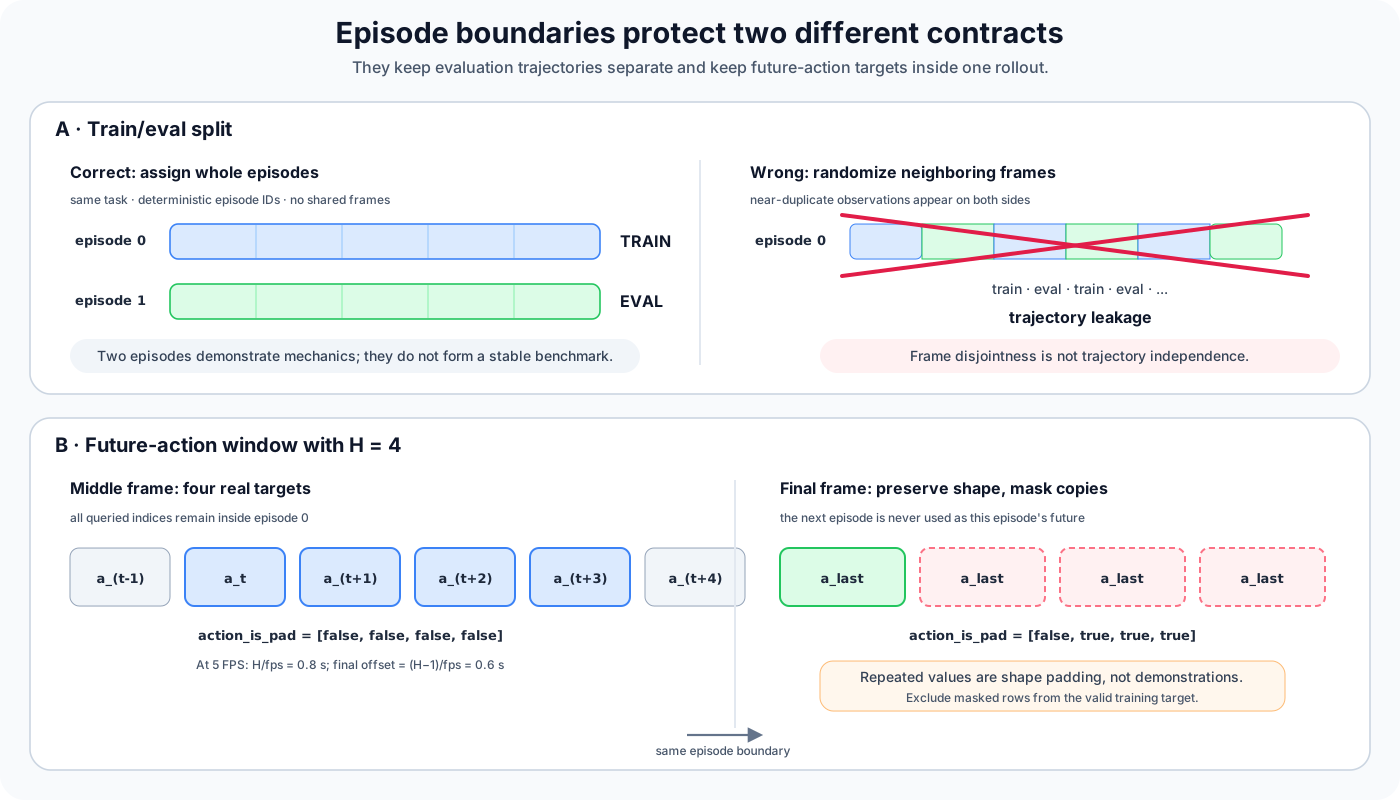
Course-created diagram. The upper half protects evaluation identity; the lower half protects temporal targets at the end of an episode.
Behavior cloning turns aligned rows into supervision
Behavior cloning (BC) treats expert demonstrations as supervised examples. For the single-step case:
observation_t = {state_t, world_t, wrist_t, optional task_t}
expert target = action_t
policy_theta(observation_t) ≈ action_t
In compact notation:
min_theta  E_(observation_t, action_t)∼D
           [ loss(policy_theta(observation_t), action_t) ]
L10 intentionally leaves loss abstract. ACT and SmolVLA use different model structures and objectives, which L12 explains. The shared requirement is the data meaning: observations and expert targets must be aligned, finite, ordered, and transformed consistently.
Although optimization looks like supervised learning, deployment is sequential. The expert generated the states in the dataset, while a deployed policy generates its own future states through its actions. A small mistake can move the robot to observations that were rare or absent in the demonstrations, and later errors can compound. This distribution shift is why training loss or open-loop prediction cannot replace closed-loop evaluation.
Offline and closed-loop evaluation measure different things
Offline evaluation compares policy actions against held-out expert actions and reports metrics such as behavior-cloning action loss. It does not execute the predicted actions in the simulator, so the policy cannot affect future observations or demonstrate whether it can recover from its own mistakes.
Closed-loop evaluation executes the policy step by step in Genesis. Each predicted action changes the robot state and the next observation, so errors can accumulate and the policy may encounter states outside the expert demonstrations. The policy then has an opportunity to react and potentially recover. The final result is measured using a task-level success criterion, such as whether the object was placed successfully in the target after release and settling.
Therefore:
held-out behavior-cloning loss ≠ closed-loop task success
offline evaluation             ≠ closed-loop evaluation
A reliable evaluation protocol first splits data by complete episode or trajectory to prevent train/eval leakage, then uses closed-loop rollouts to measure actual task performance.
Extend one target into an action chunk
Many robot policies predict a sequence of future actions at once. For a chunk size H, L10 asks the reader for offsets aligned to dataset FPS:
H = 4
delta_timestamps = {
    "action": [i / fps for i in range(H)],
}
At frame t, the action value changes from shape (9,) to (H, 9):
[action_t, action_t+1, action_t+2, action_t+3]At 5 FPS, four samples represent a nominal four-sample horizon of H / fps = 0.8 s; the final sampled target is offset by (H - 1) / fps = 0.6 s from the current frame. These are related but different quantities.
A chunk must stop at its episode boundary
Near the final frame, future indices do not exist. The LeRobot reader clamps them to the episode boundary so the tensor keeps a fixed shape, and returns action_is_pad:
last-frame action rows: [a_last, a_last, a_last, a_last]
action_is_pad:          [ false,   true,   true,   true]
The copied values are padding, not three additional demonstrations. A training loss must ignore the marked rows. Crossing into the next episode would be worse: it would teach a physically impossible future that jumps through an environment reset.
The middle of an episode should produce (4,9) with four false mask entries; the final frame should produce the same shape with only its first row valid. Those two probes test both the normal and boundary cases.
chunk_size defines the training/prediction target length. How many predicted actions are executed before replanning is n_action_steps, a policy and closed-loop trade-off introduced in L12 rather than decided here.
One raw dataset, two policy-facing contracts
ACT and SmolVLA consume the same course dataset, but their preprocessors do not have identical internal contracts:
| Question | ACT path in this course | SmolVLA path in this course |
|---|---|---|
| Raw observations | state, world, and wrist | state, world, wrist, and task text |
| Training target | action chunk from the same episode | action chunk from the same episode |
| Raw camera-key handling | new ACT configuration adapts to dataset keys | preset renames keys expected by the pretrained base |
| Rename | none for this from-configuration path | world → camera1, wrist → camera2 |
| L10 responsibility | validate fields, shapes, task availability, chunk, and adapter map | same |
| Deferred to L12 | CVAE, Transformer, KL/reconstruction loss, optimization, checkpoint | VLM/action expert, flow matching, fine-tuning, checkpoint |
The project preset expresses the SmolVLA mapping as:
{
  "observation.images.world": "observation.images.camera1",
  "observation.images.wrist": "observation.images.camera2"
}
This is a schema adapter, not a request to rename files on disk. The training pipeline saves the adapter with the preprocessor, and evaluation continues to provide meaningful raw keys world and wrist. Inventing a new mapping only at evaluation would break the training/checkpoint contract.
Neither a common schema nor an adapter makes all policies interchangeable. Model-specific resizing, normalization, language tokenization, padding, and batching remain real and must travel with the checkpoint.
Companion lab: produce an auditable read report
Reuse the environment that completed L09; it already contains the required reader stack. The repository's data extra declares LeRobot, PyArrow, and the video dependencies, but installation still follows the platform-specific setup in the project README and compatibility record. In particular, do not run a generic PyPI sync over the verified AMD environment because it can replace the pinned ROCm PyTorch wheels.
The notebook follows eight checks, each with a visible output:
- Resolve input: print the exact local root and repo ID; stop with direct recovery instructions if required files are absent.
- Audit metadata: report version, FPS, counts, tasks, feature names, joint names, episode bounds, path templates, and actual video information.
- Read one episode: compare a raw numeric row with a decoded sample, then decode the start/middle/end
worldandwristmontage. - Inspect numbers: read complete state/action columns without video, separate arm radians from finger metres, and compare them with statistics.
- Plan the split: list train/eval episode IDs, task, lengths, and frame totals; assert disjointness and full coverage.
- Construct
H=4: inspect a middle and final action chunk and visualizeaction_is_pad. - Compare consumers: read the project's ACT and SmolVLA preset contracts without creating either model.
- Summarize evidence: require every data check to pass while explicitly reporting that no training, checkpoint, Genesis rollout, or success rate was produced.
The expected L09 input has at least two non-empty episodes, one task, 5 FPS, nine-dimensional state/action features, and decodable world and wrist videos. Actual episode lengths and numerical ranges are observations from your copy, not constants to copy from this page.
Diagnose failures by layer
- Dataset not found: print the exact resolved root and check
meta/info.json. Run L09 or setRG101_L10_DATASET_ROOT; do not scan random directories or silently download another dataset. - Version mismatch: compare the stored
codebase_versionwith the pinned LeRobot 0.6.0 reader. Do not edit metadata merely to suppress a compatibility error. - Metadata opens but rows fail: inspect the data path template, episode records, and referenced Parquet files. Metadata-only success is not a full dataset read.
- Rows open but video fails: check both referenced MP4 paths, codec information, and the explicit PyAV backend.
- Images look transposed or dark: distinguish stored HWC from decoded CHW, then inspect dtype and value range before transposing or scaling.
- A numeric plot is unexpectedly slow: verify that it reads table columns rather than calling
ds[i]and decoding two videos at every frame. - Statistics look shape-incompatible: expect vector aggregates
(D,)and RGB aggregates(C,1,1), not the full sample shape. - Eval looks implausibly good: look for random frame splitting, neighboring trajectory leakage, and collection-order correlation before interpreting a loss.
- The final chunk repeats values: inspect
action_is_pad. Boundary copies must be masked rather than treated as future expert targets. - SmolVLA cannot find cameras: compare raw
world/wristkeys with the saved or presetcamera1/camera2rename; do not mutate the dataset schema.
Checkpoints and one-variable exercise
Concept checkpoints
- Why can one Parquet or MP4 chunk contain data from more than one episode?
- Why are HWC in metadata and CHW from
ds[i]both correct? - Why should a whole-episode state/action plot avoid indexing every decoded sample?
- Why should arm and finger curves not share an unlabeled numerical axis?
- How does a random frame split leak trajectory information?
- Why is a repeated boundary action invalid as a future target unless its mask is respected?
- Why does this SmolVLA path need a camera-key adapter while the current ACT configuration does not?
- Why do a decodable sample, finite action values, and a low offline loss all fall short of closed-loop success?
One-variable exercise: change only H
Keep the dataset root, selected episode, FPS, feature schema, and split fixed. Evaluate H = 2, 4, and 8.
Before running, predict for each value:
- the action tensor shape;
H / fps, the nominal number-of-samples horizon;(H - 1) / fps, the final target offset; and- which positions are padded when the current row is the episode's last frame.
Then construct each reader window, compare the actual masks with your prediction, and count only unmasked targets. This exercise changes data-window semantics; it does not train three policies or predict which horizon will have the best task success.
Evidence boundary and connection to L11/L12
Completing L10 can establish that one local dataset has coherent identity, schema, numerical values, representative decoded frames, statistics, episode boundaries, split IDs, and action-window behavior. It cannot establish:
- enough demonstrations or domain coverage for learning;
- a benefit from domain randomization;
- finite training loss, convergence, or checkpoint quality;
- open-loop policy accuracy; or
- closed-loop grasp success or sim-to-real transfer.
L11 next asks how appearance, object pose, camera, and dynamics variation change the data distribution without destroying task meaning. L12 then consumes the dataset contract here to train ACT and SmolVLA and reload their saved processors. L13 finally places a loaded policy back in the control loop.
Summary
- A LeRobot dataset has metadata, tabular, and media layers; a storage file chunk is not an episode.
- Metadata describes stored video as HWC, while a decoded sample normally exposes CHW tensors. Policy preprocessing is a third representation.
worldandwristprovide synchronized global and local evidence; inspect matched moments from the actual input dataset.- Per-channel statistics support diagnostics and reversible normalization, but do not prove coverage or generalization.
- Split complete episodes to avoid leaking near-duplicate trajectory frames.
- Behavior cloning maps aligned observations to expert targets, but deployment introduces policy-generated states and possible compounding error.
- Action chunks use FPS-aligned offsets, fixed shapes, and padding masks so a target never crosses an episode reset.
- ACT and SmolVLA share the raw dataset while retaining different task, camera-key, and preprocessing contracts.
Sources
- LeRobot 0.6.0 dataset metadata source — version-pinned loading of
info.json, statistics, tasks, episodes, and file-path resolution. - LeRobot 0.6.0 dataset reader source — version-pinned Parquet access, task lookup, on-demand video decoding, temporal queries, boundary clamping, and padding masks.
- LeRobot 0.6.0 dataset factory source — action-offset resolution and task-grouped episode-level train/eval split.
- LeRobot 0.6.0 normalization processor source and ACT processor source — policy-facing normalization and action unnormalization behavior.
- A Reduction of Imitation Learning and Structured Prediction to No-Regret Online Learning — formal treatment of the sequential distribution-shift and compounding-error problem that motivates closed-loop evaluation beyond supervised BC loss.
- Learning Fine-Grained Bimanual Manipulation with Low-Cost Hardware — the ACT paper and source for action chunking.
- SmolVLA: A Vision-Language-Action Model for Affordable and Efficient Robotics — the SmolVLA architecture and language-conditioned policy context used for the data-contract comparison.
- RoboGenesis 101 recorder, training wrapper, and compatibility record — the current nine-joint schema, policy presets, and verified runtime boundary used by this course.