
L13 · Closed-Loop Evaluation and Capstone
Course status:
gpu-verified. The core single-checkpoint closed-loop path has passed bilingual diagnostics, matched Reference/shifted rollouts on a reference R9700 with AMD+EGL, and H.264 video and report evidence audit. This status verifies the evaluation and evidence contract in the recorded environment; it does not establish a stable success rate, OOD robustness, sim-to-real transfer, or the optional multi-checkpoint sweep.
Where this lesson fits
L08 defined the banana-to-bowl task and its geometric success predicate. L09 recorded aligned demonstrations, L10 made their schema inspectable, and L11 added domain provenance. L12 then produced reloadable ACT and SmolVLA checkpoints.
L13 closes the loop:
environment → demonstrations → dataset → policy checkpoint
     ↑                                      ↓
     └──── live observation ← action ← policy rollout
The checkpoint is no longer asked for one action on a recorded sample. It sees the current simulator state, produces an action, changes the world, and must act again on the consequences. L13 measures that interaction under a protocol that was fixed before the result was known.
Before starting, you should be able to:
- explain the L08 containment predicate for placing an object in the bowl;
- identify the two camera features, 9-D robot state, 9-D action, task text, and FPS in a course LeRobot dataset;
- read the domain-randomization provenance introduced in L11;
- audit a numeric ACT or SmolVLA checkpoint together with its saved processors; and
- distinguish a pipeline-only checkpoint from a policy that has received a meaningful training budget.
A focused 120-minute route
| Time | Topic | Learner output |
|---|---|---|
| 0–15 min | Feedback and evidence levels | Explain why a live rollout tests behavior that offline probes cannot expose |
| 15–35 min | Freeze the evaluation protocol | Write a protocol manifest before seeing outcomes |
| 35–50 min | Predicate, dwell, timeout, and divergence | Convert a predicate trace into one episode result |
| 50–65 min | Reference, in-support, shifted, and OOD conditions | Name one comparison relative to training provenance |
| 65–80 min | Counts, Wilson intervals, and matched seeds | Interpret a small result without overstating precision |
| 80–95 min | Capstone preflight | Audit environment, dataset, checkpoint, cameras, action, and output paths |
| 95–110 min | Five-episode reference smoke | Produce live rollout videos and a structured result |
| 110–120 min | Failure evidence and report design | Draft a scoped conclusion and the held-out follow-up |
The first model download, a long L12 training run, and a large checkpoint sweep do not fit inside this 120-minute route. Prepare model content before class. The second five-episode condition can continue as the Capstone submission when the machine cannot finish it during the synchronous session.
Learning objectives
By the end of L13, you should be able to:
- explain how closed-loop feedback makes policy behavior, environment state, and future observations interact, and why error accumulation and recovery therefore become part of policy capability;
- design a fair, reproducible task-level evaluation whose results have a clear, comparable meaning across policies or evaluation conditions;
- combine quantitative and qualitative evidence to judge uncertainty, generalization boundaries, major failure modes, and the scope of a conclusion; and
- connect environment, data, policy learning, and closed-loop evaluation into one robot-learning workflow, then propose an evidence-based next improvement.
What changes when the loop closes?
Three evidence levels answer different questions
| Evidence | Information flow | What it can establish | What it cannot establish |
|---|---|---|---|
| Training loss | recorded observation and action → optimizer | the configured objective is computable on sampled training batches | that the policy can control a changing environment |
| Action replay or one-sample inference | recorded action → simulator, or recorded observation → one prediction | data decode, feature compatibility, and output shape/finiteness | recovery after the policy changes its own next observation |
| Closed-loop rollout | live observation → policy → action → environment → next live observation | task behavior under one declared rollout protocol | performance in untested conditions or on a physical robot |
An open-loop result can be valuable. L09 replay can reveal a broken recorder, and L12 single-sample inference can reveal a missing processor. The problem is not that those checks are weak; it is assigning them a stronger claim than they support.
Feedback exposes compounding error and recovery
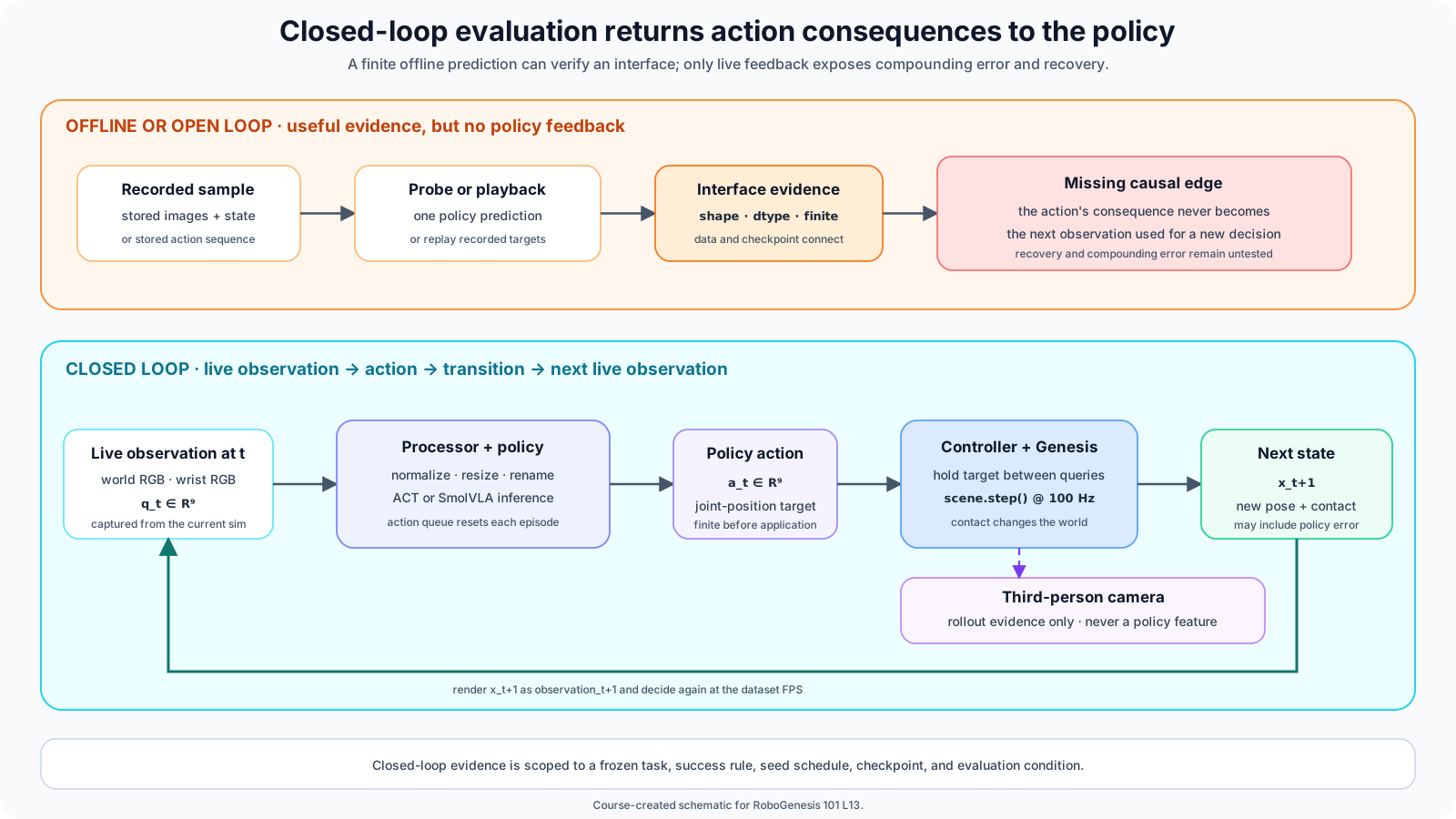
Course-created diagram. The lower lane is the actual causal loop; the upper lane shows why a recorded sample or action replay does not test recovery. The third-person camera is evidence-only.
Suppose a gripper approaches the banana two centimeters off center. In an offline sample, the model output can still look numerically plausible. In a live rollout, that action moves the wrist camera, changes contact, and may rotate or push the banana. The next decision is now conditioned on a state the expert may rarely have visited. A capable policy must either recover or fail visibly.
Action chunking does not remove feedback. ACT and SmolVLA may queue several predicted targets, but the runtime eventually requests a new chunk from a new observation. The evaluation protocol must record that execution horizon. It must also call policy.reset() before every episode so an old action queue or recurrent state cannot leak into the next trial.
The course rollout has two time scales
The policy is queried at the dataset FPS. Between queries, the current 9-D joint-position target is held while Genesis advances at the course control rate:
policy query rate = dataset FPS
simulation/control rate = 100 Hz
average simulation steps per query = 100 / dataset FPS
For rates such as 30 FPS, the ratio is fractional. The evaluator accumulates the fraction instead of rounding every query independently, so the long-run ratio remains correct. A policy FPS above the control rate is an invalid course protocol: one simulator step cannot contain more than one policy decision in this execution design.
The command is a joint-position target, not torque, Cartesian velocity, or an end-effector pose. A finite vector with the wrong semantics can be more dangerous than an obvious shape error, which is why data and checkpoint identity travel with the action.
Freeze the protocol before inspecting outcomes
An evaluation number is shorthand for a much larger statement:
This checkpoint attempted this task, in these environments, with this observation/action/timing contract and this success rule, over these seeded episodes.
Changing any bold part changes the experiment. A reproducible run therefore starts with a protocol manifest, not a percentage.
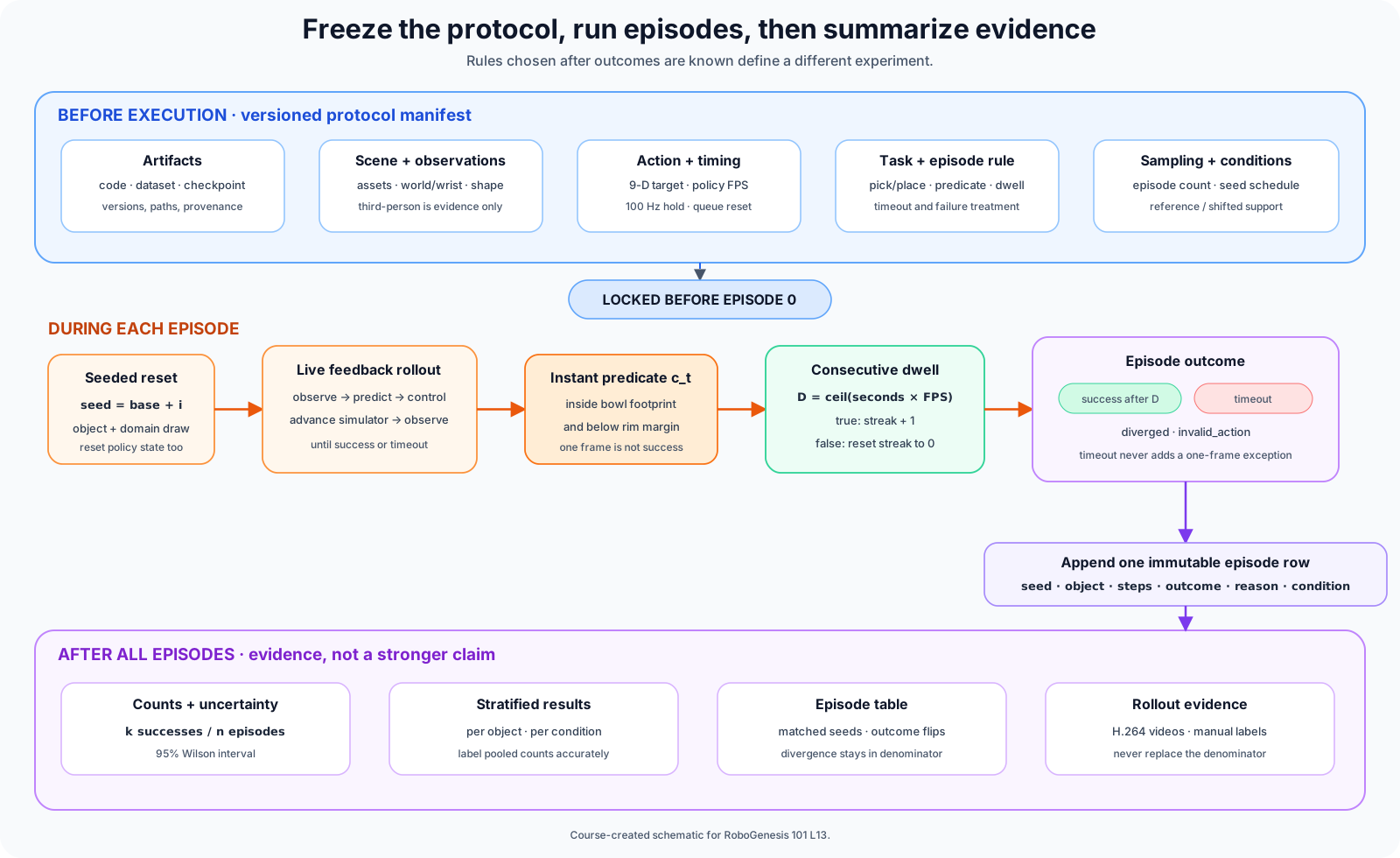
Course-created diagram. Blue denotes fields frozen before execution, orange denotes runtime decisions, and purple denotes evidence produced after the episodes. The arrow from predicate to dwell is essential: one true frame is not an episode success.
What belongs in the manifest?
| Boundary | Freeze and record |
|---|---|
| Code and runtime | course/code revision or dirty state, Python, Genesis, LeRobot, PyTorch, HIP/CUDA runtime, actual device, render backend |
| Dataset | logical repository ID, resolved local root, feature schema, FPS, camera shapes/keys, task table, domain provenance |
| Checkpoint | resolved numeric checkpoint, policy type, training dataset identity, model/processors, action horizon, camera rename, artifact revision/checksum when available |
| Scene and observation | scene/assets, world/wrist mapping, image resize, state order, which camera is evidence-only |
| Action and timing | 9-D joint-position semantics, policy FPS, 100 Hz hold/decimation, policy reset behavior |
| Task | pick pool, place target, pose/yaw reset, task text, tolerance, object schedule |
| Episode rule | containment predicate, dwell duration, timeout, exception and divergence treatment |
| Sampling | condition names, number of episodes, base and per-episode seeds, domain seeds, balanced schedule |
| Outputs | result-schema version, JSON/CSV, log, video directories, manual labels, skipped work |
This is not paperwork added after the experiment. It is the definition of the measurement. If a field is unknown, record it as unknown and narrow the claim. Do not silently reconstruct a convenient value after looking at the videos.
“The same scene” is not a sufficient audit
Recording and evaluation both call the project scene builder, but they can still differ in ways that affect the policy:
- scene or asset revisions;
- object-position and yaw jitter;
- world/wrist camera calibration or image resolution;
- Layer-A appearance and Layer-B dynamics/camera settings;
- policy FPS and action hold;
- task text, pick-object schedule, tolerance, dwell, or timeout.
The evaluation camera images are resized to the dataset metadata shape before the policy processor sees them. SmolVLA may then rename world/wrist to its canonical camera keys. The third-person video camera is cosmetic and must not be added to the policy feature set. Check those facts explicitly instead of saying “same simulator” and assuming equivalence.
Matched seeds improve control, not certainty by themselves
For episode i, the current evaluator uses base_seed + i. With multiple pick objects, its balanced mode creates nearly equal object counts and then shuffles their order reproducibly. Reusing the same seed schedule across checkpoints or conditions gives matched initial task instances.
That design reduces one source of comparison noise. It does not make different domain conditions identical, guarantee cross-platform bitwise determinism, or prove that an observed difference is statistically significant. Seed, code, assets, backend, protocol, and domain configuration jointly define an episode.
Turn the task predicate into an episode result
L08 owns the spatial predicate
For a bowl target, the course predicate checks two geometric facts:
within_footprint = horizontal_distance < min(success_tol, bowl_rim_radius)
inside_bowl = object_aabb_bottom_z < bowl_rim_z - rim_margin
instantaneous_containment = within_footprint and inside_bowl
Using the object's AABB bottom allows an elongated banana to rest partly inside the bowl even if its center remains near the rim. It also rejects an object that is still gripped above the bowl. L13 reuses this L08 predicate; the evaluator does not invent a second geometric definition of placement.
Dwell rejects a one-frame fly-by
Containment at one instant can occur while an object crosses the bowl, bounces, or is still moving in the gripper. Let c_t be the instantaneous predicate after policy step t:
dwell_frames = max(1, ceil(dwell_seconds × policy_fps))

success at step t only if:
    c_t, c_t-1, ..., c_t-dwell_frames+1 are all true
Any false predicate resets the streak. The course target is at least 0.4 seconds of consecutive containment. At 5 FPS that is two successful checks. The use of ceil matters at rates where 0.4 × FPS is not an integer: “at least 0.4 s” must not be rounded down to a shorter requirement.
Timeout does not waive dwell. A final true frame at the timeout boundary is still a failure if the required streak was not reached. After a genuine success, the evaluator may hold the last action and record a short cosmetic tail so the resting object is visible. Those extra frames do not alter the result or policy step count.
Accepted execution gate
The consecutive-dwell rule, including the timeout boundary, has passed contract tests and reference R9700 AMD+EGL closed-loop runs. gpu-verified covers the evaluator and evidence contract in the recorded environment; local results from other checkpoints, seeds, conditions, or platforms do not automatically become course-verified success rates.
Failure and infrastructure error are not the same event
A normal episode can end as:
success: the predicate held for the complete dwell;timeout: the task was not completed in time;diverged: Genesis reported a physics divergence, counted as task failure;invalid_action: the policy returned the wrong shape or non-finite values, counted as a policy/runtime failure with its own reason.
A missing checkpoint, unreadable dataset, nonexistent object, unavailable requested GPU, or absent observation camera is different. Those are run-level preflight failures. Abort before adding an episode to the denominator; otherwise an infrastructure problem is misreported as policy behavior.
Define conditions relative to training provenance
“DR on” does not mean “OOD”
Distribution language is relational. It compares evaluation conditions with a known training distribution:
| Label | Meaning in this lesson |
|---|---|
| Reference | the predeclared baseline condition for this report; ideally aligned with audited data generation |
| Unseen in-support | new seeds or domains sampled from the same documented parameter support as training |
| Shifted | at least one factor changed, but missing or overlapping provenance prevents a disjoint-support claim |
| OOD | a named factor and value/range are demonstrably outside the documented training support, while other important factors remain controlled |
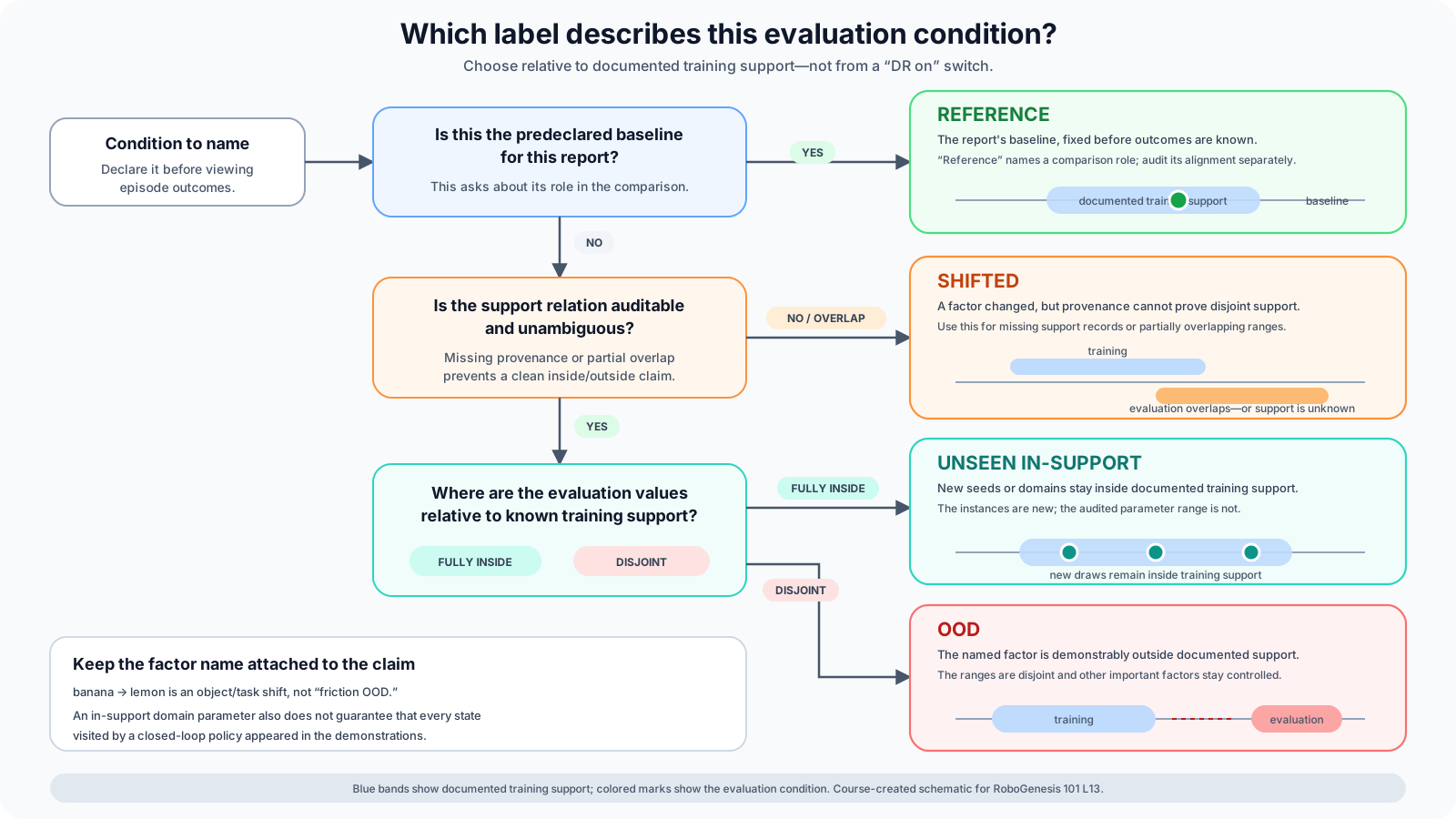
New random seeds within L11's recorded friction and mass ranges are unseen instances, not automatically OOD. A friction interval outside the recorded training support can be a physics OOD condition only if the provenance proves the ranges are disjoint and the proposed interval preserves a valid, numerically stable task. Changing banana to lemon is an object/task shift, not the same claim as a friction shift.
Even a reference domain can lead to unfamiliar states. The learned policy's own mistakes may push the closed-loop trajectory outside the demonstration state distribution. For that reason, this lesson uses “in-support” only for audited domain parameters; it does not claim the complete state-visitation distribution is identical to training.
Isolate one factor before combining shifts
A useful first comparison holds checkpoint, task, seeds, object schedule, timeout, predicate, and dwell fixed while changing one domain factor. This makes the result easier to interpret and reduces the risk that aggressive combined DR destabilizes contact.
Before running, write:
reference condition:
changed factor:
training support for that factor:
evaluation value/range:
support relation: in-support | shifted | disjoint OOD
factors held constant:
safety/task-validity check:
If the training provenance is missing, stop at shifted. Honest uncertainty in the label is stronger than a confident but unsupported OOD claim.
Report counts before percentages
For one fixed condition, each completed episode contributes a binary outcome Y_i:
k = sum(Y_i)
n = number of completed evaluation episodes
observed success rate = k / n
Always report k successes / n episodes. A bare percentage hides whether it came from five episodes or five hundred. Keep divergence counts, per-object counts, condition names, and the episode table beside the aggregate.
A success rate is an estimate, not a verdict
The observed success rate k/n describes exactly what happened in the episodes that were run. It does not reveal the policy's success probability with certainty. If the same frozen protocol were repeated with new episode seeds, the count could change simply because a finite sample contains some easier or harder initial states.
The denominator therefore changes how much evidence a percentage carries. 1/1, 5/5, and 50/50 all display as 100%, but they do not justify the same confidence. One success tells us much less about repeatability than fifty successes. Reporting only “100%” hides that distinction.
A confidence interval makes this sampling uncertainty visible. The project uses a two-sided 95% Wilson score interval because it behaves sensibly for the small samples and extreme results common in this lesson. For example:
| Observed result | Point estimate | 95% Wilson interval | What the result supports |
|---|---|---|---|
0/5 | 0% | approximately [0%, 43%] | No success was observed, but success is not proven impossible. |
3/5 | 60% | approximately [23%, 88%] | The best single estimate is 60%, but five episodes leave substantial uncertainty. |
5/5 | 100% | approximately [57%, 100%] | Every observed episode succeeded, but perfect repeatability is not established. |
50/50 | 100% | approximately [93%, 100%] | The same point estimate is supported by much more evidence. |
Read the 5/5 row as: “the policy succeeded in all five observed episodes; with so little data, success rates substantially below 100% are still compatible with the observation.” Do not read it as: “the policy is now known to succeed 100% of the time.” Similarly, 0/5 records a failed sample without proving that the underlying success probability is exactly zero.
The 95% in the interval is a property of the repeated procedure, not a promise that 95% of future episodes will succeed. Under the binomial model and a fixed protocol, intervals constructed from many repeated samples would cover the fixed underlying success probability about 95% of the time.
Why Wilson instead of the simplest normal approximation? At 0/n or n/n, the simple approximation can collapse to a zero-width interval such as [100%, 100%], precisely when the small sample should make us cautious. Wilson stays inside [0, 1] and retains nonzero uncertainty at those boundaries.
You do not need to memorize the formula. You should be able to identify k and n, read the resulting interval, and keep the conclusion proportional to its width. The repository computes the interval as follows for p_hat = k/n and z = 1.96:
denom  = 1 + z²/n
center = (p_hat + z²/(2n)) / denom
half   = z/denom × sqrt(p_hat(1-p_hat)/n + z²/(4n²))
interval = [max(0, center-half), min(1, center+half)]
This interval covers sampling uncertainty under one frozen protocol. It does not cover biased seed selection, simulator error, a changed success rule, checkpoint selection, or the sim-to-real gap. Overlapping or non-overlapping per-condition Wilson intervals are also not, by themselves, a valid paired significance test.
The five reference episodes in the focused route are therefore an integration smoke, not a performance benchmark. The Capstone repeats the same five seeds under one held-out condition, producing a transparent 5 + 5 teaching comparison. The report must retain the wide intervals and say that the sample cannot support a stable model ranking.
There is no universal “enough episodes” constant. A larger study chooses its episode budget from the desired precision, expected variability, object/domain strata, and compute cost before looking at outcomes.
Use the same seeds for a fair comparison
The protocol section explained why two conditions should reuse the same seed schedule. Here is how that choice helps when you read the results. Suppose the reference and shifted conditions produce these five episode outcomes:
| Seed | Reference | Shifted | What changed for this seed? |
|---|---|---|---|
1000 | success | success | unchanged success |
1001 | success | failure | success → failure |
1002 | failure | failure | unchanged failure |
1003 | failure | success | failure → success |
1004 | success | failure | success → failure |
The aggregate counts are 3/5 for Reference and 2/5 for Shifted. Those totals say that the shifted condition produced one fewer success in this sample. The matched rows reveal more: two initial cases became failures, one became a success, and two did not change. The effect was not identical for every case.
If the two conditions had used unrelated seeds, the shifted run might simply have received harder initial object poses. Reusing seed 1002 means that its Reference and Shifted episodes begin from the same scheduled task instance as far as the frozen protocol allows. The declared condition factor can change the subsequent trajectory—that is what the comparison is meant to expose.
For the course comparison, remember three actions:
- run both conditions with the same seed schedule;
- keep the two outcomes beside each other for every seed; and
- report both aggregate
k/nvalues and the success/failure flips.
Five matched pairs are still only a teaching-sized sample. They can reveal which episodes changed and guide video inspection, but they do not by themselves prove that one condition reliably causes a higher or lower success rate. Such a claim needs more episodes and a statistical method designed for paired outcomes; that analysis is outside the core lab.
Rollout evidence explains what an aggregate hides
The evaluation video is a horizontal panel of the course observation views and a diagnostic view:
world camera | wrist camera | third-person video camera
 policy input   policy input      evidence only
Check that all panels advance, have the expected orientation, and correspond to the recorded episode. H.264 with yuv420p makes the file broadly playable; even frame dimensions are required. A filename or decodable container does not prove that the correct cameras were recorded.
Useful manual failure categories include:
- no meaningful motion before timeout;
- approach or alignment miss;
- collision that pushes the object away;
- failed grasp or premature closure;
- loss during lift or transport;
- arrival above the bowl without release;
- release outside containment;
- unstable bounce that never satisfies dwell; and
- physics divergence.
These are observations, not labels that can be inferred from success=false. Watch the rollout and cite visible evidence.
Run one checkpoint under one frozen condition
Start with the smallest complete closed-loop evaluation unit:
one checkpoint + one dataset contract + one frozen condition
    → five closed-loop episodes
    → episode rows + aggregate statistics + rollout videos
The companion notebook mirrors this evidence order as seven numbered steps. Steps 1–3 audit the environment, dataset, and checkpoint source, freeze the protocol, and predeclare the comparison without starting Genesis. Step 1 prefers the configured local dataset; when it is absent, the notebook downloads only the pinned dataset's meta/** files because evaluation reads no training episodes or videos. A remote checkpoint is marked DEFERRED; Step 4 downloads and audits it before performing the five-episode Reference action. Step 5 audits the rows and videos. Learners who continue the Capstone then run Step 6 for the matched held-out comparison and Step 7 for the scoped report. Every experiment choice is visible in the configuration cell, and running an evaluation cell starts it. Step 7 is a local two-pass interaction: run it once to generate an evidence card and result-specific sentence stems, fill the three CAPSTONE_CONCLUSION fields next to that evidence, then rerun only Step 7 to write the report. It does not repeat either rollout condition.
This run asks whether one specific checkpoint can execute the declared task under one declared condition. It is not yet a checkpoint sweep or a Reference/Shifted comparison. Each group of command-line options fixes part of the protocol:
| Evaluation choice | Options | What they fix |
|---|---|---|
| Policy artifact | --policy-path | the exact numeric checkpoint to load |
| Dataset contract | --repo-id, --dataset-root | the matching FPS, image shape, camera keys, and feature schema |
| Runtime device | --device | the accelerator on which policy inference must run |
| Episode sample | --episodes, --seed, --balanced | the denominator and reproducible seed/object schedule |
| Task and timeout | --pick, --place, --max-seconds | the task instance and maximum duration of each episode |
| Evidence outputs | --save-video, --video-dir, --results-out | where videos and structured results are stored |
Replace every CHOOSE_... placeholder with an audited value. The policy path must name a numeric checkpoint, and the dataset identity must match the contract used to train it. Keep each run in an isolated output directory so results from different conditions cannot be mixed accidentally.
RG101_POLICY_PATH=CHOOSE_NUMERIC_CHECKPOINT_PRETRAINED_MODEL_DIR
RG101_REPO_ID=CHOOSE_TRAINING_DATASET_REPO_ID
RG101_DATASET_ROOT=CHOOSE_MATCHING_LOCAL_DATASET_ROOT
RG101_EVAL_ROOT=outputs/l13/reference

uv run python -m robo_genesis.eval_policy \
  --policy-path "$RG101_POLICY_PATH" \
  --repo-id "$RG101_REPO_ID" \
  --dataset-root "$RG101_DATASET_ROOT" \
  --device cuda \
  --episodes 5 \
  --seed 1000 \
  --max-seconds 15 \
  --pick 011_banana \
  --place 024_bowl \
  --balanced=true \
  --save-video \
  --video-dir "$RG101_EVAL_ROOT/videos" \
  --results-out "$RG101_EVAL_ROOT/results.json"
In this example, --episodes 5 --seed 1000 schedules five reproducible episode seeds beginning at 1000. The evaluator loads the checkpoint, constructs live observations using the dataset contract, runs the feedback loop, and records one row per episode before computing the aggregate count and Wilson interval.
On ROCm PyTorch, --device cuda selects the shared PyTorch device API; verify that the printed hardware is the intended AMD GPU and that HIP is present. A silent CPU fallback does not satisfy this lesson's GPU-required path.
Verified core interface
The current CLI recovers dataset FPS and image features from metadata and recovers a saved SmolVLA camera rename when available. It writes per-episode details, counts, a Wilson interval, and videos. This core path, the Capstone report schema, and the preflight checks have passed on the reference environment. Preserve the full command and environment for reproducibility; other platforms and the optional checkpoint sweep remain outside this verification scope.
What this five-episode run can establish
This first run produces integration evidence and a small-sample behavior record. Those are useful, but they do not support every conclusion about the policy:
| This run can establish | This run cannot establish |
|---|---|
| the checkpoint loads with its matching processors and dataset features | that the policy is reliable |
| live observations reach the policy and its actions affect the simulator | performance under untested conditions |
| scene reset, policy reset, timeout, predicate, and dwell execute | robustness to a shifted or OOD condition |
| episode rows, counts, a Wilson interval, and videos are produced | a stable ranking against another checkpoint |
0/5, an intermediate count, and 5/5 are all valid evaluation outputs. Judge the closed-loop evaluation path by whether every episode followed the frozen protocol and produced complete evidence. Report policy behavior separately from the observed k/n, interval, videos, and declared scope; do not require a hidden success threshold before accepting the run as valid.
A one-step L12 smoke checkpoint may establish that the evaluator can load and run a policy. Its rollout result is not evidence of a meaningfully trained policy.
Optional extension: compare saved checkpoints
eval_sweep.py discovers numeric checkpoints in one training run. Omitting --steps evaluates every usable numeric checkpoint it finds; supplying --steps restricts the comparison to an explicit list. Every checkpoint receives the same frozen task protocol and seed schedule, so differences in initial task instances do not obscure the checkpoint comparison. The core Capstone does not require this extension; it can evaluate one selected checkpoint.
uv run python -m robo_genesis.eval_sweep \
  --run-dir CHOOSE_TRAINING_RUN_DIR \
  --repo-id CHOOSE_TRAINING_DATASET_REPO_ID \
  --dataset-root CHOOSE_MATCHING_LOCAL_DATASET_ROOT \
  --episodes 5 \
  --seed 1000 \
  --pick 011_banana \
  --output-dir outputs/l13/sweep
A training smoke that saved one checkpoint produces one point, not a learning curve. With several checkpoints, success may rise, flatten, oscillate, or fall. Matched seeds improve comparability, but they do not remove every checkpoint- selection or training confound. Describe the curve that was observed; do not promise a “rising” curve in advance.
The runtime cost grows directly with the number of checkpoints:
number of rollouts = checkpoints × episodesFor example, three checkpoints evaluated on five matched episodes each require 15 rollouts. The tool writes per-checkpoint and per-episode results to sweep.json, a compact checkpoint summary to sweep.csv, and the observed success-rate curve to success_curve.png.
Optional path, not yet L13-verified
The checkpoint-sweep path exists in the current implementation, but this lesson has not yet accepted a complete multi-checkpoint GPU-and-render sweep as course evidence. Treat it as an exploration path, not a requirement for the core single-checkpoint Capstone.
Capstone: answer one question with traceable evidence
The Capstone begins with a policy question, not a checklist of commands:
For one identified checkpoint, what do its closed-loop outcomes under one Reference condition and one declared held-out condition allow us to conclude?
The answer must be traceable back through the runtime, training data, checkpoint, evaluation protocol, and live rollouts. Missing evidence weakens the conclusion; a strong-looking final percentage cannot repair an earlier gap.
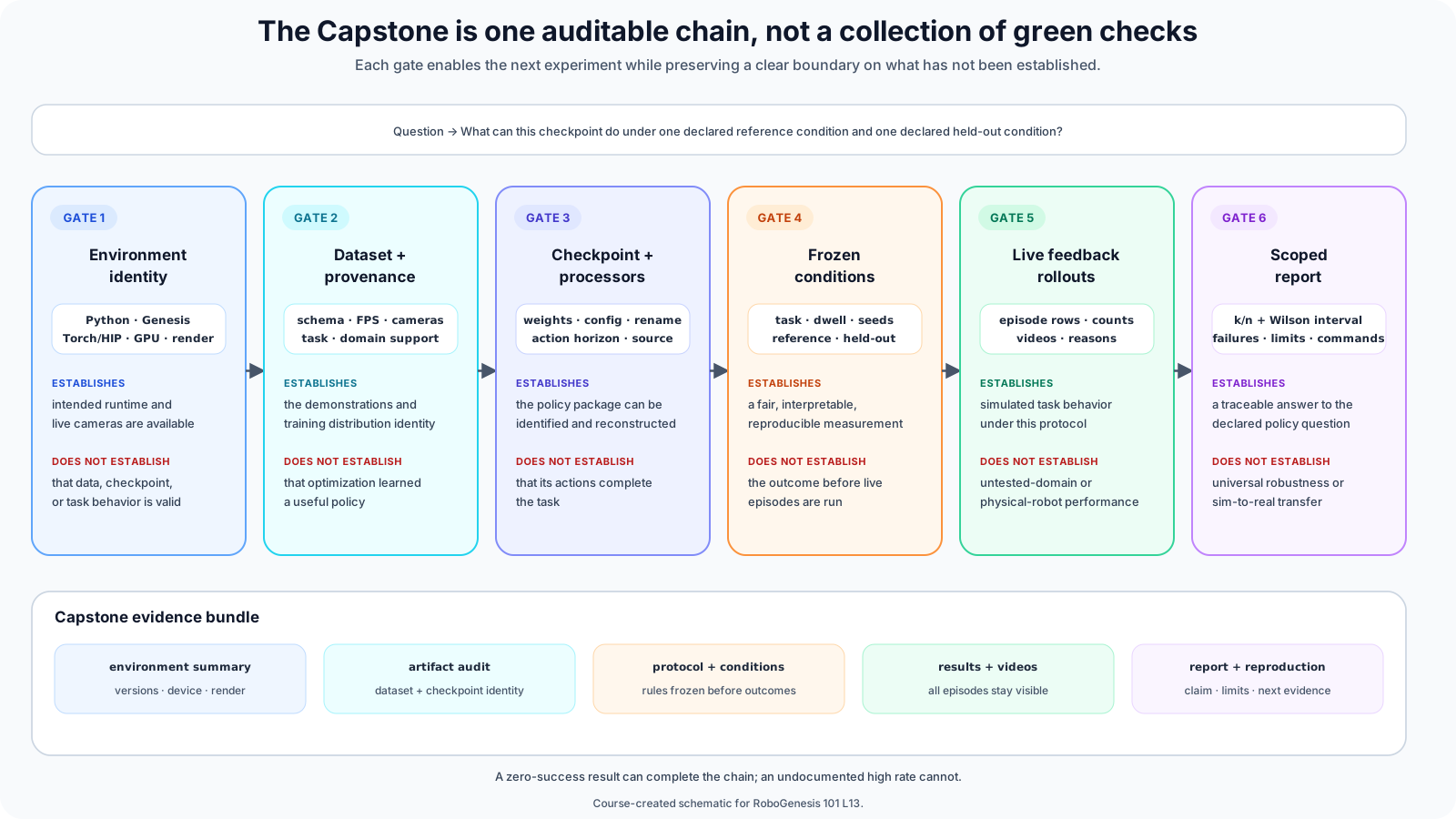
Course-created diagram. Read the gates from left to right: each one answers a necessary subquestion and limits the claim that can pass to the next gate.
Read each gate as a question
| Gate | Subquestion | Minimum evidence | Claim boundary |
|---|---|---|---|
| 1. Environment | Did the declared runtime actually execute? | environment report, actual GPU/backend, and a live camera frame | Establishes the runtime used; says nothing yet about data or policy behavior. |
| 2. Dataset | What demonstrations and training support does the policy depend on? | dataset identity, feature schema, task, and available provenance | Makes the training input interpretable; does not show that a useful policy was learned. |
| 3. Checkpoint | Which policy artifact is being evaluated? | numeric checkpoint identity, saved processors, and dataset match | Makes the policy package reconstructable; does not show that its actions complete the task. |
| 4. Protocol | What exactly will be compared? | frozen task/success rule plus Reference and held-out conditions using the same five seeds | Makes the two results comparable; does not predetermine their outcomes. |
| 5. Rollouts | What happened when the policy closed the loop? | complete episode rows, termination reasons, counts, and videos for both conditions | Establishes simulated behavior under this protocol only. |
| 6. Report | What conclusion is supported, and where does it stop? | k/n, Wilson intervals, matched rows, limitations, and reproduction commands | Produces a traceable answer; does not establish universal robustness or sim-to-real transfer. |
If a gate is missing, stop or weaken the claim. Without dataset provenance, for example, a changed condition cannot be justified as OOD. Without a fixed checkpoint identity, another learner cannot reproduce the result. Without live rollouts, checkpoint loading cannot become a task-performance claim.
Pinned default dataset and checkpoint
When the configured local datasets/fruit_pick directory is absent, Step 1 uses wangxun1010/fruit_pick at commit 475e8c6ec7079c4c52b20a0221bf959acb541abd. It downloads only meta/**: the feature/FPS contract, statistics, tasks, and episode index needed by LeRobotDatasetMetadata. Training parquet files and videos are not downloaded.
When CONFIG['checkpoint'] is None, the companion notebook uses wangxun1010/smolvla-fruit-pick-0821 at commit cdf720f162e6ee86dbc856cdf15c5dcd4a673221. Its training configuration identifies the logical dataset as genesis/fruit_pick, matching both the local candidate and pinned metadata fallback. The checkpoint download is deferred until the learner runs Step 4. Setting CONFIG['checkpoint'] explicitly replaces the model source, and the dataset fields and fallback must be updated when that checkpoint used another dataset.
Write the report from the evidence chain
Use the gates to fill one compact report rather than copying every lesson output:
Question:
  For checkpoint [identity], what do Reference and [held-out condition]
  rollouts support?

Environment and artifacts:
  [runtime identity] + [dataset identity] + [checkpoint identity]

Frozen protocol:
  [task and success rule] + [matched seeds] + [condition definitions]

Observed evidence:
  Reference: [k/n and interval]
  Held-out:  [k/n and interval]
  [matched outcome changes, termination reasons, and video evidence]

Conclusion:
  This evidence supports [claim limited to the tested protocol].

Does not establish:
  [untested conditions, stable ranking, physical-robot performance, ...]

Next experiment:
  [one change that would reduce the most important remaining uncertainty]

Reproduce with:
  [commands and output locations]
A zero-success result can still complete the Capstone when the evaluation is valid and the diagnosis follows the evidence chain. Conversely, a high observed rate cannot compensate for an unidentified checkpoint or a protocol changed after the outcomes were seen.
The lecture owns the reasoning: why each gate is necessary and which claim it permits. The companion lab owns the mechanical detail—collecting full version fields, feature names, processor files, manifests, logs, and output paths in its preflight, audit, rollout, and report cells. You should not memorize those field lists; you should be able to explain why the final conclusion depends on them.
Diagnose failures by boundary
- Environment, GPU, or rendering: confirm the project environment, package versions,
torch.cuda.is_available(),torch.version.hip, actual device, Genesis backend, and a live camera frame. Requested GPU execution that falls back to CPU is a failed full-path check. - Dataset identity: confirm repository ID, resolved root, metadata, task, FPS, camera keys/shapes, action names, and domain provenance. Do not search for a convenient substitute.
- Checkpoint identity: inspect the numeric directory, policy type, processors, training dataset, action horizon, and camera rename before loading Genesis.
- Protocol preflight: reject non-positive episode/timeout values, an empty pick pool, unsupported objects, policy FPS above control FPS, an invalid condition, or an output collision before expensive work starts.
- Live observation: inspect 9-D finite state, HWC
uint8world/wrist frames, resize behavior, and the processor's expected keys. Keep the video camera out of policy input. - Policy action: reset policy state each episode; require one finite 9-D joint target before applying it. Then inspect action queue and query/hold timing.
- Simulation: identify contact explosion, NaN divergence, invalid reset, or an unsafe shifted range. Preserve the failing seed and condition.
- Task outcome: separate approach, grasp, lift, transport, release, containment, dwell, and timeout using the video and predicate trace.
- Sampling and report: verify denominator, missing/duplicated seeds, per-object balance, condition separation, pooled labels, and interval inputs.
- Policy capability: only after the first nine boundaries hold should you change data coverage, training budget, checkpoint selection, or model capacity.
Checkpoints and exercises
Concept checkpoints
- Which causal edge is absent from a one-sample checkpoint probe?
- Why must policy state and an action-chunk queue reset between episodes?
- At 5 FPS and a 0.4-second dwell, how many consecutive predicate checks are required? What changes at 7 FPS when the rule uses
ceil? - Why is one true containment frame at timeout still a failure?
- Which facts must match before two success rates are comparable?
- Why can new seeds from the same L11 parameter ranges be unseen but in-support?
- Why is a shifted camera condition not automatically OOD?
- What does a Wilson interval capture, and which uncertainties remain outside it?
- Why should a physics divergence remain in the denominator?
- What evidence separates a successful evaluator run from a useful policy?
Protocol exercise
In companion notebook cell l13-protocol, change one synthetic predicate trace. Predict its maximum streak and episode outcome before running the cell. Include a trace whose last frame is true but whose streak is shorter than the required dwell, and explain why timeout must not promote it to success.
One-factor condition exercise
Change exactly one domain factor in the configuration cell's CONFIG['held_out'], then run l13-condition-plan. Use the training provenance to label it unseen in-support, shifted, or OOD. State which factors remain fixed and why the new range still preserves a valid task. If the provenance cannot justify the label, downgrade it to shifted.
Failure-evidence exercise
In l13-result-audit, select one actual failed episode using a rule written before watching it—for example, the first timeout. Add one manual category and two visible observations from the rollout. Do not infer a training-data or model-architecture cause from the aggregate rate alone.
Capstone conclusion exercise
After Step 6, run l13-capstone-report once. Read the evidence card and the sentence stems generated from the actual Reference and held-out results. Then fill the three empty fields in CAPSTONE_CONCLUSION inside that Step 7 cell:
- what the current evidence supports;
- what it cannot support; and
- which next experiment would reduce the most important uncertainty.
Rerun only Step 7 to write the report; the Reference and held-out rollouts are not repeated. Use the displayed counts, intervals, and matched outcome changes rather than inventing an explanation that the evidence does not contain.
The next experiment should change one justified factor or increase a predeclared episode budget. “Train longer” without a diagnosed boundary is not an evidence-based recommendation.
Summary
- Closed-loop evaluation measures a causal feedback process: each policy action changes the next observation and exposes error accumulation or recovery.
- A success rate has meaning only inside a frozen artifact, scene, observation, action, timing, task, seed, condition, and success protocol.
- L08 containment becomes an episode success only after consecutive dwell; timeout and divergence do not create exceptions to the rule.
- Reference, in-support, shifted, and OOD are defined relative to training provenance. Enabling randomization is not an OOD proof.
- Report successes and total episodes, a Wilson interval, per-condition/object details, matched episode rows, and rollout evidence. Five episodes remain a smoke, even at 0% or 100% observed success.
- The Capstone links environment, dataset, checkpoint, protocol, live rollout, and report evidence. Passing one gate never grants the claim of a later gate.
- Checkpoint sweeps are optional extensions whose cost grows with the number of saved checkpoints; their curves must be observed, not assumed to rise.
Optional next step: L14
The 13-lesson core course is complete at this point. L14 is an optional advanced practicum that reuses the data-contract, checkpoint, deployment, and closed-loop evidence discipline from L10, L12, and L13 in a separate RoboTwin/LingBot-VLA-v2 companion runtime. It requires the recorded four-W7900 profile and is not a dependency of the core course.
Sources
- Wilson, “Probable Inference, the Law of Succession, and Statistical Inference” — the score interval used for one binomial success proportion.
- Brown, Cai, and DasGupta, “Interval Estimation for a Binomial Proportion” — comparison of binomial interval behavior, including the limitations of the Wald interval.
- LeRobot 0.6.0 policy control utilities — the version-pinned
predict_actionpath used by the project evaluator. - LeRobot 0.6.0 policy factory — policy and pre/postprocessor construction used when reloading ACT and SmolVLA checkpoints.
- Genesis World documentation and Genesis World 1.3.3 on PyPI — simulator documentation and the exact course version.
- Pinned SmolVLA fruit-pick checkpoint — the default L13 artifact when the learner does not provide a checkpoint.
- Pinned fruit-pick dataset — the metadata fallback when the matching local dataset is absent.
- RoboGenesis 101 task predicate, single-checkpoint evaluator, checkpoint sweep, and shared statistics — current project behavior and the implementation boundary described here.
- RoboGenesis 101 compatibility record — verified platforms, historical checkpoint probes, and claims that remain unverified.