
L12 · Training ACT and SmolVLA Policies
Hardware contract: the complete lab is GPU-required. The verified reference platform is Linux x86_64 with an AMD Radeon AI PRO R9700 and ROCm 7.2, but the concepts and commands remain platform-neutral. Learners who cannot train can still complete the data checks and command audit; that reduced route is not a substitute for the two GPU smoke runs.
Where this lesson fits
L10 established the dataset schema, camera keys, behavior cloning, and the basic idea of action chunking. L11 then asked how the training distribution should vary. L12 now turns a versioned demonstration dataset into two kinds of policy checkpoint:
LeRobot dataset
  → validate one real sample
  → assemble the training command
  → ACT or SmolVLA optimization
  → checkpoint + saved preprocessing
  → reload on one real sample
  → closed-loop evaluation in L13
The last arrow matters. This lesson can prove that a training and loading path works. It cannot prove that the learned policy completes a grasping task. That claim requires the seeded simulator rollouts, success predicate, and reporting protocol in L13.
Before starting, you should be able to:
- locate a local LeRobot dataset and identify its logical repository ID;
- read its feature schema, FPS, episode boundaries, and task table;
- explain why this course records two RGB views, a 9-D robot state, and a 9-D commanded action;
- distinguish behavior cloning from closed-loop task evaluation; and
- record which dataset version and domain-randomization configuration a run used.
Learning objectives
By the end of L12, you should be able to:
- explain and compare how ACT and SmolVLA learn to map multimodal observations — and, for SmolVLA, task context — to action chunks, including how training differs from inference;
- reason about the data, model, temporal, and checkpoint contracts that make a policy-training run reproducible and reloadable;
- design, carry out, and evaluate a reproducible policy-training workflow for both architectures.
Start with the evidence boundary
The phrase "training worked" is too vague for a useful experiment report. L12 uses an evidence ladder instead:
| Evidence | What it establishes | What it does not establish |
|---|---|---|
| Dry-run command audit | the wrapper resolved paths and assembled the intended trainer arguments | that the dataset, model content, GPU, or optimizer can run |
| One-step smoke | one batch can be decoded and used for forward, backward, update, and save | convergence, generalization, or a useful policy |
| Finite training loss | the recorded scalar for that step is numerically defined | that the loss will decrease, or that another policy's loss is comparable |
| Checkpoint reload | weights, configuration, and processors can be reconstructed | that the policy acts sensibly in a changing environment |
| One open-loop action | the loaded model returns the required shape, dtype, and finite values | that executing the action is safe or completes the task |
| Closed-loop rollout | the policy interacts with the simulator under a defined protocol | population-level performance unless enough seeded episodes are reported |
Keep this table in view when reading logs. A tiny dataset can be memorized, and a falling loss can accompany poor behavior under new poses or appearances. The inverse is also possible over a short, noisy run: a non-monotonic loss trace is not automatically a broken pipeline.
The shared data-to-policy contract
ACT and SmolVLA use the same raw course dataset. They differ in how they preprocess and model it.
| Field | Course meaning | Required check |
|---|---|---|
observation.state | 9 joint positions: 7 arm plus 2 gripper joints | shape (9,), float32, finite values, expected joint names |
action | 9 commanded joint-position targets in the same joint order | shape (9,), float32, finite values |
observation.images.world | fixed global view | present, decodable RGB, consistent resolution |
observation.images.wrist | eye-in-hand local view | present, decodable RGB, consistent resolution |
task | non-empty language description of the episode | resolve and print one real task rather than inventing a placeholder |
| FPS | sampling rate shared by observations and actions | positive and consistent with video metadata |
| episode boundary | prevents a future-action target from crossing into another episode | metadata and padding behavior are readable |
The logical repository ID and the local root are separate inputs. For example, genesis/fruit_pick can identify the dataset while datasets/fruit_pick selects the local copy. A correct ID paired with the wrong directory is still a bad experiment.
Three representations of one image
Do not compare shapes without asking which layer they describe:
- dataset metadata describes stored video frames as height × width × channel;
- a decoded LeRobot sample normally exposes a channel-first tensor; and
- a policy preprocessor may rename, resize, normalize, pad, or batch that tensor before the model sees it.
SmolVLA also tokenizes task and can pad short state/action vectors internally. That is why a raw metadata key and an internal model feature need not have the same spelling or shape. The correct test follows the complete preprocessor and checks a real training and loading path; it does not compare two isolated JSON fragments and guess.
Behavior cloning predicts a sequence here
One-step behavior cloning can be summarized as policy(observation_t) → action_t. Both policies in this lesson instead learn a future sequence:
policy(images_t, state_t, optional_task)
  → [action_t, action_t+1, ..., action_t+chunk_size-1]
The dataset loader therefore needs future action targets from the same episode. Near the end of an episode it marks padded positions so the model loss can ignore or mask them. A chunk is a coordinated prediction over time, not proof that every action in it should be executed without observing the world again.
ACT: a CVAE that predicts action chunks
ACT stands for Action Chunking with Transformers. In the pinned LeRobot implementation, images and robot state condition a Transformer that predicts a fixed-size action chunk.
The figure separates the two parts that are both called "encoders" in the implementation. The orange CVAE encoder estimates a posterior only while the demonstrated future action chunk is available during training. The blue main Transformer path predicts actions in both training and inference; the green inference branch replaces the unavailable posterior sample with an all-zero latent. Each learned action query represents one position in the predicted chunk rather than an action copied from the dataset.
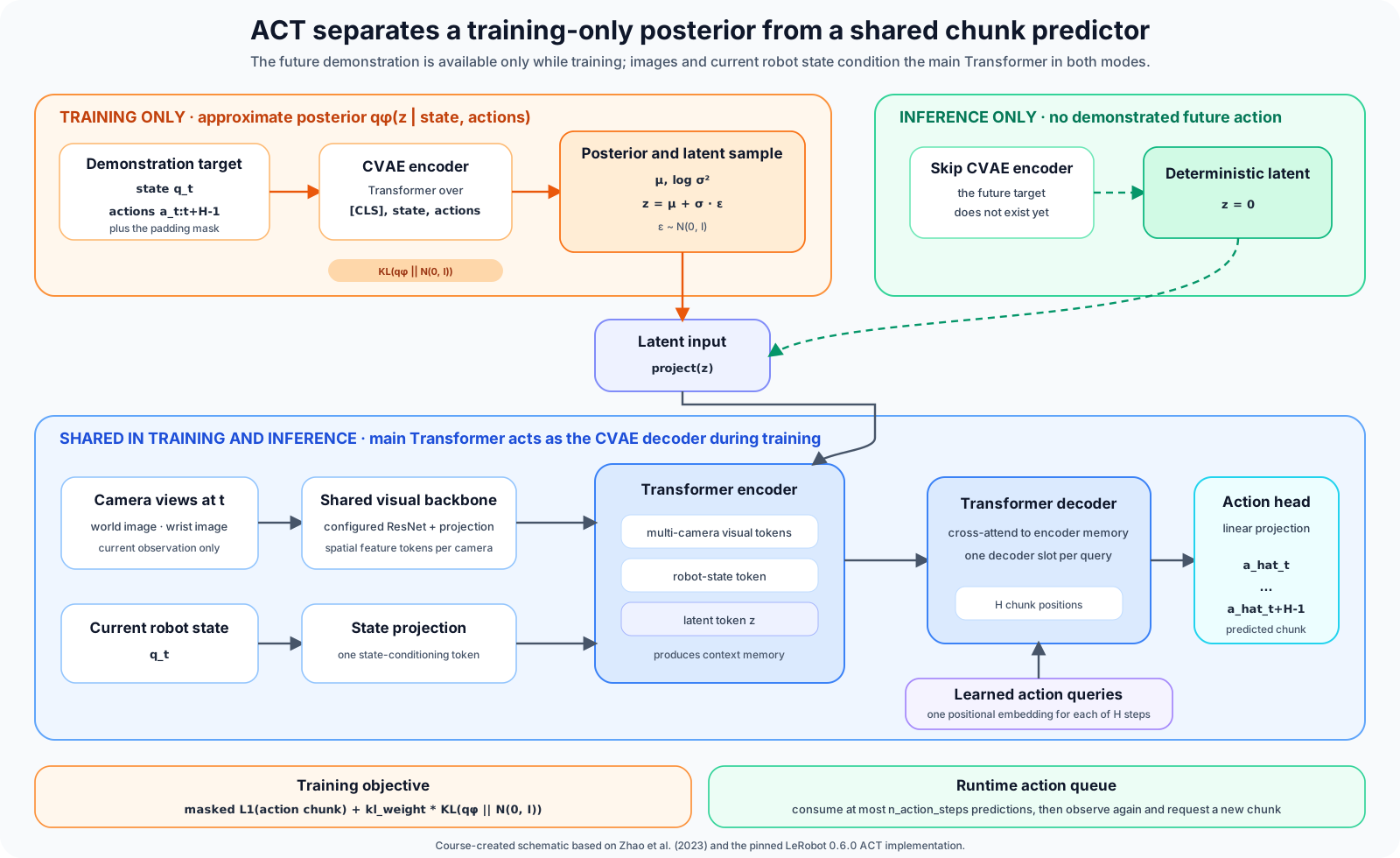
Training path
ACT contains two Transformer-based paths whose names are easy to confuse:
- The CVAE encoder sees robot state and the ground-truth action chunk during training. It produces the mean and log variance of a latent distribution.
- The main Transformer encoder/decoder consumes visual features, robot state, a sampled latent, and learned action queries. It predicts the complete action chunk and is the path retained for inference.
The current loss is the mean absolute action reconstruction error over valid, non-padded targets plus kl_weight times the KL divergence between the learned latent distribution and a standard normal prior. The reconstruction term asks the predicted chunk to imitate the demonstration; the KL term regularizes the latent space. A finite sum verifies one computation, not task competence.
Inference path
At inference there is no ground-truth future action for the CVAE encoder to read. The pinned LeRobot implementation uses a zero latent, runs the main Transformer, and returns a chunk. ACTPolicy.select_action() queues up to n_action_steps entries and queries the model again when that queue is empty.
This gives two distinct horizons:
chunk_size: how many future actions the model predicts and the loader uses as its training target;n_action_steps: how many predicted actions the runtime consumes before it asks for a new chunk.
Changing n_action_steps does not shorten the training target. It changes how often a deployed policy incorporates a new observation. Temporal ensembling is another ACT execution mode, but it is disabled by default in this course's LeRobot configuration and is not part of the minimum lab.
"From configuration" is not the same as "every weight is random"
The project ACT preset emits --policy.type=act, so the policy structure is created from configuration and adapted to the dataset features. However, the LeRobot 0.6.0 ACT default allows a pretrained ImageNet ResNet18 visual backbone. It is therefore inaccurate to claim that every default ACT weight is randomly initialized.
The one-step smoke deliberately sets --policy.pretrained_backbone_weights=null. That avoids a network download and, together with a much smaller Transformer/CVAE, makes a deterministic pipeline probe. The resulting checkpoint is a smoke model, not a representative ACT training configuration.
SmolVLA: language-conditioned flow matching
SmolVLA is a compact vision-language-action (VLA) policy. This course fine-tunes lerobot/smolvla_base; it does not train the complete model from scratch.
The figure follows the pinned cross-attention configuration. The blue prefix is computed once from the current camera images, task text, and robot state. The purple action path receives a noisy action point and its continuous time, then the action expert reads the prefix context to predict a velocity. Orange shows how one supervised flow point is constructed during training; green shows how inference repeatedly reuses the same velocity network to move from noise toward an action chunk.
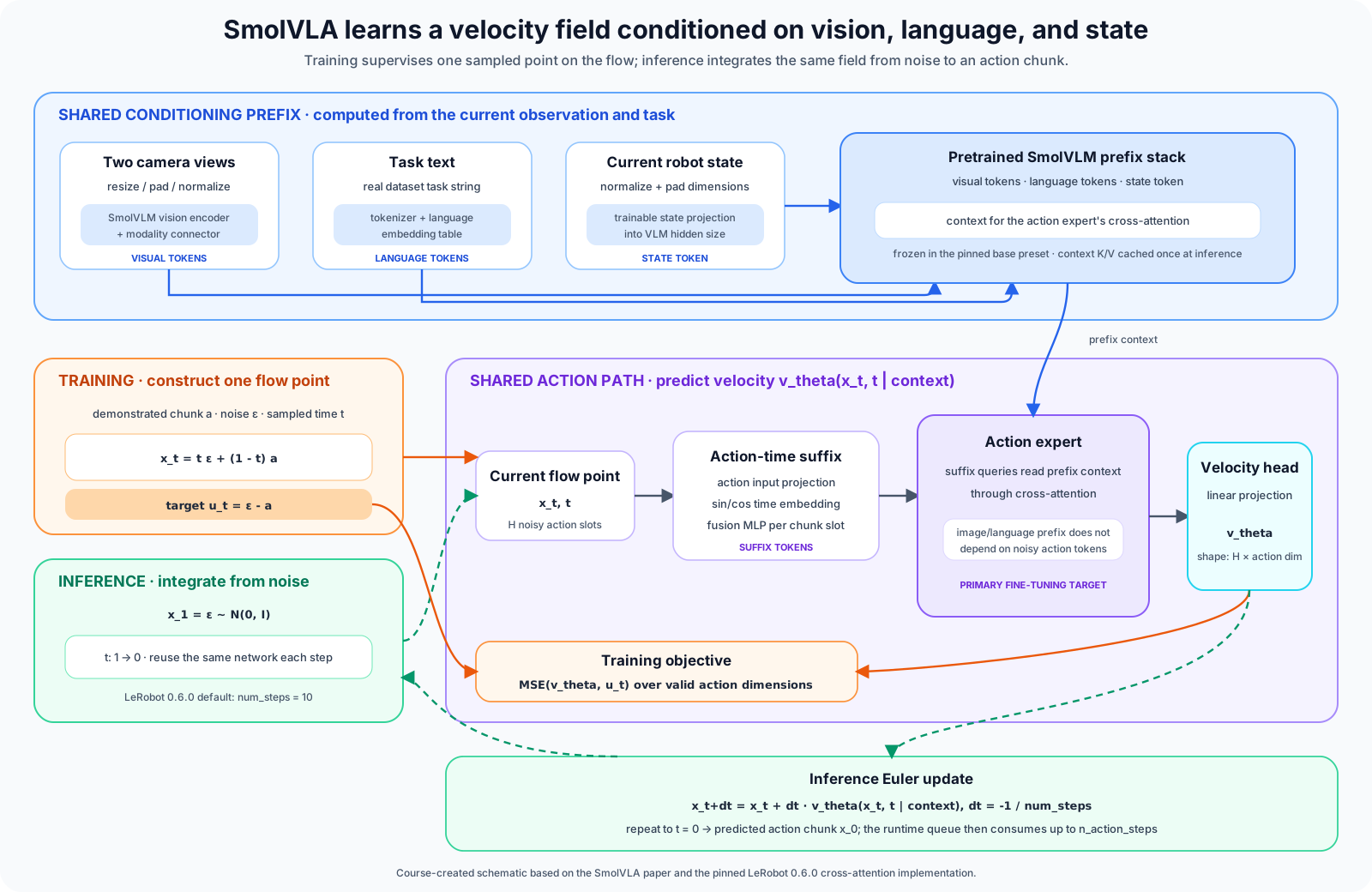
Prefix context and action expert
The model separates two conceptual streams:
- a vision-language backbone embeds camera images and task tokens; and
- an action expert combines that context with robot state, a noisy action chunk, and a continuous time value.
Images, language, and state form the context prefix. The noisy actions and their time embedding form an action suffix. Attention lets the action expert condition its prediction on the task context without treating the task string as an action label.
The pinned base configuration freezes the vision encoder, primarily trains the action expert, and trains the state projection. These choices define the fine-tuning boundary and affect trainable parameters, memory, and learning rate. Changing them creates a different experiment and must be recorded.
The flow-matching target
During training, SmolVLA samples noise and a time value. It interpolates between the demonstrated action chunk and noise, then asks the action expert to predict the velocity that points along that path. In compact notation:
demonstrated action chunk: a
noise: ε ~ N(0, I)
noisy point: x_t = t × ε + (1 - t) × a
target velocity: u_t = ε - a
predicted velocity: v_theta = v_theta(x_t, t | context)
loss = mean squared error(v_theta, u_t)
At inference the model starts from noise and integrates the learned velocity field back toward an action chunk. LeRobot 0.6.0 uses ten sampling steps by default. This is why a single SmolVLA policy query is not simply one direct linear regression from pixels to joints.
The description above is sufficient to reason about the lab. Deriving the full flow-matching theory, tokenizer internals, or every attention layer is outside this lesson's boundary.
Language is real input, not decoration
The task must come from the dataset sample, for example a description of which object to pick and where to place it. Replacing it with an unrelated hard-coded sentence changes the conditioning signal. An ACT run can use the same dataset without consuming language, but SmolVLA's training and reload probe must verify that non-empty task text reaches the preprocessor.
Pretraining may provide reusable visual, language, and action priors. Whether those priors improve this fruit-picking task is an experimental question. A model name, parameter count, or one-step loss cannot answer it.
Camera keys are part of the checkpoint contract
The course dataset names its views by their physical role:
observation.images.world
observation.images.wrist
The SmolVLA base uses canonical pretraining names. The project preset therefore adds this map:
{
  "observation.images.world": "observation.images.camera1",
  "observation.images.wrist": "observation.images.camera2"
}
LeRobot writes the mapping into train_config.json and the saved rename_observations_processor. The loader in robo_genesis.eval_policy.load_policy() reads the map back so callers continue to provide the meaningful raw keys world and wrist.
ACT created from this dataset adapts to its raw feature keys and does not need this preset rename. That is a statement about this ACT initialization path, not a universal promise that every pretrained ACT checkpoint accepts arbitrary camera names.
Do not "fix" a feature mismatch by inventing a different evaluation-time map. Training, checkpoint metadata, and evaluation must agree on the same transformation.
ACT and SmolVLA: compare contracts, not raw losses
| Question | ACT preset | SmolVLA preset |
|---|---|---|
| Trainer selection | --policy.type=act | --policy.path=lerobot/smolvla_base or a pinned local snapshot |
| Initialization | new ACT policy; visual backbone may use ImageNet weights unless overridden | fine-tune a pretrained SmolVLA base |
| Conditioning | two images and robot state | two images, robot state, and task text |
| Training objective | valid-action L1 reconstruction plus weighted KL | flow-matching velocity MSE |
| Current default chunk / execution steps | 100 / 100 | 50 / 50 |
| Wrapper default batch size | 8 | 4 |
| Camera rename in this course | none | world/wrist → camera1/camera2 |
| Reload path | generic project loader and saved processors | same loader, including recovered rename and language processing |
The raw losses have different definitions and scales. Comparing ACT loss < SmolVLA loss would not rank policy quality. Even within one policy, compare runs only after checking that the dataset, preprocessing, initialization, training budget, and reduction are the same.
Reason about the training knobs
chunk_size and dataset FPS
chunk_size counts action samples, not seconds. Its nominal time span is:
prediction horizon in seconds = chunk_size / dataset_fpsFor a 10 FPS dataset and chunk_size=40, one prediction contains 4 seconds of action targets. That does not mean all 4 seconds must be executed open loop.
Longer chunks expose longer coordinated behavior but increase the output target and the amount of padding near episode ends. Shorter chunks reduce that horizon but do not automatically make behavior smoother or more successful.
n_action_steps and replanning
The execution interval is nominally:
replan interval in seconds = n_action_steps / dataset_fpsIt must satisfy 1 <= n_action_steps <= chunk_size. Smaller values incorporate new observations more often but increase inference frequency. Larger values reduce query frequency but commit to more actions before observing again. The latency-versus-feedback trade-off must eventually be measured in L13.
Batch size and memory
Batch size changes how many samples contribute to one optimizer update. Larger batches normally require more activation memory and may improve throughput; they also change gradient noise. Exact memory depends on policy, image count and resolution, trainable modules, precision, and other processes on the GPU.
If an otherwise valid run is out of memory, first confirm the intended device and current GPU occupancy, then reduce --batch-size. Do not silently change the policy architecture or action horizon and continue calling it the same experiment.
Steps are not episodes or convergence
--steps counts optimizer updates. It is not the number of demonstrations, the number of epochs, or evidence of convergence. Record dataset frames/episodes, batch size, steps, seed, and checkpoint cadence together. Values such as 20,000 or 200,000 are budgets to justify for a particular run, not "paper-grade" settings that guarantee quality.
Seed and determinism
The wrapper records a seed for model initialization and sampling paths handled by the trainer. Reusing it improves traceability but does not promise bitwise identical results across different hardware, kernels, or dependency versions.
The project wrapper stays thin
python -m robo_genesis.train_policy does not reimplement optimization. It resolves course paths and translates a small, reviewable interface into LeRobot's trainer arguments.
The wrapper currently controls:
- the
actorsmolvlapreset; - logical repo ID and local dataset root;
- job name and output directory;
- steps, batch size, checkpoint/log frequency, workers, seed, and device;
- PyAV as the default video backend;
- optional W&B and Hub publishing, both off by default; and
- the SmolVLA camera rename and optional pinned local base/VLM snapshots.
Arguments after a standalone -- are forwarded to lerobot-train, for example:
uv run python -m robo_genesis.train_policy act \
  --repo-id genesis/fruit_pick \
  --dataset-root datasets/fruit_pick \
  --dry-run -- \
  --policy.chunk_size=40 \
  --policy.n_action_steps=10 \
  --policy.optimizer_lr=1e-5
Forwarding is powerful and easy to misuse. Every override belongs in the run record; a hidden command-line change is a changed experiment.
Before allocating the GPU
Install and identify the actual runtime
The complete course environment is installed from the lock file:
uv sync --locked --all-extrasThat portable resolution does not by itself install or verify the course's AMD ROCm wheels. Follow the compatibility matrix for the reference AMD environment.
Record at least:
- Python, LeRobot, and PyTorch versions;
torch.version.hipandtorch.version.cudaas applicable;torch.cuda.is_available(), visible device count, and actual device name; and- whether the model content came from an existing cache or a network fetch.
PyTorch intentionally exposes ROCm devices through the torch.cuda API. On the verified AMD environment, LeRobot's correct device value is therefore --device cuda, not rocm. The device name and HIP runtime provide the evidence that the underlying platform is AMD. If LeRobot falls back to CPU, the GPU smoke has failed.
Validate the dataset before the model
Fail before training if any of these checks fails:
- the resolved dataset directory and
meta/info.jsonexist; - metadata and one sample can be read with
video_backend="pyav"; - state/action are finite 9-D
float32values with matching joint order; - both expected image keys decode with consistent dimensions;
- FPS and episode/frame counts are positive; and
- the sample resolves to non-empty task text.
This ordering separates a data error from a model or GPU error and avoids an expensive download before discovering a missing camera.
Pin the SmolVLA model content
A Hub repository name can move. The verified reference content is:
| Repository | Verified revision |
|---|---|
lerobot/smolvla_base | c83c3163b8ca9b7e67c509fffd9121e66cb96205 |
HuggingFaceTB/SmolVLM2-500M-Video-Instruct | 7b375e1b73b11138ff12fe22c8f2822d8fe03467 |
Before a reproducible run, resolve both repositories to those commits or use a pre-provisioned local snapshot whose provenance records them. The current wrapper's bare lerobot/smolvla_base default is convenient for command discovery but does not, by itself, freeze content. A cache hit also does not prove that a clean-cache download path was tested.
For an auditable local run, pass the base snapshot through --policy-path and the VLM snapshot through --smolvla-vlm-path. The wrapper accepts an exact Hugging Face snapshots/<40-hex-commit> directory, or a copied directory with a robo_genesis_snapshot.json provenance record. It verifies both revisions and required files locally, then forwards the VLM directory as policy.vlm_model_name. No model is downloaded by this audit.
Level 1 lab: audit both dry-run commands
Choose the dataset that you produced and inspected in the preceding lessons:
RG101_REPO_ID=genesis/fruit_pick
RG101_DATASET_ROOT=datasets/fruit_pick
First ask the wrapper to print the ACT command:
uv run python -m robo_genesis.train_policy act \
  --repo-id "$RG101_REPO_ID" \
  --dataset-root "$RG101_DATASET_ROOT" \
  --name l12-act-dry-run \
  --output-dir outputs/train/l12-act-dry-run \
  --steps 1 --save-freq 1 --log-freq 1 --num-workers 0 \
  --seed 1000 --device cuda --video-backend pyav \
  --dry-run
Then print the SmolVLA command:
uv run python -m robo_genesis.train_policy smolvla \
  --repo-id "$RG101_REPO_ID" \
  --dataset-root "$RG101_DATASET_ROOT" \
  --name l12-smolvla-dry-run \
  --output-dir outputs/train/l12-smolvla-dry-run \
  --steps 1 --save-freq 1 --log-freq 1 --num-workers 0 \
  --seed 1000 --device cuda --video-backend pyav \
  --dry-run
Audit the generated command rather than accepting a zero exit code:
| Check | ACT | SmolVLA |
|---|---|---|
| policy selector | --policy.type=act | --policy.path=lerobot/smolvla_base |
| wrapper default batch | --batch_size=8 | --batch_size=4 |
| data | resolved ID/root and PyAV | same |
| device | --policy.device=cuda | same |
| external publishing | Hub and W&B false | same |
| camera map | absent | JSON map from world/wrist to camera1/camera2 |
Dry-run does not open the dataset, load a policy, allocate a GPU tensor, or write a checkpoint. Stop calling the result a "training smoke" at this level.
Level 2 lab: one real step for each policy
Run these only after the environment, data, and model-content gates pass. Use different output directories so one policy cannot overwrite the other.
ACT pipeline-only smoke
uv run python -m robo_genesis.train_policy act \
  --repo-id "$RG101_REPO_ID" \
  --dataset-root "$RG101_DATASET_ROOT" \
  --name l12-act-smoke \
  --output-dir outputs/train/l12-act-smoke \
  --steps 1 --batch-size 1 --save-freq 1 --log-freq 1 \
  --num-workers 0 --seed 1000 --device cuda --video-backend pyav -- \
  --policy.pretrained_backbone_weights=null \
  --policy.chunk_size=10 \
  --policy.n_action_steps=10 \
  --policy.dim_model=64 \
  --policy.n_heads=4 \
  --policy.dim_feedforward=128 \
  --policy.n_encoder_layers=1 \
  --policy.n_decoder_layers=1 \
  --policy.n_vae_encoder_layers=1 \
  --policy.latent_dim=8
These architecture reductions exist only to exercise the pipeline cheaply. The checkpoint must be labelled pipeline-only; it is not an ACT baseline for task evaluation.
SmolVLA fine-tuning smoke
Point both policy components at the verified local snapshots prepared during the revision gate. Replace /path/to/huggingface/hub with the cache root on your machine:
RG101_SMOLVLA_BASE_SNAPSHOT=/path/to/huggingface/hub/models--lerobot--smolvla_base/snapshots/c83c3163b8ca9b7e67c509fffd9121e66cb96205
RG101_SMOLVLA_VLM_SNAPSHOT=/path/to/huggingface/hub/models--HuggingFaceTB--SmolVLM2-500M-Video-Instruct/snapshots/7b375e1b73b11138ff12fe22c8f2822d8fe03467

uv run python -m robo_genesis.train_policy smolvla \
  --repo-id "$RG101_REPO_ID" \
  --dataset-root "$RG101_DATASET_ROOT" \
  --policy-path "$RG101_SMOLVLA_BASE_SNAPSHOT" \
  --smolvla-vlm-path "$RG101_SMOLVLA_VLM_SNAPSHOT" \
  --name l12-smolvla-smoke \
  --output-dir outputs/train/l12-smolvla-smoke \
  --steps 1 --batch-size 1 --save-freq 1 --log-freq 1 \
  --num-workers 0 --seed 1000 --device cuda --video-backend pyav
Model snapshots are local generated content and must not be committed. The wrapper rejects a directory name that merely resembles a revision: it requires an exact cache path or a matching provenance record and checks both complete commit IDs. Using --policy-path does not disable the SmolVLA preset's camera rename.
What a passing one-step smoke contains
For each policy, record rather than hard-code:
- the complete command and return code;
- actual GPU identity and software versions;
- dataset episode/frame/FPS and one sample's feature checks;
- resolved model revisions where applicable;
- a finite loss and finite gradient norm;
- evidence that one optimizer step completed;
- numeric checkpoint directory and the
lasttarget; - elapsed time and peak memory as observations for this run only; and
- every unrun item, especially long training and closed-loop evaluation.
Do not require one exact loss, gradient norm, time, or memory value. Those are environment- and sample-dependent. With one log point there is no loss trend to plot.
Inspect the checkpoint as a package
LeRobot writes a numeric step directory and updates last to point to the newest one:
outputs/train/l12-act-smoke/
└── checkpoints/
    ├── 000001/
    │   └── pretrained_model/
    │       ├── config.json
    │       ├── train_config.json
    │       ├── model.safetensors
    │       ├── policy_preprocessor.json
    │       ├── policy_postprocessor.json
    │       └── processor state files required by those JSON configs
    └── last -> 000001
SmolVLA uses the same roles but can have different processor-state filenames. Validate roles and references rather than assuming one numbered filename is a cross-policy API.
At minimum, check:
model.safetensorsexists and is non-empty;config.jsonrecords the expected policy type, chunk, execution steps, and 9-D action output;train_config.jsonrecords dataset identity, seed, output, and training options;- the preprocessor and postprocessor configurations reference their required state files; and
- SmolVLA records the exact camera rename in both the training configuration and rename processor.
The numeric directory is the durable evidence. last is a convenient pointer; confirm that it resolves to the numeric checkpoint rather than checking only that the string path exists.
Reload on a real sample
The next check uses robo_genesis.eval_policy.load_policy() with the same repo ID and local dataset metadata used for training. The loader reconstructs the policy and pre/postprocessors. For SmolVLA it also recovers the camera map from train_config.json.
Use the same real dataset sample for both policies. The probe must report:
policy type
actual device
raw image keys
task text present (SmolVLA)
action shape: (9,)
action dtype: float32
all action values finite: true
The dataset sample's decoded images may need conversion back to the raw HWC observation format expected by the project inference helper. In the companion notebook, perform and assert that conversion explicitly. Do not replace the sample with random tensors merely to make the call return.
This remains an open-loop single-sample probe. It does not build Genesis, apply the action, observe the next state, or check task success.
Level 3 lab: design a full run before starting it
A full training job is take-home work. It is opt-in and must not start merely because a notebook was run top to bottom. First fill in a run record:
| Decision | Record before launch |
|---|---|
| Data | repo ID, local root, artifact/version, episodes, frames, FPS, domain-randomization provenance |
| Initialization | policy type or pinned base/VLM revisions; ACT backbone-weight choice |
| Horizon | explicit chunk_size and n_action_steps, plus their duration at dataset FPS |
| Optimization | steps, batch, learning rate overrides, seed, workers, log/save frequency |
| Resources | actual GPU/software, free memory, model cache, output storage |
| Evaluation handoff | numeric checkpoint path and the L13 protocol that will consume it |
After choosing values, a complete ACT command has this form:
# Set every ALL_CAPS value from the run record before executing.
RG101_ACT_STEPS=CHOOSE_INTEGER
RG101_ACT_BATCH=CHOOSE_INTEGER
RG101_ACT_CHUNK=CHOOSE_INTEGER
RG101_ACT_EXECUTION_STEPS=CHOOSE_INTEGER
RG101_ACT_LR=CHOOSE_FLOAT
RG101_ACT_BACKBONE_WEIGHTS=CHOOSE_IMAGENET_IDENTIFIER_OR_NULL
RG101_SAVE_FREQ=CHOOSE_INTEGER
RG101_LOG_FREQ=CHOOSE_INTEGER
RG101_SEED=CHOOSE_INTEGER

uv run python -m robo_genesis.train_policy act \
  --repo-id "$RG101_REPO_ID" \
  --dataset-root "$RG101_DATASET_ROOT" \
  --name act-fruit-pick \
  --output-dir outputs/train/act-fruit-pick \
  --steps "$RG101_ACT_STEPS" \
  --batch-size "$RG101_ACT_BATCH" \
  --save-freq "$RG101_SAVE_FREQ" \
  --log-freq "$RG101_LOG_FREQ" \
  --num-workers 4 --seed "$RG101_SEED" \
  --device cuda --video-backend pyav -- \
  --policy.pretrained_backbone_weights="$RG101_ACT_BACKBONE_WEIGHTS" \
  --policy.chunk_size="$RG101_ACT_CHUNK" \
  --policy.n_action_steps="$RG101_ACT_EXECUTION_STEPS" \
  --policy.optimizer_lr="$RG101_ACT_LR"
The corresponding SmolVLA template uses the pinned snapshot and records its fine-tuning boundary:
# Set every ALL_CAPS value from the run record before executing.
RG101_SMOLVLA_BASE_SNAPSHOT=CHOOSE_PINNED_BASE_SNAPSHOT
RG101_SMOLVLA_VLM_SNAPSHOT=CHOOSE_PINNED_VLM_SNAPSHOT
RG101_SMOLVLA_STEPS=CHOOSE_INTEGER
RG101_SMOLVLA_BATCH=CHOOSE_INTEGER
RG101_SMOLVLA_CHUNK=CHOOSE_INTEGER
RG101_SMOLVLA_EXECUTION_STEPS=CHOOSE_INTEGER
RG101_SMOLVLA_LR=CHOOSE_FLOAT
RG101_SMOLVLA_FREEZE_VISION=CHOOSE_TRUE_OR_FALSE
RG101_SMOLVLA_TRAIN_EXPERT_ONLY=CHOOSE_TRUE_OR_FALSE
RG101_SMOLVLA_TRAIN_STATE_PROJ=CHOOSE_TRUE_OR_FALSE
RG101_SAVE_FREQ=CHOOSE_INTEGER
RG101_LOG_FREQ=CHOOSE_INTEGER
RG101_SEED=CHOOSE_INTEGER

uv run python -m robo_genesis.train_policy smolvla \
  --repo-id "$RG101_REPO_ID" \
  --dataset-root "$RG101_DATASET_ROOT" \
  --policy-path "$RG101_SMOLVLA_BASE_SNAPSHOT" \
  --smolvla-vlm-path "$RG101_SMOLVLA_VLM_SNAPSHOT" \
  --name smolvla-fruit-pick \
  --output-dir outputs/train/smolvla-fruit-pick \
  --steps "$RG101_SMOLVLA_STEPS" \
  --batch-size "$RG101_SMOLVLA_BATCH" \
  --save-freq "$RG101_SAVE_FREQ" \
  --log-freq "$RG101_LOG_FREQ" \
  --num-workers 4 --seed "$RG101_SEED" \
  --device cuda --video-backend pyav -- \
  --policy.chunk_size="$RG101_SMOLVLA_CHUNK" \
  --policy.n_action_steps="$RG101_SMOLVLA_EXECUTION_STEPS" \
  --policy.optimizer_lr="$RG101_SMOLVLA_LR" \
  --policy.freeze_vision_encoder="$RG101_SMOLVLA_FREEZE_VISION" \
  --policy.train_expert_only="$RG101_SMOLVLA_TRAIN_EXPERT_ONLY" \
  --policy.train_state_proj="$RG101_SMOLVLA_TRAIN_STATE_PROJ"
The CHOOSE_... values are deliberate stop signs, not suggested settings. The training CLI will reject them until you replace them. For the ACT backbone, record either an exact torchvision weight identifier or null; for the three SmolVLA booleans, record the intended fine-tuning boundary explicitly. This prevents a course-wide constant or hidden default from being mistaken for a universally sufficient configuration. If the long job was not run, write not run; do not invent its curve, duration, memory use, or checkpoint quality.
Learners without training hardware can still complete the conceptual checks, dataset gate, and dry-run. If a versioned course checkpoint is published, it can provide the handoff to L13, but do not assume that artifact exists until its metadata and download instructions are available. Using one must be reported as using a provided artifact, not as completing the L12 GPU training lab.
Diagnose failures in layers
The run used CPU unexpectedly
Check PyTorch and LeRobot versions, torch.cuda.is_available(), visible device count, the actual device name, and HIP/CUDA runtime before inspecting model code. On a multi-GPU AMD host, follow the compatibility matrix's visibility rules. A LeRobot warning followed by CPU execution is a failed GPU smoke, not a successful fallback.
SmolVLA cannot load offline
Confirm both model revisions and whether the Hugging Face cache visible to the process contains them. Changing XDG_CACHE_HOME can hide an otherwise valid model cache. Conversely, finding files in an old cache does not prove that the recorded revision or a clean download is correct.
The dataset cannot decode video
Verify the local root, meta/info.json, video metadata, and --video-backend pyav. A torchcodec/FFmpeg shared-library error belongs to a different decoder path; do not diagnose it as a policy architecture failure.
SmolVLA reports missing camera features
Inspect the generated command for --rename_map, then inspect the saved train_config.json and rename processor. Keep the raw dataset keys as world/wrist; do not rename files or add a conflicting evaluation-only map.
Training is out of memory
Confirm the intended GPU and competing processes, then lower batch size. If the failure is in ACT smoke, verify that all reduced-model overrides were forwarded after --. Do not claim equivalence after quietly changing architecture, precision, or trainable modules.
Loss or gradient is non-finite
Return to the first real sample and dataset statistics. Check finiteness, normalization, task/image alignment, learning-rate overrides, and any optional mixed precision. Preserve the first failing step and actual log instead of replacing it with a fabricated expected value.
No checkpoint appeared
Check the subprocess return code, output directory, steps, save_freq, and available storage. A created run directory is not evidence that model.safetensors was written.
Reload reports a feature mismatch
Use the training dataset metadata, numeric checkpoint directory, and saved processors together. For SmolVLA, verify the persisted rename. For both models, check the 9-D action contract before blaming the GPU.
The action is finite but the grasp fails
The reload probe has passed and the evidence boundary has been reached. Move to L13's closed-loop diagnostics: observation timing, execution horizon, control application, task predicate, seed, and distribution split.
Checkpoints and exercises
Concept checkpoints
- Why can ACT's CVAE encoder use the demonstrated future action during training but not during inference?
- At 10 FPS, what prediction and replanning intervals result from
chunk_size=40andn_action_steps=8? - Why does lowering
n_action_stepsnot reduce ACT's training target from 40 actions? - Why is a lower ACT loss not evidence that ACT is better than SmolVLA?
- Which files prove that SmolVLA's camera rename survives checkpoint reload?
- On a ROCm machine, why can
device=cudabe correct, and what evidence shows that the actual device is AMD? - Which parts of a one-step smoke would still pass for a policy that has learned no useful grasping behavior?
Command-audit exercise
Generate both dry-run commands with your own dataset root. Annotate each final trainer argument as one of:
- dataset identity and decoding;
- policy initialization;
- optimization budget;
- output/logging;
- device/runtime; or
- preprocessing compatibility.
Then remove the SmolVLA rename from a copied command without running training and explain which raw and canonical feature names no longer agree.
Experiment-design exercise
Write two run records that differ only in n_action_steps. Keep dataset, checkpoint, chunk_size, seed set, and L13 protocol fixed. Predict the trade-off in replanning frequency and inference cost. Do not predict a success-rate number; that value must come from the later rollouts.
Artifact-audit exercise
Given a numeric checkpoint directory, produce a short report containing:
- policy type and initialization source;
- dataset ID/root and seed;
- chunk and execution horizons;
- expected raw camera keys and any rename;
- weight and processor files present;
- one-sample action shape/dtype/finiteness; and
- the strongest justified claim about the artifact.
Summary and connection to L13
- Both policies consume the same two-view, 9-D state/action course dataset, but their internal preprocessing and objectives differ.
- ACT uses a training-only CVAE encoder and a Transformer to reconstruct action chunks; the current preset can still use pretrained visual-backbone weights.
- SmolVLA conditions an action expert on vision, language, and state, then uses flow matching to generate an action chunk from noise.
chunk_sizedefines the prediction target;n_action_stepsdefines how much of that target is consumed before replanning.- Dry-run, one-step smoke, checkpoint reload, and one open-loop action are four distinct evidence levels.
- Model revisions, camera rename, pre/postprocessors, data identity, and the numeric checkpoint must travel together for reproducibility.
- Full training is an explicit, recorded take-home experiment. A fixed step count is not a universal quality guarantee.
L13 will load one of these checkpoints into the Genesis control loop, apply its actions over time, evaluate the task predicate across seeded episodes, and report success counts with uncertainty. That is where policy quality becomes a closed-loop claim.
Sources
- Learning Fine-Grained Bimanual Manipulation with Low-Cost Hardware — the ACT paper; source for action chunking, the CVAE formulation, and temporal ensembling.
- Official ACT implementation — the reference implementation associated with the paper.
- SmolVLA: A Vision-Language-Action Model for Affordable and Efficient Robotics — the SmolVLA paper and architecture description.
- Flow Matching for Generative Modeling — background for the conditional flow-matching objective used by SmolVLA.
- LeRobot 0.6.0 ACT source and SmolVLA source — implementation source for the configuration defaults, loss, action queue, saved processors, and sampling behavior described here.
lerobot/smolvla_baseat the verified revision andSmolVLM2-500M-Video-Instructat the verified revision — model content used by the reference compatibility run.- PyTorch HIP semantics — official explanation of the shared
torch.cudainterface on ROCm. - RoboGenesis 101 training wrapper, policy loader, and compatibility record — the project interfaces and verification boundary used by this lesson.