
Training & Evaluation
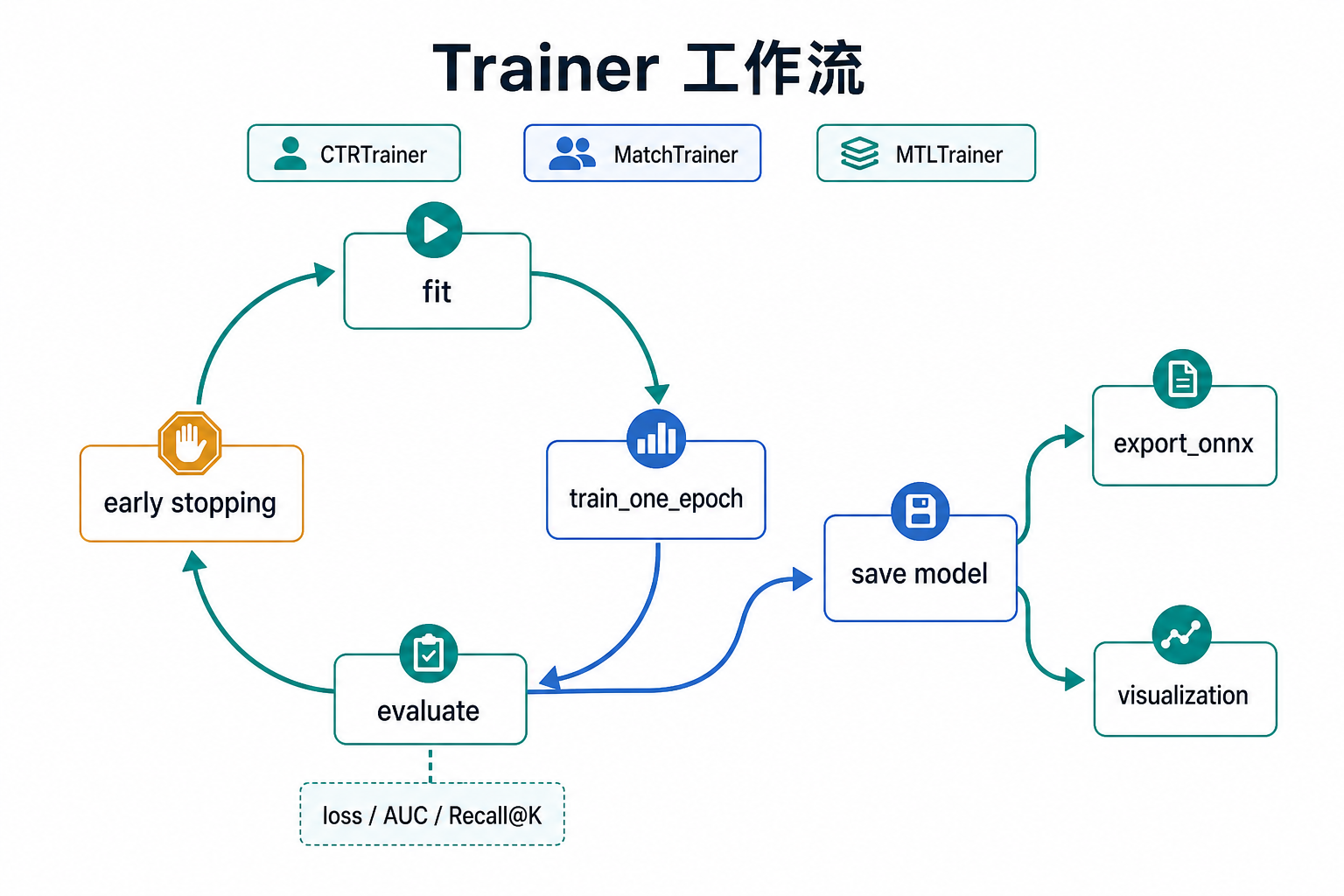
Torch-RecHub provides trainers for ranking, matching, multi-task, and sequence-generation models. All provide fit and ONNX export, but their batch formats, evaluate arguments, and return values are not identical. Follow the contract for each trainer below.
Experiment Tracking & Visualization
Install the relevant optional dependencies first:
python -m pip install "torch-rechub[tracking]"
python -m pip install "torch-rechub[visualization]"
python -m pip install "torch-rechub[onnx]"- Supports WandB / SwanLab / TensorBoardX as
model_logger; you can pass a single instance or a list. - Auto-logs train/validation metrics and hyperparameters:
train/loss,learning_rate,val/auc(CTR/Match),val/task_i_score(MTL),val/accuracy(Seq). - Set
model_logger=None(default) for zero overhead when tracking is not needed.
from torch_rechub.basic.tracking import WandbLogger, TensorBoardXLogger
from torch_rechub.trainers import CTRTrainer

wb = WandbLogger(project="rechub-demo", name="deepfm")
tb = TensorBoardXLogger(log_dir="./runs/deepfm")

trainer = CTRTrainer(model, model_logger=[wb, tb])
trainer.fit(train_dataloader, val_dataloader)
Trainers
Save directory: Trainers do not create
model_pathautomatically, so create it before callingfit. When early stopping actually fires, the trainer restores the recorded best weights before saving. If training reaches its epoch limit without early stopping, it saves the last epoch, which should not be assumed to be the validation-best checkpoint.
CTRTrainer
Used for ranking (CTR prediction) models such as DeepFM, Wide&Deep, DCN.
import os

from torch_rechub.trainers import CTRTrainer
from torch_rechub.models.ranking import DeepFM

model = DeepFM(deep_features=deep_features, fm_features=fm_features, mlp_params={"dims": [256, 128], "dropout": 0.2})

trainer = CTRTrainer(
    model=model,
    optimizer_params={"lr": 0.001, "weight_decay": 0.0001},
    n_epoch=50,
    earlystop_patience=10,
    device="cuda:0",
    model_path="saved/deepfm"
)

os.makedirs("saved/deepfm", exist_ok=True)
trainer.fit(train_dataloader, val_dataloader)
auc = trainer.evaluate(trainer.model, test_dataloader)
trainer.export_onnx("deepfm.onnx")
trainer.visualization(save_path="deepfm_architecture.pdf")
Parameters
model: Ranking model instance.optimizer_fn: Optimizer function, defaulttorch.optim.Adam.optimizer_params: Optimizer parameters.regularization_params: Dictionary that may containembedding_l1,embedding_l2,dense_l1, anddense_l2.scheduler_fn: Learning rate scheduler.scheduler_params: Scheduler parameters.n_epoch: Number of training epochs.earlystop_patience: Patience for early stopping.device: Training device.gpus: GPU device IDs; more than one usestorch.nn.DataParallel.loss_mode: Boolean.Truewhen the model returns only predictions;Falsewhen the model returns predictions plus auxiliary loss.model_path: Path to save the model.
MatchTrainer
Used for matching/retrieval models such as DSSM, YoutubeDNN, MIND.
import os

from torch_rechub.trainers import MatchTrainer
from torch_rechub.models.matching import DSSM

model = DSSM(
    user_features=user_features,
    item_features=item_features,
    temperature=1.0,  # retained by DSSM, but not applied in its current forward()
    user_params={"dims": [256, 128, 64]},
    item_params={"dims": [256, 128, 64]}
)

trainer = MatchTrainer(
    model=model,
    mode=0,  # 0: point-wise, 1: pair-wise, 2: list-wise
    optimizer_params={"lr": 0.001},
    n_epoch=50,
    device="cuda:0",
    model_path="saved/dssm"
)

os.makedirs("saved/dssm", exist_ok=True)
trainer.fit(train_dataloader)
trainer.export_onnx("user_tower.onnx", mode="user")
trainer.export_onnx("item_tower.onnx", mode="item")
Parameters
model: Matching model instance.mode: Training mode, one of 0 (point-wise), 1 (pair-wise), 2 (list-wise).in_batch_neg: Use in-batch negatives for two-tower models that exposeuser_tower()anditem_tower().in_batch_neg_ratio: Negatives sampled for each positive pair;Noneuses all available negatives.hard_negative: WhenTrue, choose the highest-scoring negatives in the current batch.sampler_seed: Random seed for in-batch negative sampling.optimizer_fn: Optimizer function, defaulttorch.optim.Adam.optimizer_params: Optimizer parameters.regularization_params: Dictionary that may containembedding_l1,embedding_l2,dense_l1, anddense_l2.scheduler_fn: Learning rate scheduler.scheduler_params: Scheduler parameters.n_epoch: Number of training epochs.earlystop_patience: Patience for early stopping.device: Training device.gpus: GPU device IDs; more than one usestorch.nn.DataParallel.model_path: Path to save the model.
MTLTrainer
Used for multi-task models such as MMoE, PLE, ESMM, SharedBottom.
import os

from torch_rechub.trainers import MTLTrainer
from torch_rechub.models.multi_task import MMOE

model = MMOE(
    features=features,
    task_types=["classification", "classification"],
    n_expert=8,
    expert_params={"dims": [32,16]},
    tower_params_list=[{"dims": [32, 16]}, {"dims": [32, 16]}]
)

trainer = MTLTrainer(
    model=model,
    task_types=["classification", "classification"],
    optimizer_params={"lr": 0.001},
    adaptive_params={"method": "uwl"},
    n_epoch=50,
    earlystop_taskid=0,
    device="cuda:0",
    model_path="saved/mmoe"
)

os.makedirs("saved/mmoe", exist_ok=True)
trainer.fit(train_dataloader, val_dataloader)
trainer.export_onnx("mmoe.onnx")
Parameters
model: Multi-task model instance.task_types: List of task types (classification,regression).optimizer_fn: Optimizer function, defaulttorch.optim.Adam.optimizer_params: Optimizer parameters.regularization_params: Dictionary that may containembedding_l1,embedding_l2,dense_l1, anddense_l2.scheduler_fn: Learning rate scheduler.scheduler_params: Scheduler parameters.adaptive_params: Adaptive loss weighting parameters.Noneuses equal weighting; the example uses{"method": "uwl"}.n_epoch: Number of training epochs.earlystop_taskid: Task id used for early stopping.earlystop_patience: Patience for early stopping.device: Training device.gpus: GPU device IDs; more than one usestorch.nn.DataParallel.model_path: Path to save the model.
Early-stopping direction:
MTLTrainercurrently always treats the score forearlystop_taskidas “higher is better.” The default regression metric is MSE, where lower is better, so do not select a regression task as the current early-stopping task.
SeqTrainer
Used for next-item sequence models such as HSTU and HLLM. Each batch must be (seq_tokens, seq_positions, seq_time_diffs, targets). Evaluation returns (average_loss, top1_accuracy).
import os

from torch_rechub.trainers import SeqTrainer

os.makedirs("saved/hstu", exist_ok=True)
trainer = SeqTrainer(
    model=model,
    optimizer_params={"lr": 1e-3, "weight_decay": 1e-5},
    n_epoch=10,
    device="cpu",
    model_path="saved/hstu",
    loss_type="cross_entropy",  # alternatively "nce"
)

history = trainer.fit(train_dataloader, val_dataloader)
test_loss, top1_accuracy = trainer.evaluate(test_dataloader)
trainer.export_onnx("hstu.onnx", vocab_size=model.vocab_size)
SeqTrainer ignores seq_positions from the batch; current HSTU/HLLM models derive positions internally. loss_type="cross_entropy" ignores token 0 by default, so preprocessing must reserve 0 exclusively for padding.
Evaluation Metrics
Metrics are available from torch_rechub.basic.metric:
from torch_rechub.basic.metric import (
    auc_score,
    coverage_score,
    diversity_score,
    gauc_score,
    log_loss,
    novelty_score,
    topk_metrics,
)

auc = auc_score(y_true, y_score)
gauc = gauc_score(y_true, y_score, user_ids)
ranking = topk_metrics(ground_truth, recommendations, topKs=[5, 10])
diversity = diversity_score(recommendations, item_embeddings, topKs=[10])
coverage = coverage_score(recommendations, all_item_ids, topKs=[10])
novelty = novelty_score(recommendations, item_popularity, topKs=[10])auc_scoreandlog_lossaccept per-example labels and scores and return floats. Higher AUC is better; lower log loss is better.gauc_scorecomputes AUC per user. Every included user group must contain both positive and negative labels; passweights={user_id: weight}for custom weighting.topk_metricscomputes NDCG, MRR, Recall, Hit, and Precision. Both inputs are{user_id: [item_id, ...]}, and each recommendation list must contain at leastmax(topKs)items.diversity_score,coverage_score, andnovelty_scoremeasure within-list difference, catalog coverage, and mean self-information respectively; higher is better.
topk_metrics and the three beyond-accuracy metrics currently return dictionaries of formatted string lists, for example {"Recall": ["Recall@10: 0.1234"]}, not dictionaries of raw floats. ndcg_score, hit_score, mrr_score, recall_score, and precision_score return their corresponding string lists as well.
Callbacks
EarlyStopper
Used for early stopping on a metric where higher is better.
from torch_rechub.basic.callback import EarlyStopper

early_stopper = EarlyStopper(patience=10)

if early_stopper.stop_training(auc, model.state_dict()):
    print(f'validation: best auc: {early_stopper.best_auc}')
    model.load_state_dict(early_stopper.best_weights)
    break
Parameters
patience: Number of consecutive epochs without improvement before stopping.
EarlyStopper currently has no delta, mode="min", or custom direction option. It cannot directly monitor a loss or MSE that must be minimized.
Loss Functions
RegularizationLoss
Supports L1 and L2 regularization.
from torch_rechub.basic.loss_func import RegularizationLoss

reg_loss_fn = RegularizationLoss(
    embedding_l1=0.0,
    embedding_l2=0.0001,
    dense_l1=0.0,
    dense_l2=0.0001
)
BPRLoss
Pairwise loss for matching models.
from torch_rechub.basic.loss_func import BPRLoss

bpr_loss = BPRLoss()
loss = bpr_loss(pos_score, neg_score)