
Vector Retrieval Wrapper
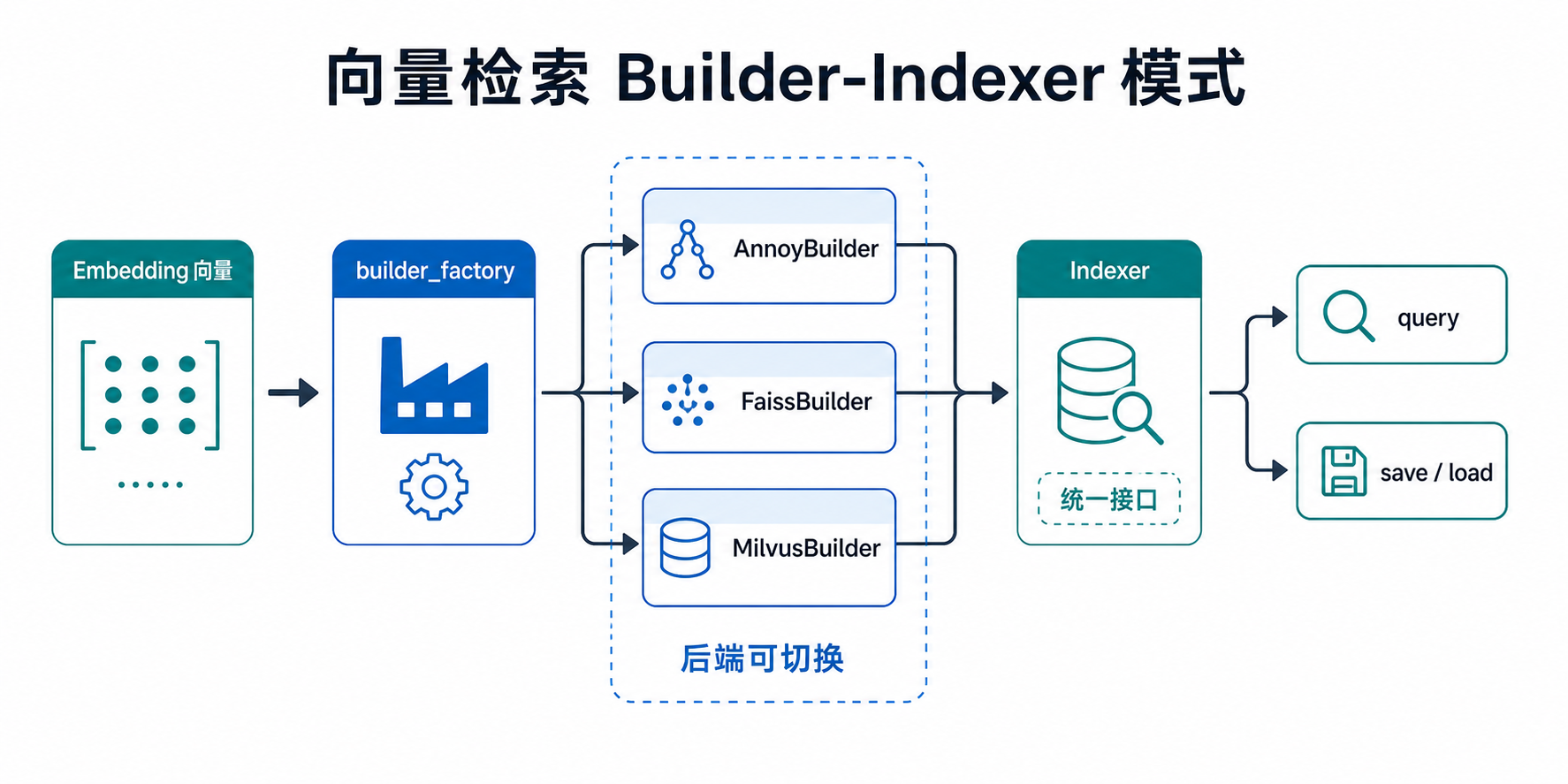
Torch-RecHub provides a unified vector retrieval interface that supports three mainstream Approximate Nearest Neighbor (ANN) search libraries: Annoy, FAISS, and Milvus. The standardized Builder-Indexer pattern makes it easy to switch between retrieval backends.
Installation
The current torch_rechub.serving package loads all three backends when imported. Even if you use only one backend, you need to install all retrieval extras:
pip install "torch-rechub[annoy,faiss,milvus]"This is a limitation of the current package import behavior; it does not mean that all three backends must be used at runtime.
Quick Start
import torch
from torch_rechub.serving import builder_factory

# Prepare embedding vectors
item_embeddings = torch.randn(1000, 64, dtype=torch.float32)  # 1,000 items, 64 dimensions
user_embeddings = torch.randn(10, 64, dtype=torch.float32)    # 10 users, 64 dimensions

# Create a Builder and build the index
builder = builder_factory("faiss", index_type="Flat", metric="L2")

with builder.from_embeddings(item_embeddings) as indexer:
    # Query Top-K
    ids, scores = indexer.query(user_embeddings, top_k=10)
    # Save the index
    indexer.save("item.index")

# Load an existing index
with builder.from_index_file("item.index") as indexer:
    ids, scores = indexer.query(user_embeddings, top_k=10)
The meaning of the second return value depends on the metric: for L2/angular it is generally a distance where smaller is closer, while for IP/COSINE it is generally a score where larger is more similar. Do not compare this value directly across different metrics.
Core Concepts
Builder-Indexer Pattern
- Builder: Manages index construction configuration and is created through the
builder_factoryfactory function - Indexer: Performs query and save operations and is obtained through the Builder's context manager
Factory Function
from torch_rechub.serving import builder_factory

builder = builder_factory(model, **builder_config)| Parameter | Type | Description |
|---|---|---|
model | str | Retrieval backend name: "annoy", "faiss", or "milvus" |
**builder_config | dict | Configuration arguments passed to the specific Builder |
Annoy
Annoy (Approximate Nearest Neighbors Oh Yeah) is an open-source approximate nearest neighbor search library from Spotify. It is memory efficient and supports memory-mapped index files.
Backend Dependencies
pip install "torch-rechub[annoy,faiss,milvus]"⚠️ Note: Annoy includes a C++ extension. If PyPI has no wheel for your Python version and platform, installation falls back to local compilation: Linux/macOS requires a working
gcc/g++orclang, while Windows requires Visual Studio Build Tools. Do not install binary wheels from unknown third-party sources.
Parameters
builder = builder_factory(
    "annoy",
    d=64,                    # Vector dimension (required)
    metric="angular",        # Distance metric
    n_trees=10,              # Number of trees
    threads=-1,              # Number of build threads
    searchk=-1,              # Number of nodes inspected during search
)| Parameter | Type | Default | Description |
|---|---|---|---|
d | int | Required | Vector dimension |
metric | str | "angular" | Distance metric: "angular" (cosine), "euclidean" (Euclidean), or "dot" (dot product) |
n_trees | int | 10 | Number of trees to build; more trees improve accuracy but slow construction |
threads | int | -1 | Number of build threads; -1 uses all available cores |
searchk | int | -1 | Nodes inspected during search; -1 means n_trees * top_k |
Usage Example
import torch
from torch_rechub.serving import builder_factory

item_embeddings = torch.randn(1000, 64, dtype=torch.float32)
user_embeddings = torch.randn(10, 64, dtype=torch.float32)

# Use cosine similarity
builder = builder_factory(
    "annoy",
    d=64,
    metric="angular",
    n_trees=50,
    searchk=100,
)

with builder.from_embeddings(item_embeddings) as indexer:
    ids, distances = indexer.query(user_embeddings, top_k=10)
    indexer.save("annoy.index")

print(f"Retrieved item IDs: {ids}")
print(f"Distances: {distances}")
FAISS
FAISS (Facebook AI Similarity Search) is Meta's open-source high-performance similarity search library with support for multiple index types. The current Torch-RecHub wrapper creates CPU indexes and does not perform CPU-to-GPU index conversion.
Backend Dependencies
pip install "torch-rechub[annoy,faiss,milvus]"The faiss-gpu package itself provides GPU capabilities, but the current FaissBuilder does not move indexes to the GPU. This page's API therefore still uses the CPU path.
Supported Index Types
| Index Type | Description | Use Case |
|---|---|---|
Flat | Brute-force search, exact results | Small-scale data (< 100K) |
HNSW | Graph-based approximate search | Medium-scale, high recall |
IVF | Inverted index, clustered search | Large-scale data |
Parameters
Flat Index
builder = builder_factory(
    "faiss",
    index_type="Flat",       # Index type
    metric="L2",             # Distance metric
)| Parameter | Type | Default | Description |
|---|---|---|---|
index_type | str | "Flat" | Index type |
metric | str | "L2" | Distance metric: "L2" (Euclidean) or "IP" (inner product) |
HNSW Index
builder = builder_factory(
    "faiss",
    index_type="HNSW",
    metric="L2",
    m=32,                    # Maximum number of neighbors per node
    efSearch=50,             # Number of candidate nodes during search
)| Parameter | Type | Default | Description |
|---|---|---|---|
m | int | 32 | Maximum neighbors per node; larger values improve accuracy |
efSearch | int | None | Candidate nodes during search; larger values are more accurate but slower |
IVF Index
builder = builder_factory(
    "faiss",
    index_type="IVF",
    metric="L2",
    nlists=100,              # Number of cluster centers
    nprobe=10,               # Number of clusters visited during search
)| Parameter | Type | Default | Description |
|---|---|---|---|
nlists | int | 100 | Number of cluster centers; sqrt(n) to 4*sqrt(n) is recommended |
nprobe | int | None | Clusters visited during search; larger values are more accurate but slower |
Usage Example
import torch
from torch_rechub.serving import builder_factory

item_embeddings = torch.randn(10000, 128, dtype=torch.float32)
user_embeddings = torch.randn(100, 128, dtype=torch.float32)

# Use an HNSW index
builder = builder_factory(
    "faiss",
    index_type="HNSW",
    metric="IP",  # Inner product, suitable for normalized vectors
    m=32,
    efSearch=64,
)

with builder.from_embeddings(item_embeddings) as indexer:
    ids, distances = indexer.query(user_embeddings, top_k=20)
    indexer.save("faiss_hnsw.index")
Milvus
Milvus is a cloud-native vector database that supports distributed deployment and multiple indexing algorithms, making it suitable for large-scale vector retrieval in production environments.
Backend Dependencies and Service
pip install "torch-rechub[annoy,faiss,milvus]"Note: You must also start a Milvus service before using this backend. Milvus Standalone includes additional components and cannot be started by simply running an image without its startup command. Follow the official Milvus Docker installation guide to start and check the service.
Supported Index Types
| Index Type | Description | Use Case |
|---|---|---|
FLAT | Brute-force search | Small-scale, exact results |
HNSW | Graph-based index | Medium-scale, high recall |
IVF_FLAT | Inverted index | Large-scale data |
Parameters
FLAT Index
builder = builder_factory(
    "milvus",
    d=64,                    # Vector dimension (required)
    index_type="FLAT",
    metric="COSINE",         # Default distance metric
)| Parameter | Type | Default | Description |
|---|---|---|---|
d | int | Required | Vector dimension |
metric | str | "COSINE" | Distance metric: "L2", "IP", or "COSINE" |
HNSW Index
builder = builder_factory(
    "milvus",
    d=64,
    index_type="HNSW",
    metric="COSINE",
    m=30,                    # Maximum number of neighbors per node
    ef=50,                   # Number of candidate nodes during search
)| Parameter | Type | Default | Description |
|---|---|---|---|
m | int | 30 | Maximum number of neighbors per node |
ef | int | None | Number of candidate nodes during search |
IVF_FLAT Index
builder = builder_factory(
    "milvus",
    d=64,
    index_type="IVF_FLAT",
    metric="IP",
    nlist=128,               # Number of cluster centers
    nprobe=16,               # Number of clusters visited during search
)| Parameter | Type | Default | Description |
|---|---|---|---|
nlist | int | 128 | Number of cluster centers |
nprobe | int | None | Number of clusters visited during search |
Usage Example
import torch
from torch_rechub.serving import builder_factory

item_embeddings = torch.randn(10000, 64, dtype=torch.float32)
user_embeddings = torch.randn(100, 64, dtype=torch.float32)

# Use a Milvus HNSW index
builder = builder_factory(
    "milvus",
    d=64,
    index_type="HNSW",
    metric="COSINE",
    m=32,
    ef=64,
)

with builder.from_embeddings(item_embeddings) as indexer:
    ids, distances = indexer.query(user_embeddings, top_k=10)
    # The current wrapper does not support local save
MilvusBuilder.from_embeddings() creates a randomly named temporary collection and calls drop() when the with block exits; save() and from_index_file() are also unimplemented. This wrapper is therefore suitable for one-off experiments, not for managing persistent online collections. For long-running services, create and maintain collections directly with the Milvus client.
Complete Example: Retrieval Model Evaluation
The following is a vector retrieval evaluation example for a single-interest two-tower model, where both user and item embeddings are two-dimensional tensors. Multi-interest models such as MIND and ComiRec, which output [batch, interests, dim], require the interests to be flattened and deduplication and merge strategies to be defined; they cannot use this function directly.
import collections
import numpy as np
import pandas as pd
import torch
from torch_rechub.serving import builder_factory
from torch_rechub.basic.metric import topk_metrics

def match_evaluation(
    user_embedding: torch.Tensor,
    item_embedding: torch.Tensor,
    test_user: dict,
    all_item: dict,
    user_col: str = 'user_id',
    item_col: str = 'item_id',
    raw_id_maps: str = "./raw_id_maps.npy",
    topk: int = 10,
    backend: str = "faiss",
    **backend_kwargs,
):
    """
    Evaluate retrieval using vector search

    Args:
        user_embedding: User embedding vectors (n_users, dim)
        item_embedding: Item embedding vectors (n_items, dim)
        test_user: Test user data dictionary
        all_item: Complete item data dictionary
        user_col: User ID column name
        item_col: Item ID column name
        raw_id_maps: Path to the ID mapping file
        topk: Number of items to retrieve
        backend: Retrieval backend ("annoy", "faiss", "milvus")
        **backend_kwargs: Additional arguments passed to builder_factory

    Returns:
        Evaluation metrics dictionary
    """
    print(f"Evaluating vector retrieval with {backend}")

    # 1. Create a Builder
    dim = item_embedding.shape[1]

    if backend == "annoy":
        config = {"d": dim, "n_trees": 10}
    elif backend == "faiss":
        config = {"index_type": "Flat", "metric": "L2"}
    elif backend == "milvus":
        config = {"d": dim, "index_type": "FLAT", "metric": "L2"}
    else:
        raise ValueError(f"Unsupported backend: {backend}")
    # Caller arguments override defaults, avoiding duplicate keywords such as index_type
    config.update(backend_kwargs)
    builder = builder_factory(backend, **config)

    # 2. Ensure tensors are on the CPU
    item_embedding = item_embedding.cpu().float()
    user_embedding = user_embedding.cpu().float()

    # 3. Load ID mappings
    user_map, item_map = np.load(raw_id_maps, allow_pickle=True)

    # 4. Build the index and query it
    match_res = collections.defaultdict(dict)

    with builder.from_embeddings(item_embedding) as indexer:
        ids, distances = indexer.query(user_embedding, topk)
        ids_np = ids.numpy()

        for i, user_id in enumerate(test_user[user_col]):
            items_idx = ids_np[i]
            predicted_item_ids = all_item[item_col][items_idx]
            match_res[user_map[user_id]] = np.vectorize(item_map.get)(predicted_item_ids)

    # 5. Build the ground truth
    data = pd.DataFrame({user_col: test_user[user_col], item_col: test_user[item_col]})
    data[user_col] = data[user_col].map(user_map)
    data[item_col] = data[item_col].map(item_map)
    user_pos_item = data.groupby(user_col).agg(list).reset_index()
    ground_truth = dict(zip(user_pos_item[user_col], user_pos_item[item_col]))

    # 6. Compute metrics
    out = topk_metrics(y_true=ground_truth, y_pred=match_res, topKs=[topk])
    return out


# Usage example
# result = match_evaluation(
#     user_embedding, item_embedding, test_user, all_item,
#     topk=10, backend="faiss", index_type="HNSW", m=32
# )
Performance Comparison and Selection Guide
| Feature | Annoy | FAISS | Milvus |
|---|---|---|---|
| Installation Difficulty | Easy | Moderate | Requires a service |
| Memory Usage | Low | Moderate | Depends on service configuration |
| Build Speed | Slow | Fast | Fast |
| Query Speed | Moderate | Fast | Fast |
| Current Wrapper GPU Path | ❌ | ❌ | Determined by the Milvus service |
| Distributed | ❌ | ❌ | ✅ |
| Current Wrapper Use Case | Small-scale offline | Medium-to-large-scale offline | Temporary experiments |
Selection Recommendations
- Quick prototyping / Small datasets: Use Annoy for simple installation and efficient memory use
- Medium-to-large-scale offline computation: Use FAISS; the current wrapper uses the CPU path
- Persistent online services: The Milvus service itself supports distributed operation and dynamic updates, but manage collections directly with the Milvus client instead of using the current context wrapper, which automatically deletes its collection
API Reference
BaseBuilder
class BaseBuilder(abc.ABC):
    def from_embeddings(self, embeddings: torch.Tensor) -> ContextManager[BaseIndexer]:
        """Build an index from embedding vectors"""

    def from_index_file(self, index_file: FilePath) -> ContextManager[BaseIndexer]:
        """Load an index from a file"""
BaseIndexer
class BaseIndexer(abc.ABC):
    def query(self, embeddings: torch.Tensor, top_k: int) -> tuple[torch.Tensor, torch.Tensor]:
        """
        Query nearest neighbors

        Args:
            embeddings: Query vectors (n, d)
            top_k: Number of nearest neighbors to return

        Returns:
            ids: Nearest-neighbor IDs (n, top_k)
            distances: Distances (n, top_k)
        """

    def save(self, file_path: FilePath) -> None:
        """Save the index to a file"""
These are abstract interfaces; not every backend implements the persistence methods. The current Milvus backend raises NotImplementedError from from_index_file() and save().