Chapters
On this page
4. Embodied AI platforms
An embodied AI platform is the body an agent uses to perceive, act, and interact with its environment. For a physical robot, this includes mechanical structures, sensors, and actuators. Different bodies determine what a robot can observe, which actions it can perform, and where it can operate.
4.1 What the body determines
| Component | What it determines | Examples |
|---|---|---|
| Mechanical structure | Degrees of freedom, workspace, and whether the robot can move | An arm can only manipulate within its reach; legs can climb steps and wheels cannot |
| Sensors | What the robot can observe | A wrist camera sees details near the gripper; an IMU measures orientation and angular velocity; tactile sensors detect contact |
| Actuators | Which actions the robot can produce and how much force it can apply | Motor torque limits determine how much a robot can lift and how high it can jump; a dexterous hand can do more in-hand manipulation than a parallel gripper |
Here, degrees of freedom (DoF) are the number of independently controllable directions of motion. For example, a common industrial arm has 6 joints and therefore 6 degrees of freedom; a typical quadruped has 3 joints per leg, for 12 degrees of freedom in its legs.
Move the same method to a different body and the observations, actions, and achievable tasks all change. So when you read a paper or reproduce an experiment, first check which robot platform it uses.
4.2 Common platforms
With the four skills from Chapter 3 in mind, explore these five common types of physical platform, followed by simulated bodies used in research. The demos below show how each type moves; switch between official clips and 3D illustrations:
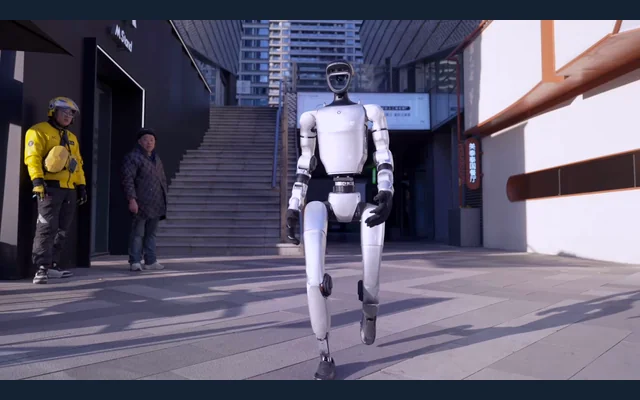
Unitree G1Alternating footsteps coordinate with the torso and arms to produce bipedal walking.
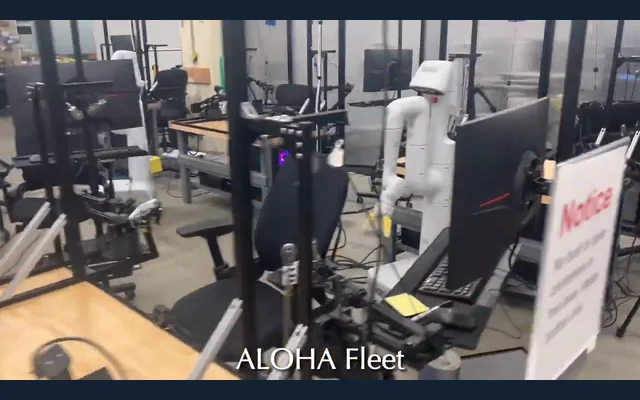
ALOHA 2Two arms pick up and transfer tabletop objects. Teleoperated demonstration; the original footage runs at 4× speed.
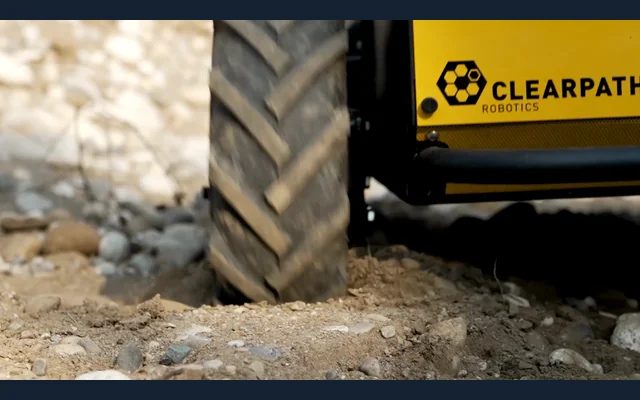
Husky A300Wheels drive the base across outdoor surfaces and uneven terrain.
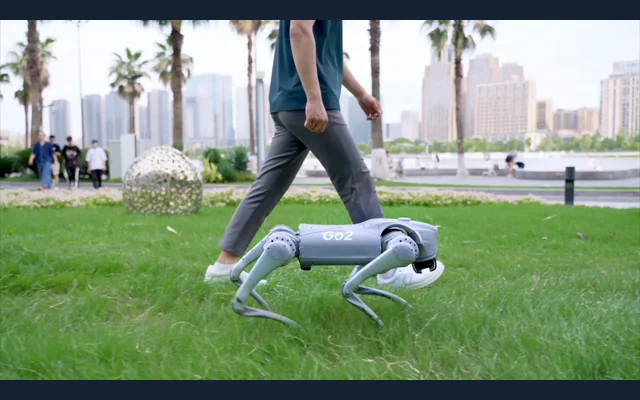
Unitree Go2Four legs alternate support and coordinate turns while following a person.
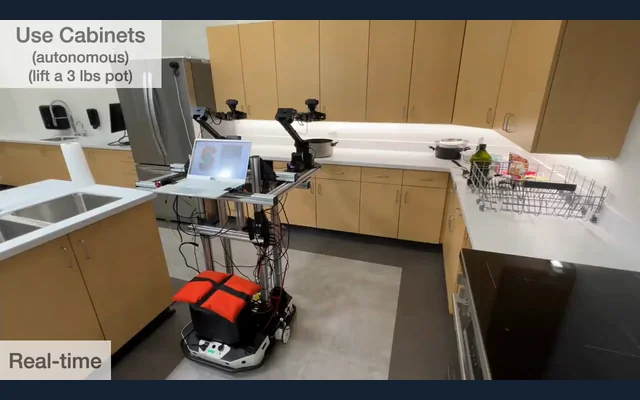
Mobile ALOHAThe mobile base approaches a cabinet, then an arm reaches out and opens its door.
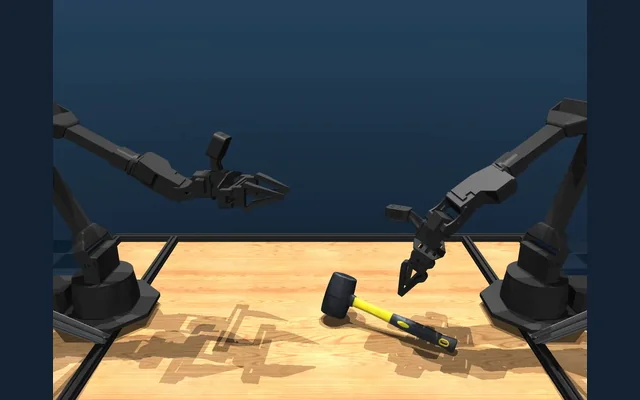
MuJoCo · ALOHA 2Virtual arms grasp and transfer a tool in the official ALOHA 2 MuJoCo teleoperation simulation.
Official clips preserve the original playback speed and visual labels. Follow the source links for the full demonstrations.
Humanoid robots
- Body: two legs, a torso, and two arms.
- Example platforms: Unitree G1, Figure 03.
- Related skills: grasping, manipulation, locomotion, and navigation, which can be studied together depending on the configuration.
- Common research questions: biped walking, balance, whole-body coordination of arms and body, and manipulation while moving. Hand design, sensors, and control interfaces determine which experiments are possible.
Fixed-base robot arms
- Body: one or two arms on a fixed base.
- Example platforms: Franka Research 3, ALOHA 2, SO-101.
- Related skills: grasping, manipulation.
- Common research questions: tabletop grasping, assembly, bimanual coordination, and imitation learning. Useful for focusing on end-effector–object interaction, with a workspace limited by the arms' reach.
Wheeled mobile robots
- Body: move using a wheeled base.
- Example platforms: TurtleBot 4, Jackal, Husky A300.
- Related skills: locomotion, navigation.
- Common research questions: localization, mapping, path planning, obstacle avoidance, and multirobot coordination. Motion control must account for steering constraints, wheel–ground contact, and slipping.
Quadruped robots
- Body: use four legs for support and movement.
- Example platforms: Unitree Go2, Spot.
- Related skills: locomotion, navigation; adding an arm enables manipulation skills.
- Common research questions: gaits, balance, challenging terrain, perception–locomotion coordination, and sim-to-real policy transfer. Navigation and locomotion must be validated together in the target environment.
Mobile manipulation platforms
- Body: a mobile base combined with a manipulator.
- Example platforms: Stretch 3, Mobile ALOHA, ALMA.
- Related skills: grasping, manipulation, locomotion, and navigation, with an emphasis on coordinating mobility and manipulation.
- Common research questions: reach a work location, then pick and place objects, open doors, or carry items. The base may use wheels or legs; its position must be coordinated with arm reach and body stability.
Simulated bodies
- Body: models define the body and sensors.
- Example platforms / tools: Habitat, Isaac Lab, MuJoCo.
- Related skills: depend on the simulated body and task.
- Common research questions: study navigation, manipulation, or locomotion in configurable scenes, collect interaction data, and run repeatable evaluations. Observations, actions, and physics settings determine what the experiment can demonstrate.
4.3 Compare the platforms
| Platform | Typical observations | Typical actions | Related skills |
|---|---|---|---|
| Humanoid robots | Joint states, IMU, head camera | Whole-body joint targets | Grasping, manipulation, locomotion, navigation |
| Fixed-base robot arms | Joint states, external or wrist cameras, optionally force sensing | End-effector poses or joint targets, gripper open/close | Grasping, manipulation |
| Wheeled mobile robots | LiDAR, cameras, odometry | Linear and angular velocity of the base | Locomotion, navigation |
| Quadruped robots | Joint states, IMU, optionally depth cameras or elevation maps | Target angles for 12 joints | Locomotion, navigation |
| Mobile manipulation platforms | Combined sensors of the base and arm | Base velocity and arm actions | Grasping, manipulation, locomotion, navigation |
| Simulated bodies | Defined by the simulation model | Defined by the simulation model | Depend on the simulated body and task |
The table shows common configurations; specific platforms vary.
4.4 The categories overlap
These categories overlap: humanoids and quadrupeds with arms can also be mobile manipulation platforms. The body enables skills; actual capabilities still require validation in specific tasks.
A simulated body is a robot or agent in simulation. Habitat, Isaac Lab, and MuJoCo listed above are platforms and tools for building or running these bodies. Virtual bodies also require explicitly defined sensors, action spaces, and interactions with the environment.
Simulation makes training safer and cheaper, and it allows parallel runs and repeatable evaluation. The cost is a gap between simulation and reality, which Chapter 5 discusses.
4.5 Choosing a platform for learning
- Start in simulation: simulators such as MuJoCo are free to use, and mistakes cannot damage hardware. Build a quadruped from scratch takes place entirely in simulation.
- For imitation learning and real-robot manipulation: a low-cost open source arm with LeRobot supports data collection, training, and deployment. See the SO-101 + LeRobot hardware tutorial.
- For motion control: training legged robots in simulation is a good starting point. See MicroDuck RL.
For more directions and entry points, see projects.
Summary
- A platform is the agent's body: its mechanical structure, sensors, and actuators determine observations, actions, and working environments.
- Common platforms include humanoids, fixed-base arms, wheeled mobile robots, quadrupeds, mobile manipulation platforms, and simulated bodies, and the categories overlap.
- While learning, start in simulation, then choose a real robot platform based on your direction.
Further reading
- 5. Key challenges: the problems robots still face in real-world applications.
- Simulation tools: quick starts for MuJoCo, Isaac Sim, Gymnasium, and PyBullet.
References
- Modern Robotics: Wheeled robots and mobile manipulation
- For platform details, refer to the official pages linked above.