外观

第10章 Normalization:归一化算子
本章导读
第 9 章把多个输入合成一个和。现在希望把一行分数变成一行非负权重,让它们加起来等于 1。Softmax 先取指数,再除以整行指数的和;因此每个输出既需要自己的输入,也需要整行共同算出的分母。
本章用 [1000, 1001, 1002] 看清稳定公式,再分别研究两个问题:一行里的计算怎样分工,中间结果是否值得留在一次 kernel 内完成? HIP 先建立每行一个 block 的三阶段基线,再比较融合;Triton 从一行一个 program 出发,分别比较参与的 warps 数和逻辑向量宽度。
- 先理解算法:阅读行级语义、数值稳定性与中间数据流。
- 选择 HIP:进入 HIP 路线,先确认行内协作,再验证融合是否划算。
- 选择 Triton:进入 Triton 路线,用固定参数的对照逐步选择执行配置。
配套代码在 code/part2-kernels/chapter10/,环境沿用 Radeon RX 9070 XT(gfx1201)+ ROCm 10.0 + 原生 Ubuntu 24.04。归约、mask 与 GPU event 分别沿用第 9、8、5 章;动画展示手算步骤,不表示真实执行速度。
10.1 从一行分数到一行概率
输入一行 [2, 1, 0],先逐位置取自然指数,再除以这些指数的总和:
输入 x | exp(x),约值 | 除以总和 11.1074 后,约值 |
|---|---|---|
| 2 | 7.3891 | 0.6652 |
| 1 | 2.7183 | 0.2447 |
| 0 | 1.0000 | 0.0900 |
分数越大,得到的权重越大。未舍入输出的和为 1,因此可以解释成一组概率;表中四位小数之和为 0.9999,只是显示舍入。
对 R×C 的矩阵 X,本章沿每一行的列维度计算:
r 是行号,c 是列号。一个输出的分子来自当前位置,分母却来自整行;同一行内需要协作,不同行互不依赖。我们不会为整个矩阵只计算一个共同分母。
10.2 平移输入,避免指数溢出
把输入换成 [1000, 1001, 1002]。直接计算 exp(1000) 已远超 FP32 的有限范围,最后可能得到 inf/inf。反过来,[-1002, -1001, -1000] 的指数可能全部下溢为 0,分母也变成 0。
整行减去同一个常数,可以在数学上保留原来的比例:
选择 a=max(x),最大的指数自变量就变成 0:
| 步骤 | [1000,1001,1002] 的结果 |
|---|---|
最大值 m | 1002 |
平移 x−m | [-2, -1, 0] |
指数 p=exp(x−m) | 约 [0.1353, 0.3679, 1.0000] |
分母 s=sum(p) | 约 1.5032 |
输出 y=p/s | 约 [0.0900, 0.2447, 0.6652] |
手算示例 · 一行三个值整行归约,再将标量分发给各位置
跟踪同一行的三个数输入是 1000、1001、1002。原值一直保留在顶行;最大值、分母与输出尚未产生。
箭头表示数据依赖与值的副本,不指定物理线程或存储位置;动画速度不表示 GPU 耗时。
图 10.1 同一行先汇入最大值 m,再把 m 分发给各位置;指数求和得到 s 后,所有位置再使用同一个分母。数字在运算完成时更新,图中小数保留四位。
图 10.1 中,先停在“汇入 max”,确认三个输入共同产生一个 1002;再进入“分发 m”,看同一个值怎样用于三次减法。分母也遵循相同的汇入与分发关系。最大值和分母各只有一个,却要供整行共同使用。这正是两次归约的职责。减去最大值后,至少一项指数为 1;其他项处在 0 与 1 之间,因此不会因为全部指数下溢而得到零分母。
所有版本采用相同的稳定形式:
本章输入限定为有限 FP32 值。减去最大值解决了直接指数的主要范围问题,并不消除舍入误差;非常小的概率仍可能下溢为 0。含 NaN 或无穷的输入需要另行规定语义。
10.3 中间结果与计算边界
稳定公式串起了四个逻辑操作:
| 操作 | 已学过的模式 | 下一步需要什么 |
|---|---|---|
max(x) | Reduction | 整行共同使用的最大值 |
exp(x−m) | Element-Wise | 每列一个稳定指数 |
sum(p) | Reduction | 整行共同使用的分母 |
p/s | Element-Wise | 每列一个输出 |
四个逻辑操作不要求启动四个 kernel。一个直接方案用三个阶段:求最大值;计算并保存指数,同时求和;读取指数与行和,完成归一化。后一个阶段要读前一个阶段的结果,所以它们通过全局数组连接。
图 10.2 上方用中间数组连接三次调用;下方尝试在一次调用中完成。融合版如何保存或重算指数,要到具体实现中判断。
图 10.2 给出一个优化方向:少一次中间数组往返,是否值得?主输入为 4096×1024,单个 FP32 指数数组 exp_tmp 就有 16 MiB,完整写入再读取对应 32 MiB 的逻辑访问。
但省掉这个数组后,指数仍要用于最后的除法。可以保留它,也可以重新计算。HIP 本章采用重算,Triton 在 program 的逻辑表达式中复用指数值。我们会分别检查各自新增和减少的工作,再用完整计时作选择。
10.4 正确性参考与计时范围
两条路线使用同一输入语义:连续的 R×C FP32 矩阵,沿最后一维做 Softmax。测试值随行列位置变化,并按行叠加 +1000、−1000、0,以覆盖直接取指数容易出问题的范围;本轮固定 seed=20260920。
| 检查项目 | 本章约定 |
|---|---|
| 输入与输出 | 有限 FP32 输入,同形状 FP32 输出 |
| 正确性参考 | CPU 按 FP64 稳定公式计算,再转为 FP32 与输出比较 |
| 逐元素误差 | 输出必须有限,最大绝对误差不超过 2e-5 |
| 行和误差 | 每行与 1 的差不超过 2e-5;两条路线均用 FP64 累加输出行和 |
| 检查时机 | 计时前检查完整输出;计时后检查最后一次完整输出 |
| 初始化检查 | 首次输出预填 NaN,使未写入位置能被发现 |
正确性参考负责判断答案;HIP 的路线基线是 cooperative 三阶段,Triton 的路线基线是紧凑逻辑宽度与 4 warps。CPU reference 不作为 GPU 性能基线。
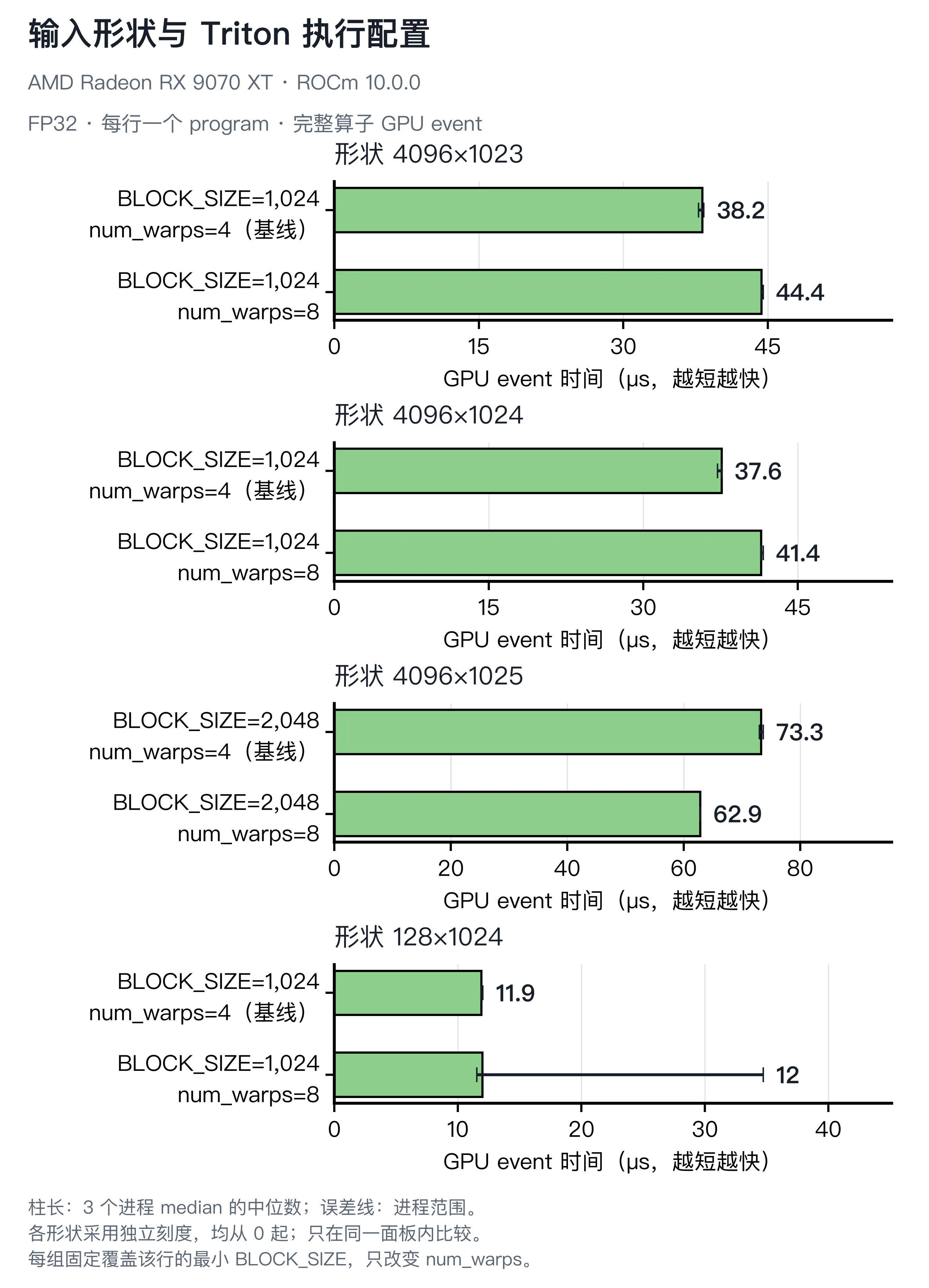
本章基准测试的主形状定为 4096×1024。为了检验不同尺寸下的泛化表现,我们还会测试 4096×1023(比主形状少一列的尾部边界)、4096×1025(超过 1024 列后需要额外补齐与掩码保护的边界)以及行数较少的 128×1024;主矩阵与这些补充形状共涵盖 75 个独立进程、3,750 个计时样本。此外,在微小尺寸(如 1×1、3×33、3×257、3×1025)上验证全部七种配置的数值正确性(共 28 项检查通过)。这里验证的是带较大正负偏移的代表性有限输入,并不意味着任意极端数值输入都能获得绝对数学保证。
完整 Softmax 的 event 区间从第一个 kernel 之前开始,到最后一个 kernel 之后结束:三阶段包含全部三次调用,融合包含一次调用。两条路线每轮都等待结束 event 完成,再读取该轮时间。内存分配、初始数据拷贝、CPU reference、输出检查和 Triton 首次 JIT 均在稳态计时之外。
正式采集于 2026-09-20,Radeon RX 9070 XT(gfx1201)、ROCm SDK 10.0.0、原生 Ubuntu 24.04,HIP 为 7.15.26333,Triton 为 3.8.0。每配置三个独立进程,各预热 10 次、计时 50 次,轮换执行顺序;同一进程复用数组、不主动刷缓存,设备保留桌面与已有上下文。短 event 区间仍可能包括 CPU 提交空隙。
正式计时不打开 profiler,trace 另行采集。结果图以各独立进程 median 的中位数作为中心,范围表示这些 median 的最小值到最大值,不是置信区间。先检查完整时间,再用阶段诊断解释下一步要研究什么。
10.5 HIP 与 Triton 优化路线
两条路线分别建立自然的基线,再围绕一个问题修改。先选一种语言读完整即可。
环境与结果目录。 以下命令在 GPU 机器的仓库根目录开始执行,后续保持在 code/part2-kernels/。沿用本篇 uv.lock,不要删除锁文件:
bash
cd code/part2-kernels &&
uv sync --locked &&
source ./activate-rocm.sh
为本章新建一个独立结果目录,保存打印出来的路径:
bash
mkdir -p chapter10/results &&
RUN=$(mktemp -d chapter10/results/walkthrough-XXXXXX) &&
mkdir "$RUN/build" &&
printf '本轮结果目录:%s\n' "$RUN"
换终端后,重新执行环境准备,再恢复之前打印的目录;提示处只粘贴路径,不含 RUN=:
bash
read -r -p '粘贴上次输出的结果目录:' RUN &&
test -n "$RUN" && test -d "$RUN/build" &&
printf '继续使用结果目录:%s\n' "$RUN"
需要重测或改动源码时,新建 RUN,重新编译 HIP;恢复旧目录只用于继续未修改的实验。后续命令会拒绝写入已有样本。
每条命令先校验,再完成一个进程的 10 次预热与 50 次计时;折叠输出对应第 1 个进程。图使用三个独立进程的统计,不是一次终端输出。 手工复测时同时把样本名 p1 与 --process 1 改为 p2/2、p3/3,每遍覆盖同组候选并轮换起始项。章末批量入口会自动完成这一步、汇总并画本轮图,不要求先运行 profiler。
本章把三个问题分开:答案与行和是否正确,完整 Softmax 是否更快,以及融合后程序是否保持了计划中的行分工。前两个问题每轮都检查,第三个问题只在融合对照中用一组 trace 核对。
10.5.1 公式入口:展开三个阶段
完整源码:code/part2-kernels/chapter10/softmax_hip.hip
cpp
// Chapter 10: numerically stable row-wise Softmax in HIP.
//
// The baseline deliberately exposes three global-memory stages. The fused
// version assigns one block to one row and keeps both reductions in LDS.
#include <hip/hip_runtime.h>
#include <algorithm>
#include <cmath>
#include <cstddef>
#include <cstdint>
#include <cstdio>
#include <cstdlib>
#include <exception>
#include <fstream>
#include <iomanip>
#include <limits>
#include <numeric>
#include <string>
#include <vector>
#define HIP_CHECK(call) \
do { \
const hipError_t error = (call); \
if (error != hipSuccess) { \
std::fprintf(stderr, "HIP error at %s:%d: %s (%s)\n", \
__FILE__, __LINE__, hipGetErrorString(error), #call); \
std::exit(EXIT_FAILURE); \
} \
} while (0)
namespace {
constexpr float kDeviceNegativeInfinity = -std::numeric_limits<float>::infinity();
constexpr double kAbsoluteTolerance = 2.0e-5;
constexpr double kRowSumTolerance = 2.0e-5;
__global__ void row_max_serial(const float* __restrict__ input,
float* __restrict__ row_max,
std::size_t rows,
std::size_t columns) {
const std::size_t row =
static_cast<std::size_t>(blockIdx.x) * blockDim.x + threadIdx.x;
if (row >= rows) {
return;
}
float maximum = kDeviceNegativeInfinity;
const std::size_t base = row * columns;
for (std::size_t column = 0; column < columns; ++column) {
maximum = fmaxf(maximum, input[base + column]);
}
row_max[row] = maximum;
}
__global__ void row_exp_sum_serial(const float* __restrict__ input,
const float* __restrict__ row_max,
float* __restrict__ exponentials,
float* __restrict__ row_sum,
std::size_t rows,
std::size_t columns) {
const std::size_t row =
static_cast<std::size_t>(blockIdx.x) * blockDim.x + threadIdx.x;
if (row >= rows) {
return;
}
const std::size_t base = row * columns;
float sum = 0.0F;
for (std::size_t column = 0; column < columns; ++column) {
const float value = expf(input[base + column] - row_max[row]);
exponentials[base + column] = value;
sum += value;
}
row_sum[row] = sum;
}
__global__ void normalize_rows(const float* __restrict__ exponentials,
const float* __restrict__ row_sum,
float* __restrict__ output,
std::size_t elements,
std::size_t columns) {
const std::size_t index =
static_cast<std::size_t>(blockIdx.x) * blockDim.x + threadIdx.x;
if (index < elements) {
output[index] = exponentials[index] / row_sum[index / columns];
}
}
// Bridge experiment: preserve three stages while assigning one block per row.
// The max/sum trees and column-stride mapping match softmax_fused_lds.
__global__ void row_max_block(const float* __restrict__ input,
float* __restrict__ row_max,
std::size_t columns) {
extern __shared__ float shared[];
const unsigned int lane = threadIdx.x;
const std::size_t base = static_cast<std::size_t>(blockIdx.x) * columns;
float local = kDeviceNegativeInfinity;
for (std::size_t column = lane; column < columns; column += blockDim.x)
local = fmaxf(local, input[base + column]);
shared[lane] = local;
__syncthreads();
for (unsigned int stride = blockDim.x / 2; stride > 0; stride /= 2) {
if (lane < stride) shared[lane] = fmaxf(shared[lane], shared[lane + stride]);
__syncthreads();
}
if (lane == 0) row_max[blockIdx.x] = shared[0];
}
__global__ void row_exp_sum_block(const float* __restrict__ input,
const float* __restrict__ row_max,
float* __restrict__ exponentials,
float* __restrict__ row_sum,
std::size_t columns) {
extern __shared__ float shared[];
const unsigned int lane = threadIdx.x;
const std::size_t base = static_cast<std::size_t>(blockIdx.x) * columns;
const float maximum = row_max[blockIdx.x];
float local = 0.0F;
for (std::size_t column = lane; column < columns; column += blockDim.x) {
const float value = expf(input[base + column] - maximum);
exponentials[base + column] = value;
local += value;
}
shared[lane] = local;
__syncthreads();
for (unsigned int stride = blockDim.x / 2; stride > 0; stride /= 2) {
if (lane < stride) shared[lane] += shared[lane + stride];
__syncthreads();
}
if (lane == 0) row_sum[blockIdx.x] = shared[0];
}
__global__ void normalize_block(const float* __restrict__ exponentials,
const float* __restrict__ row_sum,
float* __restrict__ output,
std::size_t columns) {
const std::size_t base = static_cast<std::size_t>(blockIdx.x) * columns;
const float denominator = row_sum[blockIdx.x];
for (std::size_t column = threadIdx.x; column < columns; column += blockDim.x)
output[base + column] = exponentials[base + column] / denominator;
}
__global__ void softmax_fused_lds(const float* __restrict__ input,
float* __restrict__ output,
std::size_t rows,
std::size_t columns) {
const std::size_t row = blockIdx.x;
if (row >= rows) {
return;
}
extern __shared__ float shared[];
const unsigned int lane = threadIdx.x;
const std::size_t base = row * columns;
float local_maximum = kDeviceNegativeInfinity;
for (std::size_t column = lane; column < columns; column += blockDim.x) {
local_maximum = fmaxf(local_maximum, input[base + column]);
}
shared[lane] = local_maximum;
__syncthreads();
for (unsigned int stride = blockDim.x / 2; stride > 0; stride /= 2) {
if (lane < stride) {
shared[lane] = fmaxf(shared[lane], shared[lane + stride]);
}
__syncthreads();
}
const float maximum = shared[0];
// Every thread must read the maximum before LDS is reused for the sum.
__syncthreads();
float local_sum = 0.0F;
for (std::size_t column = lane; column < columns; column += blockDim.x) {
local_sum += expf(input[base + column] - maximum);
}
shared[lane] = local_sum;
__syncthreads();
for (unsigned int stride = blockDim.x / 2; stride > 0; stride /= 2) {
if (lane < stride) {
shared[lane] += shared[lane + stride];
}
__syncthreads();
}
const float denominator = shared[0];
for (std::size_t column = lane; column < columns; column += blockDim.x) {
output[base + column] =
expf(input[base + column] - maximum) / denominator;
}
}
struct Args {
std::string version = "all";
std::size_t rows = 4096;
std::size_t columns = 1024;
int block = 256;
int warmup = 10;
int repeat = 50;
std::uint64_t seed = 20260920;
std::string samples;
std::string config_id;
int process = 1;
};
enum class Kind { baseline, cooperative, fused };
struct Implementation {
const char* name;
Kind kind;
int launches;
};
struct Validation {
bool correct;
bool finite;
double max_absolute_error;
double max_row_sum_error;
std::size_t first_bad_index;
};
struct Timing {
double minimum_ms;
double median_ms;
double mean_ms;
std::vector<double> samples;
};
[[noreturn]] void usage_error(const std::string& message) {
std::fprintf(
stderr,
"%s\nUsage: softmax_hip [--version all|baseline|cooperative|fused] "
"[--rows N] [--cols N] [--block N] [--warmup N] "
"[--repeat N] [--seed N] [--samples CSV] [--config-id ID] [--process N]\n",
message.c_str());
std::exit(EXIT_FAILURE);
}
Args parse_args(int argc, char** argv) {
Args args;
for (int index = 1; index < argc; ++index) {
const std::string option = argv[index];
auto next = [&]() -> std::string {
if (index + 1 >= argc) {
usage_error("missing value for " + option);
}
return argv[++index];
};
try {
if (option == "--version") {
args.version = next();
} else if (option == "--rows") {
args.rows = std::stoull(next());
} else if (option == "--cols") {
args.columns = std::stoull(next());
} else if (option == "--block") {
args.block = std::stoi(next());
} else if (option == "--warmup") {
args.warmup = std::stoi(next());
} else if (option == "--repeat") {
args.repeat = std::stoi(next());
} else if (option == "--seed") {
args.seed = std::stoull(next());
} else if (option == "--samples") {
args.samples = next();
} else if (option == "--config-id") {
args.config_id = next();
} else if (option == "--process") {
args.process = std::stoi(next());
} else {
usage_error("unknown option: " + option);
}
} catch (const std::exception&) {
usage_error("invalid value for " + option);
}
}
if (args.rows == 0 || args.columns == 0) {
usage_error("--rows and --cols must be positive");
}
if (args.rows > std::numeric_limits<unsigned int>::max()) {
usage_error("--rows is too large for the fused grid");
}
if (args.columns > std::numeric_limits<std::size_t>::max() / args.rows) {
usage_error("rows * columns overflows size_t");
}
if (args.rows * args.columns >
std::numeric_limits<std::size_t>::max() / sizeof(float)) {
usage_error("the FP32 tensor byte size overflows size_t");
}
if (args.block <= 0 || args.block > 1024 ||
(args.block & (args.block - 1)) != 0) {
usage_error("--block must be a power of two between 1 and 1024");
}
if (args.warmup < 0 || args.repeat <= 0) {
usage_error("--warmup must be non-negative and --repeat positive");
}
if (args.version != "all" && args.version != "baseline" &&
args.version != "cooperative" && args.version != "fused") {
usage_error("unknown version: " + args.version);
}
if (!args.samples.empty() && (args.version == "all" || args.config_id.empty()))
usage_error("--samples requires one version and a --config-id");
if (args.seed > UINT32_MAX) usage_error("seed must fit uint32");
if (args.process <= 0 || args.config_id.find_first_not_of("abcdefghijklmnopqrstuvwxyzABCDEFGHIJKLMNOPQRSTUVWXYZ0123456789-_.") != std::string::npos)
usage_error("invalid process or config-id");
return args;
}
std::vector<Implementation> selected_implementations(
const std::string& version) {
const Implementation baseline{"hip-baseline-3kernel", Kind::baseline, 3};
const Implementation cooperative{"hip-cooperative-3kernel", Kind::cooperative, 3};
const Implementation fused{"hip-fused-block-lds", Kind::fused, 1};
if (version == "all") {
return {baseline, cooperative, fused};
}
if (version == "cooperative") return {cooperative};
return version == "baseline" ? std::vector<Implementation>{baseline}
: std::vector<Implementation>{fused};
}
std::size_t ceil_div(std::size_t numerator, std::size_t denominator) {
return numerator / denominator + (numerator % denominator != 0);
}
unsigned int checked_grid(std::size_t blocks) {
if (blocks == 0 || blocks > std::numeric_limits<unsigned int>::max()) {
usage_error("calculated grid is outside the supported range");
}
return static_cast<unsigned int>(blocks);
}
void launch(const Implementation& implementation,
const Args& args,
const float* input,
float* output,
float* exponentials,
float* row_max,
float* row_sum) {
const dim3 block(static_cast<unsigned int>(args.block));
const std::size_t elements = args.rows * args.columns;
if (implementation.kind == Kind::baseline) {
const dim3 row_grid(checked_grid(ceil_div(args.rows, args.block)));
const dim3 element_grid(checked_grid(ceil_div(elements, args.block)));
hipLaunchKernelGGL(row_max_serial, row_grid, block, 0, 0,
input, row_max, args.rows, args.columns);
hipLaunchKernelGGL(row_exp_sum_serial, row_grid, block, 0, 0,
input, row_max, exponentials, row_sum,
args.rows, args.columns);
hipLaunchKernelGGL(normalize_rows, element_grid, block, 0, 0,
exponentials, row_sum, output,
elements, args.columns);
} else if (implementation.kind == Kind::cooperative) {
const dim3 row_grid(static_cast<unsigned int>(args.rows));
const std::size_t lds_bytes = static_cast<std::size_t>(args.block) * sizeof(float);
hipLaunchKernelGGL(row_max_block, row_grid, block, lds_bytes, 0,
input, row_max, args.columns);
hipLaunchKernelGGL(row_exp_sum_block, row_grid, block, lds_bytes, 0,
input, row_max, exponentials, row_sum, args.columns);
hipLaunchKernelGGL(normalize_block, row_grid, block, 0, 0,
exponentials, row_sum, output, args.columns);
} else {
const dim3 row_grid(static_cast<unsigned int>(args.rows));
const std::size_t lds_bytes =
static_cast<std::size_t>(args.block) * sizeof(float);
hipLaunchKernelGGL(softmax_fused_lds, row_grid, block, lds_bytes, 0,
input, output, args.rows, args.columns);
}
HIP_CHECK(hipGetLastError());
}
std::vector<float> make_input(const Args& args) {
std::vector<float> input(args.rows * args.columns);
for (std::size_t row = 0; row < args.rows; ++row) {
const float shift = row % 3 == 0 ? 1000.0F
: row % 3 == 1 ? -1000.0F
: 0.0F;
for (std::size_t column = 0; column < args.columns; ++column) {
const std::uint64_t mixed =
static_cast<std::uint64_t>(column) * 17ULL +
static_cast<std::uint64_t>(row) * 131ULL + args.seed;
const int centered = static_cast<int>(mixed % 4096ULL) - 2048;
input[row * args.columns + column] =
shift + static_cast<float>(centered) / 128.0F;
}
}
return input;
}
std::vector<float> cpu_reference(const std::vector<float>& input,
std::size_t rows,
std::size_t columns) {
std::vector<float> reference(input.size());
std::vector<double> exponentials(columns);
for (std::size_t row = 0; row < rows; ++row) {
const std::size_t base = row * columns;
double maximum = -std::numeric_limits<double>::infinity();
for (std::size_t column = 0; column < columns; ++column) {
maximum = std::max(maximum, double(input[base + column]));
}
double sum = 0.0;
for (std::size_t column = 0; column < columns; ++column) {
const double value = std::exp(double(input[base + column]) - maximum);
exponentials[column] = value;
sum += value;
}
for (std::size_t column = 0; column < columns; ++column) {
reference[base + column] = float(exponentials[column] / sum);
}
}
return reference;
}
Validation validate(const std::vector<float>& output,
const std::vector<float>& reference,
std::size_t rows,
std::size_t columns) {
Validation result{true, true, 0.0, 0.0, output.size()};
for (std::size_t row = 0; row < rows; ++row) {
double row_sum = 0.0;
for (std::size_t column = 0; column < columns; ++column) {
const std::size_t index = row * columns + column;
result.finite = result.finite && std::isfinite(output[index]);
row_sum += output[index];
const double error =
std::abs(static_cast<double>(output[index]) - reference[index]);
result.max_absolute_error =
std::max(result.max_absolute_error, error);
if ((!std::isfinite(output[index]) ||
error > kAbsoluteTolerance) &&
result.first_bad_index == output.size()) {
result.first_bad_index = index;
result.correct = false;
}
}
result.max_row_sum_error =
std::max(result.max_row_sum_error, std::abs(row_sum - 1.0));
}
result.correct = result.correct &&
result.max_row_sum_error <= kRowSumTolerance;
return result;
}
Timing benchmark(const Implementation& implementation,
const Args& args,
const float* input,
float* output,
float* exponentials,
float* row_max,
float* row_sum) {
for (int iteration = 0; iteration < args.warmup; ++iteration) {
launch(implementation, args, input, output,
exponentials, row_max, row_sum);
}
HIP_CHECK(hipDeviceSynchronize());
hipEvent_t start;
hipEvent_t end;
HIP_CHECK(hipEventCreate(&start));
HIP_CHECK(hipEventCreate(&end));
std::vector<double> times_ms;
times_ms.reserve(args.repeat);
for (int iteration = 0; iteration < args.repeat; ++iteration) {
HIP_CHECK(hipEventRecord(start, nullptr));
launch(implementation, args, input, output,
exponentials, row_max, row_sum);
HIP_CHECK(hipEventRecord(end, nullptr));
HIP_CHECK(hipEventSynchronize(end));
float elapsed_ms = 0.0F;
HIP_CHECK(hipEventElapsedTime(&elapsed_ms, start, end));
times_ms.push_back(elapsed_ms);
}
HIP_CHECK(hipEventDestroy(start));
HIP_CHECK(hipEventDestroy(end));
const std::vector<double> samples = times_ms;
std::sort(times_ms.begin(), times_ms.end());
const double median = times_ms.size() % 2 == 0
? (times_ms[times_ms.size() / 2 - 1] +
times_ms[times_ms.size() / 2]) / 2.0
: times_ms[times_ms.size() / 2];
return Timing{
times_ms.front(),
median,
std::accumulate(times_ms.begin(), times_ms.end(), 0.0) /
times_ms.size(),
samples,
};
}
void print_result(const Implementation& implementation,
const Args& args,
const Timing* timing,
const Validation& validation,
const char* precheck,
const char* postcheck) {
const char* status = validation.correct ? "OK" : "FAIL";
std::printf(
"RESULT operator=softmax implementation=%s runtime=hip "
"shape=%zux%zu dtype=float32 block=%d launches=%d lds_bytes=%zu "
"warmup=%d repeat=%d seed=%llu timing=gpu-event "
"scope=gpu-event-full-operator input=shifted-dyadic reference=fp64-softmax-to-fp32 "
"timed=%d correct=%s precheck=%s postcheck=%s ",
implementation.name, args.rows, args.columns, args.block,
implementation.launches,
implementation.kind != Kind::baseline
? static_cast<std::size_t>(args.block) * sizeof(float)
: 0,
args.warmup, args.repeat,
static_cast<unsigned long long>(args.seed), timing != nullptr,
status, precheck, postcheck);
std::printf("config_id=%s num_warps=0 output_finite=%s ", args.config_id.c_str(), validation.finite ? "OK" : "FAIL");
if (timing == nullptr) {
std::printf("min_ms=NA median_ms=NA mean_ms=NA ");
} else {
std::printf("min_ms=%.9f median_ms=%.9f mean_ms=%.9f ",
timing->minimum_ms, timing->median_ms, timing->mean_ms);
}
std::printf("max_abs_error=%.9g max_row_sum_error=%.9g\n",
validation.max_absolute_error,
validation.max_row_sum_error);
}
void save_samples(const Implementation& implementation, const Args& args,
const Timing& timing) {
if (args.samples.empty()) return;
std::ofstream file(args.samples);
if (!file) usage_error("cannot open sample file");
file << "config_id,implementation,runtime,shape,dtype,block,num_warps,launches,warmup,repeat,seed,process,scope,input,sample,ms\n";
file << std::setprecision(17);
for (std::size_t i = 0; i < timing.samples.size(); ++i)
file << args.config_id << ',' << implementation.name << ",hip,"
<< args.rows << 'x' << args.columns << ",float32," << args.block
<< ",0," << implementation.launches << ',' << args.warmup << ','
<< args.repeat << ',' << args.seed << ',' << args.process << ",gpu-event-full-operator,shifted-dyadic,"
<< i << ',' << timing.samples[i] << '\n';
if (!file) usage_error("failed writing sample file");
}
} // namespace
int main(int argc, char** argv) {
const Args args = parse_args(argc, argv);
const std::size_t elements = args.rows * args.columns;
const std::size_t bytes = elements * sizeof(float);
const std::size_t row_bytes = args.rows * sizeof(float);
int device = 0;
hipDeviceProp_t properties{};
HIP_CHECK(hipGetDevice(&device));
HIP_CHECK(hipGetDeviceProperties(&properties, device));
std::printf("ENV runtime=hip gpu=\"%s\" arch=%s wave_size=%d rows=%zu cols=%zu\n",
properties.name, properties.gcnArchName, properties.warpSize, args.rows, args.columns);
const std::vector<float> host_input = make_input(args);
const std::vector<float> reference =
cpu_reference(host_input, args.rows, args.columns);
std::vector<float> host_output(elements);
float* device_input = nullptr;
float* device_output = nullptr;
float* device_exponentials = nullptr;
float* device_row_max = nullptr;
float* device_row_sum = nullptr;
HIP_CHECK(hipMalloc(&device_input, bytes));
HIP_CHECK(hipMalloc(&device_output, bytes));
HIP_CHECK(hipMalloc(&device_exponentials, bytes));
HIP_CHECK(hipMalloc(&device_row_max, row_bytes));
HIP_CHECK(hipMalloc(&device_row_sum, row_bytes));
HIP_CHECK(hipMemcpy(device_input, host_input.data(), bytes,
hipMemcpyHostToDevice));
bool all_correct = true;
for (const Implementation& implementation :
selected_implementations(args.version)) {
HIP_CHECK(hipMemset(device_output, 0xFF, bytes));
HIP_CHECK(hipMemset(device_exponentials, 0xFF, bytes));
HIP_CHECK(hipMemset(device_row_max, 0xFF, row_bytes));
HIP_CHECK(hipMemset(device_row_sum, 0xFF, row_bytes));
launch(implementation, args, device_input, device_output,
device_exponentials, device_row_max, device_row_sum);
HIP_CHECK(hipDeviceSynchronize());
HIP_CHECK(hipMemcpy(host_output.data(), device_output, bytes,
hipMemcpyDeviceToHost));
const Validation precheck =
validate(host_output, reference, args.rows, args.columns);
if (!precheck.correct) {
print_result(implementation, args, nullptr, precheck,
"FAIL", "NA");
all_correct = false;
continue;
}
const Timing timing = benchmark(
implementation, args, device_input, device_output,
device_exponentials, device_row_max, device_row_sum);
HIP_CHECK(hipMemcpy(host_output.data(), device_output, bytes,
hipMemcpyDeviceToHost));
const Validation postcheck =
validate(host_output, reference, args.rows, args.columns);
print_result(implementation, args, &timing, postcheck,
"OK", postcheck.correct ? "OK" : "FAIL");
all_correct = all_correct && postcheck.correct;
if (postcheck.correct) save_samples(implementation, args, timing);
}
HIP_CHECK(hipFree(device_row_sum));
HIP_CHECK(hipFree(device_row_max));
HIP_CHECK(hipFree(device_exponentials));
HIP_CHECK(hipFree(device_output));
HIP_CHECK(hipFree(device_input));
return all_correct ? EXIT_SUCCESS : EXIT_FAILURE;
}这份文件包含本路线的输入准备、kernel、启动、校验与计时;后续配置共用它,按函数和运行参数定位改动。
先编译一次。未修改源码时可复用本轮可执行文件;修改源码后请新建结果目录再编译:
bash
test -d "${RUN:?请先准备本章环境与结果目录}/build" && \
if [[ ! -x "$RUN/build/softmax_hip" ]]; then
  hipcc --offload-arch=gfx1201 -O3 -std=c++17 \
    chapter10/softmax_hip.hip -o "$RUN/build/softmax_hip"
fi
softmax_hip.hip 的 baseline 版本便于对照公式:前两个 kernel 各让一个线程处理一整行,第三个 kernel 再按元素写回。
| kernel | 分工 | 写出什么 |
|---|---|---|
row_max_serial | 一个线程循环读取整行 | row_max[row] |
row_exp_sum_serial | 同样逐列循环,取指数并求和 | exponentials、row_sum[row] |
normalize_rows | 每个有效线程处理一个元素 | exponentials[index] / row_sum[index / columns] |
同一行通过全局数组交接
这里只跟踪一行,数组的原值在读取后保留。箭头是数据依赖,不表示耗时或硬件线路。
图 10.3 三次调用的静态交接图,只跟踪一行 [1000,1001,1002]。橙色框是全局中间数组:后续调用读取这些结果,输入和中间数组不会因读取消失。
图 10.3 中,第二次调用需要原输入和行最大值,第三次调用需要保存的指数和行和。先沿这些依赖确认中间数组的用途。进入优化之前,还要解决它的行内分工:一个线程独自扫描 1024 个数,同行没有用上多个线程的协作;同一轮中相邻线程还在读取不同行,地址相隔 columns 个元素。
先运行公式版本,检查逐元素误差和行和误差:
bash
test -d "${RUN:?请先准备本章环境与结果目录}/build" && \
test ! -e "$RUN/n4096x1024-hip-serial-b256-p1.csv" && \
"$RUN/build/softmax_hip" \
  --block 256 --version baseline --rows 4096 \
  --cols 1024 --warmup 10 --repeat 50 \
  --seed 20260920 --config-id hip-serial-b256 --samples "$RUN/n4096x1024-hip-serial-b256-p1.csv" \
  --process 1
真实输出:hip-serial-b256,shape=4096x1024,第 1 个独立进程
text
ENV runtime=hip gpu="AMD Radeon RX 9070 XT" arch=gfx1201 wave_size=32 rows=4096 cols=1024
RESULT operator=softmax implementation=hip-baseline-3kernel runtime=hip shape=4096x1024 dtype=float32 block=256 launches=3 lds_bytes=0 warmup=10 repeat=50 seed=20260920 timing=gpu-event scope=gpu-event-full-operator input=shifted-dyadic reference=fp64-softmax-to-fp32 timed=1 correct=OK precheck=OK postcheck=OK config_id=hip-serial-b256 num_warps=0 output_finite=OK min_ms=0.707899988 median_ms=0.765038997 mean_ms=0.765107559 max_abs_error=3.35276127e-08 max_row_sum_error=1.03569604e-06
先确认 correct/precheck/postcheck=OK,再核对 shape=4096x1024,launches=3。median_ms 是这个进程的完整三阶段时间,不能只选最短一轮作为成绩。
因此先保留三个阶段和这些中间数组,把每一行交给整个 block。这一步建立后面的融合基线,避免将行内并行化和阶段融合一次混在同一个比较里。
10.5.2 建立基线:每行一个 block,保留三个阶段
新版 cooperative 仍由三个 kernel 组成,每个 kernel 都让一个 block 处理一行。blockIdx.x 是行号,线程 t 负责列 t、t+blockDim.x、t+2×blockDim.x……。
先把 block 缩为 4 个线程、列数设为 10,就能检查分工:
| block 内线程 | 负责的列 |
|---|---|
| 0 | 0、4、8 |
| 1 | 1、5、9 |
| 2 | 2、6 |
| 3 | 3、7 |
每列恰好处理一次,每一轮相邻线程读取相邻列。真实主配置使用 block=256、C=1024,所以每个线程先处理 4 列。
第一个阶段 row_max_block 先各自求局部最大值,再用第 9 章的 LDS 树合并:
cpp
const unsigned int lane = threadIdx.x;
const std::size_t base = static_cast<std::size_t>(blockIdx.x) * columns;
float local = kDeviceNegativeInfinity;
for (std::size_t column = lane; column < columns; column += blockDim.x)
    local = fmaxf(local, input[base + column]);
shared[lane] = local;
__syncthreads();
for (unsigned int stride = blockDim.x / 2; stride > 0; stride /= 2) {
    if (lane < stride) shared[lane] = fmaxf(shared[lane], shared[lane + stride]);
    __syncthreads();
}
if (lane == 0) row_max[blockIdx.x] = shared[0];
这里沿用源码中的变量名 lane,它表示 threadIdx.x,即 block 内线程编号。没有有效列的线程保持 max 的单位元,仍要到达 block 屏障。 第二阶段 row_exp_sum_block 使用同样的列分工,每个线程计算自己负责的指数、写入全局指数数组,并累加局部和:
cpp
const float maximum = row_max[blockIdx.x];
float local = 0.0F;
for (std::size_t column = lane; column < columns; column += blockDim.x) {
    const float value = expf(input[base + column] - maximum);
    exponentials[base + column] = value;
    local += value;
}
之后用 LDS 求和树得到 row_sum。第三阶段 normalize_block 仍按一行一个 block,把保存的指数除以这行的分母。三个阶段之间通过同一 stream 的调用顺序交接;每个阶段内部则用 block 屏障协调 LDS 读写。
建立这一步对照的目的,是先观察行内协作。 serial → cooperative 没有减少 kernel 数,也没有去掉中间数组,但改变了归约方式、线程与列的映射以及启动规模。它们的总体变化不能简化成某一项硬件成本。
在同一份源码中选择 cooperative;输入与计时参数不变:
bash
test -d "${RUN:?请先准备本章环境与结果目录}/build" && \
test ! -e "$RUN/n4096x1024-hip-cooperative-b256-p1.csv" && \
"$RUN/build/softmax_hip" \
  --block 256 --version cooperative --rows 4096 \
  --cols 1024 --warmup 10 --repeat 50 \
  --seed 20260920 --config-id hip-cooperative-b256 --samples "$RUN/n4096x1024-hip-cooperative-b256-p1.csv" \
  --process 1
真实输出:hip-cooperative-b256,shape=4096x1024,第 1 个独立进程
text
ENV runtime=hip gpu="AMD Radeon RX 9070 XT" arch=gfx1201 wave_size=32 rows=4096 cols=1024
RESULT operator=softmax implementation=hip-cooperative-3kernel runtime=hip shape=4096x1024 dtype=float32 block=256 launches=3 lds_bytes=1024 warmup=10 repeat=50 seed=20260920 timing=gpu-event scope=gpu-event-full-operator input=shifted-dyadic reference=fp64-softmax-to-fp32 timed=1 correct=OK precheck=OK postcheck=OK config_id=hip-cooperative-b256 num_warps=0 output_finite=OK min_ms=0.147676006 median_ms=0.149155997 mean_ms=0.160483680 max_abs_error=3.7252903e-09 max_row_sum_error=1.41068035e-07
同样先检查输出与行和,再比较完整时间。下面图表汇总三个进程,终端折叠区展示第 1 个进程。
两版均通过输出和行和检查。主输入的完整时间从 serial 的 773.261 μs 降至 cooperative 的 149.296 μs。启动代码中,串行版前两阶段各用 16 个 block,协作版三个阶段各用 4,096 个 block,每块 256 线程。分工可从代码核对;这项完整时间差没有单独测出某一种成本。
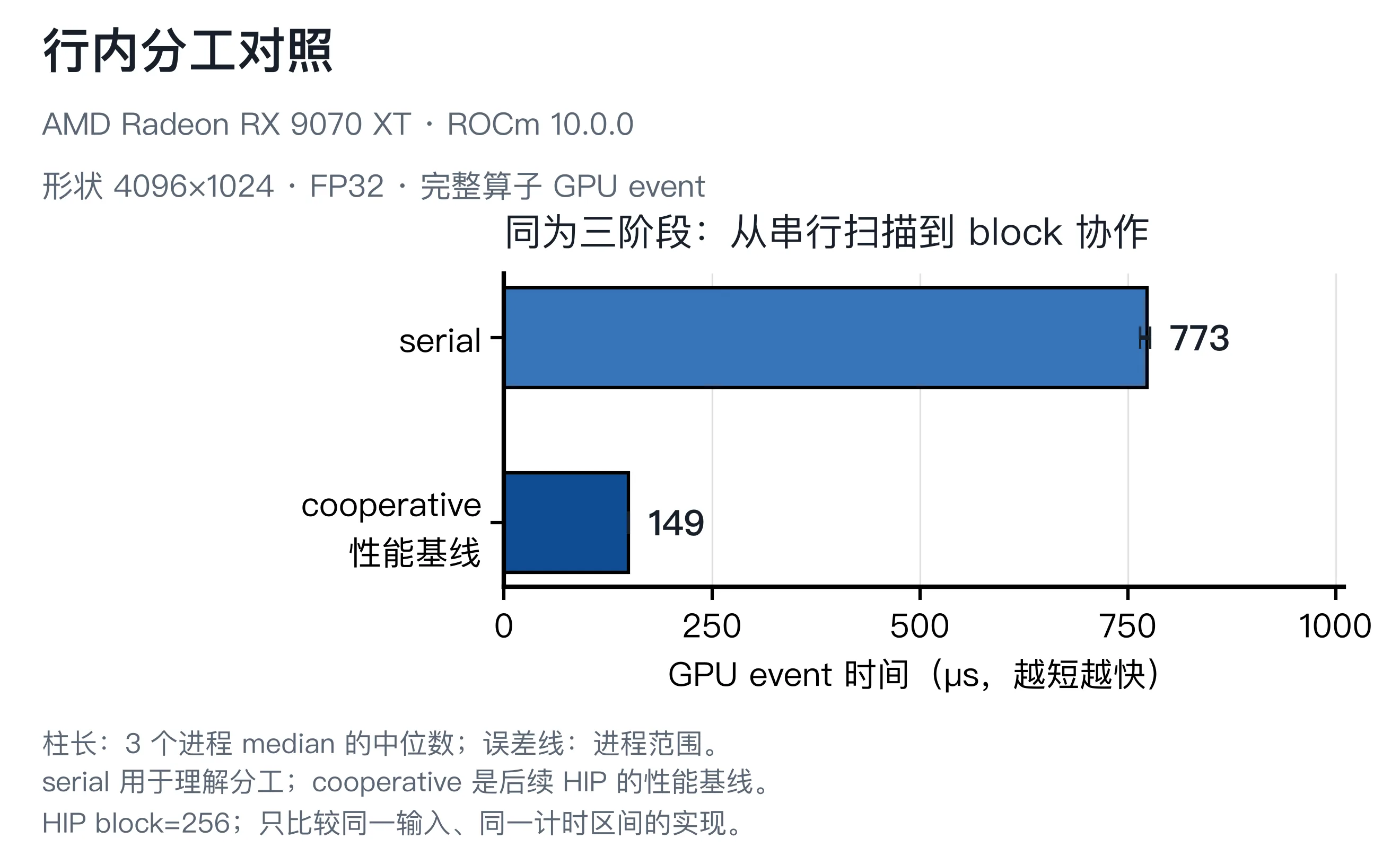
图 10.4 行内协作准备对照:两版保留相同中间数组和三个阶段,变化的是怎样将一行分配给线程。后续融合统一与 cooperative 比较。
本轮先采用 cooperative 作为 HIP 性能基线。它仍要保存整张指数数组,仍通过三个 kernel 完成。下一步围绕这些中间交接提出融合假设,而不是继续用串行版本作为所有收益的分母。
10.5.3 融合对照:保持行分工,减少中间交接
现在有了每行一个 block 的正确实现,三个阶段之间仍要传递 row_max、exponentials、row_sum。下一项假设是:保持这套行分工,在同一个 kernel 中完成 max、sum 和归一化,减少中间交接能否覆盖重读与重算的代价?
fused 保持 block=256,沿用相同的列步长和两棵 LDS 树。区别在于行最大值与分母在一次 kernel 内交接,不再通过全局行标量数组传递。指数不写入 exponentials,最后输出时重新计算。
LDS 复用必须等到所有读者完成
max 树结束后,行最大值位于 shared[0]。每个线程先把它读到自己的局部变量,再共同经过一道屏障:
cpp
const float maximum = shared[0];
// Every thread must read the maximum before LDS is reused for the sum.
__syncthreads();前一轮屏障保证最大值已经写好;这里的屏障保证所有线程都已经读完。否则,一个 wavefront 先把 LDS 改作 sum 空间,另一个尚未读取最大值的 wavefront 就可能读到被覆盖的数据。
接下来每个线程再次扫描自己的列,累加 expf(input - maximum);将局部和写入 LDS,用同样的树求出分母。最后再扫描一次自己的列,写出:
cpp
output[base + column] =
    expf(input[base + column] - maximum) / denominator;
HIP · 同一共享槽的两种用途读完最大值,才能覆盖共享槽
shared[0] 保存最大值,读者尚未取得副本沿用输入 [1000,1001,1002],最大值树已经完成。这里只观察同一 block 的线程 0 和线程 32,它们属于不同 wave;其余 254 个线程省略。
只跟踪 shared[0] 与两个代表读者;其余线程也须经过全 block 屏障。副本表示局部变量,动画节奏不是实际调度或耗时。
图 10.5 LDS 复用特写:shared[0] 的 1002 被读成各线程自己的 maximum 副本;全 block 经过读者屏障后,线程 0 才将局部指数和约 0.1353 写入这个共享槽。本例采用 3 列、256 线程,只显示两个代表读者。
在 图 10.5 的“允许覆盖”一步,比较共享槽和两个 maximum 副本:只有共享槽变成约 0.1353,已经取得的副本仍为 1002。线程 32 没有有效列,也须读最大值并参与 block 屏障;图外其余线程遵循相同规则。无有效列的线程给 max 贡献负无穷,给 sum 贡献 0,不能跳过同步。
把减少和增加的工作一起列出来
融合没有把输入变成只读一次。按当前源码,每个有效元素在 max、sum、最终输出三个阶段各被读取一次,指数在 sum 和输出时各计算一次:
| 源码中的工作 | cooperative 三阶段基线 | fused |
|---|---|---|
| 每次完整调用的 kernel 数 | 3 | 1 |
输入 X 的扫描次数 | 2 | 3 |
每个元素的 expf 次数 | 1 | 2 |
| 指数数组 | 写一次、读一次 | 不读写 |
row_max、row_sum | 经全局数组传递 | 在一次 kernel 内使用 |
| 行内分工与归约 | 一行一 block、列步长相同、LDS 树 | 保持同一方案,并正确同步 LDS 复用 |
主输入每张 FP32 矩阵是 16 MiB。只数输入、指数数组和输出这三类大数组,基线为 2×读X + 写exp + 读exp + 写Y,共 80 MiB;融合版为 3×读X + 写Y,共 64 MiB。去掉指数数组的 32 MiB 往返,同时新增一遍 16 MiB 输入读取,还多算了一次指数。
这是按源码估算的逻辑访问量,另有行标量和 LDS 访问;缓存与编译器会影响实际硬件流量。当前统一测试程序还为不同版本分配了相同的中间缓冲区,所以这里说明的是 fused 不再读写这些数组,不能直接当作整个进程峰值显存减少的证明。
运行 fused,完整输入和检查标准与 cooperative 相同:
bash
test -d "${RUN:?请先准备本章环境与结果目录}/build" && \
test ! -e "$RUN/n4096x1024-hip-fused-b256-p1.csv" && \
"$RUN/build/softmax_hip" \
  --block 256 --version fused --rows 4096 \
  --cols 1024 --warmup 10 --repeat 50 \
  --seed 20260920 --config-id hip-fused-b256 --samples "$RUN/n4096x1024-hip-fused-b256-p1.csv" \
  --process 1
真实输出:hip-fused-b256,shape=4096x1024,第 1 个独立进程
text
ENV runtime=hip gpu="AMD Radeon RX 9070 XT" arch=gfx1201 wave_size=32 rows=4096 cols=1024
RESULT operator=softmax implementation=hip-fused-block-lds runtime=hip shape=4096x1024 dtype=float32 block=256 launches=1 lds_bytes=1024 warmup=10 repeat=50 seed=20260920 timing=gpu-event scope=gpu-event-full-operator input=shifted-dyadic reference=fp64-softmax-to-fp32 timed=1 correct=OK precheck=OK postcheck=OK config_id=hip-fused-b256 num_warps=0 output_finite=OK min_ms=0.118597001 median_ms=0.119717002 mean_ms=0.121076540 max_abs_error=3.7252903e-09 max_row_sum_error=1.41068035e-07
检查两种误差与前后校验,再读 launches=1 和完整时间。是否采用由这组不带 profiler 的 benchmark 决定。
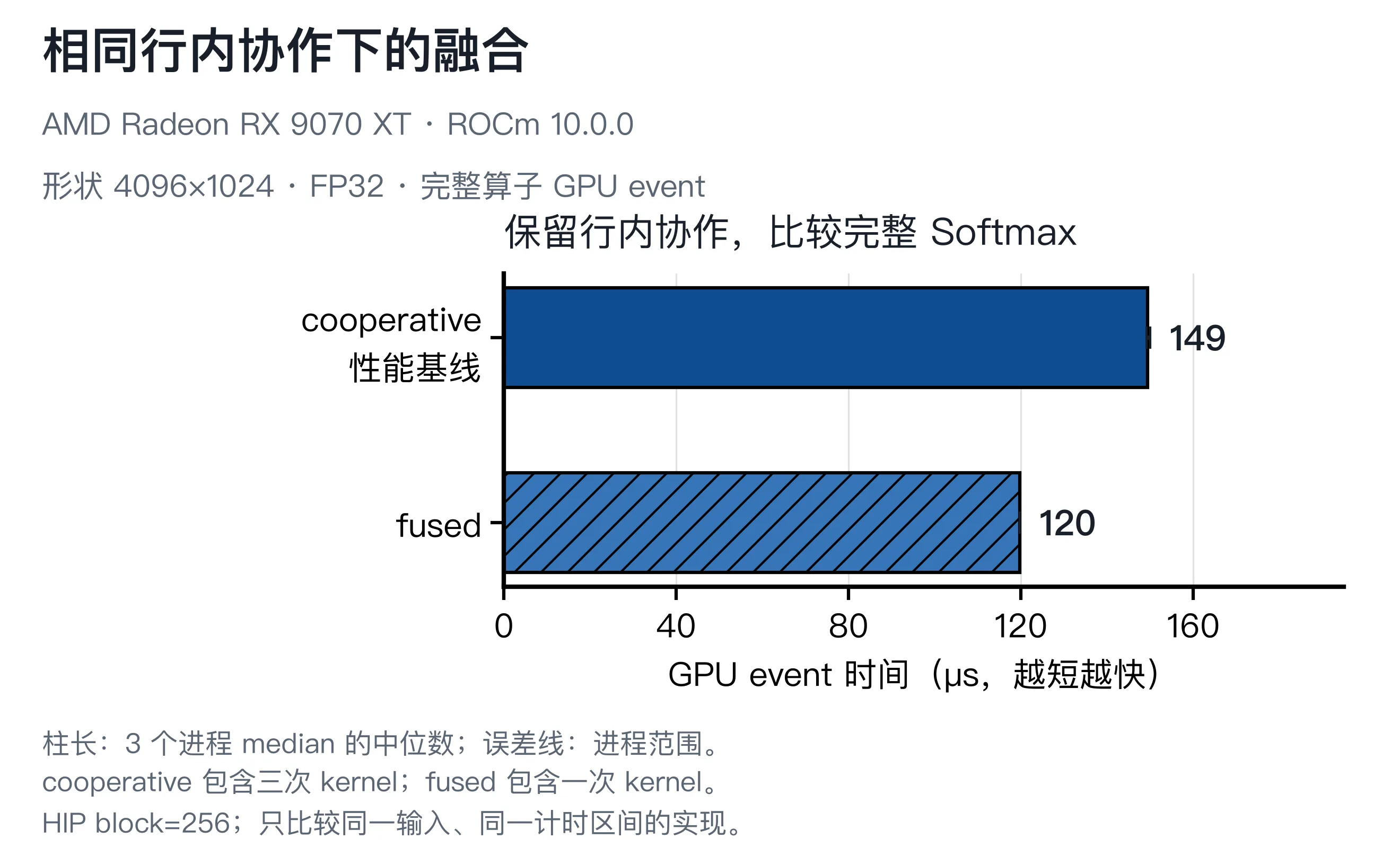
图 10.6 保持行分工后比较融合方案。图中时间包含得到整张输出的完整路径,不能只取其中一个归约阶段。
完整时间由 149.296 μs 降至 119.717 μs,约为基线时间的 80.2%,速度比约 1.25×。因此对主输入保留 fused。这支持的是减少交接、增加重读与重算之后的净收益,不能把约 29.6 μs 全部归为某次内存访问或某两次启动。
按需分析:融合是否按计划保持行分工、减少阶段交接?
已经知道 fused 更快,下面只核对执行结构。仍从 code/part2-kernels/ 运行,对 cooperative 与 fused 分别采集;每条命令新建自己的目录,已有目录会停止本条命令。随后用第 8 章的标准库脚本按 kernel 名分开读:
bash
test -d "${RUN:?请先准备本章环境与结果目录}/build" && \
mkdir "$RUN/profile-hip-cooperative-b256" && \
rocprofv3 --kernel-trace --output-format csv \
  --output-directory "$RUN/profile-hip-cooperative-b256" --output-file hip-cooperative-b256 -- \
  "$RUN/build/softmax_hip" \
    --block 256 --version cooperative --rows 4096 \
    --cols 1024 --warmup 5 --repeat 10 \
    --seed 20260920 --config-id hip-cooperative-b256 && \
python chapter8/inspect_trace.py \
  "$RUN/profile-hip-cooperative-b256/hip-cooperative-b256_kernel_trace.csv" \
  --kernel row_max_block --skip 6 --take 10 && \
python chapter8/inspect_trace.py \
  "$RUN/profile-hip-cooperative-b256/hip-cooperative-b256_kernel_trace.csv" \
  --kernel row_exp_sum_block --skip 6 --take 10 && \
python chapter8/inspect_trace.py \
  "$RUN/profile-hip-cooperative-b256/hip-cooperative-b256_kernel_trace.csv" \
  --kernel normalize_block --skip 6 --take 10
筛选后的真实 trace:hip-cooperative-b256,shape=4096x1024
text
kernel_name="(anonymous namespace)::row_max_block(float const*, float*, unsigned long)"
csv_rows=52 target_rows=16 skipped_rows=6 kept_rows=10
sort=Start_Timestamp_ascending
first_start_ns=885352907365890 first_end_ns=885352907410649 first_duration_ns=44759
kernel_min_us=44.519000 kernel_median_us=44.759000 kernel_max_us=270.714000
grid_work_items_xyz=1048576x1x1 workgroup_size_xyz=256x1x1 workgroups_xyz=4096x1x1
workgroups_total=4096
vgpr_count=8 sgpr_count=128 lds_bytes=0 scratch_bytes=0

kernel_name="(anonymous namespace)::row_exp_sum_block(float const*, float const*, float*, float*, unsigned long)"
csv_rows=52 target_rows=16 skipped_rows=6 kept_rows=10
sort=Start_Timestamp_ascending
first_start_ns=885352907414689 first_end_ns=885352907475607 first_duration_ns=60918
kernel_min_us=56.679000 kernel_median_us=60.158500 kernel_max_us=60.918000
grid_work_items_xyz=1048576x1x1 workgroup_size_xyz=256x1x1 workgroups_xyz=4096x1x1
workgroups_total=4096
vgpr_count=16 sgpr_count=128 lds_bytes=0 scratch_bytes=0

kernel_name="(anonymous namespace)::normalize_block(float const*, float const*, float*, unsigned long)"
csv_rows=52 target_rows=16 skipped_rows=6 kept_rows=10
sort=Start_Timestamp_ascending
first_start_ns=885352907481287 first_end_ns=885352907541366 first_duration_ns=60079
kernel_min_us=36.439000 kernel_median_us=59.158500 kernel_max_us=61.118000
grid_work_items_xyz=1048576x1x1 workgroup_size_xyz=256x1x1 workgroups_xyz=4096x1x1
workgroups_total=4096
vgpr_count=16 sgpr_count=128 lds_bytes=0 scratch_bytes=0
原始 kernel trace CSV:hip-cooperative-b256,shape=4096x1024
text
"Kind","Agent_Id","Queue_Id","Stream_Id","Thread_Id","Dispatch_Id","Kernel_Id","Kernel_Name","Correlation_Id","Start_Timestamp","End_Timestamp","LDS_Block_Size","Scratch_Size","VGPR_Count","Accum_VGPR_Count","SGPR_Count","Workgroup_Size_X","Workgroup_Size_Y","Workgroup_Size_Z","Grid_Size_X","Grid_Size_Y","Grid_Size_Z"
"KERNEL_DISPATCH","Agent 1",1,0,1200097,1,7,"__amd_rocclr_fillBufferUnAligned",1,885352876454435,885352876478714,0,0,8,0,128,256,1,1,8192,1,1
"KERNEL_DISPATCH","Agent 1",1,0,1200097,2,7,"__amd_rocclr_fillBufferUnAligned",2,885352876642399,885352876657759,0,0,8,0,128,256,1,1,8192,1,1
"KERNEL_DISPATCH","Agent 1",1,0,1200097,3,7,"__amd_rocclr_fillBufferUnAligned",3,885352876669839,885352876672199,0,0,8,0,128,256,1,1,1024,1,1
"KERNEL_DISPATCH","Agent 1",1,0,1200097,4,7,"__amd_rocclr_fillBufferUnAligned",4,885352876677238,885352876680158,0,0,8,0,128,256,1,1,1024,1,1
"KERNEL_DISPATCH","Agent 1",1,0,1200097,5,19,"(anonymous namespace)::row_max_block(float const*, float*, unsigned long)",5,885352888391880,885352888442878,0,0,8,0,128,256,1,1,1048576,1,1
"KERNEL_DISPATCH","Agent 1",1,0,1200097,6,20,"(anonymous namespace)::row_exp_sum_block(float const*, float const*, float*, float*, unsigned long)",6,885352888448118,885352888514837,0,0,16,0,128,256,1,1,1048576,1,1
"KERNEL_DISPATCH","Agent 1",1,0,1200097,7,23,"(anonymous namespace)::normalize_block(float const*, float const*, float*, unsigned long)",7,885352888523237,885352888583235,0,0,16,0,128,256,1,1,1048576,1,1
"KERNEL_DISPATCH","Agent 1",1,0,1200097,8,19,"(anonymous namespace)::row_max_block(float const*, float*, unsigned long)",8,885352906389885,885352906440004,0,0,8,0,128,256,1,1,1048576,1,1
"KERNEL_DISPATCH","Agent 1",1,0,1200097,9,20,"(anonymous namespace)::row_exp_sum_block(float const*, float const*, float*, float*, unsigned long)",9,885352906445124,885352906511681,0,0,16,0,128,256,1,1,1048576,1,1
"KERNEL_DISPATCH","Agent 1",1,0,1200097,10,23,"(anonymous namespace)::normalize_block(float const*, float const*, float*, unsigned long)",10,885352906519761,885352906581639,0,0,16,0,128,256,1,1,1048576,1,1
"KERNEL_DISPATCH","Agent 1",1,0,1200097,11,19,"(anonymous namespace)::row_max_block(float const*, float*, unsigned long)",11,885352906589719,885352906639558,0,0,8,0,128,256,1,1,1048576,1,1
"KERNEL_DISPATCH","Agent 1",1,0,1200097,18,20,"(anonymous namespace)::row_exp_sum_block(float const*, float const*, float*, float*, unsigned long)",18,885352907016149,885352907076947,0,0,16,0,128,256,1,1,1048576,1,1
"KERNEL_DISPATCH","Agent 1",1,0,1200097,13,23,"(anonymous namespace)::normalize_block(float const*, float const*, float*, unsigned long)",13,885352906717316,885352906778834,0,0,16,0,128,256,1,1,1048576,1,1
"KERNEL_DISPATCH","Agent 1",1,0,1200097,14,19,"(anonymous namespace)::row_max_block(float const*, float*, unsigned long)",14,885352906784994,885352906829713,0,0,8,0,128,256,1,1,1048576,1,1
"KERNEL_DISPATCH","Agent 1",1,0,1200097,15,20,"(anonymous namespace)::row_exp_sum_block(float const*, float const*, float*, float*, unsigned long)",15,885352906834033,885352906894912,0,0,16,0,128,256,1,1,1048576,1,1
"KERNEL_DISPATCH","Agent 1",1,0,1200097,19,23,"(anonymous namespace)::normalize_block(float const*, float const*, float*, unsigned long)",19,885352907083027,885352907142185,0,0,16,0,128,256,1,1,1048576,1,1
"KERNEL_DISPATCH","Agent 1",1,0,1200097,16,23,"(anonymous namespace)::normalize_block(float const*, float const*, float*, unsigned long)",16,885352906900951,885352906960790,0,0,16,0,128,256,1,1,1048576,1,1
"KERNEL_DISPATCH","Agent 1",1,0,1200097,12,20,"(anonymous namespace)::row_exp_sum_block(float const*, float const*, float*, float*, unsigned long)",12,885352906644358,885352906710596,0,0,16,0,128,256,1,1,1048576,1,1
"KERNEL_DISPATCH","Agent 1",1,0,1200097,17,19,"(anonymous namespace)::row_max_block(float const*, float*, unsigned long)",17,885352906966910,885352907011669,0,0,8,0,128,256,1,1,1048576,1,1
"KERNEL_DISPATCH","Agent 1",1,0,1200097,20,19,"(anonymous namespace)::row_max_block(float const*, float*, unsigned long)",20,885352907148305,885352907193144,0,0,8,0,128,256,1,1,1048576,1,1
"KERNEL_DISPATCH","Agent 1",1,0,1200097,21,20,"(anonymous namespace)::row_exp_sum_block(float const*, float const*, float*, float*, unsigned long)",21,885352907197544,885352907258703,0,0,16,0,128,256,1,1,1048576,1,1
"KERNEL_DISPATCH","Agent 1",1,0,1200097,22,23,"(anonymous namespace)::normalize_block(float const*, float const*, float*, unsigned long)",22,885352907264822,885352907323461,0,0,16,0,128,256,1,1,1048576,1,1
"KERNEL_DISPATCH","Agent 1",1,0,1200097,23,19,"(anonymous namespace)::row_max_block(float const*, float*, unsigned long)",23,885352907365890,885352907410649,0,0,8,0,128,256,1,1,1048576,1,1
"KERNEL_DISPATCH","Agent 1",1,0,1200097,24,20,"(anonymous namespace)::row_exp_sum_block(float const*, float const*, float*, float*, unsigned long)",24,885352907414689,885352907475607,0,0,16,0,128,256,1,1,1048576,1,1
"KERNEL_DISPATCH","Agent 1",1,0,1200097,25,23,"(anonymous namespace)::normalize_block(float const*, float const*, float*, unsigned long)",25,885352907481287,885352907541366,0,0,16,0,128,256,1,1,1048576,1,1
"KERNEL_DISPATCH","Agent 1",1,0,1200097,26,19,"(anonymous namespace)::row_max_block(float const*, float*, unsigned long)",26,885352907577925,885352907622604,0,0,8,0,128,256,1,1,1048576,1,1
"KERNEL_DISPATCH","Agent 1",1,0,1200097,27,20,"(anonymous namespace)::row_exp_sum_block(float const*, float const*, float*, float*, unsigned long)",27,885352907626724,885352907686922,0,0,16,0,128,256,1,1,1048576,1,1
"KERNEL_DISPATCH","Agent 1",1,0,1200097,28,23,"(anonymous namespace)::normalize_block(float const*, float const*, float*, unsigned long)",28,885352907692722,885352907751801,0,0,16,0,128,256,1,1,1048576,1,1
"KERNEL_DISPATCH","Agent 1",1,0,1200097,29,19,"(anonymous namespace)::row_max_block(float const*, float*, unsigned long)",29,885352907782720,885352907827719,0,0,8,0,128,256,1,1,1048576,1,1
"KERNEL_DISPATCH","Agent 1",1,0,1200097,30,20,"(anonymous namespace)::row_exp_sum_block(float const*, float const*, float*, float*, unsigned long)",30,885352907831759,885352907892197,0,0,16,0,128,256,1,1,1048576,1,1
"KERNEL_DISPATCH","Agent 1",1,0,1200097,31,23,"(anonymous namespace)::normalize_block(float const*, float const*, float*, unsigned long)",31,885352907897957,885352907959075,0,0,16,0,128,256,1,1,1048576,1,1
"KERNEL_DISPATCH","Agent 1",1,0,1200097,32,19,"(anonymous namespace)::row_max_block(float const*, float*, unsigned long)",32,885352907990195,885352908034954,0,0,8,0,128,256,1,1,1048576,1,1
"KERNEL_DISPATCH","Agent 1",1,0,1200097,33,20,"(anonymous namespace)::row_exp_sum_block(float const*, float const*, float*, float*, unsigned long)",33,885352908039033,885352908099832,0,0,16,0,128,256,1,1,1048576,1,1
"KERNEL_DISPATCH","Agent 1",1,0,1200097,34,23,"(anonymous namespace)::normalize_block(float const*, float const*, float*, unsigned long)",34,885352908105552,885352908165990,0,0,16,0,128,256,1,1,1048576,1,1
"KERNEL_DISPATCH","Agent 1",1,0,1200097,35,19,"(anonymous namespace)::row_max_block(float const*, float*, unsigned long)",35,885352908197110,885352908241868,0,0,8,0,128,256,1,1,1048576,1,1
"KERNEL_DISPATCH","Agent 1",1,0,1200097,36,20,"(anonymous namespace)::row_exp_sum_block(float const*, float const*, float*, float*, unsigned long)",36,885352908245988,885352908306307,0,0,16,0,128,256,1,1,1048576,1,1
"KERNEL_DISPATCH","Agent 1",1,0,1200097,37,23,"(anonymous namespace)::normalize_block(float const*, float const*, float*, unsigned long)",37,885352908312027,885352908371265,0,0,16,0,128,256,1,1,1048576,1,1
"KERNEL_DISPATCH","Agent 1",1,0,1200097,38,19,"(anonymous namespace)::row_max_block(float const*, float*, unsigned long)",38,885352908402345,885352908447263,0,0,8,0,128,256,1,1,1048576,1,1
"KERNEL_DISPATCH","Agent 1",1,0,1200097,39,20,"(anonymous namespace)::row_exp_sum_block(float const*, float const*, float*, float*, unsigned long)",39,885352908451383,885352908511502,0,0,16,0,128,256,1,1,1048576,1,1
"KERNEL_DISPATCH","Agent 1",1,0,1200097,40,23,"(anonymous namespace)::normalize_block(float const*, float const*, float*, unsigned long)",40,885352908517302,885352908577420,0,0,16,0,128,256,1,1,1048576,1,1
"KERNEL_DISPATCH","Agent 1",1,0,1200097,41,19,"(anonymous namespace)::row_max_block(float const*, float*, unsigned long)",41,885352908608819,885352908879533,0,0,8,0,128,256,1,1,1048576,1,1
"KERNEL_DISPATCH","Agent 1",1,0,1200097,42,20,"(anonymous namespace)::row_exp_sum_block(float const*, float const*, float*, float*, unsigned long)",42,885352908883693,885352908940571,0,0,16,0,128,256,1,1,1048576,1,1
"KERNEL_DISPATCH","Agent 1",1,0,1200097,43,23,"(anonymous namespace)::normalize_block(float const*, float const*, float*, unsigned long)",43,885352908946291,885352908984890,0,0,16,0,128,256,1,1,1048576,1,1
"KERNEL_DISPATCH","Agent 1",1,0,1200097,44,19,"(anonymous namespace)::row_max_block(float const*, float*, unsigned long)",44,885352909016009,885352909060568,0,0,8,0,128,256,1,1,1048576,1,1
"KERNEL_DISPATCH","Agent 1",1,0,1200097,45,20,"(anonymous namespace)::row_exp_sum_block(float const*, float const*, float*, float*, unsigned long)",45,885352920373090,885352920431369,0,0,16,0,128,256,1,1,1048576,1,1
"KERNEL_DISPATCH","Agent 1",1,0,1200097,46,23,"(anonymous namespace)::normalize_block(float const*, float const*, float*, unsigned long)",46,885352920437809,885352920475288,0,0,16,0,128,256,1,1,1048576,1,1
"KERNEL_DISPATCH","Agent 1",1,0,1200097,47,19,"(anonymous namespace)::row_max_block(float const*, float*, unsigned long)",47,885352920514967,885352920561046,0,0,8,0,128,256,1,1,1048576,1,1
"KERNEL_DISPATCH","Agent 1",1,0,1200097,48,20,"(anonymous namespace)::row_exp_sum_block(float const*, float const*, float*, float*, unsigned long)",48,885352920565286,885352920622484,0,0,16,0,128,256,1,1,1048576,1,1
"KERNEL_DISPATCH","Agent 1",1,0,1200097,49,23,"(anonymous namespace)::normalize_block(float const*, float const*, float*, unsigned long)",49,885352920628324,885352920664763,0,0,16,0,128,256,1,1,1048576,1,1
"KERNEL_DISPATCH","Agent 1",1,0,1200097,50,19,"(anonymous namespace)::row_max_block(float const*, float*, unsigned long)",50,885352920700802,885352920745321,0,0,8,0,128,256,1,1,1048576,1,1
"KERNEL_DISPATCH","Agent 1",1,0,1200097,51,20,"(anonymous namespace)::row_exp_sum_block(float const*, float const*, float*, float*, unsigned long)",51,885352920749441,885352920806120,0,0,16,0,128,256,1,1,1048576,1,1
"KERNEL_DISPATCH","Agent 1",1,0,1200097,52,23,"(anonymous namespace)::normalize_block(float const*, float const*, float*, unsigned long)",52,885352920811960,885352920848599,0,0,16,0,128,256,1,1,1048576,1,1
bash
test -d "${RUN:?请先准备本章环境与结果目录}/build" && \
mkdir "$RUN/profile-hip-fused-b256" && \
rocprofv3 --kernel-trace --output-format csv \
  --output-directory "$RUN/profile-hip-fused-b256" --output-file hip-fused-b256 -- \
  "$RUN/build/softmax_hip" \
    --block 256 --version fused --rows 4096 \
    --cols 1024 --warmup 5 --repeat 10 \
    --seed 20260920 --config-id hip-fused-b256 && \
python chapter8/inspect_trace.py \
  "$RUN/profile-hip-fused-b256/hip-fused-b256_kernel_trace.csv" \
  --kernel softmax_fused_lds --skip 6 --take 10
筛选后的真实 trace:hip-fused-b256,shape=4096x1024
text
kernel_name="(anonymous namespace)::softmax_fused_lds(float const*, float*, unsigned long, unsigned long)"
csv_rows=20 target_rows=16 skipped_rows=6 kept_rows=10
sort=Start_Timestamp_ascending
first_start_ns=885353157818181 first_end_ns=885353157928658 first_duration_ns=110477
kernel_min_us=110.117000 kernel_median_us=110.577500 kernel_max_us=118.757000
grid_work_items_xyz=1048576x1x1 workgroup_size_xyz=256x1x1 workgroups_xyz=4096x1x1
workgroups_total=4096
vgpr_count=16 sgpr_count=128 lds_bytes=0 scratch_bytes=0
原始 kernel trace CSV:hip-fused-b256,shape=4096x1024
text
"Kind","Agent_Id","Queue_Id","Stream_Id","Thread_Id","Dispatch_Id","Kernel_Id","Kernel_Name","Correlation_Id","Start_Timestamp","End_Timestamp","LDS_Block_Size","Scratch_Size","VGPR_Count","Accum_VGPR_Count","SGPR_Count","Workgroup_Size_X","Workgroup_Size_Y","Workgroup_Size_Z","Grid_Size_X","Grid_Size_Y","Grid_Size_Z"
"KERNEL_DISPATCH","Agent 1",1,0,1200117,1,5,"__amd_rocclr_fillBufferUnAligned",1,885353127709195,885353127724394,0,0,8,0,128,256,1,1,8192,1,1
"KERNEL_DISPATCH","Agent 1",1,0,1200117,2,5,"__amd_rocclr_fillBufferUnAligned",2,885353127893189,885353127903189,0,0,8,0,128,256,1,1,8192,1,1
"KERNEL_DISPATCH","Agent 1",1,0,1200117,3,5,"__amd_rocclr_fillBufferUnAligned",3,885353127911869,885353127914149,0,0,8,0,128,256,1,1,1024,1,1
"KERNEL_DISPATCH","Agent 1",1,0,1200117,4,5,"__amd_rocclr_fillBufferUnAligned",4,885353127918629,885353127921229,0,0,8,0,128,256,1,1,1024,1,1
"KERNEL_DISPATCH","Agent 1",1,0,1200117,5,22,"(anonymous namespace)::softmax_fused_lds(float const*, float*, unsigned long, unsigned long)",5,885353139218459,885353139332616,0,0,16,0,128,256,1,1,1048576,1,1
"KERNEL_DISPATCH","Agent 1",1,0,1200117,6,22,"(anonymous namespace)::softmax_fused_lds(float const*, float*, unsigned long, unsigned long)",6,885353157179919,885353157296556,0,0,16,0,128,256,1,1,1048576,1,1
"KERNEL_DISPATCH","Agent 1",1,0,1200117,7,22,"(anonymous namespace)::softmax_fused_lds(float const*, float*, unsigned long, unsigned long)",7,885353157300996,885353157414192,0,0,16,0,128,256,1,1,1048576,1,1
"KERNEL_DISPATCH","Agent 1",1,0,1200117,8,22,"(anonymous namespace)::softmax_fused_lds(float const*, float*, unsigned long, unsigned long)",8,885353157420191,885353157539668,0,0,16,0,128,256,1,1,1048576,1,1
"KERNEL_DISPATCH","Agent 1",1,0,1200117,9,22,"(anonymous namespace)::softmax_fused_lds(float const*, float*, unsigned long, unsigned long)",9,885353157545508,885353157656425,0,0,16,0,128,256,1,1,1048576,1,1
"KERNEL_DISPATCH","Agent 1",1,0,1200117,10,22,"(anonymous namespace)::softmax_fused_lds(float const*, float*, unsigned long, unsigned long)",10,885353157662265,885353157772942,0,0,16,0,128,256,1,1,1048576,1,1
"KERNEL_DISPATCH","Agent 1",1,0,1200117,11,22,"(anonymous namespace)::softmax_fused_lds(float const*, float*, unsigned long, unsigned long)",11,885353157818181,885353157928658,0,0,16,0,128,256,1,1,1048576,1,1
"KERNEL_DISPATCH","Agent 1",1,0,1200117,12,22,"(anonymous namespace)::softmax_fused_lds(float const*, float*, unsigned long, unsigned long)",12,885353157963737,885353158082494,0,0,16,0,128,256,1,1,1048576,1,1
"KERNEL_DISPATCH","Agent 1",1,0,1200117,13,22,"(anonymous namespace)::softmax_fused_lds(float const*, float*, unsigned long, unsigned long)",13,885353158114734,885353158225331,0,0,16,0,128,256,1,1,1048576,1,1
"KERNEL_DISPATCH","Agent 1",1,0,1200117,14,22,"(anonymous namespace)::softmax_fused_lds(float const*, float*, unsigned long, unsigned long)",14,885353158257450,885353158367927,0,0,16,0,128,256,1,1,1048576,1,1
"KERNEL_DISPATCH","Agent 1",1,0,1200117,15,22,"(anonymous namespace)::softmax_fused_lds(float const*, float*, unsigned long, unsigned long)",15,885353158399646,885353158510563,0,0,16,0,128,256,1,1,1048576,1,1
"KERNEL_DISPATCH","Agent 1",1,0,1200117,16,22,"(anonymous namespace)::softmax_fused_lds(float const*, float*, unsigned long, unsigned long)",16,885353158541642,885353158652400,0,0,16,0,128,256,1,1,1048576,1,1
"KERNEL_DISPATCH","Agent 1",1,0,1200117,17,22,"(anonymous namespace)::softmax_fused_lds(float const*, float*, unsigned long, unsigned long)",17,885353158683279,885353158793916,0,0,16,0,128,256,1,1,1048576,1,1
"KERNEL_DISPATCH","Agent 1",1,0,1200117,18,22,"(anonymous namespace)::softmax_fused_lds(float const*, float*, unsigned long, unsigned long)",18,885353158824795,885353158935152,0,0,16,0,128,256,1,1,1048576,1,1
"KERNEL_DISPATCH","Agent 1",1,0,1200117,19,22,"(anonymous namespace)::softmax_fused_lds(float const*, float*, unsigned long, unsigned long)",19,885353158965791,885353159076349,0,0,16,0,128,256,1,1,1048576,1,1
"KERNEL_DISPATCH","Agent 1",1,0,1200117,20,22,"(anonymous namespace)::softmax_fused_lds(float const*, float*, unsigned long, unsigned long)",20,885353159107028,885353159217145,0,0,16,0,128,256,1,1,1048576,1,1
先读 target_rows=16,排除预检和预热的前 6 次,留下 10 次。再看 kernel 名称:cooperative 的三个阶段与 fused 的一个阶段分别存在;不能把整个文件的行数当作一次调用的 kernel 数。四个阶段的 workgroups_total=4096、每组 256 线程,符合每行一个 block 的对照设计。
最后才看 kernel_median_us:fused 的设备区间约 110.6 μs。它不与另一轮 event 相减估算启动成本,也不把 cooperative 三个独立中位数之和作为正式成绩。首阶段有约 270.7 μs 的单次值,报告保留完整范围。
这些记录支持“融合遵循了预期的行分工与阶段数量”,仍不能把总收益分给某次读取或某次启动。HIP 的 lds_bytes=0 未包含这次动态 LDS 申请,源码实际请求 256×4=1024 B,不能读成没有 LDS。
10.5.4 检查行长与行数的影响
一个主形状不足以决定今后的配置。先保持行数不变,检查列数 1023、1024、1025:对于 block=256,1024 列时每线程处理 4 项;1025 列时线程 0 多处理一项,其他线程的分工基本不变。1023 列则有一个线程少处理一项,尾部仍要正确参与两次归约。
先用一个小尾部验证 fused 的分工。此处只检查答案,warmup=0,repeat=1 的时间不进入性能图:
bash
test -d "${RUN:?请先准备本章环境与结果目录}/build" && \
"$RUN/build/softmax_hip" \
  --block 256 --version fused --rows 3 \
  --cols 1025 --warmup 0 --repeat 1 \
  --seed 20260920 --config-id hip-fused-b256
正确性输出:HIP fused,3×1025,输出与行和
text
ENV runtime=hip gpu="AMD Radeon RX 9070 XT" arch=gfx1201 wave_size=32 rows=3 cols=1025
RESULT operator=softmax implementation=hip-fused-block-lds runtime=hip shape=3x1025 dtype=float32 block=256 launches=1 lds_bytes=1024 warmup=0 repeat=1 seed=20260920 timing=gpu-event scope=gpu-event-full-operator input=shifted-dyadic reference=fp64-softmax-to-fp32 timed=1 correct=OK precheck=OK postcheck=OK config_id=hip-fused-b256 num_warps=0 output_finite=OK min_ms=0.016480001 median_ms=0.016480001 mean_ms=0.016480001 max_abs_error=3.7252903e-09 max_row_sum_error=2.65218175e-08
先读前后校验、有限值与两种误差;尾部正确后,才比较较大输入的性能。
再保持 1024 列,把行数从 4096 减少到 128。每行一个 block 意味着 grid 也从 4096 个 block 变为 128 个;可供 GPU 调度的组数和总工作量都减少了。阶段启动、中间数组与线程协作的相对成本可能随形状变化,因此要在新形状内重新比较 cooperative 和 fused。
| 形状 | cooperative(μs) | fused(μs) |
|---|---|---|
4096x1023 | 150.40(147.12–151.52) | 120.38(120.06–120.48) |
4096x1024 | 149.30(149.16–149.96) | 119.72(119.72–119.74) |
4096x1025 | 156.98(153.76–157.86) | 130.52(130.26–130.62) |
128x1024 | 24.68(24.68–24.80) | 15.88(15.84–15.90) |
括号表示三进程 median 范围;每行在相同形状内比较。
三个补充形状里,fused 也都低于同形状的 cooperative。主形状的独立确认中,cooperative 为 146.857 μs(145.938–149.297),fused 为 119.858 μs(117.098–119.858),这项收益再次出现。确认组另行统计,不并入原来的图。这里没有扫描其他 block 大小,因此结论是保留本轮融合方案,并非找到了每种形状的最佳实现。
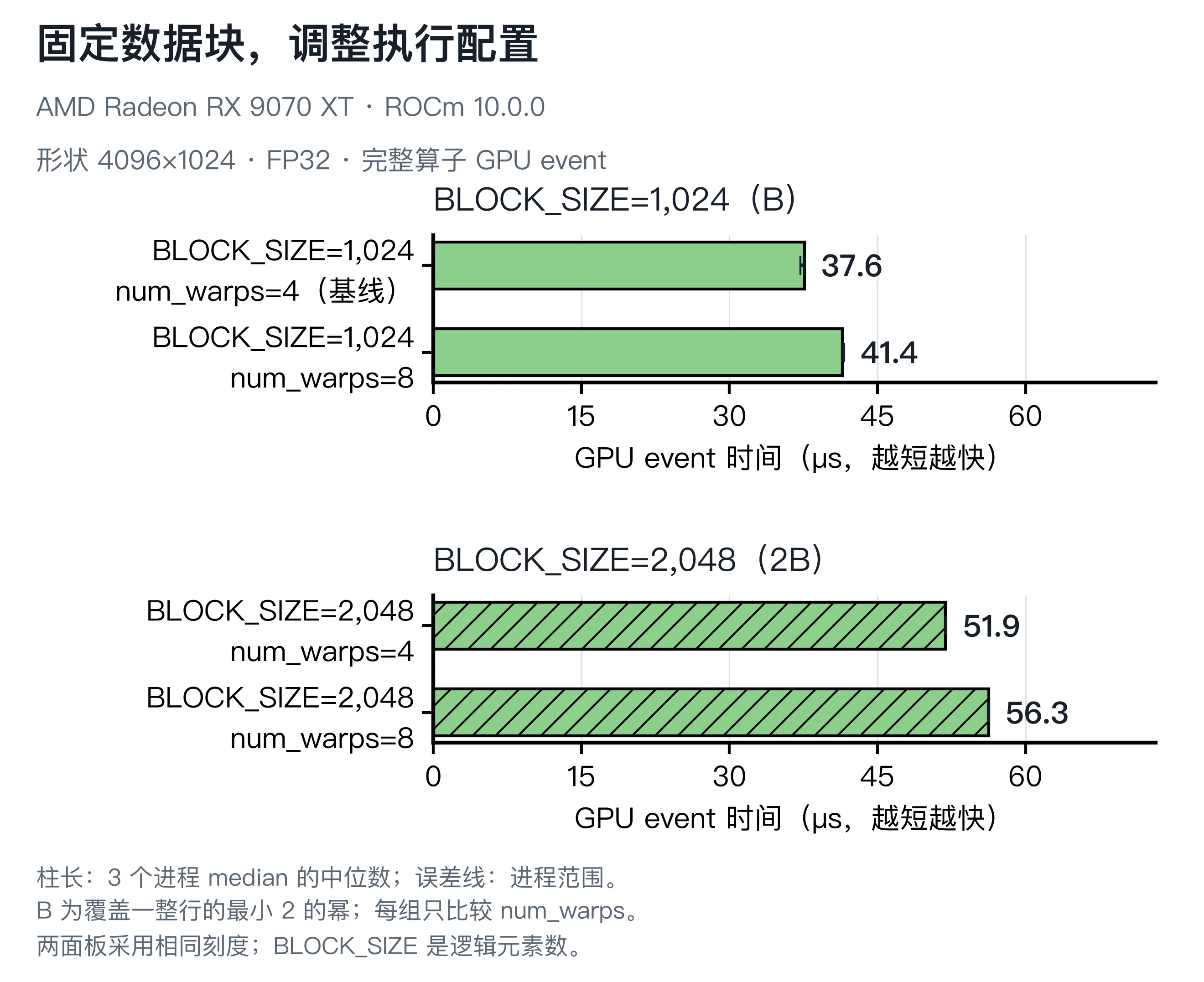
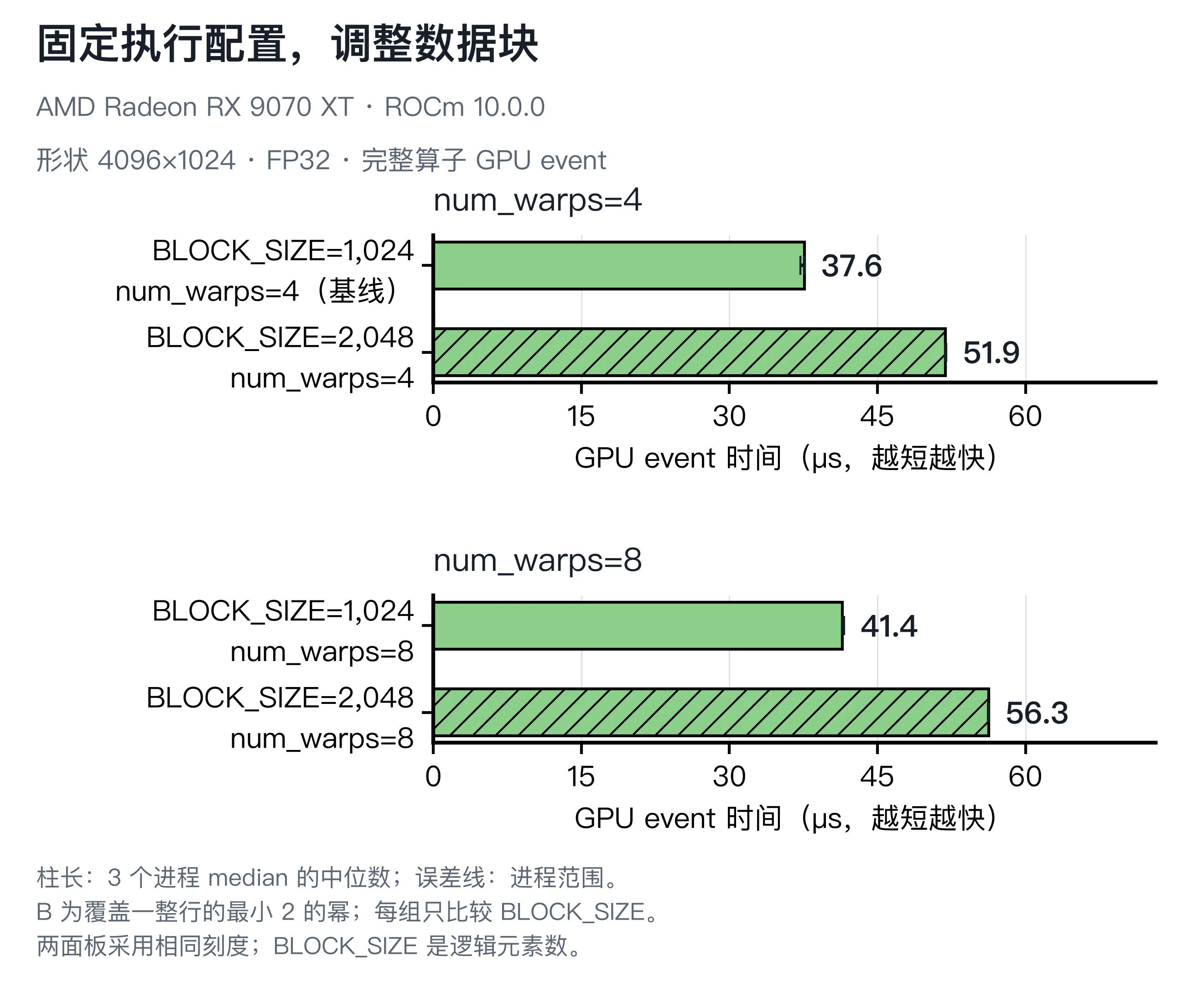
10.6 比较结果与保留方案
两条路线围绕同一公式,却直接控制不同的工作:
| 问题 | HIP cooperative | HIP fused | Triton |
|---|---|---|---|
| 行内分工 | 一 block 一行 | 相同行分工 | 一 program 一行 |
| 一次调用的主体 kernel 数 | 3 | 1 | 1 |
| 指数如何用于输出 | 全局保存后读取 | 再次计算 | 复用 program 内逻辑值 |
| max、sum 归约 | LDS 树 | LDS 树与正确的复用屏障 | tl.max、tl.sum |
| 本轮主要选择 | 作为融合前的路线基线 | 中间交接与重算是否划算 | warps 和逻辑宽度分别是否值得改变 |
| 配置 | 完整 median(μs) | 三进程范围(μs) | 相对本路线基线的速度比 |
|---|---|---|---|
hip-cooperative-b256 | 149.296 | 149.156–149.956 | 1.00× |
hip-fused-b256 | 119.717 | 119.717–119.737 | 1.25× |
triton-b4 | 37.599 | 37.199–37.599 | 1.00× |
triton-b8 | 41.439 | 41.399–41.639 | 0.91× |
triton-2b4 | 51.879 | 51.879–51.999 | 0.72× |
triton-2b8 | 56.279 | 56.199–56.318 | 0.67× |
上表为主输入 4096×1024。速度比用各自路线基线的时间除以当前时间;HIP 以 cooperative 为分母,Triton 以 (B,4) 为分母,不据此排列语言优劣。
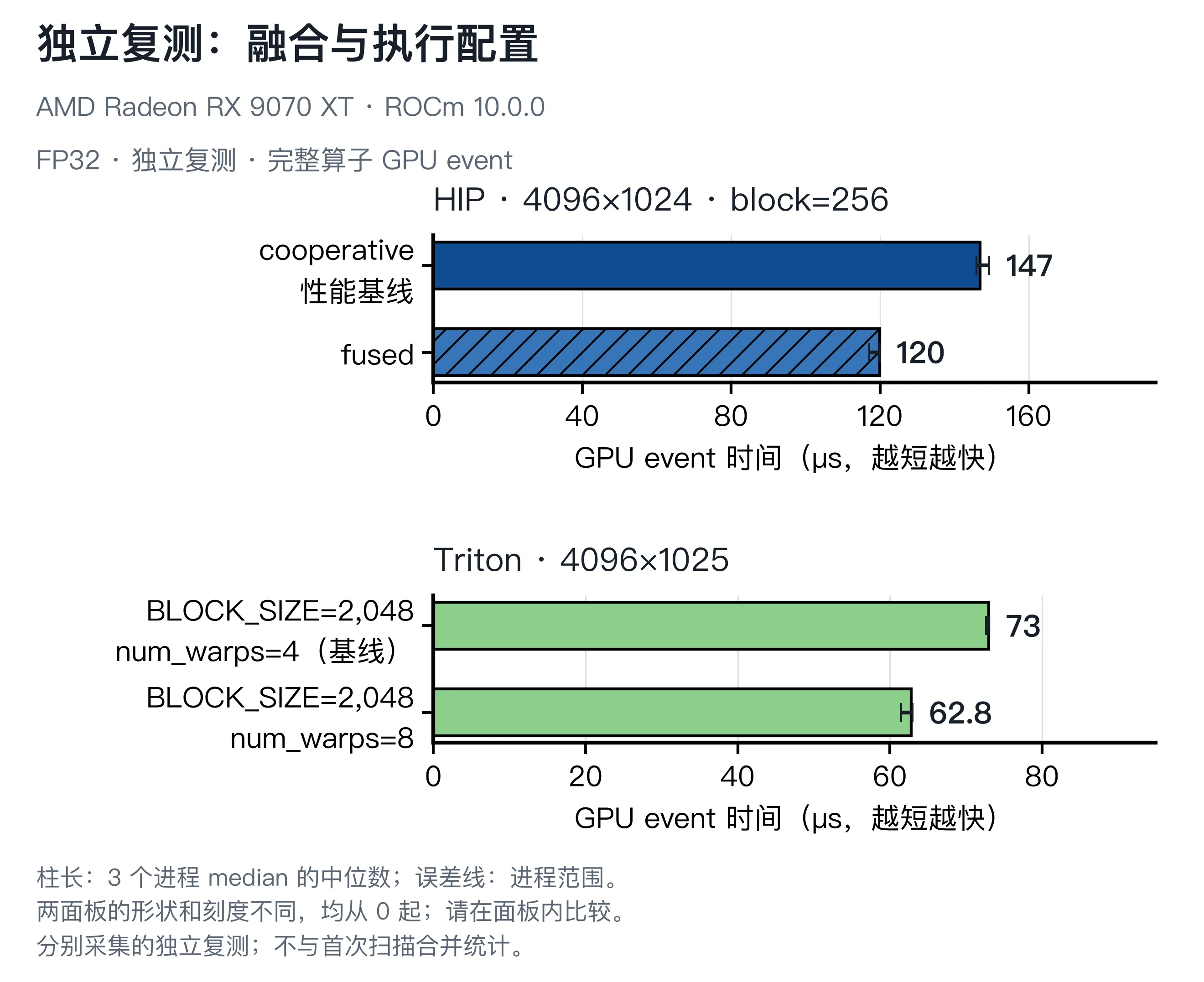
图 10.11 独立确认使用 RX 9070 XT、ROCm 10.0 与完整输出时间。上面比较主形状的 HIP 融合,下面比较 1025 列的 Triton warps;每项仍为三进程各 50 次计时,两组分别统计。
HIP 主形状的融合收益在独立确认中保持,因而保留 fused;Triton 在 1024 列时保留紧凑宽度与 4 warps,1025 列则需要重新比较 warps。后一个案例说明,调参不是给算子贴上一个永远适用的配置标签。
判断融合时,把减少的中间读写、调用次数,与增加的重读和重算一起考虑。判断参数时,先确认是否只改了计划中的选择,再看有效工作和编译配置怎样变化。配置更大、逻辑访问更少,都只是待验证的线索。
10.7 运行与诊断
前面的命令便于逐项理解。要完成三个独立进程的整组比较,仍在已激活的 code/part2-kernels/ 中,使用批量入口;它以尚不存在的 $RUN/rounds 子目录保存本轮结果:
bash
test -d "${RUN:?请先准备本章环境与结果目录}/build" && \
python chapter10/run_rounds.py --output "$RUN/rounds" --phase main && \
python chapter10/plot_rounds.py \
  --evidence "$RUN/rounds/summary" --out-dir "$RUN/figures/main" \
  --round cooperative --round fusion --round warps --round tile
主阶段固定 4096×1024,先检查 28 项小边界,再测七项配置。 每项三个独立进程,各预热 10 次、计时 50 次,轮换候选顺序;先检查正确性,再汇总性能。main 不采集 profiler。图中心为三个进程中位数的中位数,误差线为它们的最小值到最大值,不是置信区间。
需要检查形状迁移时,再运行 validation:
bash
python chapter10/run_rounds.py --output "$RUN/rounds" --phase validation && \
python chapter10/plot_rounds.py \
  --evidence "$RUN/rounds/summary" --out-dir "$RUN/figures/validation" \
  --round shapes
补测 4096×1023、4096×1025、128×1024,均保留 cooperative/fused 与四项 Triton。这一步继续使用本轮冻结的源码和配置,并检查实际环境。两条绘图命令都显式读取你的本轮 summary,不会用教程发布的成绩替缺失结果补值。
选出候选后,再以独立目录确认:
bash
python chapter10/verify_rounds.py \
  --frozen-run "$RUN/rounds" --output "$RUN/confirmation"
默认保留 cooperative、fused、Triton 基线与主形状最快候选,重复项只运行一次。确认数据保存在自己的 summary/summary.csv、summary/process-summary.csv 与 confirmation.json 中,不自动并入父实验。先比较同形状的新旧进程范围,再决定是否保留候选;不要复制教程中的确认文件到新目录拼图。
程序把逐次计时写入 samples/,把检查与终端记录写入 logs/;source/ 保存本轮源码,commands.jsonl 保存实际参数。已有主目录拒绝被新的 main 覆盖;修改代码、改变条件或重新采一轮时,新建 RUN。第一次编译和 Triton JIT 在稳态计时之外,后续终端继续使用本篇环境。
本章图使用 chapter10/evidence/rounds/ 的三进程实测与独立确认;折叠终端输出来自其中第 1 个进程的原始日志,保存在 chapter10/evidence/walkthrough/。一次进程的中位数不必等于图的中心。按需 trace 的采集命令与阅读报告已经放在对应问题旁;批量 --phase profile 仅供需要完整诊断矩阵时选用。
要检查 1025 列的 warps 排名是否保持,先完成 validation,再另建确认目录:
bash
python chapter10/verify_rounds.py --frozen-run "$RUN/rounds" \
  --output "$RUN/confirmation-1025" \
  --shape 4096x1025 --configs triton-b4 triton-b8
此确认只回答新形状内的 4/8 warps 选择。主形状的 trace 不能替 1025 列解释原因;少量行的大波动也应保留,不能用最快一次替换。
10.8 练习:预测成本并验证
- 稳定性与补齐:分别对
[0,0,0]、[1000,1000,1000]手算稳定 Softmax,再用宽度 4 处理[-1002,-1001,-1000]。如果无效位置填0,它会怎样影响 max 和分母? - 构造关系测试:用同一基础行生成
x、x+1000、x−1000,检查平移前后的输出,并记录非有限结果。与“不同的行各自加一个平移量”相比,这项测试多检查了什么? - HIP 修改:保持 cooperative 与 fused 的相同行分工,在一个新形状上比较完整时间。若准备保存指数以避免重算,先说明每个线程要保存几个值、怎样处理尾部,再检查实际资源与性能;不能仅凭少一次
expf宣布更快。 - Triton 修改:选择一个新的列宽,先算
B,分别比较(B,4)/(B,8)与固定 warps 的B/2B。保留全部结果,在新进程中确认候选;说明选择是否依赖行数。
自检提示
两组三个相同输入都得到 [1/3,1/3,1/3]。最大值不同,但平移后都成为 [0,0,0]。
全负输入若用 0 填充,无效位置可能成为最大值,并向分母加入自己的指数。真实三项还可能下溢为 0;即使最后的 store 不写无效位置,中间计算已经被污染。
保存指数会减少重算,也增加需要保留的值。扩大逻辑宽度可能改变编译分工,但在原宽度已覆盖整行时没有增加有效输入。这些改动的取舍都需要回到完整结果与实测时间。
本章小结
Softmax 将两次行内归约与逐元素计算连在一起。减最大值保护指数范围,单位元和 mask 让尾部正确参与运算;复用 LDS 时还要确保所有线程读完旧值,再覆盖为新用途。
HIP 先保持三个阶段建立行内协作基线,再比较融合,因而能更清楚地观察中间交接与重算的净效果。Triton 分别比较 warps 和逻辑宽度,并检查列宽边界与行数。每条路线都保留自己的初版和本轮对照,用新测量决定保留方案。
下一章进入矩阵乘。复用将从“同一行的多个阶段”扩展为“多个输出共同使用同一块输入”。
延伸阅读
- Triton Fused Softmax 教程:稳定公式、mask 与行融合;本章采用一行一个 program。
- HIP Kernel Language:共享存储与 block 同步。
- 第 9 章:Reduction:树形归约、单位元和阶段边界。
- 第 6 章:用 rocprof 找到慢点:筛选目标记录和解释字段。