
22. MoE Parameter and Compute | MoE 模型参数量计算
难度: Medium-Hard | 环境: CPU-first | 标签: 模型结构, MoE, 参数与计算 | 目标人群: 硬件约束学习者
🚀 云端运行环境
本章节的实战代码可以点击以下链接在免费 GPU 算力平台上直接运行:
(国内推荐:魔搭社区免费实例)

本节导读
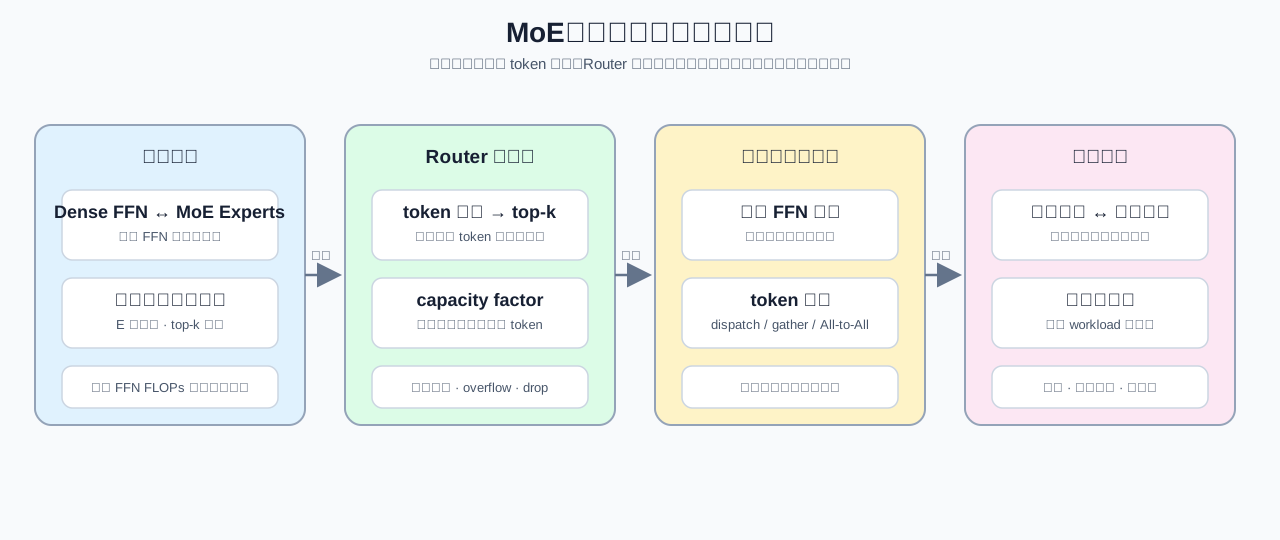
混合专家模型(MoE)通过增加专家扩大总参数量,但每个 Token 只激活其中一部分。总参数量、活跃计算量和专家负载因此不再同步增长。 本节建立“路由选择 → 专家激活 → 容量与负载 → 通信代价”的关系。完成后,你应能解释稀疏激活为何可以控制计算量,以及负载不均如何削弱这种收益。
关键词: 专家、路由器、负载均衡
前置阅读
导语: 先复习参数量、显存和分布式通信,再观察为什么 MoE 能扩大总容量,却同时引入路由、负载均衡和专家并行通信问题。
- 01. Data Types and Precision | 大模型的数据格式与混合精度
- 02. LLM Params and FLOPs | 大模型参数量与算力推导
- 05. Communication Topologies | 通信拓扑与分布式基石
Q1:MoE 和普通 dense Transformer 的参数量差别在哪里?
普通 dense Transformer 的每层参数主要来自:
- Attention
- FFN / MLP
而 MoE 会把原本的 FFN / MLP 替换成多个专家(experts)。粗略地说:
- 一个 dense FFN 的参数量约为
2 d d_ff - 如果有
E个专家,那么专家总参数量约为E × 2 d d_ff - 但每个 token 通常只会激活
k个专家,而不是全部E个
所以 MoE 的特点是:
- 总参数量:很大
- 单 token 激活参数量:相对没那么大
- 单 token 计算量:通常按
k而不是按E增长
这就是为什么 MoE 常被用来扩大模型容量,但不把每次计算都线性放大。这里的“活跃参数量”只描述 token 经过的专家规模;完整的推理 FLOPs 还包括 Attention、Router、数据搬运和其他算子,不能直接把活跃参数量当成完整 FLOPs。
一个最常见的直觉例子是 Mixtral 8x7B:
| 维度 | 量级直觉 |
|---|---|
隐藏维度 d | 4096 |
专家数 E | 8 |
激活专家数 k | 2 |
d_ff | 约 4d = 16384 |
如果只看专家 FFN,单个专家参数量大约是 2 × d × d_ff ≈ 134M,8 个专家加起来大约 1.07B 级别。加上 Attention、Embedding 和其他层之后,模型总参数可以到 47B 左右,但每个 token 实际只激活其中一小部分,常见说法是“活跃参数”大约在 13B 量级。
flowchart TD
    Dense[Dense Transformer] --> A[Attention]
    Dense --> F[Single FFN / MLP]
    MoE[MoE Layer] --> A
    MoE --> R[Router / Gate]
    R --> E1[Expert 1]
    R --> E2[Expert 2]
    R --> EN[Expert N]
Q1小验证:计算专家参数量与活跃 FFN FLOPs
写出参数量公式,再对比 dense 和 MoE 的总参数、活跃参数与专家 FFN FLOPs。
import math
import torch
from typing import Dict, List


def dense_ffn_params(d: int, d_ff: int) -> int:
    """Dense FFN/MLP 的参数量,按 2 * d * d_ff 估算。"""
    return 2 * d * d_ff


def moe_expert_params(d: int, d_ff: int, num_experts: int) -> int:
    """MoE 所有专家的总参数量。"""
    return num_experts * dense_ffn_params(d, d_ff)


def active_expert_params(d: int, d_ff: int, active_experts: int) -> int:
    """单个 token 激活的专家参数量。"""
    return active_experts * dense_ffn_params(d, d_ff)


def active_expert_ffn_flops(d: int, d_ff: int, active_experts: int, flops_per_param: int = 2) -> int:
    """估算单 token 激活专家的 FFN 矩阵乘 FLOPs。

    这里只估算专家 FFN 的乘加,不包含 Attention、Router、路由搬运和通信。
    """
    if active_experts <= 0 or flops_per_param <= 0:
        raise ValueError('active_experts 和 flops_per_param 必须为正数')
    return active_expert_params(d, d_ff, active_experts) * flops_per_param


def moe_layer_params(d: int, d_ff: int, num_experts: int, include_router: bool = True) -> int:
    """MoE 单层粗略参数量:Attention + Experts + Router。"""
    attention_params = 4 * d * d
    router_params = d * num_experts if include_router else 0
    return attention_params + moe_expert_params(d, d_ff, num_experts) + router_params


def to_million(x: int) -> float:
    return x / 1e6


def to_billion(x: int) -> float:
return x / 1e9def test_moe_parameter_formulas():
d = 4096
d_ff = 16384
experts = 8
active = 2
dense = dense_ffn_params(d, d_ff)
total_expert = moe_expert_params(d, d_ff, experts)
active_params = active_expert_params(d, d_ff, active)
active_flops = active_expert_ffn_flops(d, d_ff, active)
layer_params = moe_layer_params(d, d_ff, experts)
assert dense == 134_217_728, dense
assert total_expert == 1_073_741_824, total_expert
assert active_params == 268_435_456, active_params
assert active_flops == 536_870_912, active_flops
assert layer_params == 1_140_883_456, layer_params
print('✅ MoE 参数量公式测试通过')
test_moe_parameter_formulas()
print('单个 dense FFN 参数量:', to_million(dense_ffn_params(4096, 16384)), 'M')
print('8 个专家的总参数量:', to_billion(moe_expert_params(4096, 16384, 8)), 'B')
print('top-2 激活参数量:', to_billion(active_expert_params(4096, 16384, 2)), 'B')
print('top-2 专家 FFN FLOPs / token:', active_expert_ffn_flops(4096, 16384, 2))
print('MoE 单层粗略参数量:', to_billion(moe_layer_params(4096, 16384, 8)), 'B')Q2:Router / Gate 为什么重要?
Router / Gate 先根据每个 token 的分数选择 top-k 专家,再决定每个专家会不会过载,以及路由结果会不会引入额外通信和同步开销。
从原理上看,Router 至少同时承担三件事:
选择专家
- 对每个 token 打分,决定 top-k 专家是谁。
- 这一步决定了 token 的计算路径,不同 token 可能走完全不同的专家。
控制容量
- 每个专家能接收的 token 数量是有限的。
- 如果 token 分布不均衡,某些专家会过载,部分 token 可能被丢弃或被迫重分配。
影响训练稳定性
- 如果路由长期偏向少数专家,MoE 可能退化成“少数专家在工作,其余专家闲置”。
- 所以很多方案会引入 load balancing loss 或容量因子,强迫路由更均匀。
这也是为什么 MoE 不只是“参数变多了”,它的工程难点其实在路由质量和负载均衡,而不是单纯在 FFN 参数本身。当前小验证只观察 top-k 路由、容量和溢出;load balancing loss 作为训练机制在这里保留概念说明,不由这段代码直接计算。
flowchart LR
    Token[Token] --> Router[Router / Gate]
    Router --> E1[Expert A]
    Router --> E2[Expert B]
    Router --> E3[Expert C]
    E1 --> Cap[Capacity limit]
    E2 --> Cap
    E3 --> Cap
    Cap --> Balance[Load balancing / overflow]
Q2小验证:观察 Router / Gate 的容量和负载均衡
先估算每个专家的容量,再看 token 分布不均时会发生什么。
def expert_capacity(num_tokens: int, num_experts: int, capacity_factor: float = 1.0) -> int:
    """每个专家可接收的 token 数量上限。"""
    return math.ceil(num_tokens / num_experts * capacity_factor)


def overflow_tokens(token_counts: List[int], capacity: int) -> int:
    """给定每个专家接收的 token 数量,计算总溢出 token 数。"""
    return sum(max(0, c - capacity) for c in token_counts)


def load_balance_stats(token_counts: List[int], capacity: int) -> Dict[str, float]:
    """根据 Router 已产生的专家 token 数,统计容量和溢出。"""
    total = sum(token_counts)
    overflow = overflow_tokens(token_counts, capacity)
    return {
        'total_tokens': total,
        'capacity_per_expert': capacity,
        'max_tokens': max(token_counts),
        'min_tokens': min(token_counts),
        'overflow_tokens': overflow,
        'drop_rate': overflow / total if total else 0.0,
    }


def route_tokens(router_scores: torch.Tensor, top_k: int = 1) -> Dict[str, object]:
    """根据 token 对各专家的分数,选择 top-k 专家并统计分布。

    输入形状为 `[num_tokens, num_experts]`;这里只模拟离散路由,
    不实现专家网络、容量截断或跨设备通信。
    """
    if router_scores.ndim != 2:
        raise ValueError('router_scores 必须是 [num_tokens, num_experts]')
    num_tokens, num_experts = router_scores.shape
    if not 1 <= top_k <= num_experts:
        raise ValueError('top_k 必须在 1 和 num_experts 之间')
    selected = torch.topk(router_scores, k=top_k, dim=-1).indices
    token_counts = torch.bincount(selected.reshape(-1), minlength=num_experts).tolist()
    return {'selected_experts': selected, 'token_counts': token_counts, 'top_k': top_k}


torch.manual_seed(0)
router_scores = torch.randn(32, 4)
route = route_tokens(router_scores, top_k=2)
print('top-k 路由后的专家 token 数:', route['token_counts'])
assert route['selected_experts'].shape == (32, 2)
assert sum(route['token_counts']) == 32 * 2token_counts = [140, 40, 70, 90, 110, 80, 60, 110]
capacity = expert_capacity(sum(token_counts), len(token_counts), capacity_factor=1.0)
stats = load_balance_stats(token_counts, capacity)
print('专家 token 分布:', token_counts)
print('每个专家容量上限:', capacity)
print('-' * 60)
for k, v in stats.items():
if k.endswith('rate'):
print(f'{k:20s}: {v:.1%}')
else:
print(f'{k:20s}: {v}')Q3:为什么 MoE 的工程代价不只在计算,还在通信?
MoE 的额外代价主要来自专家并行(Expert Parallelism)下的 token 调度和 All-to-All 通信。
可以把这一层理解成:
- token 先按 Router 的结果分发到不同专家所在的设备
- 专家计算完成后,再把结果聚合回原来的序列位置
这意味着 MoE 的通信不是“顺手搬一点数据”,而是会在每一层都出现比较明确的分发 / 聚合过程。
如果 token 数、hidden_dim 或 batch 变大,通信量就会明显增加;如果 token 分布不均衡,某些专家设备还会比别的设备更忙,进一步放大尾部等待时间。
所以 MoE 的核心权衡可以概括成:
- 容量:更大
- 激活计算:不一定同比增大
- 系统复杂度:更高,尤其是路由、负载均衡和通信
flowchart LR
    Tokens[Tokens] --> Dispatch[Dispatch / All-to-All]
    Dispatch --> Devices[Expert devices]
    Devices --> Gather[Gather / All-to-All]
    Gather --> Output[Output tokens]
Q3小验证:粗估专家并行通信量
先把 top-k 视为每个 token 的路由副本数,估算每层的 dispatch / gather 数据量,再看它为什么会成为 MoE 的工程代价。这个结果是容量级估算,不是 NCCL All-to-All 实测。
def estimate_expert_parallel_traffic(
    batch: int,
    seq_len: int,
    hidden_dim: int,
    num_experts: int,
    num_devices: int,
    top_k: int = 1,
    bytes_per_param: int = 2,
    dispatch_and_gather_factor: float = 2.0,
) -> int:
    """粗略估算专家并行的通信量(字节)。

    这里按 token 数、hidden size、top-k 和 dispatch/gather 次数
    做数量级估算;不代表 NCCL All-to-All 的真实 trace。
    """
    tokens = batch * seq_len
    traffic = tokens * hidden_dim * bytes_per_param
    if top_k <= 0 or num_devices <= 0:
        raise ValueError('top_k 和 num_devices 必须为正数')
    traffic *= top_k
    traffic *= (num_experts / num_devices)
    traffic *= dispatch_and_gather_factor
    return int(traffic)


def bytes_to_mb(x: int) -> float:
    return x / 1e6


def bytes_to_gb(x: int) -> float:
return x / 1e9batch = 8
seq_len = 2048
hidden_dim = 4096
num_experts = 8
num_devices = 8
top_k = 2
traffic = estimate_expert_parallel_traffic(
batch, seq_len, hidden_dim, num_experts, num_devices, top_k=top_k
)
print('专家并行通信量粗估:')
print('-' * 60)
print(f'batch={batch}, seq_len={seq_len}, hidden_dim={hidden_dim}, top_k={top_k}')
print(f'communication = {bytes_to_mb(traffic):.1f} MB / layer')
print(f'communication = {bytes_to_gb(traffic):.3f} GB / layer')def test_traffic_estimation():
traffic_small = estimate_expert_parallel_traffic(4, 1024, 4096, 8, 8, top_k=1)
traffic_large = estimate_expert_parallel_traffic(8, 2048, 4096, 8, 8, top_k=1)
traffic_top2 = estimate_expert_parallel_traffic(4, 1024, 4096, 8, 8, top_k=2)
assert traffic_small > 0
assert traffic_large > traffic_small
assert traffic_large == 4 * traffic_small
assert traffic_top2 == 2 * traffic_small
print('✅ 通信量测试通过')
test_traffic_estimation()Q4:MoE 账本还缺哪些采用证据?
参数与计算账本可以识别 MoE 容量候选,但不能直接决定采用 MoE。形成候选通常需要两个前提:
- 你想扩大模型容量,但不希望每次推理都把计算量一起放大
- 你能接受更复杂的路由、调度和通信实现
下面这些情况说明证据仍不完整:
- 你更在意实现简单、稳定和可预测
- 你的系统带宽 / 通信条件并不理想
- 你很难接受路由不均衡带来的训练波动
可以先用下面的条件表记录账本信号和缺失证据,再进入架构、通信与性能专题验证:
| 账本或系统信号 | 仍需验证 |
|---|---|
| 总参数需求高,活跃参数明显低于总参数 | 质量、实际吞吐和显存驻留 |
| 专家需要跨设备放置 | All-to-All 通信量、暴露时间和扩展效率 |
| 专家负载不均或发生容量溢出 | Router 分布、overflow 和尾部等待 |
| 服务要求实现简单、延迟可预测 | 调度复杂度、尾延迟和回退方案 |
这张表只把理论账本转换成待测清单;最终选择仍需要记录质量、吞吐、通信时间和尾延迟。
Q4小验证:从账本生成待测清单
把容量需求、通信条件、负载均衡和工程简洁度转换成后续需要补齐的证据。
def moe_follow_up_evidence(capacity_need, communication_ready, load_balance_ok, simplicity_priority):
    """把 MoE 账本信号转换成后续待测证据,不直接给出采用决策。"""
    flags = [capacity_need, communication_ready, load_balance_ok, simplicity_priority]
    if not all(isinstance(value, bool) for value in flags):
        raise TypeError('四个条件必须是 bool')
    required = ['quality', 'throughput', 'tail_latency']
    if capacity_need:
        required.append('capacity_gain')
    if not communication_ready:
        required.extend(['all_to_all_time', 'scaling_efficiency'])
    if not load_balance_ok:
        required.extend(['expert_load_distribution', 'overflow_rate'])
    if simplicity_priority:
        required.extend(['scheduling_complexity', 'fallback_path'])
    return {
        'ledger_signal': 'capacity_candidate' if capacity_need else 'no_capacity_pressure',
        'required_measurements': sorted(set(required)),
        'evidence_level': 'theoretical_ledger',
    }

cases = [
    (True, True, True, False),
    (True, False, True, False),
    (False, True, True, True),
]
for case in cases:
    print(case, '->', moe_follow_up_evidence(*case))
assert 'capacity_gain' in moe_follow_up_evidence(True, True, True, False)['required_measurements']
assert 'all_to_all_time' in moe_follow_up_evidence(True, False, True, False)['required_measurements']
assert 'fallback_path' in moe_follow_up_evidence(False, True, True, True)['required_measurements']
print('✅ MoE 待测证据清单检查通过')
相关阅读
导语: 把参数与计算账本接到 Router 和专家并行,继续观察 capacity、overflow 与跨卡 token 交换。