
Chapter 9: Transformer: The Attention Revolution of Dynamic Topology
Every Attention Head is asking: at this moment, which parts are important to which parts?
I. A Paper in June 2017
On June 12, 2017, eight authors led by Ashish Vaswani of Google Brain uploaded a paper to arXiv with the title "Attention Is All You Need."
The title was audacious. At the time, the dominant architecture for machine translation was RNNs (Recurrent Neural Networks) and LSTMs (Long Short-Term Memory networks)—they had ruled the NLP field for over twenty years. And this paper said: you are all unnecessary; attention mechanism alone is enough.
More audaciously, they were right.
Five months later, the paper was accepted by NIPS 2017. Two years later, BERT and GPT-2 burst onto the scene, all based on the Transformer architecture. Three more years later, GPT-3 proved that Transformers could scale to 175 billion parameters.
Today, virtually all large language models—from ChatGPT to Claude—are variants of the Transformer.
But in June 2017, it was just a radical idea: could we completely abandon recurrent structures?
1.1 The Cost of Sequential Dependency
RNNs work in a very intuitive way: process words one by one from left to right, at each step combining the current word with the previous "memory" to update the hidden state.
This design looks very natural—after all, humans also read sentences from left to right. But it has two fatal flaws:
RNN, LSTM: What are Recurrent Neural Networks?
RNN (Recurrent Neural Network): A neural network that processes sequences by time steps. At each step, it receives the current input
Intuitive analogy: each time you read a word, you update your mental understanding of the sentence, then read the next word—RNNs simulate this process.
LSTM (Long Short-Term Memory): An improved version of RNNs, adding "gating" mechanisms (forget gate, input gate, output gate) to control which information should be retained and which should be forgotten, mitigating the problem of long-distance information loss.
Vanishing gradient: When training neural networks, the error signal (gradient) propagates from the output layer to the input layer. If the propagation path is very long (e.g., an RNN processing a long sentence), the gradient gets repeatedly multiplied by numbers less than 1, eventually becoming close to zero—distant weights then "cannot learn anything." LSTMs mitigate this problem through gating, but do not fundamentally solve it.
Flaw 1: Inability to parallelize
To compute the hidden state of the 10th word, you must first compute the hidden state of the 9th word; to compute the 9th word's, you must first compute the 8th word's... This chain cannot be parallelized.
In the GPU era, this is catastrophic. GPUs have thousands of cores and can simultaneously compute thousands of operations. But RNNs force you to compute serially—processing only one word at a time.
For a sequence of length N, an RNN requires N steps of serial computation. Even if each step takes only 1 millisecond, a sentence of 1000 words would take 1 second.
Flaw 2: Information decay in long-range dependencies
Suppose you want to translate this sentence:
"The cat, which we found in the garden last summer, was very friendly."
The subject "cat" and the predicate "was" are separated by 12 words. The RNN needs to pass the information of "cat" through 12 steps to reach "was."
With each step of transmission, information decays. Even with LSTM's gating mechanisms, long-distance transmission remains difficult—this is another manifestation of the vanishing gradient problem.
Bengio et al. proved in 1994: when RNNs learn long-range dependencies, gradients decay exponentially. LSTMs mitigate this problem but do not fundamentally solve it.
1.2 Vaswani's Wager
The idea of Vaswani et al. was: if every word could directly "see" all other words, there would be no need to pass information through hidden states.
This is the Self-Attention mechanism. It allows every position in a sequence to directly compute its relevance to all other positions, then perform a weighted sum using those relevance scores.
No recurrence, no sequential dependency, fully parallelizable computation.
What is the cost? Computational complexity goes from
Self-Attention: Every word asks every other word, "Are you important?"
The core idea of Self-Attention: when processing a sentence, for each word, let it "query" all other words in the sentence "How important are you to me?", then combine information from all words weighted by importance.
Intuitive example: "The bank failed"—when processing the word "failed," Self-Attention lets "failed" ask "bank," "The" etc. about their importance, discovers that "bank" is most relevant, and thus references "bank"'s information more heavily to understand the context of "failed."
The
Why is it worth it? Because all
For a sequence of length N, Self-Attention requires computing an
This is a bold wager: trade
The results proved this wager was worthwhile.
A Pause
"The results proved this wager was worthwhile"—but worthwhile, by what measure?
Does the Transformer work because Self-Attention, as a design, is structurally closer to the "true structure" of language than RNNs? Or is it simply because
In other words: Is the Transformer's success due to its inductive bias being correct, or due to its inductive bias being the weakest—so weak that brute-force data can fill the gap?
"Having no inductive bias" is itself an inductive bias. The Transformer assumes that "words at any position may be important to words at any other position." Is this assumption correct for language? Is it correct for all tasks?
Set this question aside for now.
II. The Mathematics of Self-Attention: An Elegant Symmetry
The core of the Transformer is the Self-Attention mechanism. The problem it aims to solve is simple:
Given a sequence, how can every position "see" all other positions, and decide which positions are important?
The mathematical form is surprisingly concise. For an input sequence
These three matrices have different semantic roles:
Query: "What am I looking for?"—the pattern the current position wants to attend to
Key: "What can I provide?"—the index information each position offers
Value: "What is my content?"—the actual information at each position
Then compute attention:
Let me unpack every step of this formula:
Step 1: Compute similarity
Each query takes the dot product with each key. The element at row
Why can the dot product measure similarity? Because
Step 2: Scale Divide by
This is a crucial technical detail. When
Under the initialization assumption, each dimension of
Step 3: Normalize softmax normalization per row
Convert similarities into a probability distribution. The softmax output of row
Step 4: Weighted sum Multiply by
Use the attention weights to compute a weighted sum of values. The output of position
This is a soft addressing mechanism: instead of hard-selecting a specific position, it computes a weighted average over all positions, with weights determined by similarity.
The beauty of this mechanism:
Global receptive field: Each position can directly "see" all other positions, without passing through hidden states
Fully parallel: All positions' outputs can be computed simultaneously, with no sequential dependency
Dynamic topology: The attention matrix is dynamically generated based on input content, not fixed weights
III. Hands-On: Seeing What Attention Is "Looking" At
Take out a piece of paper and manually compute a simple example.
Input sentence: "cat sat mat" (3 words, for simplicity)
Assume each word has been embedded as a 2-dimensional vector:
cat: [1, 0]
sat: [0, 1]
mat: [1, 1]
Step 1: Compute Q, K, V
For simplicity, assume
Step 2: Compute attention scores
Divide by
Step 3: Apply softmax (per row)
For the first row
The complete attention matrix (approximate):
Interpretation: - Row 1: "cat" has similar attention to itself (0.42) and "mat" (0.42), lower attention to "sat" (0.16) - Row 3: "mat" attends to all words, but highest to itself (0.46)
Step 4: Weighted sum
Output for the 1st word:
This vector fuses information from "cat" and "mat," because the attention weights are high.
Key observation: The attention matrix
Professor Pallas's Cat's Monologue: The Dynamic Topology of Hidden Space
There is a fatal weakness in the textbooks.
They say: "The attention mechanism models explicit relationships between tokens." They say: "Self-Attention lets every token directly see all other tokens."
This is wrong.
Let me clarify a core misconception—one that has even infiltrated papers at many top conferences, leading the entire community down the wrong intuition for years.
Spatial Confusion: Hidden Space vs. Token Space
People always think that attention operates in "token space." But what is "token space"? Is it the lookup table of embedding vectors? That space only encodes word forms; it is static, vocabulary-level.
The real operation occurs in hidden space.
When a sequence
Positional encoding, layer normalization... these are not decorations. They transform static embeddings into context-dependent hidden representations.
Then attention takes the stage:
Note:
The Real Operation: Representation Retrieval in Hidden Space
So, what is attention doing?
It is not comparing "token A" with "token B." It is comparing "the hidden representation of position A" with "the hidden representation of position B."
To put it in more technical terms:
- Embedding space: Word form -> Static vector
- Hidden space: Contextual understanding -> Dynamic vector
The attention mechanism performs representation retrieval within hidden space.
The similarity
RNN's Hard Bottleneck vs. Transformer's Dynamic Topology
This distinction reveals the essence of the two architectures:
RNN: The hard bottleneck of explicit memory recurrence
is a fixed-dimensional hidden vector - All historical information must be compressed into this low-dimensional space
- This is a hard bottleneck—information is forced into dimensionality reduction, like compressing a book into a one-page summary
- Vanishing/exploding gradients are the inevitable cost of this one-dimensional chain structure
- Low-entropy structure: Connection pattern is fixed, information capacity is constant
Transformer: The dynamic topology of hidden space
- Each hidden representation
generates via QKV projections - Attention weights
are computed in real time, forming a dynamic connection graph - No fixed-dimensional bottleneck—information capacity scales with sequence length
- High-entropy structure: Connection weights are dynamically generated, with extremely high representational degrees of freedom
Entropy and Representational Degrees of Freedom
Let me use slightly more quantitative terminology:
- RNN representational degrees of freedom:
, independent of sequence length - Attention representational degrees of freedom:
, scales linearly with sequence length
But attention is not just "more storage." Its high entropy comes from dynamic selectivity.
For every input, it constructs in real time a topological structure optimally suited to the current context. This adaptivity—building connections on demand within hidden space—is the true manifestation of intelligence.
GPT's Pyramid Structure
This also explains why GPT can still function after pruning some layers.
The Transformer is not a flat structure, but a pyramid:
- Shallow hidden layers: Encode surface syntax, local dependencies
- Middle hidden layers: Encode phrase structure, medium-distance dependencies
- Deep hidden layers: Encode semantic roles, logical relationships, long-range dependencies
Each layer performs "representation refinement" within hidden space. Pruning top layers only loses the most abstract understanding; the foundations in the lower layers remain.
The True Meaning of Dynamic Topology
Now I can define "dynamic topology" more precisely:
The attention mechanism is a dynamic connection graph constructed in real time within hidden space, based on the current context. These connections are not determined by tokens, but by the hidden representations of tokens in specific contexts.
The same word ("bank"):
- In a riverbank context, its hidden representation encodes "river, shore, nature"
- In a financial bank context, its hidden representation encodes "finance, money, commerce"
Therefore, its attention patterns with other words are completely different.
This is the charm of dynamic topology—connections are context-dependent, content-driven, and evolve in real time.
It is not "all tokens equally see all other tokens." Rather, it is "under the current hidden representations, which positions' understandings are most relevant to the current position's understanding."
A Clarification from Graph Theory: Seeing ≠ Walking
But there is an even deeper misconception, especially common in textbooks.
Those books love to use "two kids making friends" as a metaphor for the attention mechanism: each child (token) can see all other children and then decide whose hand to hold. This metaphor is vivid, but misses the most critical link.
Seeing does not equal being able to walk there, nor being able to pass messages.
In the language of graph theory: view one layer of a Transformer as a complete graph, where each node (position) has an edge pointing to all other nodes. This edge represents "attention"—I can see your hidden representation, I can take information from you.
But the "bandwidth" of this edge is limited. A single attention operation is merely a single shallow information integration. If you want to have deep information fusion with a distant node—say, integrating its semantics with your syntax, then further fusing with a third node's pragmatic information—you need multi-step propagation.
In a Transformer, one step is one layer.
Therefore:
- One-layer Transformer: Each position can see all positions, but can only do one shallow integration
- Two-layer Transformer: Information can propagate two steps—A takes information from B, integrates it, then takes information from C
- L-layer Transformer: Information can walk L steps in the graph, achieving deep, multi-hop fusion
This is why depth is so important.
At the same width (
- Shallow networks: Information fusion paths are short; only local or shallow pattern matching is possible
- Deep networks: Information can "travel" farther in hidden space, achieving integration across multiple abstraction levels
The length of information fusion ≈ the depth of the network.
This is not my speculation. This is a basic fact of graph theory: in a graph
For example:
- Layer 1: Learn part-of-speech tagging (noun/verb)
- Layer 2: Learn phrase structure (noun phrase/verb phrase)
- Layer 3: Learn syntactic roles (subject/object)
- Layer 4: Learn semantic relations (agent/patient)
- Layer 5: Learn pragmatic intent (statement/question/command)
Each layer performs deeper information fusion on the foundation of the previous layer. Without sufficient depth, information cannot "travel" to sufficiently abstract levels.
So, when you hear "Transformer lets every token see every token," remember:
- It describes the local property of one layer
- True understanding requires the deep propagation paths formed by stacking multiple layers
- This is why GPT-3 has 96 layers, not 1
Seeing is free; walking requires paying the cost of layers.
Returning to That Classic Question
Now we can answer that suspended question:
Is the Transformer's success due to its inductive bias being correct?
The answer is: partially correct.
Its inductive bias is not "all tokens may be relevant," but something deeper:
"In an appropriate hidden space, context-dependent representations can be selectively integrated through dynamic topology."
This bias is closer to the true structure of language than RNN's "sequence is a Markov chain," yet not so weak as to have no bias at all.
It falls precisely on the sweet spot between "flexible enough to capture linguistic complexity" and "biased enough to learn efficiently."
"Alright, now we can continue discussing multi-head attention."
IV. Multi-Head Attention: Division of Labor and Collaboration
A single attention head can only capture one relational pattern. But relationships in language are diverse:
Syntactic relations: subject-predicate, modifier-head
Semantic relations: pronoun-antecedent, synonyms
Positional relations: adjacent words, long-distance dependencies
The Transformer uses Multi-Head Attention to solve this problem: run multiple attention heads in parallel, each learning a different relational pattern.
Where each head:
Intuition: Divide the
Experimental observations (from BERT visualization studies):
- Head 1: Attends to adjacent words (local syntax)
- Head 2: Attends to pronouns and antecedents (coreference resolution)
- Head 3: Attends to sentence beginnings and endings (global structure)
- Head 4: Attends to punctuation marks (syntactic boundaries)
Different heads spontaneously learned different linguistic functions, despite no explicit supervision.
V. The Cost of O(N²): The Thermodynamic Bill of a Global Receptive Field
The time complexity of Self-Attention is
This is not a constant factor that can be optimized away; it is the intrinsic cost of the architecture.
5.1 Why N²?
Computing
Storing the attention matrix requires
Comparing other architectures:
RNN:
— linear in sequence length, but sequentially dependent CNN:
— linear in sequence length, but receptive field limited by kernel size Transformer:
— global receptive field, but quadratic complexity
5.2 An Information-Theoretic Perspective: The Entropy Cost of Full Connectivity
From an information-theoretic perspective,
RNN is a chain topology: each node only connects to the previous node. Information flow is unidirectional, left to right. This is a low-entropy structure—the connection pattern is deterministic and does not need to be stored.
Transformer is a fully-connected topology: each node connects to all other nodes. This is a high-entropy structure—connection weights (the attention matrix) are dynamic and must be stored.
Shannon's information theory tells us: describing the connection weights of an
This is not an implementation issue; this is an information-theoretic lower bound.
5.3 A Physics Perspective: The Constraint of Landauer's Principle
Landauer's principle states: erasing 1 bit of information requires at least
In every forward pass, the Transformer computes and stores
This means: processing a sequence of length
When
GPT-3 training consumed approximately 1287 MWh of electricity. A substantial portion of that was used for computing and storing the attention matrix.
5.4 Is This Cost Worth It?
For sequences of length
But for long sequences (document-level translation, long text summarization, gene sequence analysis),
This has spawned a series of "efficient Transformer" research efforts:
Sparse Attention: Only compute partial attention, e.g., local windows + global tokens
Linear Attention: Use kernel tricks to reduce complexity to
Reformer: Use locality-sensitive hashing to approximate attention
Longformer: Mix local windows and global attention
But all these methods have a cost: either sacrifice the global receptive field, or introduce approximation error.
No free lunch: global receptive field and linear complexity—you can only pick one. This is not an engineering limitation; this is a fundamental constraint from information theory and thermodynamics.
VI. Linear Attention: Replacing softmax with the Associativity of Addition
The root of
So, what if we remove softmax?
8.1 A Kernel Function Perspective
Recall standard attention:
The
Kernel functions have a universal approximation scheme: feature mapping. If there exists a function
Then attention can be rewritten as:
Key: Using the associativity of addition and matrix multiplication, swap the order of the parentheses:
Now the
All
Total complexity:
8.2 The Fatal Flaw of Linear Attention: Smoothness
This sounds perfect. But linear attention has consistently underperformed standard attention in practice—especially when precise, sharp attention is needed (e.g., coreference resolution, keyword matching).
The reason is: softmax naturally produces sharp distributions; linear kernels cannot.
The exponential function in softmax greatly amplifies large scores and suppresses small scores. The result is highly concentrated attention weights—one position might take 0.95 of the weight, leaving only 0.05 for the rest.
The linear kernel
This looks more "fair," but that is precisely the problem.
To use an analogy: you are at a noisy party trying to hear one person speak (signal). Softmax attention lets you concentrate 95% of your attention on that person, with 5% distributed to others (noise). Linear attention distributes attention evenly to everyone—you can hear that person, but the noise is equally amplified, and the signal is drowned out.
Linear attention is too smooth—it accumulates noise and signal indiscriminately, diluting sharpness.
More formally: linear attention computes a single linear readout from the Key-Value outer product matrix
This is the essence of linear attention: it is actually a finite-capacity recurrent state, not a true global receptive field.
VII. State Space Models: From Linear Attention to Selective Memory
The analysis of linear attention reveals a deeper problem: Can a global receptive field and linear complexity be had simultaneously?
The answer is: no—unless a new dimension is introduced: selectivity.
This is the core idea of State Space Models (SSMs) and Mamba.
9.1 Seeing the Shadow of SSMs in Linear Attention
The recurrent form of linear attention:
where
This recurrence is almost identical to the classic linear state space model (Linear SSM):
Linear attention's
The improvement of SSMs: Make
9.2 HiPPO: Compressing History with Orthogonal Polynomials
In 2020, Albert Gu et al. proposed the HiPPO (High-order Polynomial Projection Operator) framework, providing a theoretical construction of the
Intuition: HiPPO-
This solves the overwriting problem of linear attention: old information is not accumulated equally, but compressed by importance into a low-dimensional "historical summary."
9.3 Mamba: Selective State Space Models
In 2023, Albert Gu and Tri Dao proposed Mamba, whose core innovation is the selective mechanism (Selective SSM, S6).
In standard SSMs, the
Mamba makes
The discretized state transition:
The meaning of selectivity:
large: , the state decays heavily—the model actively forgets old information and focuses on the current input small: , the state is almost unchanged—the model actively remembers old information and ignores the current input
This is not a fixed forgetting curve, but content-driven selective memory. For important tokens, the model lowers the decay rate, letting their information persist longer in the state; for noise tokens, the model accelerates forgetting.
9.4 Why Selectivity Solves Linear Attention's Problem
Returning to the "smoothness" problem: linear attention accumulates all information equally into the state, causing signal to be diluted by noise.
Mamba solves this through selective
- Seeing important information ->
large -> state is dramatically updated, old noise is cleared - Seeing noise ->
small -> state barely changes, noise is ignored
This is the counterpart of softmax's "sharpness" in a recurrent architecture: not concentrating attention in the spatial dimension, but selectively remembering in the temporal dimension.
9.5 The Cost: Locality Returns
Mamba is
But it has a cost: selectivity is local.
For tasks requiring precise matching of distant tokens (e.g., finding a specific word that appeared 1000 tokens ago), Mamba's performance will be weaker than the Transformer.
This is inevitable: you cannot have both global direct access and linear complexity. Mamba trades "indirect access via compressed history" for linear cost.
9.6 Transformer, Linear Attention, Mamba: The Triangular Trade-off
| Architecture | Time Complexity | Space Complexity | Long-range Capability | Precise Matching Capability |
|---|---|---|---|---|
| Transformer | Global direct access | Strong (softmax sharpness) | ||
| Linear Attention | Finite-capacity state | Weak (smooth, noise-diluted) | ||
| Mamba (SSM) | Compressed historical memory | Medium (selective memory) |
No free lunch. Global receptive field, linear complexity, precise matching capability—you can have at most two of the three simultaneously.
This is a fundamental constraint of information theory, not an engineering problem.
VIII. Positional Encoding: How the Transformer Understands "Order"
Self-Attention has a curious property: it is insensitive to word order.
If you shuffle "cat sat mat" into "mat cat sat," the attention matrix will change (because the row and column order of
But language has order. "cat sat mat" and "mat sat cat" have different meanings.
The solution: Positional Encoding. Add position information into the input embeddings:
The original Transformer uses sinusoidal positional encoding:
where
Why use sinusoidal functions? Because they have an elegant property:
That is, relative positions can be expressed as a linear function of absolute positions. This makes it easier for the model to learn "relative positional relationships."
Sinusoidal positional encoding is an absolute positional encoding method; its encoding is deterministic and contains no learnable parameters, thus introducing no additional learning noise. However, because this encoding method is injected by adding it to the token embedding, the content information and absolute position information in the token representation are strongly coupled, making them difficult to explicitly decouple during attention computation. Its limitation lies in—it does not explicitly model relative positional relationships between tokens; the model must indirectly derive these relationships through absolute positional encoding, thereby increasing the learning burden.
Moreover, this implicit modeling approach may, to some extent, affect the model's ability to capture long-distance dependencies and its ability to extrapolate to unseen sequence lengths.
Subsequent research proposed relative positional encoding:
- RoPE (Rotary Position Embedding): Encodes relative position directly in attention computation
- ALiBi: Adds a positional bias to attention scores; the farther the distance, the lower the weight
These methods perform better on long-sequence extrapolation—trained on length 512, tested on length 2048.
IX. Pseudocode: A Complete Forward Pass of the Transformer
Let me formalize the core algorithm of the Transformer.
Algorithm 1: Self-Attention Layer
import torch
import torch.nn.functional as F

def self_attention(X, W_Q, W_K, W_V):
    # X: (N, d_model), W_Q/W_K/W_V: (d_model, d_k)
    Q = X @ W_Q          # (N, d_k)
    K = X @ W_K          # (N, d_k)
    V = X @ W_V          # (N, d_v)
    d_k = Q.shape[-1]
    scores = Q @ K.T / d_k ** 0.5              # (N, N)
    attn   = F.softmax(scores, dim=-1)         # normalize per row
    return attn @ V                            # (N, d_v)
# Time complexity O(N²·d), space complexity O(N²)
Algorithm 2: Multi-Head Attention
import torch
import torch.nn as nn

class MultiHeadAttention(nn.Module):
    def __init__(self, d_model, num_heads):
        super().__init__()
        assert d_model % num_heads == 0
        self.h  = num_heads
        self.dk = d_model // num_heads
        self.W_Q = nn.Linear(d_model, d_model, bias=False)
        self.W_K = nn.Linear(d_model, d_model, bias=False)
        self.W_V = nn.Linear(d_model, d_model, bias=False)
        self.W_O = nn.Linear(d_model, d_model, bias=False)

    def forward(self, X):
        B, N, D = X.shape
        # Project and split into multi-head (B, h, N, dk)
        Q = self.W_Q(X).view(B, N, self.h, self.dk).transpose(1, 2)
        K = self.W_K(X).view(B, N, self.h, self.dk).transpose(1, 2)
        V = self.W_V(X).view(B, N, self.h, self.dk).transpose(1, 2)
        attn = F.softmax(Q @ K.transpose(-2, -1) / self.dk**0.5, dim=-1)
        out  = (attn @ V).transpose(1, 2).reshape(B, N, D)  # concatenate heads
        return self.W_O(out)
Algorithm 3: Complete Transformer Block
class TransformerBlock(nn.Module):
    def __init__(self, d_model, num_heads, d_ff):
        super().__init__()
        self.attn  = MultiHeadAttention(d_model, num_heads)
        self.ff1   = nn.Linear(d_model, d_ff)
        self.ff2   = nn.Linear(d_ff, d_model)
        self.norm1 = nn.LayerNorm(d_model)
        self.norm2 = nn.LayerNorm(d_model)

    def forward(self, X):
        X = self.norm1(X + self.attn(X))                         # Attention + Residual + LN
        X = self.norm2(X + self.ff2(F.relu(self.ff1(X))))        # FFN + Residual + LN
        return X
# Full Transformer = stack multiple TransformerBlocks
X. The Philosophy of Attention: Understanding or Retrieval?
The success of the Transformer raises a profound question: Is the attention mechanism "understanding" relationships, or "retrieving" relevant information?
Consider this sentence:
"The trophy doesn't fit in the suitcase because it is too big."
Humans know that "it" refers to "trophy" (not "suitcase"), because we understand the logic of "too big"—the trophy is too big so it doesn't fit.
The Transformer can also correctly focus "it"'s attention on "trophy." But does it truly understand the causal logic, or did it merely learn a statistical pattern: "it" usually refers to the preceding noun, and "it" near "too big" is more likely to refer to the first noun?
This question has no simple answer. But there are some clues:
Evidence 1: Interpretability of attention patterns
Researchers have found that certain attention heads indeed learn linguistically meaningful patterns: subject-verb agreement, modifier-head relationships, pronoun-antecedent binding.
These patterns are not random; they are systematic.
Evidence 2: Fragility under distribution shift
But when the test data distribution differs from the training data, these patterns collapse. If during training "it" always refers to the first noun, and during testing you encounter cases where "it" refers to the second noun, the model fails.
This suggests that what the Transformer learns may be statistical shortcuts, not deep causal understanding.
Evidence 3: Attention ≠ Explanation
More subtly, attention weights themselves may not be the true cause of the model's decisions. Research from 2019 showed that even if you randomly shuffle attention weights, the model's output sometimes does not change much—because the true information may be encoded in the value vectors, not in the attention distribution.
Attention is a useful tool, but it is not a sufficient condition for understanding.
XI. Visualization: What Attention Heads Are "Looking" At
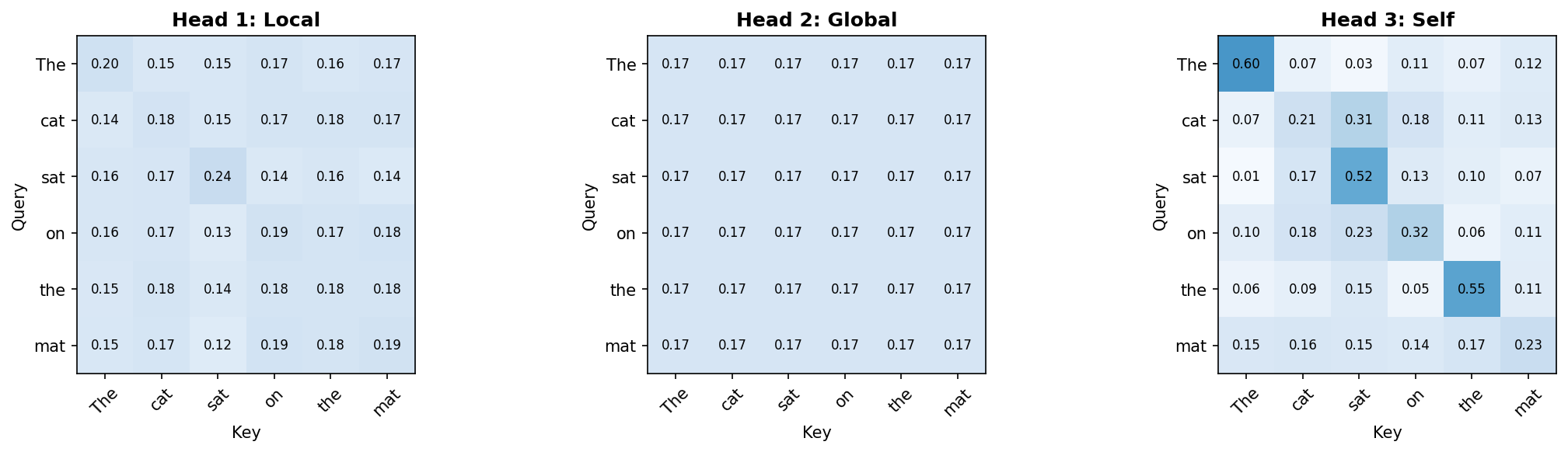
The Transformer defines the infrastructure of reasoning. In the next chapter, we will see how it combines with search—finding the optimal reasoning path in state space.
Unresolved Questions
Does the attention mechanism truly "understand" relationships?
Or is it just doing complex pattern matching? Consider this test: if you randomly shuffle attention weights but keep value vectors unchanged, how much does the model's output change? Jain & Wallace (2019) found: on some tasks, shuffling attention weights has little effect on the output. What does this indicate? Are attention weights unimportant, or is the true information encoded in the value vectors?
Can the O(N²) cost be fundamentally broken?
All "efficient Transformers" sacrifice either the global receptive field or introduce approximation. But is this inevitable? The information-theoretic lower bound says: describing a fully-connected graph of
nodes requires bits. But perhaps we don't need to store the complete attention matrix—perhaps there exists an implicit representation that encodes connection patterns in space? What is the essence of positional encoding?
Why do sinusoidal functions work? Why is RoPE (Rotary Position Embedding) better for long-sequence extrapolation? What is the optimal encoding method for positional information? This question is equivalent to: how can we inject sequential information while preserving permutation invariance?
How many heads should multi-head attention have?
BERT uses 12 heads, GPT-3 uses 96 heads. How is this number chosen? Is there a theory for the optimal number of heads? One possible angle: each head learns relational patterns in a subspace; the number of heads should equal the "intrinsic dimensionality of linguistic relations." But what is this dimensionality?
Can attention weights serve as an interpretability tool?
If attention is not explanation (Jain & Wallace's argument), how should we understand the model's decision process? A deeper question: does interpretability require causality? That is, what we need is not "what the model is looking at," but "if we change the input, how does the model's output change?"
What is the inductive bias of the Transformer?
CNNs have a locality bias (convolution kernels), RNNs have a sequential bias (recurrent structure). What is the Transformer's inductive bias? Is "having no inductive bias" itself an inductive bias? This question touches the philosophy of architecture as prior: every architecture assumes some structure in the observed data; it's just that some assumptions are more concealed than others.
Further Reading
Vaswani et al. (2017). Attention Is All You Need — The original Transformer paper, ushering in a new era for NLP
-> [arXiv:1706.03762]Katharopoulos et al. (2020). Transformers are RNNs: Fast Autoregressive Transformers with Linear Attention — Kernel function derivation of linear attention; the associativity of addition trades for
complexity and its smoothness cost -> [arXiv:2006.16236]Gu, A. et al. (2020). HiPPO: Recurrent Memory with Optimal Polynomial Projections — Optimal historical compression via Legendre polynomials, the theoretical foundation of SSMs
-> [arXiv:2008.07669]Gu, A. & Dao, T. (2023). Mamba: Linear-Time Sequence Modeling with Selective State Spaces — Selective SSMs, using content-driven
to achieve softmax-like sharpness in the temporal dimension -> [arXiv:2312.00752]Devlin et al. (2018). BERT: Pre-training of Deep Bidirectional Transformers — Bidirectional Transformer pre-training, demonstrating the power of attention mechanisms
-> [arXiv:1810.04805]Su et al. (2021). RoFormer: Enhanced Transformer with Rotary Position Embedding — RoPE rotary position encoding, improving long-sequence extrapolation
-> [arXiv:2104.09864]Press et al. (2021). Train Short, Test Long: Attention with Linear Biases Enables Input Length Extrapolation — ALiBi positional bias method
Clark et al. (2019). What Does BERT Look At? An Analysis of BERT's Attention — Attention visualization and interpretability research
Tay et al. (2020). Efficient Transformers: A Survey — Survey of efficient Transformer architectures
Jain & Wallace (2019). Attention is not Explanation — Critical analysis of attention as an explanatory tool
Wiegreffe & Pinter (2019). Attention is not not Explanation — Rebuttal to the above critique, a defense of attention