
34. Heterogeneous Accelerators and Runtime Constraints | 异构加速器与运行时约束
难度: Medium | 环境: CPU-first | 标签: 异构系统, 运行时, 部署约束 | 目标人群: 需要比较不同加速器执行条件的学习者
🚀 云端运行环境
本章节的实战代码可以点击以下链接在免费 GPU 算力平台上直接运行:
(国内推荐:魔搭社区免费实例)

本节导读
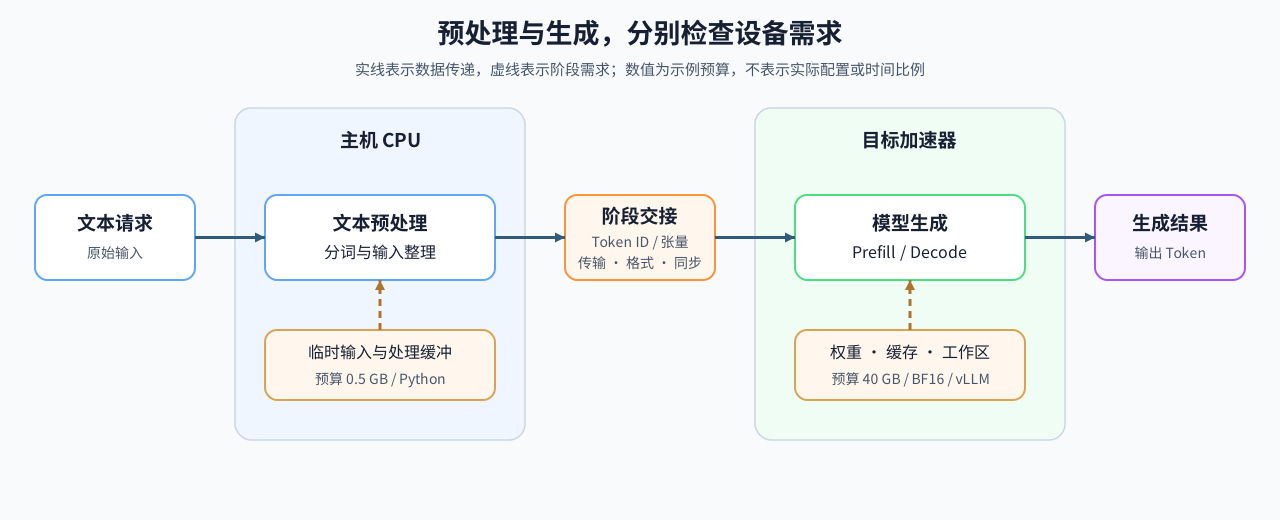
模型迁移不要求所有阶段都使用同一种设备。文本预处理可能只需少量主机内存,生成阶段却要容纳权重、缓存和工作区;若把生成阶段的需求套给预处理,就可能错误排除本来可用的 CPU。
本节把任务拆成阶段,分别比较容量、精度、操作和运行时要求,再计算输入转换、跨设备搬运与同时驻留。完成后,你应能区分“声明匹配”“真实路径能够执行”和“性能满足要求”;这些判断接到部署与异构系统专题中的加载与执行验证。
关键词: 阶段需求、数据交接、格式转换、同时驻留、运行时
前置阅读
先按任务筛选候选,再用搬运量与带宽估算阶段交接。
- 10 加速器选型与软件栈适配:任务需求与软件支持。
- 07 CPU与GPU异构调度:数据位置、带宽与完整路径时间。
Q1:各阶段需要记录哪些资源与操作?
以“主机分词 → 加速器生成”为例,前者需要词元编号与少量处理缓冲,后者需要权重、KV缓存和工作区。将整模型40 GB预算套给预处理,会错误排除小内存设备;只检查总容量,又可能遗漏生成阶段所需的精度、操作或执行框架。运行时是加载产物、组织操作执行的软件环境,名称相同也还需核对具体版本与路径。
下面给出构造的CPU、GPU、NPU能力和两阶段需求。每阶段分别记录预计峰值、数值类型、所需操作、运行时及是否使用集合通信,再从同一份声明中读取字段。实际设备支持情况由目标规格与功能验证补充。
import math


DEVICE_PROFILES = {
    "cpu": {"memory_gb": 128, "precisions": {"fp32", "bf16"}, "ops": {"tokenize", "route", "postprocess"}, "runtimes": {"python"}, "collective": False},
    "gpu": {"memory_gb": 48, "precisions": {"fp16", "bf16", "int8"}, "ops": {"prefill", "decode", "rope", "attention"}, "runtimes": {"torch", "vllm"}, "collective": True},
    "npu": {"memory_gb": 64, "precisions": {"bf16", "int8"}, "ops": {"prefill", "decode", "attention"}, "runtimes": {"vendor-runtime"}, "collective": True},
}


def summarize_device_profile(profile):
    """把设备 profile 转成便于比较的基础账本。"""
    return {
        "memory_gb": profile["memory_gb"],
        "precision_count": len(profile["precisions"]),
        "operator_count": len(profile["ops"]),
        "runtime_count": len(profile["runtimes"]),
        "collective": profile["collective"],
        "operators": sorted(profile["ops"]), "runtimes": sorted(profile["runtimes"]),
    }


assert summarize_device_profile(DEVICE_PROFILES["gpu"])["operator_count"] == 4

REQUEST_PLAN = {
    "estimated_peak_gb": 40,
    "precision": "bf16",
    "required_ops": {"prefill", "decode", "attention"},
    "runtime": "vllm",
    "requires_collective": False,
    "stages": {
        "prepare": {
            "estimated_peak_gb": 0.5, "precision": "fp32",
            "required_ops": {"tokenize"}, "runtime": "python",
            "requires_collective": False,
        },
        "generate": {
            "estimated_peak_gb": 40, "precision": "bf16",
            "required_ops": {"prefill", "decode", "attention"},
            "runtime": "vllm", "requires_collective": False,
        },
    },
}

assert REQUEST_PLAN["stages"]["prepare"]["estimated_peak_gb"] == 0.5
assert REQUEST_PLAN["stages"]["generate"]["estimated_peak_gb"] == 40
print("GPU声明中的操作:", summarize_device_profile(DEVICE_PROFILES["gpu"])["operators"])
print("预处理与生成预算:", [
    stage["estimated_peak_gb"] for stage in REQUEST_PLAN["stages"].values()])
Q2:哪些设备声明满足生成阶段的需求?
生成要求BF16、40 GB预计峰值、预填充/解码/注意力操作及vLLM运行时。给定GPU声明全部满足;NPU虽有64 GB和BF16,却没有声明vLLM,因而不能直接采用同一执行路径。若改用它支持的运行时,还需重新准备匹配产物并验证结果,不能仅替换一个名称便视为已经迁移。
下面逐项比较需求与声明,容量按十进制GB计。集合通信只在当前阶段需要时检查;阶段候选确定后,再计算它与相邻阶段之间新增的工作。
def check_device_feasibility(profile, plan):
    """比较一个阶段与给定设备声明,不探测设备或执行模型。"""
    required = ("estimated_peak_gb", "precision", "required_ops",
                "runtime", "requires_collective")
    if any(key not in plan for key in required):
        raise ValueError('阶段需求缺少必要字段')
    if (type(profile["memory_gb"]) not in (int, float)
            or not math.isfinite(profile["memory_gb"]) or profile["memory_gb"] <= 0
            or type(plan["estimated_peak_gb"]) not in (int, float)
            or not math.isfinite(plan["estimated_peak_gb"])
            or plan["estimated_peak_gb"] < 0):
        raise ValueError('设备容量须为有限正数,阶段预算须为有限非负数')
    if (type(plan["requires_collective"]) is not bool
            or type(profile["collective"]) is not bool):
        raise ValueError('集合通信需求和支持状态必须是布尔值')
    memory_ok = profile["memory_gb"] >= plan["estimated_peak_gb"]
    precision_ok = plan["precision"] in profile["precisions"]
    missing_ops = sorted(set(plan["required_ops"]) - set(profile["ops"]))
    runtime_ok = plan["runtime"] in profile["runtimes"]
    collective_ok = not plan["requires_collective"] or profile["collective"]
    return {
        "declared_requirements_met": bool(
            memory_ok and precision_ok and not missing_ops
            and runtime_ok and collective_ok),
        "memory_ok": memory_ok, "precision_ok": precision_ok,
        "missing_ops": missing_ops, "runtime_ok": runtime_ok,
        "collective_ok": collective_ok,
    }


assert check_device_feasibility(DEVICE_PROFILES["gpu"], REQUEST_PLAN)["declared_requirements_met"]
assert not check_device_feasibility(DEVICE_PROFILES["npu"], REQUEST_PLAN)["runtime_ok"]
Q3:阶段都能执行,交接还增加哪些搬运与内存?
沿用主机分词到GPU生成的路径,假设4096个词元编号由32位整数存储,消费端要求64位整数。转换前为16384 B,转换后为32768 B;先在主机产生转换缓冲、再传输时,两份编号暂时同时存在,主机载荷为49152 B。带宽按16 GB/s计算,32768 B的纯传输估算为0.002048 ms;类型转换、固定提交和等待时间另计。
这里转换改变存储位宽,编号数值、顺序和有效长度仍应保持。加速器若已有40000000000 B状态,同时还要接收32768 B输入,容量恰好40 GB便不足,48 GB则允许这两项共同驻留。共同驻留只对本例明确同时存活的对象求和;已有阶段峰值若包含该输入,就不再重复加入。下面先筛选阶段,再复现这组交接账目。

def assign_stages(profiles, plan):
    """按显式阶段配置逐项筛选声明,不决定实际放置或验证交接。"""
    if not isinstance(plan.get("stages"), dict) or not plan["stages"]:
        raise ValueError('必须提供非空阶段需求')
    stage_trace = {}
    for stage, stage_plan in plan["stages"].items():
        checks = {
            name: check_device_feasibility(profile, stage_plan)
            for name, profile in profiles.items()
        }
        stage_trace[stage] = {
            "candidate_devices": [
                name for name, check in checks.items()
                if check["declared_requirements_met"]
            ],
            "checks": checks,
        }
    return stage_trace


STAGE_TRACE = assign_stages(DEVICE_PROFILES, REQUEST_PLAN)
assert "cpu" in STAGE_TRACE["prepare"]["candidate_devices"]
assert STAGE_TRACE["generate"]["candidate_devices"] == ["gpu"]


def handoff_ledger(num_tokens: int, source_dtype: str, target_dtype: str,
                   bandwidth_gb_s: float) -> dict:
    """估算CPU整数编号转换后传到GPU的载荷;GB/s按十进制计,时间为ms。

    假设转换缓冲与源编号同时存在;传输窗口不包含转换、分配和提交。
    """
    sizes = {"int32": 4, "int64": 8}
    if type(num_tokens) is not int or num_tokens <= 0:
        raise ValueError("词元数须为正整数")
    if (source_dtype, target_dtype) not in {("int32", "int32"), ("int64", "int64"),
                                            ("int32", "int64")}:
        raise ValueError("本例支持整数编号原类型传输或int32转int64")
    if (type(bandwidth_gb_s) not in (int, float)
            or not math.isfinite(bandwidth_gb_s) or bandwidth_gb_s <= 0):
        raise ValueError("带宽须为有限正数,单位GB/s")
    source_bytes = num_tokens * sizes[source_dtype]
    target_bytes = num_tokens * sizes[target_dtype]
    conversion_bytes = target_bytes if source_dtype != target_dtype else 0
    return {"source_bytes": source_bytes, "target_bytes": target_bytes,
            "host_live_bytes": source_bytes + conversion_bytes,
            "transfer_ms": target_bytes / (bandwidth_gb_s * 1e9) * 1000}


def placement_memory_check(resident_bytes: int, incoming_bytes: int,
                           capacity_bytes: int) -> dict:
    """将明确同时存活的既有状态与新增输入相加,单位B;输入未计入既有预算。"""
    if any(type(value) is not int or value < 0
           for value in (resident_bytes, incoming_bytes, capacity_bytes)):
        raise ValueError("同时驻留载荷与容量须为非负整数字节数")
    peak_bytes = resident_bytes + incoming_bytes
    return {"peak_bytes": peak_bytes, "fits": peak_bytes <= capacity_bytes,
            "shortfall_bytes": max(peak_bytes - capacity_bytes, 0)}


handoff = handoff_ledger(num_tokens=4096, source_dtype="int32",
                         target_dtype="int64", bandwidth_gb_s=16)
assert handoff["source_bytes"] == 16384
assert handoff["target_bytes"] == 32768 and handoff["host_live_bytes"] == 49152
assert math.isclose(handoff["transfer_ms"], 0.002048)
unchanged = handoff_ledger(4096, "int64", "int64", 16)
assert unchanged["host_live_bytes"] == 32768
capacity_miss = placement_memory_check(40_000_000_000, handoff["target_bytes"], 40_000_000_000)
capacity_ok = placement_memory_check(40_000_000_000, handoff["target_bytes"], 48_000_000_000)
assert capacity_miss["shortfall_bytes"] == 32768 and not capacity_miss["fits"]
assert capacity_ok["fits"]
assert placement_memory_check(40_000_000_000, 32768, 40_000_032_768)["fits"]
print("主机转换与传输账目:", handoff)
print("同时驻留检查:", capacity_miss, capacity_ok)
Q4:已有功能与质量检查结果,下一步应做什么?
前面的阶段候选与交接账目提供估算条件,模型加载、编号类型与顺序、输入就绪依赖以及最终输出仍需在实际路径上检查。例如,异步传输的源缓冲要保留到搬运结束,消费端要等待输入就绪;单凭容量足够无法确认这些行为。
下面接收已经给出的功能与质量检查结论,再选择下一动作:阶段缺失或没有候选时补齐需求,质量未通过时先定位输出问题,功能路径尚未核对时先做加载与执行测试,两项检查均通过后才进入性能测量。代码消费外部结论,不执行模型或重新检查缓冲寿命;这里的输入都是构造场景。将同一份阶段候选固定下来,只改变检查结果,可以看到“还要做功能测试”与“可以开始测量”的区别。
def benchmark_admission(stage_trace, required_stages, quality_gate_passed,
                        runtime_smoke_passed):
    """读取阶段候选与外部功能、质量结论,只选择下一动作;不执行模型。"""
    if (type(quality_gate_passed) is not bool
            or type(runtime_smoke_passed) is not bool):
        raise ValueError('质量与路径检查结果必须是布尔值')
    if (not isinstance(required_stages, (list, tuple, set)) or not required_stages
            or any(not isinstance(name, str) or not name for name in required_stages)):
        raise ValueError('必须显式给出非空的必需阶段名称集合')
    missing = sorted(set(required_stages) - set(stage_trace))
    if missing:
        return {"status": "blocked", "reason": "缺少必需阶段", "missing": missing}
    if any(not stage_trace[name].get("candidate_devices")
           for name in required_stages):
        return {"status": "blocked", "reason": "必需阶段没有声明匹配的设备"}
    if not quality_gate_passed:
        return {"status": "blocked", "reason": "质量检查未通过"}
    if not runtime_smoke_passed:
        return {"status": "needs_runtime_check", "reason": "需要整条路径的真实功能测试"}
    return {"status": "benchmark_ready", "reason": "已声明必要检查通过,可进入性能测量"}


required_stages = list(REQUEST_PLAN["stages"])
given_results = {
    "待做功能测试": dict(quality_gate_passed=True, runtime_smoke_passed=False),
    "质量未通过": dict(quality_gate_passed=False, runtime_smoke_passed=True),
    "可以开始测量": dict(quality_gate_passed=True, runtime_smoke_passed=True),
}
next_actions = {
    name: benchmark_admission(
        stage_trace=STAGE_TRACE, required_stages=required_stages, **checks,
    )
    for name, checks in given_results.items()
}
assert next_actions["待做功能测试"]["status"] == "needs_runtime_check"
assert next_actions["质量未通过"]["status"] == "blocked"
assert next_actions["质量未通过"]["reason"] == "质量检查未通过"
assert next_actions["可以开始测量"]["status"] == "benchmark_ready"
missing_stage = benchmark_admission(
    stage_trace={}, required_stages=required_stages,
    **given_results["可以开始测量"],
)
assert missing_stage["status"] == "blocked"
assert missing_stage["missing"] == sorted(required_stages)
for name, action in next_actions.items():
    print(f"给定场景:{name};下一步:{action['reason']}")
相关阅读
把阶段账目用于真实加载与请求执行,再比较完整方案。
- 部署与异构系统专题:检查目标设备、产物、交接与回退路径。
- Part02·72 多模型部署比较:在共同负载下比较运行方案。
- 33 TCO与成本:使用实际吞吐、可用时间与共同成功标准计算成本。