
70. Serving Scheduler Benchmark | 推理服务调度基准
难度: Hard | 环境: CPU 主线,GPU 可选 | 标签: 推理优化, 推理服务, 调度, 基准对比 | 目标人群: 理解请求调度与服务指标的读者
🚀 云端运行环境
本章节的实战代码可以点击以下链接在免费 GPU 算力平台上直接运行:
(国内推荐:魔搭社区免费实例)

本节导读
短请求和长请求排在同一队列里时,先来先服务可能让短请求久等;提高业务优先级又可能把等待转移给其他请求。比较调度策略,需要同时看到谁先开始、谁先完成,以及整组请求的吞吐是否变化。
从固定请求流出发,先用 CPU 队列模型解释排序与等待,再用同一后端配对比较先到先服务和业务优先级策略。把高优先级请求的收益与低优先级请求的长尾放在一起,才能判断这次排序变化是否值得采用。
关键词: 请求排序、首内容延迟、吞吐、等待差距、低优先级长尾
运行环境
- 基础练习: 使用
BASE-CPU,运行队列模拟与候选判断。 - GPU 实测: 使用 Step 5 声明的独立 vLLM 环境;模型、请求流与配置见 5.1。
前置阅读
先了解请求排序、缓存容量与预填充/解码配额,区分“选择谁”“能否准入”和“一轮执行多少工作”。
- 36. Decode Scheduling | 解码调度
- 37. KV Cache Lifecycle and Capacity Control | KV Cache 生命周期与容量控制
- 38. Prefill/Decode Scheduling | Prefill/Decode 调度
Step 1:把请求流、准入策略与执行后端分开记录
服务调度沿请求状态安排执行:请求到达后进入等待集合(pending),被选入批次(batch)后变为活跃(active),结束后标记完成(completed)。请求选择策略决定谁先获得执行资格;后端的连续批处理、抢占、块管理和执行内核决定这一批怎样运行。CPU 模型以整批结束作为释放边界:最慢请求决定批次窗口,批内请求在窗口结束时一起退出;真实后端的连续批处理则可在轮次边界补位。优先级策略在这里与后端实验都采用数值越小越优先的约定。
| 状态或动作 | 发生了什么 | 会影响什么 |
|---|---|---|
| pending | 请求已到达、尚未获准执行 | queue wait、队列长度 |
| 选择策略 | 先到先服务(FIFO)、最短请求优先或业务优先级,从已到达队列选择请求 | 完成顺序与公平性 |
| active batch | 至多 batch_size 个请求共享一次服务窗口 | 批次耗时、utilization、吞吐 |
| completed | batch 结束后请求完成并从队列移除 | E2E、完成数与下一轮等待 |
| 策略对照 | 对同一请求流比较 baseline 与 candidate | 是否接受、继续调优或拒绝 |

Step 2:验证准入不变量与后端执行证据
CPU 模型固定请求流与服务成本,检查请求到达后才执行、每个请求只完成一次、批次不超过容量。真实后端对照固定模型、请求流、并发、生成参数和硬件,只改变已声明的调度策略;配置记录与首内容返回顺序共同用于判断策略是否生效。客户端记录提交、首次非空内容和完成时刻;服务端何时允许请求进入计算,需要另采后端事件。两组记录对齐后,才能分开排队与首轮执行。
| 对照对象 | 固定条件 | 唯一变化 | 必须保持的不变量 |
|---|---|---|---|
| FIFO baseline | 请求流、单 worker、服务成本 | FIFO,batch_size=1 | 每个请求只完成一次 |
| 策略对照 | 同一请求流与 batch 上限 | FIFO / shortest / priority | 未到达请求不能被提前选择 |
| 批次对照 | 同一请求流与选择策略 | batch_size 或 batch_speedup | batch 不超过上限;未选请求留在队列 |
| 到达模式对照 | 同一服务成本与策略 | arrival_ms | 只有已到达请求可参与当前轮 |
Step 3:分清排队等待与首内容延迟
请求到达、获准执行、首次收到内容和流结束,是四个不同事件。排队等待止于获准执行,首次内容返回还要经过首轮计算与传输。CPU 模型记录前两者之间的等待;后端实验则沿用客户端 TTFT 和 TPOT 字段,分别观察首次内容与之后至流结束的平均时长,后者包含收尾时间。
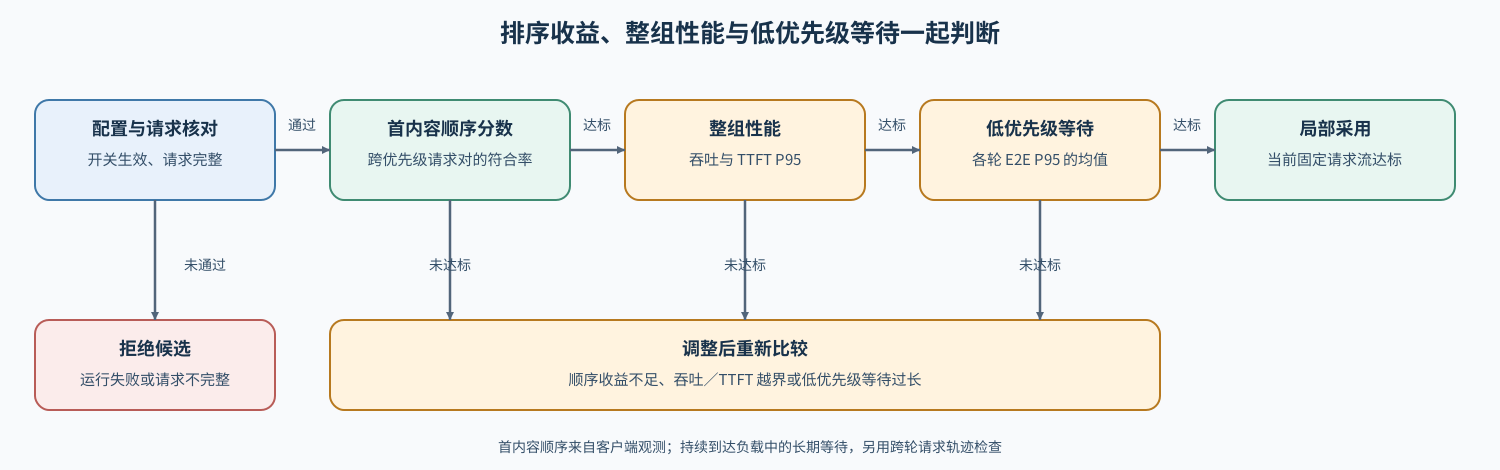
吞吐变高仍可能让一部分请求等得更久。采用候选时,先确认同一请求流确实由不同策略执行,再检查完成情况、延迟门槛与吞吐。CPU示例用等待差距构造公平性分数;真实对照改看低优先级请求的端到端长尾,分别说明两类判断。容量是否达标则要另将实际峰值与设备预算比较。下表列出 CPU 模型的统计口径,下图展示真实服务如何联合判断响应顺序与延迟代价。
| 指标 | 单位 | 定义与比较条件 |
|---|---|---|
queue_wait_ms | ms | CPU 中从到达到获准执行的等待;旧字段 ttft_ms 仅保留为同值兼容别名 |
makespan_ms | ms | 首个请求到达至最后一个请求完成的观察窗口,不是绝对完成时刻 |
throughput_tps | token/s | 总输出 token 数除以观察窗口,结合请求等待共同判断 |
utilization | 0–1 | 模拟执行者忙碌时间占窗口的比例;GPU忙碌情况另看设备采样 |
fairness | 0–1 | 等待极差除以不小于 1 ms 的平均等待,再用 1 减去该比值并截断到非负;仅用于本题 |
completed_count | 请求数 | 与输入请求数相等,并逐项核对完成编号是否重复或丢失 |
Step 4:实现 CPU 调度机制与决策
题目提供队列推进模型和结果记录,补全请求流是否可比、请求完成清单是否完整,以及调度候选能否同时满足延迟、完成率和公平性门槛。
| 任务与目的 | 已知条件 | 完成标准 | 测试验证 |
|---|---|---|---|
| TODO 1:核对调度对照契约 | 请求流、模型、后端和唯一调度变化 | 固定条件一致且仅策略发生变化 | 请求集错配、多变量变化和后端差异 |
| TODO 2:建立轨迹证据 | 请求与完成编号、运行状态和服务指标 | 两侧请求清单一致,每个请求只完成一次,关键指标齐全 | 重复完成、丢失请求和轨迹缺口 |
| TODO 3:形成采用状态 | TTFT、TPOT、吞吐、完成率、公平性与资源记录 | 用户体验和服务能力同时达标才采用 | accept、tune、reject |
from typing import Dict, List# 队列选择、状态推进和指标汇总构成机制底座;TODO 聚焦配对、轨迹和采用状态。
# CPU 模型解释不变量,真实服务收益由 Step 5 的后端对照产生。
def select_next_batch(queue: List[Dict[str, float]], policy: str, batch_size: int) -> tuple[list[Dict[str, float]], list[Dict[str, float]]]:
"""从已到达的 pending 队列中选择一个不超过上限的 active batch。
``shortest`` 按 ``service_ms`` 排序,``priority`` 优先选择较小 priority,
``fifo`` 保持到达与输入顺序。返回值分别是本轮 active batch 与剩余 pending 队列。
"""
if policy not in {'fifo', 'shortest', 'priority'}:
raise ValueError('policy 只能是 fifo、shortest 或 priority')
if batch_size < 1:
raise ValueError('batch_size 必须 >= 1')
if policy == 'shortest':
ordered = sorted(queue, key=lambda item: (item['service_ms'], item['_index']))
elif policy == 'priority':
ordered = sorted(queue, key=lambda item: (item.get('priority', 0.0), item['arrival_ms'], item['_index']))
else:
ordered = list(queue)
return ordered[:batch_size], ordered[batch_size:]
# 机制:推进请求状态、批处理和完成时间。
def simulate_serving_scheduler(requests: List[Dict[str, float]], policy: str = 'fifo', batch_size: int = 1, batch_speedup: float = 1.0) -> Dict[str, object]:
"""用单 worker CPU 模型推进 pending、active 与 completed 三种状态。
请求到达后才可被选择;每轮至多选择 ``batch_size`` 个请求。批内最慢请求决定
服务窗口,``batch_speedup`` 表示教学模型中的批处理收益;``queue_wait_ms`` 是
到达到获准执行的排队等待,``batch_trace`` 记录每个 active 窗口。
"""
if policy not in {'fifo', 'shortest', 'priority'}:
raise ValueError('policy 只能是 fifo、shortest 或 priority')
if batch_size < 1 or batch_speedup <= 0:
raise ValueError('batch_size 必须 >= 1,batch_speedup 必须 > 0')
if not isinstance(requests, list):
raise TypeError('requests 必须是 list[dict]')
if not requests:
return {'request_count': 0, 'completed_count': 0, 'makespan_ms': 0.0, 'throughput_tps': 0.0, 'utilization': 0.0, 'fairness': 1.0, 'requests': []}
pending = []
seen_ids = set()
for index, item in enumerate(requests):
request_id = item.get('request_id', f'request-{index}')
if not isinstance(request_id, str) or not request_id or request_id in seen_ids:
raise ValueError('request_id 必须是唯一的非空字符串')
seen_ids.add(request_id)
arrival = float(item.get('arrival_ms', 0.0))
service = float(item.get('service_ms', 0.0))
tokens = int(item.get('output_tokens', 0))
if arrival < 0 or service <= 0 or tokens < 0:
raise ValueError('arrival_ms >= 0,service_ms > 0,output_tokens >= 0')
pending.append({**item, 'request_id': request_id, '_index': index, 'arrival_ms': arrival, 'service_ms': service, 'output_tokens': tokens})
pending.sort(key=lambda item: (item['arrival_ms'], item['_index']))
queue, completed, batch_trace, cursor = [], [], [], 0
now = busy = 0.0
while cursor < len(pending) or queue:
if not queue and cursor < len(pending):
now = max(now, pending[cursor]['arrival_ms'])
while cursor < len(pending) and pending[cursor]['arrival_ms'] <= now:
queue.append(pending[cursor]); cursor += 1
batch, queue = select_next_batch(queue, policy, batch_size)
start = now
duration = max(item['service_ms'] for item in batch) / batch_speedup
batch_trace.append({'start_ms': round(start, 4), 'duration_ms': round(duration, 4), 'request_ids': [item.get('request_id', f"request-{item['_index']}") for item in batch]})
now += duration; busy += duration
for item in batch:
completed.append({
'request_id': item.get('request_id', f"request-{item['_index']}"),
'arrival_ms': item['arrival_ms'],
'admitted_ms': start,
'finished_ms': now,
'queue_wait_ms': round(start - item['arrival_ms'], 4),
# 兼容旧示例的别名,不是首 token 实测值。
'ttft_ms': round(start - item['arrival_ms'], 4),
'e2e_ms': round(now - item['arrival_ms'], 4),
'output_tokens': item['output_tokens'],
})
makespan = now - min(item['arrival_ms'] for item in pending)
waits = [item['queue_wait_ms'] for item in completed]
mean_wait = sum(waits) / len(waits) if waits else 0.0
spread = (max(waits) - min(waits)) if waits else 0.0
fairness = max(0.0, 1.0 - spread / max(mean_wait, 1.0))
total_tokens = sum(item['output_tokens'] for item in completed)
avg_queue_wait_ms = sum(item['queue_wait_ms'] for item in completed) / len(completed) if completed else 0.0
return {
'request_count': len(pending), 'completed_count': len(completed),
'makespan_ms': round(makespan, 4),
'throughput_tps': round(total_tokens / (makespan / 1000.0), 4) if makespan else 0.0,
'utilization': round(busy / makespan, 4) if makespan else 0.0,
'avg_queue_wait_ms': round(avg_queue_wait_ms, 4),
'fairness': round(fairness, 4), 'batch_trace': batch_trace, 'requests': completed,
}
# 辅助函数:汇总调度运行结果
def summarize_serving_scheduler_runs(runs: List[Dict[str, float]]) -> Dict[str, object]:
"""汇总同一请求流和 batch 配置下的调度运行结果。"""
if not isinstance(runs, list):
raise TypeError('runs 必须是 list[dict]')
required = {'name', 'ttft_ms', 'throughput_tps'}
for index, item in enumerate(runs):
if not isinstance(item, dict) or not required.issubset(item):
raise ValueError(f'第 {index} 条 run 必须包含 {sorted(required)}')
run_count = len(runs)
avg_throughput_tps = sum(item['throughput_tps'] for item in runs) / run_count if run_count else 0.0
best = min(runs, key=lambda item: item['ttft_ms']) if runs else None
return {'run_count': run_count, 'best_latency_run': best.get('name', 'run') if best else None, 'avg_throughput_tps': avg_throughput_tps}
# 辅助函数:比较 baseline 与 candidate
def compare_scheduler_to_baseline(baseline: Dict[str, float], candidate: Dict[str, float]) -> Dict[str, float]:
"""计算 candidate 相对 baseline 的延迟、吞吐、公平性和利用率变化。"""
required = {'ttft_ms', 'tpot_ms', 'throughput_tps', 'fairness', 'utilization'}
for name, item in (('baseline', baseline), ('candidate', candidate)):
if not isinstance(item, dict) or not required.issubset(item):
raise ValueError(f'{name} 必须包含 {sorted(required)}')
delta_specs = [
('ttft_ms', 'ttft_delta_ms'),
('tpot_ms', 'tpot_delta_ms'),
('throughput_tps', 'throughput_gain_tps'),
('fairness', 'fairness_delta'),
('utilization', 'utilization_delta'),
]
comparison = {
output_key: round(candidate[source_key] - baseline[source_key], 4)
for source_key, output_key in delta_specs
}
return comparison
def validate_scheduler_contract(baseline, candidate):
"""核对请求流、模型、后端和测量过程是否一致。"""
fixed_fields = ('model_id', 'revision', 'backend', 'request_stream_id', 'measurement_key')
mismatches = [field for field in fixed_fields
if baseline.get(field) in (None, '') or candidate.get(field) in (None, '')
or baseline.get(field) != candidate.get(field)]
# TODO 1:固定条件一致且调度策略确实变化,才允许解释策略收益。
# fixed_ok:固定字段没有差异。
# changed_once:两侧策略非空且不同。
raise NotImplementedError('TODO 1:请核对调度对照契约')
def build_scheduler_trace_evidence(baseline, candidate):
"""检查配对契约、请求完成不变量和关键服务指标。"""
contract = validate_scheduler_contract(baseline, candidate)
request_ids = list(candidate.get('request_ids', []))
completed_ids = list(candidate.get('completed_ids', []))
required_metrics = ('ttft_p95_ms', 'tpot_p95_ms', 'throughput_tps', 'completion_rate', 'fairness', 'peak_memory_gb')
missing = [field for field in required_metrics if candidate.get(field) is None]
# TODO 2:契约错配、重复或已知丢失为硬失败;未采集轨迹和指标为缺证。
# trace_complete:已采集非空请求与完成清单;分别检查两侧完成唯一性及同请求流。
raise NotImplementedError('TODO 2:请建立调度轨迹证据')
def decide_scheduler_candidate(evidence, max_ttft_p95_ms, max_tpot_p95_ms, min_throughput_gain, min_completion_rate, min_fairness):
"""按失败、缺证、用户体验和服务能力形成采用状态。"""
# TODO 3:硬失败 reject;缺证或部分门槛未过 tune;全部通过 accept。
# latency_ok:TTFT 与 TPOT 的 P95 均不越界。
# service_ok:吞吐增益、完成率和公平性均达标;先处理硬失败与缺证,再比较数值。
raise NotImplementedError('TODO 3:请形成调度候选状态')
def recommend_serving_scheduler_run(
baseline: Dict[str, float], candidate: Dict[str, float], min_throughput_gain: float, min_fairness: float
) -> Dict[str, object]:
"""Choose a scheduler action from latency, throughput, utilization and fairness.
min_throughput_gain is candidate minus baseline token/s; min_fairness is an
absolute candidate fairness floor. Accept requires all user-facing metrics
to pass, while tune retains a candidate with partial capacity improvement.
"""
if min_throughput_gain < 0:
raise ValueError('min_throughput_gain 不能为负数')
if not 0 <= min_fairness <= 1:
raise ValueError('min_fairness 必须位于 [0, 1]')
comparison = compare_scheduler_to_baseline(baseline, candidate)
throughput_ok = comparison['throughput_gain_tps'] >= min_throughput_gain
fairness_ok = candidate['fairness'] >= min_fairness
latency_ok = comparison['ttft_delta_ms'] < 0 and comparison['tpot_delta_ms'] <= 0
# 决策:交互延迟、服务能力与公平性共同判断。
if latency_ok and throughput_ok and fairness_ok:
return {'decision': 'accept', 'reason': '延迟、吞吐和公平性都达标,适合进入真实 serving 验证', 'next_action': 'promote_to_serving_rollout'}
if comparison['throughput_gain_tps'] >= 0 and comparison['utilization_delta'] >= 0:
return {'decision': 'tune', 'reason': '吞吐和利用率已有改善,但公平性或延迟边界还不够稳', 'next_action': 'refine_queue_rules_or_worker_split'}
return {'decision': 'reject', 'reason': 'candidate 没有形成可信的 serving 调度收益', 'next_action': 'fallback_to_scheduler_audit'}测试
先核对 CPU 状态与时间关系,再检查配对条件、完成清单和决策。
# 测试你的实现
# 测试目标:分别验证队列状态转移、运行汇总、baseline 对照和 accept/tune/reject 决策。
# 这些断言检查机制契约与指标方向,不把 CPU 教学耗时当作真实 GPU serving 性能。
REQUESTS = [
    {'request_id': 'r1', 'arrival_ms': 0, 'service_ms': 10, 'output_tokens': 20, 'priority': 5},
    {'request_id': 'r2', 'arrival_ms': 0, 'service_ms': 2, 'output_tokens': 20, 'priority': 0},
    {'request_id': 'r3', 'arrival_ms': 1, 'service_ms': 3, 'output_tokens': 20, 'priority': 2},
]

BASELINE = {
    'name': 'fifo',
    'ttft_ms': 220,
    'tpot_ms': 42,
    'throughput_tps': 180,
    'fairness': 0.78,
    'utilization': 0.70,
}

CANDIDATE = {
    'name': 'priority_scheduler',
    'ttft_ms': 180,
    'tpot_ms': 36,
    'throughput_tps': 205,
    'fairness': 0.81,
    'utilization': 0.79,
}


def _assert_value_error(callable_, message):
    """断言调用会抛出 ValueError。"""
    try:
        callable_()
    except ValueError:
        return
    raise AssertionError(message)


def test_serving_simulation_contract():
    """验证请求完成一次、等待时间和聚合指标之间的契约。"""
    simulation = simulate_serving_scheduler(REQUESTS, policy='fifo', batch_size=1)
    assert simulation['request_count'] == 3
    assert simulation['completed_count'] == 3
    assert simulation['makespan_ms'] == 15.0
    assert simulation['throughput_tps'] == 4000.0
    assert simulation['utilization'] == 1.0
    assert simulation['avg_queue_wait_ms'] == round((0.0 + 10.0 + 11.0) / 3, 4)
    assert simulation['requests'][0]['queue_wait_ms'] == 0.0
    for row in simulation['requests']:
        assert row['arrival_ms'] <= row['admitted_ms'] <= row['finished_ms']
        assert row['queue_wait_ms'] == round(row['admitted_ms'] - row['arrival_ms'], 4)
    shifted = [{**row, 'arrival_ms': row['arrival_ms'] + 100} for row in REQUESTS]
    assert simulate_serving_scheduler(shifted)['makespan_ms'] == simulation['makespan_ms']
    _assert_value_error(lambda: simulate_serving_scheduler([REQUESTS[0], REQUESTS[0]]), '重复请求编号应拒绝')
    for row in simulation['requests']:
        assert row['arrival_ms'] <= row['admitted_ms'] <= row['finished_ms']
        assert row['queue_wait_ms'] == round(row['admitted_ms'] - row['arrival_ms'], 4)
    shifted = [{**row, 'arrival_ms': row['arrival_ms'] + 100} for row in REQUESTS]
    assert simulate_serving_scheduler(shifted)['makespan_ms'] == simulation['makespan_ms']
    _assert_value_error(lambda: simulate_serving_scheduler([REQUESTS[0], REQUESTS[0]]), '重复请求编号应拒绝')
    assert simulation['requests'][1]['ttft_ms'] == 10.0
    assert [trace['request_ids'] for trace in simulation['batch_trace']] == [['r1'], ['r2'], ['r3']]
    assert 0.0 <= simulation['fairness'] <= 1.0


def test_policy_batching_and_input_guards():
    """验证 FIFO/shortest、batch 边界、空输入和非法配置。"""
    shortest = simulate_serving_scheduler(REQUESTS, policy='shortest', batch_size=1)
    assert shortest['requests'][0]['request_id'] == 'r2'
    assert shortest['requests'][-1]['request_id'] == 'r1'
    priority = simulate_serving_scheduler(REQUESTS, policy='priority', batch_size=1)
    assert priority['requests'][0]['request_id'] == 'r2'
    assert priority['batch_trace'][0]['request_ids'] == ['r2']
    batched = simulate_serving_scheduler(REQUESTS, policy='fifo', batch_size=2, batch_speedup=1.0)
    assert batched['completed_count'] == len(REQUESTS)
    assert batched['makespan_ms'] == 13.0
    assert batched['makespan_ms'] < 15.0
    empty = simulate_serving_scheduler([])
    assert empty['request_count'] == 0 and empty['completed_count'] == 0
    _assert_value_error(lambda: simulate_serving_scheduler(REQUESTS, policy='unknown'), '非法调度策略应明确拒绝!')
    for invalid in ({'batch_size': 0}, {'batch_speedup': 0.0}):
        _assert_value_error(lambda invalid=invalid: simulate_serving_scheduler(REQUESTS, **invalid), '非法 batch 参数应明确拒绝!')


def test_result_summary_contract():
    """验证同一 workload 的运行汇总和最低 TTFT 选择。"""
    summary = summarize_serving_scheduler_runs([BASELINE, CANDIDATE])
    assert summary['run_count'] == 2
    assert summary['best_latency_run'] == 'priority_scheduler'
    assert summary['avg_throughput_tps'] == 192.5
    assert summarize_serving_scheduler_runs([]) == {
        'run_count': 0,
        'best_latency_run': None,
        'avg_throughput_tps': 0.0,
    }


def test_baseline_comparison_contract():
    """验证 candidate-baseline 的差值方向和指标解释。"""
    comparison = compare_scheduler_to_baseline(BASELINE, CANDIDATE)
    assert comparison['ttft_delta_ms'] == -40
    assert comparison['tpot_delta_ms'] == -6
    assert comparison['throughput_gain_tps'] == 25
    assert comparison['fairness_delta'] == 0.03
    assert comparison['utilization_delta'] == 0.09
    assert comparison['throughput_gain_tps'] > 0
    assert comparison['fairness_delta'] > 0


def test_decision_policy_contract():
    """验证同时达标、部分改善和无收益三种决策。"""
    decision = recommend_serving_scheduler_run(
        BASELINE,
        CANDIDATE,
        min_throughput_gain=20,
        min_fairness=0.8,
    )
    assert decision['decision'] == 'accept'
    assert decision['next_action'] == 'promote_to_serving_rollout'

    weak_candidate = {
        'name': 'aggressive_batching',
        'ttft_ms': 195,
        'tpot_ms': 38,
        'throughput_tps': 202,
        'fairness': 0.76,
        'utilization': 0.82,
    }
    weak_decision = recommend_serving_scheduler_run(
        BASELINE,
        weak_candidate,
        min_throughput_gain=20,
        min_fairness=0.8,
    )
    assert weak_decision['decision'] == 'tune'

    bad_candidate = {
        'name': 'overfit_scheduler',
        'ttft_ms': 260,
        'tpot_ms': 48,
        'throughput_tps': 170,
        'fairness': 0.60,
        'utilization': 0.66,
    }
    bad_decision = recommend_serving_scheduler_run(
        BASELINE,
        bad_candidate,
        min_throughput_gain=20,
        min_fairness=0.8,
    )
    assert bad_decision['decision'] == 'reject'


def _scheduler_project_record(policy, throughput_tps, ttft_p95_ms, tpot_p95_ms, fairness):
    """构造同请求流的调度项目记录。"""
    request_ids = ['r1', 'r2', 'r3']
    return {'model_id': 'target', 'revision': 'commit', 'backend': 'vllm',
            'request_stream_id': 'mixed-v1', 'measurement_key': 'warm2-repeat5',
            'scheduler_policy': policy, 'request_ids': request_ids, 'completed_ids': list(request_ids),
            'ttft_p95_ms': ttft_p95_ms, 'tpot_p95_ms': tpot_p95_ms,
            'throughput_tps': throughput_tps, 'completion_rate': 1.0,
            'fairness': fairness, 'peak_memory_gb': 7.0, 'failure': None}


def test_scheduler_project_contract_and_trace():
    """验证调度契约、完成轨迹和采用门槛。"""
    baseline = _scheduler_project_record('fifo', 180.0, 220.0, 42.0, 0.78)
    candidate = _scheduler_project_record('priority', 205.0, 180.0, 36.0, 0.82)
    assert validate_scheduler_contract(baseline, candidate)['contract_ok']
    assert not validate_scheduler_contract(baseline, {**candidate, 'backend': 'other'})['contract_ok']
    evidence = build_scheduler_trace_evidence(baseline, candidate)
    assert evidence['hard_failures'] == [] and evidence['missing_evidence'] == []
    assert decide_scheduler_candidate(evidence, 200.0, 40.0, 20.0, 1.0, 0.8)['decision'] == 'accept'
    broken = build_scheduler_trace_evidence(baseline, {**candidate, 'completed_ids': ['r1', 'r1', 'r3']})
    assert decide_scheduler_candidate(broken, 200.0, 40.0, 20.0, 1.0, 0.8)['decision'] == 'reject'
    missing = build_scheduler_trace_evidence(baseline, {**candidate, 'ttft_p95_ms': None, 'throughput_tps': None})
    assert decide_scheduler_candidate(missing, 200.0, 40.0, 20.0, 1.0, 0.8)['decision'] == 'tune'
    empty = build_scheduler_trace_evidence(baseline, {**candidate, 'request_ids': [], 'completed_ids': []})
    assert decide_scheduler_candidate(empty, 200.0, 40.0, 20.0, 1.0, 0.8)['decision'] != 'accept'
    no_model = dict(candidate)
    no_model.pop('model_id')
    no_model_baseline = dict(baseline)
    no_model_baseline.pop('model_id')
    assert not validate_scheduler_contract(no_model_baseline, no_model)['contract_ok']


def test_serving_scheduler_benchmark_template():
    """运行本节全部 CPU 调度测试。"""
    test_serving_simulation_contract()
    test_policy_batching_and_input_guards()
    test_result_summary_contract()
    test_baseline_comparison_contract()
    test_decision_policy_contract()
    test_scheduler_project_contract_and_trace()
    print('测试通过:调度对照契约、请求轨迹与采用状态均通过。')


test_serving_scheduler_benchmark_template()
🛑 STOP HERE
请先完成题目并运行测试,再查看参考代码与解析。
参考代码与解析
代码
from typing import Dict, List
def select_next_batch(queue: List[Dict[str, float]], policy: str, batch_size: int) -> tuple[list[Dict[str, float]], list[Dict[str, float]]]:
    """从已到达的 pending 队列中选择一个不超过上限的 active batch。

    ``shortest`` 按 ``service_ms`` 排序,``priority`` 优先选择较小 priority,
    ``fifo`` 保持到达与输入顺序。返回值分别是本轮 active batch 与剩余 pending 队列。
    """
    if policy not in {'fifo', 'shortest', 'priority'}:
        raise ValueError('policy 只能是 fifo、shortest 或 priority')
    if batch_size < 1:
        raise ValueError('batch_size 必须 >= 1')
    # 机制:稳定排序后切分批次,剩余请求继续等待。
    if policy == 'shortest':
        ordered = sorted(queue, key=lambda item: (item['service_ms'], item['_index']))
    elif policy == 'priority':
        ordered = sorted(queue, key=lambda item: (item.get('priority', 0.0), item['arrival_ms'], item['_index']))
    else:
        ordered = list(queue)
    return ordered[:batch_size], ordered[batch_size:]

# 机制:推进请求状态、批处理和完成时间。
def simulate_serving_scheduler(requests: List[Dict[str, float]], policy: str = 'fifo', batch_size: int = 1, batch_speedup: float = 1.0) -> Dict[str, object]:
    """用单 worker CPU 模型推进 pending、active 与 completed 三种状态。

    请求到达后才可被选择;每轮至多选择 ``batch_size`` 个请求。批内最慢请求决定
    服务窗口,``batch_speedup`` 表示教学模型中的批处理收益;``queue_wait_ms`` 是
    到达到获准执行的排队等待,``batch_trace`` 记录每个 active 窗口。
    """
    if policy not in {'fifo', 'shortest', 'priority'}:
        raise ValueError('policy 只能是 fifo、shortest 或 priority')
    if batch_size < 1 or batch_speedup <= 0:
        raise ValueError('batch_size 必须 >= 1,batch_speedup 必须 > 0')
    if not isinstance(requests, list):
        raise TypeError('requests 必须是 list[dict]')
    if not requests:
        return {'request_count': 0, 'completed_count': 0, 'makespan_ms': 0.0, 'throughput_tps': 0.0, 'utilization': 0.0, 'fairness': 1.0, 'requests': []}
    pending = []
    seen_ids = set()
    for index, item in enumerate(requests):
        request_id = item.get('request_id', f'request-{index}')
        if not isinstance(request_id, str) or not request_id or request_id in seen_ids:
            raise ValueError('request_id 必须是唯一的非空字符串')
        seen_ids.add(request_id)
        arrival = float(item.get('arrival_ms', 0.0))
        service = float(item.get('service_ms', 0.0))
        tokens = int(item.get('output_tokens', 0))
        if arrival < 0 or service <= 0 or tokens < 0:
            raise ValueError('arrival_ms >= 0,service_ms > 0,output_tokens >= 0')
        pending.append({**item, 'request_id': request_id, '_index': index, 'arrival_ms': arrival, 'service_ms': service, 'output_tokens': tokens})
    pending.sort(key=lambda item: (item['arrival_ms'], item['_index']))
    queue, completed, batch_trace, cursor = [], [], [], 0
    now = busy = 0.0
    while cursor < len(pending) or queue:
        if not queue and cursor < len(pending):
            now = max(now, pending[cursor]['arrival_ms'])
        while cursor < len(pending) and pending[cursor]['arrival_ms'] <= now:
            queue.append(pending[cursor]); cursor += 1
        batch, queue = select_next_batch(queue, policy, batch_size)
        start = now
        # 机制:同一活动批次的服务窗口由最慢请求决定。
        duration = max(item['service_ms'] for item in batch) / batch_speedup
        batch_trace.append({'start_ms': round(start, 4), 'duration_ms': round(duration, 4), 'request_ids': [item.get('request_id', f"request-{item['_index']}") for item in batch]})
        now += duration; busy += duration
        for item in batch:
            completed.append({
                'request_id': item.get('request_id', f"request-{item['_index']}"),
                'arrival_ms': item['arrival_ms'],
                'admitted_ms': start,
                'finished_ms': now,
                'queue_wait_ms': round(start - item['arrival_ms'], 4),
                # 兼容旧示例的别名,不是首 token 实测值。
                'ttft_ms': round(start - item['arrival_ms'], 4),
                'e2e_ms': round(now - item['arrival_ms'], 4),
                'output_tokens': item['output_tokens'],
            })
    makespan = now - min(item['arrival_ms'] for item in pending)
    waits = [item['queue_wait_ms'] for item in completed]
    mean_wait = sum(waits) / len(waits) if waits else 0.0
    spread = (max(waits) - min(waits)) if waits else 0.0
    fairness = max(0.0, 1.0 - spread / max(mean_wait, 1.0))
    total_tokens = sum(item['output_tokens'] for item in completed)
    avg_queue_wait_ms = sum(item['queue_wait_ms'] for item in completed) / len(completed) if completed else 0.0
    return {
        'request_count': len(pending), 'completed_count': len(completed),
        'makespan_ms': round(makespan, 4),
        'throughput_tps': round(total_tokens / (makespan / 1000.0), 4) if makespan else 0.0,
        'utilization': round(busy / makespan, 4) if makespan else 0.0,
        'avg_queue_wait_ms': round(avg_queue_wait_ms, 4),
        'fairness': round(fairness, 4), 'batch_trace': batch_trace, 'requests': completed,
    }

# 辅助函数:汇总调度运行结果
def summarize_serving_scheduler_runs(runs: List[Dict[str, float]]) -> Dict[str, object]:
    """汇总同一请求流和 batch 配置下的调度运行结果。"""
    if not isinstance(runs, list):
        raise TypeError('runs 必须是 list[dict]')
    required = {'name', 'ttft_ms', 'throughput_tps'}
    for index, item in enumerate(runs):
        if not isinstance(item, dict) or not required.issubset(item):
            raise ValueError(f'第 {index} 条 run 必须包含 {sorted(required)}')
    run_count = len(runs)
    avg_throughput_tps = sum(item['throughput_tps'] for item in runs) / run_count if run_count else 0.0
    best = min(runs, key=lambda item: item['ttft_ms']) if runs else None
    return {'run_count': run_count, 'best_latency_run': best.get('name', 'run') if best else None, 'avg_throughput_tps': avg_throughput_tps}

# 辅助函数:比较 baseline 与 candidate
def compare_scheduler_to_baseline(baseline: Dict[str, float], candidate: Dict[str, float]) -> Dict[str, float]:
    """计算 candidate 相对 baseline 的延迟、吞吐、公平性和利用率变化。"""
    required = {'ttft_ms', 'tpot_ms', 'throughput_tps', 'fairness', 'utilization'}
    for name, item in (('baseline', baseline), ('candidate', candidate)):
        if not isinstance(item, dict) or not required.issubset(item):
            raise ValueError(f'{name} 必须包含 {sorted(required)}')
    delta_specs = [
        ('ttft_ms', 'ttft_delta_ms'),
        ('tpot_ms', 'tpot_delta_ms'),
        ('throughput_tps', 'throughput_gain_tps'),
        ('fairness', 'fairness_delta'),
        ('utilization', 'utilization_delta'),
    ]
    comparison = {
        output_key: round(candidate[source_key] - baseline[source_key], 4)
        for source_key, output_key in delta_specs
    }
    return comparison

def validate_scheduler_contract(baseline, candidate):
    """核对请求流、模型、后端和测量过程是否一致。"""
    fixed_fields = ('model_id', 'revision', 'backend', 'request_stream_id', 'measurement_key')
    mismatches = [field for field in fixed_fields
                  if baseline.get(field) in (None, '') or candidate.get(field) in (None, '')
                  or baseline.get(field) != candidate.get(field)]
    # TODO 1:固定条件一致,且唯一声明变化是调度策略。
    fixed_ok = not mismatches
    changed_once = (bool(baseline.get('scheduler_policy')) and bool(candidate.get('scheduler_policy'))
                    and baseline['scheduler_policy'] != candidate['scheduler_policy'])
    issues = list(mismatches) + ([] if changed_once else ['scheduler_policy'])
    return {'contract_ok': fixed_ok and changed_once, 'issues': issues}


def build_scheduler_trace_evidence(baseline, candidate):
    """检查配对契约、请求完成不变量和关键服务指标。"""
    contract = validate_scheduler_contract(baseline, candidate)
    request_ids = list(candidate.get('request_ids', []))
    completed_ids = list(candidate.get('completed_ids', []))
    required_metrics = ('ttft_p95_ms', 'tpot_p95_ms', 'throughput_tps', 'completion_rate', 'fairness', 'peak_memory_gb')
    missing = [f'{name}.{field}' for name, record in (('baseline', baseline), ('candidate', candidate))
               for field in required_metrics if record.get(field) is None]
    # TODO 2:请求必须全部且只完成一次,轨迹缺口不能伪装成性能收益。
    trace_complete = bool(request_ids) and bool(completed_ids)
    hard_failures = list(contract['issues'])
    if baseline.get('failure'):
        hard_failures.append('baseline')
    if candidate.get('failure'):
        hard_failures.append('candidate')
    for name, record in (('baseline', baseline), ('candidate', candidate)):
        expected = list(record.get('request_ids', []))
        actual = list(record.get('completed_ids', []))
        if expected and len(expected) != len(set(expected)):
            hard_failures.append(f'{name}.duplicate_request_ids')
        if actual and (len(actual) != len(set(actual)) or (expected and set(actual) != set(expected))):
            hard_failures.append(f'{name}.invalid_completed_ids')
        if not expected or not actual:
            missing.append(f'{name}.request_trace')
    if baseline.get('request_ids') != candidate.get('request_ids'):
        hard_failures.append('request_ids')
    throughput_gain = (candidate['throughput_tps'] - baseline['throughput_tps']
                       if candidate.get('throughput_tps') is not None
                       and baseline.get('throughput_tps') is not None else None)
    missing_evidence = list(missing) + ([] if trace_complete else ['request_trace'])
    return {'hard_failures': hard_failures, 'missing_evidence': missing_evidence,
            'ttft_p95_ms': candidate.get('ttft_p95_ms'), 'tpot_p95_ms': candidate.get('tpot_p95_ms'),
            'throughput_gain': throughput_gain,
            'completion_rate': candidate.get('completion_rate'), 'fairness': candidate.get('fairness')}


def decide_scheduler_candidate(evidence, max_ttft_p95_ms, max_tpot_p95_ms, min_throughput_gain, min_completion_rate, min_fairness):
    """按失败、缺证、用户体验和服务能力形成采用状态。"""
    # TODO 3:交互延迟与服务能力必须同时达标。
    if evidence['hard_failures']:
        return {'decision': 'reject', 'next_action': 'repair_contract_or_backend'}
    if evidence['missing_evidence']:
        return {'decision': 'tune', 'next_action': 'collect_request_trace'}
    latency_ok = evidence['ttft_p95_ms'] <= max_ttft_p95_ms and evidence['tpot_p95_ms'] <= max_tpot_p95_ms
    service_ok = (evidence['throughput_gain'] >= min_throughput_gain
                  and evidence['completion_rate'] >= min_completion_rate
                  and evidence['fairness'] >= min_fairness)
    if latency_ok and service_ok:
        return {'decision': 'accept', 'next_action': 'promote_to_deployment_comparison'}
    return {'decision': 'tune', 'next_action': 'adjust_queue_or_batch_policy'}


def recommend_serving_scheduler_run(
    baseline: Dict[str, float], candidate: Dict[str, float], min_throughput_gain: float, min_fairness: float
) -> Dict[str, object]:
    """按延迟、吞吐和公平性门槛给出教学决策。"""
    if min_throughput_gain < 0:
        raise ValueError('min_throughput_gain 不能为负数')
    if not 0 <= min_fairness <= 1:
        raise ValueError('min_fairness 必须位于 [0, 1]')
    comparison = compare_scheduler_to_baseline(baseline, candidate)
    throughput_ok = comparison['throughput_gain_tps'] >= min_throughput_gain
    fairness_ok = candidate['fairness'] >= min_fairness
    latency_ok = comparison['ttft_delta_ms'] < 0 and comparison['tpot_delta_ms'] <= 0
    # 决策:交互延迟、吞吐增益和公平性同时满足才采用。
    if latency_ok and throughput_ok and fairness_ok:
        return {'decision': 'accept', 'reason': '延迟、吞吐和公平性都达标,适合进入真实 serving 验证', 'next_action': 'promote_to_serving_rollout'}
    if comparison['throughput_gain_tps'] >= 0 and comparison['utilization_delta'] >= 0:
        return {'decision': 'tune', 'reason': '吞吐和利用率已有改善,但公平性或延迟边界还不够稳', 'next_action': 'refine_queue_rules_or_worker_split'}
    return {'decision': 'reject', 'reason': 'candidate 没有形成可信的 serving 调度收益', 'next_action': 'fallback_to_scheduler_audit'}
解析
TODO 1:核对调度对照契约
- 模型、后端、请求流和测量过程必须一致,唯一解释变量是调度策略。
- 测试分别检查后端错配、策略未变化和两侧共同缺少模型身份,避免把缺失当成一致。
TODO 2:建立请求轨迹证据
- 完成集合必须与请求集合一致,每个请求只能完成一次;否则完成率和延迟分布都不可信。
- 重复完成或已知请求丢失进入拒绝;未采集完成清单或缺少指标则补采证据。这里核对的是完成清单,真实执行先后仍需后端事件。
TODO 3:形成调度候选状态
- TTFT 与 TPOT 的 P95 共同约束用户体验;吞吐增益、完成率和公平性共同约束服务能力。
- 先处理失败与缺证,再进行数值比较;缺失指标测试确保返回补采状态,而非触发空值比较错误。
Step 5(可选):单卡 GPU 调度策略对照
| CPU 已验证 | 单卡 GPU 补充 | 本页输出 |
|---|---|---|
| 到达后准入、容量上限、完成唯一性与决策门槛 | 同一 vLLM 版本下配对比较 FCFS 与 priority | 两组原始 JSON、逐请求首 token/完成顺序和采用判断 |
5.1 环境、请求流与固定条件
使用 INF-VLLM-011-CU128 Profile,当前固定配置面向单张约12 GB显存的NVIDIA GPU,运行前按模型与服务预算预检。首次运行先按推理优化 Quickstart创建环境。配置集中在下一单元:G0 与 G1 固定模型、请求流、并发、生成长度、队列容量和重复次数,只改变 vLLM 的 scheduling-policy;G1 才把 workload 中的 priority 字段发送给服务。固定的小 max_num_seqs 用来形成可观测的等待队列。
| 组别 | 服务端策略 | 请求 priority | 回答的问题 |
|---|---|---|---|
| G0 | FCFS | 不发送,但保留标签用于离线统计 | 默认完成顺序与服务指标是什么 |
| G1 | priority | 发送;数值越小越早 | 交互请求是否更早完成,且没有不可接受的整体退化 |
# 5.1:唯一可编辑配置。正式复测只修改本单元,并为 RUN_LABEL 使用新值。
RUN_REAL_BACKEND = False  # 改为 True 后,5.4 会顺序启动 G0 与 G1;不要预先启动其他 vLLM 服务。
RUN_LABEL = 'rtx5070ti_scheduler_priority_v4'  # 每次复测使用新标签,保留旧 JSON。
SEMANTIC_ID = 'INF-SERVING-SCHEDULER'
SCHEMA_VERSION = 'inference-benchmark/v1'
PROFILE_ID = 'INF-VLLM-011-CU128'  # vLLM 0.11 + CUDA 12.8 隔离环境。
MODEL_ID = 'Qwen/Qwen2.5-0.5B-Instruct'  # 两组使用同一模型资产。
MODEL_SOURCE = 'auto'  # 优先复用 model_cache;缺失时由共享解析器处理。
DTYPE = 'bfloat16'
WORKLOAD = 'benchmarks/workloads/scheduler_priority.jsonl'  # 冻结的交互/批处理混合请求流。
NUM_PROMPTS = 8  # 与 workload 行数一致,避免重复 request_id。
MAX_TOKENS = 96
CONCURRENCY = 8  # 同步提交全部请求,避免客户端提交抖动主导到达顺序。
MAX_NUM_SEQS = 2  # 两组都限制同时运行序列数,确保其余请求进入等待队列。
WARMUP = 2
REPEATS = 5
MAX_MODEL_LEN = 2048
GPU_MEMORY_UTILIZATION = 0.80
ENFORCE_EAGER = True  # 首轮减少 CUDA Graph 之外的环境变量;后续可单独比较 graph 模式。
MIN_PRIORITY_ORDER_GAIN = 0.15  # G1 的高优先级首 token 顺序分数至少提高 0.15。
MAX_THROUGHPUT_REGRESSION = 0.10  # 总输出吞吐最多回退 10%。
MAX_TTFT_P95_REGRESSION = 0.25  # 全体 TTFT P95 最多回退 25%。
MAX_LOW_PRIORITY_E2E_REGRESSION = 0.50  # 低优先级 E2E P95 最多回退 50%。
GROUPS = (
    {'name': 'g0_fcfs', 'role': 'baseline', 'scheduler_policy': 'fcfs', 'send_priority': False},
    {'name': 'g1_priority', 'role': 'candidate', 'scheduler_policy': 'priority', 'send_priority': True},
)
5.2 环境与输入预检
本单元只检查当前 Kernel、GPU、vLLM 命令、固定请求流和 Profile 身份,不下载模型、不启动服务。
# 5.2:只读预检;失败时先修复环境或输入,再进入候选检查。
import json
import shutil
import sys
from pathlib import Path
import torch
from tools.inference_project_runtime import locate_repo_root

REPO_ROOT = locate_repo_root()
WORKLOAD_PATH = REPO_ROOT / WORKLOAD
preflight = {
    'profile_id': PROFILE_ID,
    'python': sys.executable,
    'torch': torch.__version__,
    'cuda_available': torch.cuda.is_available(),
    'gpu': torch.cuda.get_device_name(0) if torch.cuda.is_available() else None,
    'gpu_memory_gb': (round(torch.cuda.get_device_properties(0).total_memory / 1024**3, 2)
                      if torch.cuda.is_available() else None),
    'vllm_command': shutil.which('vllm'),
    'workload_exists': WORKLOAD_PATH.is_file(),
}
if RUN_REAL_BACKEND and (not preflight['cuda_available'] or not preflight['vllm_command'] or not preflight['workload_exists']):
    raise RuntimeError(f'真实实验预检失败:{preflight}')
print(json.dumps(preflight, ensure_ascii=False, indent=2))
5.3 候选与可比性检查
读取冻结请求流并检查 request_id、priority 和组别定义。该单元只派生结果路径,不启动后端。
# 5.3:检查同负载配对以及 priority 的可辨识性。
records = [json.loads(line) for line in WORKLOAD_PATH.read_text(encoding='utf-8').splitlines() if line.strip()]
request_ids = [item.get('request_id') for item in records]
priorities = [item.get('priority') for item in records]
if len(records) != NUM_PROMPTS:
    raise ValueError(f'NUM_PROMPTS={NUM_PROMPTS},但冻结 workload 有 {len(records)} 行')
if None in request_ids or len(request_ids) != len(set(request_ids)):
    raise ValueError('每条调度请求必须有唯一 request_id')
if None in priorities or len(set(priorities)) < 2:
    raise ValueError('调度 workload 至少需要两个 priority 层级')
if {group['scheduler_policy'] for group in GROUPS} != {'fcfs', 'priority'}:
    raise ValueError('本页必须保留 FCFS 与 priority 两个策略组')
if any(value <= 0 for value in (NUM_PROMPTS, MAX_TOKENS, CONCURRENCY, MAX_NUM_SEQS, REPEATS)) or WARMUP < 0:
    raise ValueError('请求数、生成长度、并发和重复次数必须为正,预热不能为负')
if CONCURRENCY < NUM_PROMPTS:
    raise ValueError('同步发车要求 CONCURRENCY 不小于 NUM_PROMPTS')
if MAX_NUM_SEQS >= NUM_PROMPTS:
    raise ValueError('MAX_NUM_SEQS 必须小于请求数,否则不能形成等待队列')
RESULT_DIR = REPO_ROOT / 'benchmarks/results/70_serving_scheduler'
RESULT_PATHS = {
    group['name']: RESULT_DIR / f"{group['name']}_{RUN_LABEL}.json"
    for group in GROUPS
}
RAW_RESULT_PATHS = {
    group['name']: RESULT_DIR / f"{group['name']}_raw_{RUN_LABEL}.json"
    for group in GROUPS
}
print({'request_ids': request_ids, 'priority_levels': sorted(set(priorities)),
       'groups': GROUPS, 'result_paths': {k: str(v) for k, v in RESULT_PATHS.items()}})
5.4 顺序执行两组真实服务
每组都单独启动 vLLM、完成预热与重复测量、保存逐请求结果,再释放显存。成功和失败都写入对应 JSON;本单元不形成采用结论。
# 5.4:顺序运行 FCFS 与 priority;不要并行启动两组服务。
import importlib
from tools import backend_runtime
from tools import inference_project_runtime as inference_runtime
backend_runtime = importlib.reload(backend_runtime)  # 先刷新底层 vLLM 启动封装。
inference_runtime = importlib.reload(inference_runtime)  # 再刷新项目运行时,避免 Kernel 使用旧签名。
start_optional_vllm = inference_runtime.start_optional_vllm
stop_optional_vllm = inference_runtime.stop_optional_vllm
run_backend_benchmark = inference_runtime.run_backend_benchmark
from tools.project_runtime import save_json_record_once

RESULT_DIR.mkdir(parents=True, exist_ok=True)
if RUN_REAL_BACKEND:
    collisions = [path for path in (*RESULT_PATHS.values(), *RAW_RESULT_PATHS.values()) if path.exists()]
    if collisions:
        raise FileExistsError(f'当前 RUN_LABEL 已有结果,请更换标签:{collisions}')
    for group in GROUPS:
        output_path = RESULT_PATHS[group['name']]
        raw_output_path = RAW_RESULT_PATHS[group['name']]
        server = log_handle = None
        try:
            server, log_handle, port, selected_dtype, model_path = start_optional_vllm(
                model_id=MODEL_ID, model_source=MODEL_SOURCE, dtype=DTYPE,
                max_model_len=MAX_MODEL_LEN,
                gpu_memory_utilization=GPU_MEMORY_UTILIZATION,
                enforce_eager=ENFORCE_EAGER,
                served_model_name=MODEL_ID,
                scheduling_policy=group['scheduler_policy'],
                max_num_seqs=MAX_NUM_SEQS,
                log_path=RESULT_DIR / f"{group['name']}_{RUN_LABEL}.log",
            )
            report = run_backend_benchmark(
                project='70', base_url=f'http://127.0.0.1:{port}', model=MODEL_ID,
                label=group['name'], output=raw_output_path, workload=WORKLOAD,
                num_prompts=NUM_PROMPTS, max_tokens=MAX_TOKENS,
                concurrency=CONCURRENCY, warmup=WARMUP, repeats=REPEATS,
                backend='vllm', dtype=selected_dtype, role=group['role'],
                include_requests=True,
                send_workload_priority=group['send_priority'],
                synchronize_start=True,
            )
            report.update({'schema_version': SCHEMA_VERSION, 'semantic_id': SEMANTIC_ID, 'run_label': RUN_LABEL, 'run_mode': 'real_backend', 'raw_result_path': str(raw_output_path)})
            report['scheduler_identity'] = {
                **group, 'model_path': model_path, 'profile_id': PROFILE_ID,
                'workload': WORKLOAD, 'concurrency': CONCURRENCY,
                'max_num_seqs': MAX_NUM_SEQS, 'synchronized_start': True,
            }
            save_json_record_once(output_path, report)
        except Exception as exc:
            failure = {
                'schema_version': 'serving-scheduler-run/v1', 'semantic_id': SEMANTIC_ID,
                'run_label': RUN_LABEL, 'run_mode': 'real_backend',
                'scheduler_identity': group, 'status': 'failed',
                'failure': {'type': type(exc).__name__, 'message': str(exc)},
            }
            if not output_path.exists():
                save_json_record_once(output_path, failure)
            print(failure)
        finally:
            if server is not None:
                stop_optional_vllm(server, log_handle)
else:
    print('实验未启动:确认 5.1 后将 RUN_REAL_BACKEND 改为 True。')
5.5 读取配对证据
读取两组JSON,核对策略、请求完成、非空输出和各轮首次内容返回顺序。旧字段保留原名;TPOT包含从首次内容至流结束的尾部。低优先级长尾使用各轮E2E P95的平均值,逐轮保留以便复核;完成顺序另作诊断。
# 5.5:读取原始结果并形成统一视图;不启动服务、不改写 JSON。
def percentile(values, q):
    """返回小样本线性插值分位数;空序列返回 None。"""
    if not values:
        return None
    ordered = sorted(values)
    position = (len(ordered) - 1) * q
    lower = int(position)
    upper = min(lower + 1, len(ordered) - 1)
    weight = position - lower
    return ordered[lower] * (1 - weight) + ordered[upper] * weight

loaded = {}
for name, path in RESULT_PATHS.items():
    loaded[name] = json.loads(path.read_text(encoding='utf-8')) if path.is_file() else None

scheduler_rows = {}
for name, record in loaded.items():
    if record is None or record.get('failure'):
        scheduler_rows[name] = {'status': 'missing_or_failed', 'failure': None if record is None else record.get('failure')}
        continue
    metrics = record.get('metrics', {})
    runs = record.get('runs') or [record]
    request_runs = [run.get('results') or [] for run in runs]
    requests = [item for request_run in request_runs for item in request_run]
    low_priority_p95_by_run = [
        percentile([item['e2e_ms'] for item in request_run
                    if item.get('ok') and item.get('priority') == 5], 0.95)
        for request_run in request_runs
    ]
    low_priority_p95_by_run = [value for value in low_priority_p95_by_run if value is not None]
    scheduler_rows[name] = {
        'status': 'ok', 'identity': record.get('scheduler_identity'),
        'successful_requests': metrics.get('successful_requests'),
        'failed_requests': metrics.get('failed_requests'),
        'output_nonempty': all(bool(item.get('output_text', '').strip()) for item in requests if item.get('ok')),
        'priority_first_token_order_score': metrics.get('priority_first_token_order_score'),
        'priority_first_token_scores_by_run': [
            (run.get('metrics') or {}).get('priority_first_token_order_score') for run in runs
        ],
        'priority_completion_order_score': metrics.get('priority_order_score'),
        'throughput_tps': metrics.get('output_token_throughput_per_s'),
        'ttft_p95_ms': (metrics.get('ttft_ms') or {}).get('p95'),
        'tpot_p95_ms': (metrics.get('tpot_ms') or {}).get('p95'),
        'low_priority_e2e_p95_ms': (sum(low_priority_p95_by_run) / len(low_priority_p95_by_run)
                                        if low_priority_p95_by_run else None),
        'request_metric_runs': len(request_runs),
    }
print(json.dumps(scheduler_rows, ensure_ascii=False, indent=2))
5.6 形成调度采用判断
先拒绝后端失败或不可比结果,再检查完成率和输出;最后用首次内容返回顺序判断高优先级请求是否更早看到响应,并检查吞吐、全体 TTFT 和低优先级长尾是否仍在门槛内。完成顺序只保留为诊断指标,避免生成长度混入调度采用门槛。若低优先级长尾超出设定预算,调整优先级分层或容量后复测;长期饥饿另用持续请求流检查。
首次内容顺序分数统计不同优先级请求对中,高优先级先返回的比例;同优先级请求对不计入。本次两组平均分数从0.4625到0.8625,相差0.4,表示顺序符合率提高40个百分点。将这一结果与时间、吞吐和低优先级代价一起写入独立证据文件。
当前登记结果
| 字段 | 登记内容 |
|---|---|
| 项目与标签 | 70 节优先级调度;rtx5070ti_scheduler_priority_v4 |
| 运行条件 | RTX 5070 Ti Laptop GPU;FCFS 与 priority 配对请求流 |
| 原始证据 | FCFS 日志、priority 日志 |
| 正式证据 | G0、G1、证据记录 |
| 清单与交接 | 证据记录供 72 与 81 节引用 |
| 结论 | accept(限当前优先级混合 workload):高优先级首内容返回顺序改善;吞吐和 TTFT 门槛通过,低优先级 E2E P95 增加约 6.9%,仍在设定上限内 |
# 5.6:基于 5.5 的只读视图形成 accept / tune / reject。
baseline = scheduler_rows.get('g0_fcfs', {})
candidate = scheduler_rows.get('g1_priority', {})
if baseline.get('status') != 'ok' or candidate.get('status') != 'ok':
    scheduler_decision = {'decision': 'reject', 'reason': 'FCFS 或 priority 后端失败或结果缺失',
                          'next_action': '修复失败组后使用新 RUN_LABEL 复测'}
elif baseline.get('identity', {}).get('workload') != candidate.get('identity', {}).get('workload'):
    scheduler_decision = {'decision': 'reject', 'reason': '两组请求流不一致',
                          'next_action': '恢复同一冻结 workload'}
elif any(row.get('successful_requests') != NUM_PROMPTS or row.get('failed_requests') != 0 or not row.get('output_nonempty')
         for row in (baseline, candidate)):
    scheduler_decision = {'decision': 'reject', 'reason': '请求完成率或输出检查失败',
                          'next_action': '检查逐请求失败与输出'}
else:
    required = ('priority_first_token_order_score', 'throughput_tps', 'ttft_p95_ms', 'low_priority_e2e_p95_ms')
    missing = [field for field in required if baseline.get(field) is None or candidate.get(field) is None]
    if missing:
        scheduler_decision = {'decision': 'tune', 'reason': f'缺少配对指标:{missing}',
                              'next_action': '补齐逐请求结果后复测'}
    else:
        order_gain = candidate['priority_first_token_order_score'] - baseline['priority_first_token_order_score']
        paired_order_gains = [
            candidate_score - baseline_score
            for baseline_score, candidate_score in zip(
                baseline.get('priority_first_token_scores_by_run', []),
                candidate.get('priority_first_token_scores_by_run', []),
            )
            if baseline_score is not None and candidate_score is not None
        ]
        throughput_ratio = candidate['throughput_tps'] / baseline['throughput_tps']
        ttft_ratio = candidate['ttft_p95_ms'] / baseline['ttft_p95_ms']
        low_priority_ratio = candidate['low_priority_e2e_p95_ms'] / baseline['low_priority_e2e_p95_ms']
        gates = {
            'priority_first_token_order_gain_ok': order_gain >= MIN_PRIORITY_ORDER_GAIN,
            'throughput_ok': throughput_ratio >= 1 - MAX_THROUGHPUT_REGRESSION,
            'ttft_p95_ok': ttft_ratio <= 1 + MAX_TTFT_P95_REGRESSION,
            'low_priority_tail_ok': low_priority_ratio <= 1 + MAX_LOW_PRIORITY_E2E_REGRESSION,
        }
        scheduler_decision = {
            'decision': 'accept' if all(gates.values()) else 'tune',
            'reason': ('高优先级首 token 顺序改善且整体服务门槛通过' if all(gates.values())
                       else '优先级收益、整体延迟、吞吐或低优先级长尾尚未同时达标'),
            'gates': gates,
            'comparison': {'priority_first_token_order_gain': round(order_gain, 4),
                           'priority_first_token_gains_by_run': [round(value, 4) for value in paired_order_gains],
                           'throughput_ratio': round(throughput_ratio, 4),
                           'ttft_p95_ratio': round(ttft_ratio, 4),
                           'low_priority_e2e_p95_ratio': round(low_priority_ratio, 4)},
            'next_action': ('交给 72 做部署候选复核' if all(gates.values())
                            else '调整 priority 分层或服务容量后复测'),
        }
print(json.dumps(scheduler_decision, ensure_ascii=False, indent=2))# 5.7:只在 G0/G1 结果存在时登记独立证据,不覆盖原始测量。
from tools.project_runtime import save_json_record_once
EVIDENCE_PATH = RESULT_DIR / f'70_evidence_record_{RUN_LABEL}.json'
baseline_record = loaded.get('g0_fcfs') or {}
candidate_record = loaded.get('g1_priority') or {}
candidate_normalized = candidate_record.get('normalized_result') or {}
pair_ok = baseline.get('status') == candidate.get('status') == 'ok'
failure_reason = None if pair_ok else '; '.join(
f"{name}: {(record.get('failure') or {}).get('message', 'missing result')}"
for name, record in (('g0_fcfs', baseline_record), ('g1_priority', candidate_record))
if record.get('failure') or not record
)
evidence_record = {
'schema_version': SCHEMA_VERSION,
'semantic_id': SEMANTIC_ID,
'project': '70',
'run_label': RUN_LABEL,
'run_mode': 'real_backend' if RUN_REAL_BACKEND else 'read_only',
'strategy': 'priority_scheduler',
'role': 'candidate',
'config': {
'model': MODEL_ID, 'backend': 'vllm', 'dtype': DTYPE,
'generated_tokens': MAX_TOKENS, 'batch': 1, 'concurrency': CONCURRENCY,
'cache_policy': 'default', 'workload': WORKLOAD,
**(candidate_normalized.get('config') or {}),
'scheduler_policy': 'priority',
'baseline_scheduler_policy': 'fcfs',
'max_num_seqs': MAX_NUM_SEQS,
'synchronized_start': True,
'repeats': REPEATS,
},
'workload': candidate_record.get('workload') or {
'source': WORKLOAD, 'requests': NUM_PROMPTS, 'max_tokens': MAX_TOKENS,
'concurrency': CONCURRENCY, 'warmup': WARMUP, 'repeats': REPEATS,
'workload_priority_sent': True, 'synchronized_start': True,
},
'metrics': candidate_normalized.get('metrics') or candidate_record.get('metrics'),
'quality': {
'status': 'passed' if pair_ok else 'incomplete',
'output_completeness': baseline.get('output_nonempty') and candidate.get('output_nonempty'),
'paired_runs': min(baseline.get('request_metric_runs', 0), candidate.get('request_metric_runs', 0)),
},
'status': 'measured' if pair_ok else 'failed',
'evidence_level': 'real_backend_scheduler_pair' if pair_ok else 'backend_failure_record',
'failure': {
'failure_reason': failure_reason,
'retest_path': None if pair_ok else '重载运行时后使用新 RUN_LABEL 复测',
},
'decision': scheduler_decision,
'strategy_metrics': {
'priority_first_token_order_score': candidate.get('priority_first_token_order_score'),
'baseline_first_token_order_score': baseline.get('priority_first_token_order_score'),
'priority_completion_order_score': candidate.get('priority_completion_order_score'),
'baseline_completion_order_score': baseline.get('priority_completion_order_score'),
'low_priority_e2e_p95_ms': candidate.get('low_priority_e2e_p95_ms'),
'baseline_low_priority_e2e_p95_ms': baseline.get('low_priority_e2e_p95_ms'),
},
'source_paths': {name: str(path.relative_to(REPO_ROOT)) for name, path in RESULT_PATHS.items()},
}
save_json_record_once(EVIDENCE_PATH, evidence_record)
print(f'调度证据已保存: {EVIDENCE_PATH.relative_to(REPO_ROOT)}')相关阅读
先比较轮次补位和单轮预算,再把调度方案放到多实例请求分配中。
- 连续批处理:完成请求退出后,下一轮怎样补入成员。
- 服务迭代成本与批次容量上界:一次前向能安排多少工作。
- 服务副本路由:请求分给多个模型实例时,怎样比较负载与缓存复用。