
INF-AFD. Attention FFN Disaggregation | Attention–FFN 解耦
难度: Hard | 环境: CPU-first,GPU/backend optional | 标签: 推理优化, MoE, AFD, Serving | 目标人群: 分布式推理与 MoE Serving 学习者
🚀 云端运行环境
本章节的实战代码可以点击以下链接在免费 GPU 算力平台上直接运行:
(国内推荐:魔搭社区免费实例)

本节导读
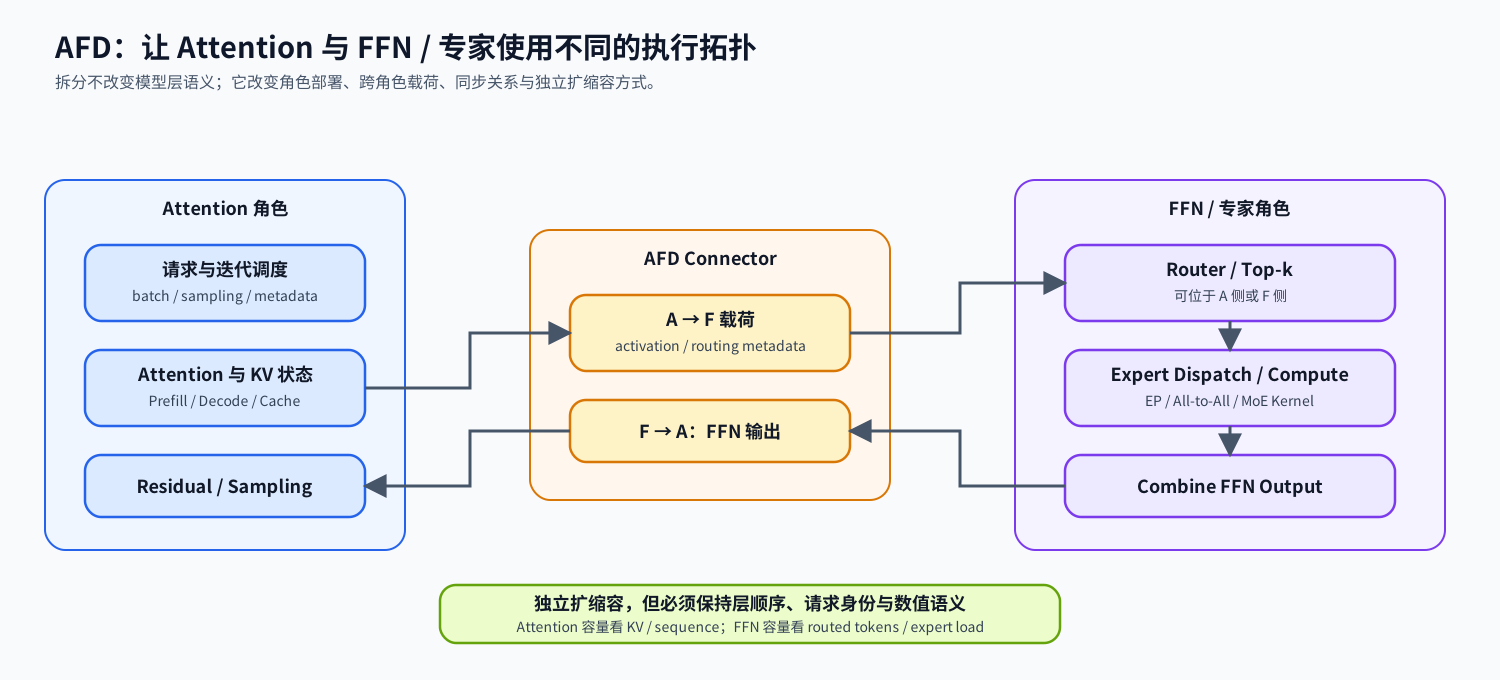
MoE 层中的 Attention 和 FFN / 专家共享同一层顺序,却承受不同的系统压力:Attention 保存请求状态和 KV Cache,专家侧处理动态路由、计算与 All-to-All。AFD 将两类角色部署到不同 worker 组,使其能够独立扩缩容;代价是每层都要维护跨角色载荷、请求身份和同步关系。
本节先建立角色、数据流和时间线,再用 CPU 账本验证拓扑、载荷与暴露时间。真实收益必须在受支持的 AFD plugin、模型 wrapper 和多卡环境中验证。
前置阅读
- 06. MoE Router:理解 token 如何选择专家。
- 46. MoE Expert Parallel:理解 dispatch、combine 与 All-to-All。
- INF-SERVING-OVERLAP:理解总传输时间和暴露时间的区别。
Step 1:为什么拆分 Attention 与 FFN
Attention 侧必须维护请求调度、KV 状态和生成顺序,其容量随并发、上下文和 Cache 压力变化;FFN / 专家侧的容量主要取决于 routed token 数、专家负载和计算吞吐。把两侧固定在同一组 rank 上,会迫使两类不同瓶颈使用同一扩缩容比例。
| 角色 | 持有的状态或计算 | 主要容量压力 | 典型扩展维度 |
|---|---|---|---|
| Attention | Q/K/V、KV Cache、请求元数据、sampling | sequence、并发、Cache 容量 | DP / TP / CP、KV 容量 |
| FFN / Experts | Router、Expert MLP、dispatch / combine | routed tokens、expert skew、算力 | EP、专家副本、FFN worker 数 |
| Connector | activation、routing metadata、FFN output | payload、链路、同步频率 | 同步 / 异步、通信 backend |
Step 2:跨角色传输与执行时间线
每个被拆分的层都要把 Attention 后的 hidden state 送到 FFN 侧,再把 FFN 输出送回 Attention 侧继续 residual 路径。若 Router 位于 Attention 侧,还要附带 top-k expert id 和权重。AFD 不减少模型计算;它通过不同拓扑和重叠机会改变资源利用率与暴露等待。
| 路径 | 执行关系 | 主要优点 | 主要风险 |
|---|---|---|---|
| 同步 AFD | A 发送 → F 计算 → A 等待返回 | 顺序清晰,适合正确性基线 | 通信与 FFN 时间直接暴露 |
| 异步 AFD | 不同 uBatch 的 A/F 阶段重叠 | 有机会隐藏传输或专家计算 | 调度、buffer、顺序和 graph 兼容更复杂 |
| 不拆分 | Attention 与 FFN 共用 worker | 无跨角色 connector | 两类资源不能独立扩缩容 |

Step 3:AFD 候选必须通过哪些 Gate
AFD 首先是部署候选,不是看到 MoE 就默认启用的优化。模型 wrapper、Attention/FFN 切分点、Router 所在侧、connector、rank topology、graph mode、量化和输出正确性必须形成同一份能力矩阵;任一条件不成立,都不能用吞吐结果掩盖语义或兼容性失败。
| Gate | 必须确认的问题 | 失败后的处理 |
|---|---|---|
| 模型 | checkpoint 架构是否有 AFD wrapper | 回到普通 MoE Serving |
| 拓扑 | A/F rank 是否有效且资源足够 | 调整角色比例或拒绝候选 |
| Connector | 硬件与通信 backend 是否支持 | 更换 connector,不跨环境外推 |
| 执行模式 | prefill/decode、eager/graph、uBatch 是否兼容 | 使用已验证路径或关闭相应能力 |
| 精度 | baseline 与 AFD 输出误差是否在阈值内 | reject,不进入性能排序 |
| 性能 | transfer 是否被有效重叠,专家是否仍偏斜 | tune 角色比例、EP 或 overlap |
Step 4:实现 AFD 拓扑、载荷与暴露时间账本
本题用角色拓扑、hidden state 形状和阶段时间复现 AFD 候选。输入校验、报告结构和压力参数已经给出;你将补全双向载荷、拓扑能力检查、有效重叠与 rank 分配。测试分别覆盖字节单调性、非法组合、时间上下界和 rank 守恒。
| TODO / 函数 | 学习者完成的机制 | 必须满足的约束 | 测试证据 |
|---|---|---|---|
TODO 1 · estimate_afd_payload_bytes | 计算跨角色载荷 | 记录双向 activation 与可选 routing metadata;单位统一为字节 | 载荷分项与总量 |
TODO 2 · validate_afd_topology | 检查 Attention / FFN 拓扑能力 | 角色、rank、执行模式和异步条件必须一致 | 可行拓扑与逐项失败原因 |
TODO 3 · estimate_afd_time_ms | 计算暴露时间 | 有效 overlap 不得超过预算或可重叠区间 | 时间下界、上界与边界情况 |
TODO 4 · allocate_afd_ranks | 按压力分配角色 rank | 至少为两类角色各保留一个 rank;总数不变 | 不同压力比与非法 world size |
from dataclasses import dataclass
from typing import Dict, List@dataclass(frozen=True)
class AFDTopology:
"""描述 Attention 与 FFN 两类 worker 的执行拓扑。"""
world_size: int
attention_ranks: int
ffn_ranks: int
mode: str = 'sync'
stage: str = 'decode'
graph_enabled: bool = False
def estimate_afd_payload_bytes(
tokens: int,
hidden_size: int,
split_layers: int,
dtype_bytes: int,
*,
top_k: int = 0,
router_on_attention: bool = False,
) -> Dict[str, int]:
"""估算一次前向中跨 A/F 角色边界传输的载荷。"""
if min(tokens, hidden_size, split_layers, dtype_bytes) <= 0 or top_k < 0:
raise ValueError('shape and dtype values must be positive; top_k cannot be negative')
one_way_activation = tokens * hidden_size * dtype_bytes * split_layers
# ==========================================
# TODO 1(跨角色载荷):计算双向 activation 和可选 routing metadata。
# 注意:双向 activation 包含 A→F hidden state 与 F→A FFN output;
# Router 在 A 侧时,每个 top-k 项暂按 int32 expert id + dtype 权重估算。
# ==========================================
# activation_bytes = ??? # 所有拆分层的双向 activation 字节数。
# routing_bytes = ??? # Router 位于 Attention 侧时附加的路由元数据字节数。
return {
'activation_bytes': activation_bytes,
'routing_bytes': routing_bytes,
'total_bytes': activation_bytes + routing_bytes,
}
def validate_afd_topology(topology: AFDTopology) -> List[str]:
"""返回阻止候选进入真实实验的拓扑与执行模式问题。"""
failures: List[str] = []
# TODO 2(能力检查):判断角色、rank、模式与异步执行条件。
# roles_positive = ??? # Attention 与 FFN 两侧都至少有一个 rank。
# ranks_match = ??? # 两侧 rank 总数等于 world_size。
# mode_supported = ??? # mode 只能是 sync 或 async。
# async_contract_supported = ??? # async 仅在约定 stage 且未启用 graph 时为真。
if not roles_positive:
failures.append('both roles need positive ranks')
if not ranks_match:
failures.append('role ranks must equal world_size')
if not mode_supported:
failures.append('unsupported mode')
if topology.mode == 'async' and not async_contract_supported:
failures.append('async execution contract is not satisfied')
return failures
def estimate_afd_time_ms(
attention_ms: float,
transfer_to_ffn_ms: float,
ffn_ms: float,
transfer_to_attention_ms: float,
overlap_budget_ms: float,
) -> Dict[str, float]:
"""比较完全串行时间与扣除有效 overlap 后的暴露时间。"""
values = [attention_ms, transfer_to_ffn_ms, ffn_ms, transfer_to_attention_ms, overlap_budget_ms]
if any(value < 0 for value in values):
raise ValueError('time values cannot be negative')
serial_ms = sum(values[:4])
overlapable_ms = transfer_to_ffn_ms + ffn_ms + transfer_to_attention_ms
# ==========================================
# TODO 3(暴露时间):有效 overlap 不能超过预算或可重叠区间。
# 返回 exposed_ms 时不能小于 Attention 自身的依赖时间。
# ==========================================
# effective_overlap_ms = ??? # 不超过预算与可重叠区间的有效时间。
# exposed_ms = ??? # 串行总时间扣除有效重叠后的关键路径时间。
return {
'serial_ms': round(serial_ms, 4),
'effective_overlap_ms': round(effective_overlap_ms, 4),
'exposed_ms': round(exposed_ms, 4),
}
def allocate_afd_ranks(world_size: int, attention_pressure: float, ffn_pressure: float) -> AFDTopology:
"""按两类压力给 A/F 角色分配 rank,并保证两侧都可运行。"""
if world_size < 2 or attention_pressure <= 0 or ffn_pressure <= 0:
raise ValueError('AFD needs at least two ranks and positive pressure values')
# ==========================================
# TODO 4(独立扩缩容):按压力比例分配 Attention ranks。
# 注意:两侧至少各保留一个 rank,且二者之和必须等于 world_size。
# ==========================================
# attention_ranks = ??? # 按压力分配并裁剪到 [1, world_size - 1]。
# ffn_ranks = ??? # 剩余 rank,确保总数守恒。
return AFDTopology(world_size, attention_ranks, ffn_ranks)测试
测试分别检查载荷账本、能力 Gate、暴露时间和角色分配。失败时先定位对应机制,不要通过改输出格式绕过约束。
def test_payload_accounting():
    """验证双向 activation 和路由元数据的字节账本。"""
    base = estimate_afd_payload_bytes(8, 16, 2, 2)
    routed = estimate_afd_payload_bytes(8, 16, 2, 2, top_k=2, router_on_attention=True)
    assert base['activation_bytes'] == 2 * 8 * 16 * 2 * 2
    assert base['routing_bytes'] == 0
    assert routed['total_bytes'] > base['total_bytes']


def test_topology_gate():
    """验证 rank 守恒以及 async stage / graph 限制。"""
    assert validate_afd_topology(AFDTopology(8, 4, 4)) == []
    assert validate_afd_topology(AFDTopology(8, 4, 3))
    assert validate_afd_topology(AFDTopology(8, 4, 4, mode='async', stage='decode'))
    assert validate_afd_topology(AFDTopology(8, 4, 4, mode='async', stage='prefill', graph_enabled=True))


def test_exposed_time_bounds():
    """验证 overlap 只减少可重叠区间,不能消除 Attention 依赖。"""
    no_overlap = estimate_afd_time_ms(4, 1, 6, 1, 0)
    overlapped = estimate_afd_time_ms(4, 1, 6, 1, 5)
    saturated = estimate_afd_time_ms(4, 1, 6, 1, 99)
    assert no_overlap['exposed_ms'] == 12
    assert overlapped['exposed_ms'] == 7
    assert saturated['exposed_ms'] == 4


def test_rank_allocation():
    """验证角色分配响应压力变化并保持 rank 守恒。"""
    balanced = allocate_afd_ranks(8, 1, 1)
    attention_heavy = allocate_afd_ranks(8, 3, 1)
    assert balanced.attention_ranks + balanced.ffn_ranks == 8
    assert attention_heavy.attention_ranks > balanced.attention_ranks
    assert min(attention_heavy.attention_ranks, attention_heavy.ffn_ranks) >= 1


def test_afd_mechanisms():
    """汇总四组 AFD 机制测试。"""
    try:
        test_payload_accounting()
        test_topology_gate()
        test_exposed_time_bounds()
        test_rank_allocation()
        print('✅ AFD 机制测试通过:载荷、拓扑、暴露时间与角色分配均符合预期。')
    except (NameError, UnboundLocalError) as exc:
        raise NotImplementedError('请根据变量级提示完成 TODO。') from exc


test_afd_mechanisms()
🛑 STOP HERE 🛑
请先尝试自己完成代码并跑通测试。
如果遇到困难,再向下查看参考代码与解析。
参考代码与解析
代码
@dataclass(frozen=True)
class AFDTopology:
    """描述 Attention 与 FFN 两类 worker 的执行拓扑。"""

    world_size: int
    attention_ranks: int
    ffn_ranks: int
    mode: str = 'sync'
    stage: str = 'decode'
    graph_enabled: bool = False


# TODO 1:计算跨角色载荷。
def estimate_afd_payload_bytes(tokens, hidden_size, split_layers, dtype_bytes, *, top_k=0, router_on_attention=False):
    if min(tokens, hidden_size, split_layers, dtype_bytes) <= 0 or top_k < 0:
        raise ValueError('shape and dtype values must be positive; top_k cannot be negative')
    one_way_activation = tokens * hidden_size * dtype_bytes * split_layers
    activation_bytes = 2 * one_way_activation
    routing_bytes = tokens * top_k * (4 + dtype_bytes) * split_layers if router_on_attention else 0
    return {'activation_bytes': activation_bytes, 'routing_bytes': routing_bytes, 'total_bytes': activation_bytes + routing_bytes}


# TODO 2:检查 Attention / FFN 拓扑能力。
def validate_afd_topology(topology):
    failures = []
    roles_positive = topology.attention_ranks > 0 and topology.ffn_ranks > 0
    ranks_match = topology.attention_ranks + topology.ffn_ranks == topology.world_size
    mode_supported = topology.mode in {'sync', 'async'}
    async_contract_supported = topology.stage == 'prefill' and not topology.graph_enabled
    if not roles_positive:
        failures.append('both roles need positive ranks')
    if not ranks_match:
        failures.append('role ranks must equal world_size')
    if not mode_supported:
        failures.append('unsupported mode')
    if topology.mode == 'async' and not async_contract_supported:
        failures.append('async execution contract is not satisfied')
    return failures


# TODO 3:计算暴露时间。
def estimate_afd_time_ms(attention_ms, transfer_to_ffn_ms, ffn_ms, transfer_to_attention_ms, overlap_budget_ms):
    values = [attention_ms, transfer_to_ffn_ms, ffn_ms, transfer_to_attention_ms, overlap_budget_ms]
    if any(value < 0 for value in values):
        raise ValueError('time values cannot be negative')
    serial_ms = sum(values[:4])
    overlapable_ms = transfer_to_ffn_ms + ffn_ms + transfer_to_attention_ms
    effective_overlap_ms = min(overlap_budget_ms, overlapable_ms)
    exposed_ms = serial_ms - effective_overlap_ms
    return {'serial_ms': round(serial_ms, 4), 'effective_overlap_ms': round(effective_overlap_ms, 4), 'exposed_ms': round(exposed_ms, 4)}


# TODO 4:按压力分配角色 rank。
def allocate_afd_ranks(world_size, attention_pressure, ffn_pressure):
    if world_size < 2 or attention_pressure <= 0 or ffn_pressure <= 0:
        raise ValueError('AFD needs at least two ranks and positive pressure values')
    raw_attention = round(world_size * attention_pressure / (attention_pressure + ffn_pressure))
    attention_ranks = min(world_size - 1, max(1, raw_attention))
    ffn_ranks = world_size - attention_ranks
    return AFDTopology(world_size, attention_ranks, ffn_ranks)
解析
TODO 1:载荷账本
- 基础载荷包含 A→F hidden state 与 F→A FFN output,因此 activation 是单向载荷的两倍。
- Router 位于 Attention 侧时才附加 top-k id 与权重;这个估算用于比较候选,不替代 connector 的真实序列化字节数。
TODO 2:能力 Gate
- A/F 两侧都必须拥有正数 rank,且角色总数与 world size 一致。
- stage、graph 与 connector 限制必须来自当前能力矩阵;测试中的 async 规则是显式实验契约,不是永久 API 承诺。
TODO 3:暴露时间
- 有效 overlap 由预算和可重叠区间共同限制。
- 即使 transfer 与 FFN 完全被其他工作覆盖,当前请求的 Attention 依赖仍构成时间下界。
TODO 4:角色分配
- 按压力比例给出第一版 rank 计划,再通过真实利用率、排队和专家负载复测。
- rank 计划不是性能结论;它只是进入 backend 实验的候选。
Step 5:可选多 GPU/backend 实验
| 学习问题 | CPU 已确认 | GPU 要确认与后续使用 |
|---|---|---|
| A/F 拆分能否在同硬件预算下隐藏通信并改善服务指标 | 载荷、拓扑、暴露时间和 rank 守恒 | plugin 实际命中、输出正确性、transfer/exposed time、TTFT、TPOT 与吞吐 |
5.1 环境与固定工作负载
使用 INF-VLLM-011-CU128 Serving Profile,并额外固定兼容的 AFD plugin、MoE checkpoint 与 connector。实验至少需要两个独立角色组;首次配置见推理优化实验 Quickstart,实验身份和当前证据见推理优化实验资产表。两个 endpoint 的健康检查、模型 revision 和输出正确性预检通过后,才能切换到 real_gpu。
| 配置层 | 本实验固定口径 | 修改规则 |
|---|---|---|
| 运行环境 | 同一总 GPU 预算;普通 MoE 与 AFD 两个 endpoint | plugin、connector 或 GPU 数变化后不得合并旧结果 |
| 模型 / 输入 | 同一 checkpoint revision、请求集、dtype 与输出约束 | 模型必须由当前 plugin 能力矩阵支持 |
| 配对变量 | 普通 MoE → AFD sync/async | 只改变 A/F 拆分和对应执行模式 |
| 测量 | 输出正确性、transfer/exposed time、TTFT、TPOT、吞吐 | 路径未确认或输出不一致时直接拒绝性能比较 |
| 结果 | baseline/candidate JSON 与唯一运行标签 | 正式复测不得覆盖历史结果 |
RUN_MODE = 'dry_run'  # 默认值 dry_run:只登记计划;改为 real_gpu 后访问两个已就绪 endpoint。
RUN_LABEL = 'default'  # 默认值 default;正式复测改为唯一标签,避免覆盖旧结果。
PROFILE_ID = 'INF-VLLM-011-CU128'  # 默认 Serving Profile;还需另行安装并固定兼容的 AFD plugin。
AFD_MODEL_ID = ''  # 默认空值:禁止执行;填写 plugin 明确支持的 checkpoint@revision。
AFD_BASELINE_URL = 'http://127.0.0.1:8000'  # 默认普通 MoE vLLM endpoint。
AFD_CANDIDATE_URL = 'http://127.0.0.1:8100'  # 默认 AFD candidate endpoint。
AFD_WORKLOAD = 'benchmarks/workloads/fixed.jsonl'  # 默认固定请求集;更换后结果不可直接合并。
AFD_NUM_PROMPTS = 16  # 默认 16 条请求;增大会延长运行并提高排队压力。
AFD_MAX_TOKENS = 64  # 默认每请求最多生成 64 token。
AFD_CONCURRENCY = 4  # 默认并发 4;调整后需同时记录队列与尾延迟。
AFD_RESULT_DIR = 'benchmarks/results/inf_afd'  # 默认仓库相对结果目录。
5.2 执行并保存 JSON
按相同请求顺序依次运行普通 MoE 与 AFD endpoint。执行单元只消费 5.1 配置,并把失败、服务指标和规范化结果写入独立 JSON。
if RUN_MODE == 'real_gpu':
    if not AFD_MODEL_ID:
        raise ValueError('必须填写 AFD plugin 当前支持的模型及 revision。')
    from pathlib import Path
    from tools.inference_project_runtime import locate_repo_root, run_backend_benchmark

    root = locate_repo_root()
    result_dir = root / AFD_RESULT_DIR
    result_dir.mkdir(parents=True, exist_ok=True)
    common = dict(
        project='INF-AFD', model=AFD_MODEL_ID, workload=AFD_WORKLOAD,
        num_prompts=AFD_NUM_PROMPTS, max_tokens=AFD_MAX_TOKENS,
        concurrency=AFD_CONCURRENCY, warmup=1, repeats=1, backend='vllm',
    )
    baseline = run_backend_benchmark(
        base_url=AFD_BASELINE_URL, label='moe_baseline',
        output=result_dir / f'{RUN_LABEL}_baseline.json', cache_policy='backend_default', **common,
    )
    candidate = run_backend_benchmark(
        base_url=AFD_CANDIDATE_URL, label='afd_candidate',
        output=result_dir / f'{RUN_LABEL}_afd_candidate.json', cache_policy='backend_default', **common,
    )
    print({'baseline': baseline['metrics'], 'candidate': candidate['metrics']})
else:
    print('AFD backend 实验未启动:先完成 plugin 能力矩阵、服务健康检查和正确性验证。')
5.3 读取结果
只读取 5.2 已保存的两份结果,先展示运行状态、失败、工作负载、核心指标、证据等级与决策。plugin revision、模型 wrapper、A/F ranks、connector、stage、graph 和量化状态必须存在于正式结果或 companion manifest;字段不全时不比较性能。
import json
from pathlib import Path

result_dir = Path(AFD_RESULT_DIR)
summaries = []
for role, name in (
    ('baseline', f'{RUN_LABEL}_baseline.json'),
    ('candidate', f'{RUN_LABEL}_afd_candidate.json'),
):
    path = result_dir / name
    if not path.exists():
        summaries.append({'role': role, 'status': 'not_run', 'path': str(path)})
        continue
    report = json.loads(path.read_text(encoding='utf-8'))
    required = {'workload', 'metrics', 'normalized_result'}
    missing = sorted(required - set(report))
    summaries.append({
        'role': role,
        'status': 'invalid' if missing else 'completed',
        'failure': report.get('failure'),
        'workload': report.get('workload'),
        'metrics': report.get('metrics'),
        'evidence_level': report.get('evidence_level'),
        'decision': report.get('decision'),
        'missing_fields': missing,
        'path': str(path),
    })

summaries
5.4 解释结果并作出决策
先检查两组结果是否成功且使用同一模型、输入、dtype 和总 GPU 预算,再确认 AFD plugin、connector 与角色拓扑真实命中。只有输出正确性通过后,才比较暴露传输、TTFT、TPOT 和吞吐。
当前页面尚无登记的真实多 GPU 快照,因此结论保持“待验证”。下一步是在固定 plugin 与 checkpoint 后生成唯一标签结果,并根据正确性和暴露时间决定保留、调参或淘汰。
| 观察项 | 读取字段 | 当前结果 | 解释与动作 |
|---|---|---|---|
| 运行与口径 | failure、workload、模型、总 GPU | 待验证 | 两组口径不一致时先重跑,不进入性能比较 |
| 机制与路径 | plugin、wrapper、A/F ranks、connector、stage | 待验证 | 未命中 AFD 路径时拒绝候选 |
| 正确性 | 输出误差、完成状态 | 待验证 | 超过阈值时停止,不用吞吐掩盖语义失败 |
| 资源与性能 | transfer/exposed time、TTFT、TPOT、吞吐 | 待验证 | 观察通信是否真正被隐藏,以及瓶颈是否转移 |
| 证据与决策 | evidence_level、decision、下一步 | tune | 固定环境后进入真实多 GPU 配对复测 |