
PERF-MEMORY-TIMELINE. Memory Residency and Peak Overlap | 显存驻留与峰值重叠
难度: Medium | 环境: CPU基础练习,GPU可选 | 标签: 性能分析、显存时间线、对象驻留 | 目标人群: 具备张量与训练基础的读者
🚀 云端运行环境
本章节的实战代码可以点击以下链接在免费 GPU 算力平台上直接运行:
(国内推荐:魔搭社区免费实例)

本节导读
删掉一个大张量的变量,显存为什么可能没有下降?切片视图可能仍指向同一块存储;即使存储已经可复用,分配器也可能继续保留内存,供下一次申请使用。对象消失、存储可复用和内存归还设备驱动,是不同的时刻。
本节追踪对象从创建到释放的过程,按独立存储计算同一时刻占用多少字节,再找出哪些存储在峰值时同时存在。随后比较提前释放与重新计算的取舍,检查减少重叠是否真的降低设备峰值,以及增加了多少时间。
关键词: 对象引用、共享存储、驻留区间、活动字节、分配器预留
运行环境
- 基础练习: 使用BASE-CPU,运行Step 4的题目与测试。
- 框架核对: 同样使用BASE-CPU,完成练习后运行框架一致性核对。
- GPU实测: 环境和工作负载见Step 5。
前置阅读
先区分当前张量占用与分配器预留,再把时间线中的对象对应到训练状态。
- Part00·18 显存分析:理解已分配与预留内存。
- 43. 训练内存账本:区分参数、梯度、优化器状态和激活。
Step 1:区分对象引用、存储与分配器
张量对象描述形状、步长和存储位置,底层存储实际持有数据。视图只改变访问方式,可能与原对象共享同一块存储;这些对象也称为别名。驻留区间表示一份存储仍被持有的时间,从而把“对象多大”变成“哪些对象同时占用容量”。
最后一个对象引用消失后,CUDA流上尚未完成的使用还可能推迟复用;可复用的块也可能留在分配器缓存中。观察窗口开始前已经存在的存储要作为初始对象登记,窗口结束时仍存活的参数则可以是正常状态。
| 对象或事件 | 记录什么 | 影响什么数量 |
|---|---|---|
| 对象引用 | 指向的存储与创建、释放时刻 | 一个存储可能有多个持有者 |
| 独立存储 | 容量、类别与当前引用 | 共享时只计一次字节 |
| 同刻事件顺序 | 释放与创建的实际先后 | 不同顺序可能产生不同瞬时峰值 |
| 分配器与异步工作 | 活跃分配、等待完成与缓存块 | 逻辑引用变化不一定立即改变运行时统计 |
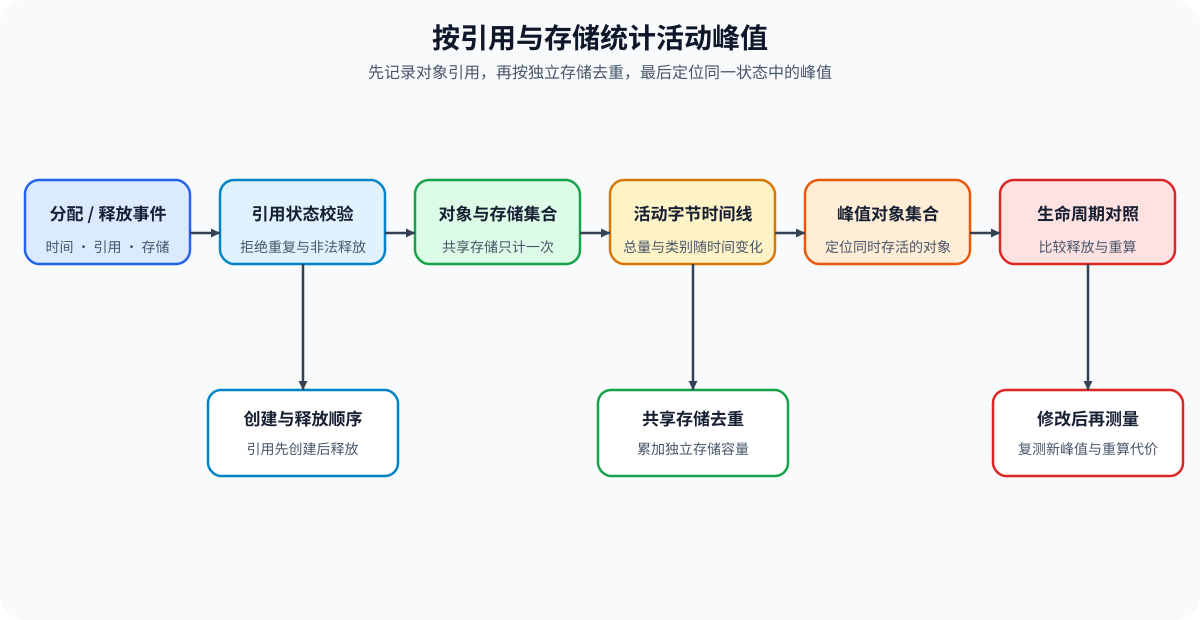
Step 2:共享视图为何不重复计数字节
先找出仍被引用的独立存储,再累加容量。例如12个FP32元素占48字节,从中切出的4元素视图虽然只访问16字节,仍持有原来的48字节存储;删掉原对象而保留视图,存储仍在。克隆则创建新存储,应另外计数。
设时刻
| 变化 | 引用怎样变化 | 独立存储量怎样变化 |
|---|---|---|
| 创建独立张量 | 增加对象与存储 | 增加相应字节 |
| 创建共享视图 | 增加一个存储持有者 | 不重复增加 |
| 释放一个别名 | 减少一个持有者 | 其他引用存在时保持不变 |
| 释放最后引用 | 移除最后逻辑持有者 | 教学计数减少,实际复用还要等相关工作完成 |
Step 3:在同一个状态中寻找峰值对象
峰值是同一时刻独立存储字节的最高值,不是各类别最大值的相加。设
图中四类独立存储在同一时间重叠,合计100MiB。峰值时间、类别和存活对象都应从同一个状态读取;时间戳相同也要保留真实先后。提前释放一个跨越峰值的对象后,仍需扫描整个窗口,检查其他时刻是否出现新的最高值。
| 观察 | 可以确认什么 | 接着查看什么 |
|---|---|---|
| 重叠减少后逻辑峰值下降 | 当前对象模型中的最高占用变小 | 设备实测峰值、输出与时间 |
| 删除引用但字节不变 | 仍可能有别名持有存储 | 其他引用与未完成的异步使用 |
| 活跃占用下降而预留不变 | 分配器可能仍缓存已释放块 | 实际分配记录与设备可用内存 |
| 各类别峰值不在同一时刻 | 类别最大值不能一起出现 | 整体峰值时的同一组对象 |

Step 4:实现引用变化、存储去重与峰值归因
输入事件包含毫秒时间、对象标识、动作、存储字节和类别;可选 storage_id 表示共享存储,未提供时默认每个对象独占存储。窗口开始前已有的对象用起点创建记录表示;这里的allocate/free表示引用创建与释放;共享存储的字节与类别必须一致,不能用局部视图大小冒充整块存储。相同时间戳按输入先后处理,采集时丢失顺序则无法恢复真实瞬时峰值。
骨架负责字段校验、排序与快照装配,你将补全非法状态判断、独立存储汇总及峰值选择。测试覆盖同刻事件顺序、最后一个引用释放、重复峰值、未释放状态和非法输入。
| TODO / 函数 | 学习者完成的机制 | 必须满足的约束 | 测试证据 |
|---|---|---|---|
TODO 1:检查引用状态转移normalize_memory_events | 识别重复创建和未知释放 | 时间有限、字节为正整数;同刻按输入先后;释放元数据与创建一致 | 非法字段、重复引用、未知释放、元数据冲突与同刻顺序 |
TODO 2:按独立存储计算驻留量build_residency_timeline | 按存储去重后计算活动字节 | 多个别名只计一次;类别与对象集合属于同一事件后状态 | 两个别名、释放一个和最后一个引用、存储重新分配 |
TODO 3:选择同一峰值状态peak_overlap_report | 找出最大字节和首次达到峰值的状态 | 不相加各类别独立最大值;空时间线无峰值 | 180 字节峰值、相同峰值取首次、类别求和与空图拒绝 |
from collections import defaultdict
from math import isfinite
from typing import Dict, List, Sequencedef normalize_memory_events(events: Sequence[Dict[str, object]]) -> List[Dict[str, object]]:
"""按时间和同刻原始顺序校验对象引用与底层存储的生命周期。"""
normalized = []
for order, event in enumerate(events):
action = event.get("action")
object_id = event.get("object_id")
category = event.get("category")
storage_id = event.get("storage_id", object_id)
size = event.get("bytes")
try:
time_ms = float(event.get("time_ms", -1.0))
except (TypeError, ValueError) as error:
raise ValueError("invalid event time") from error
if (action not in {"allocate", "free"} or not isfinite(time_ms) or time_ms < 0
or not all(isinstance(value, str) and value.strip()
for value in (object_id, category, storage_id))
or not isinstance(size, int) or isinstance(size, bool) or size <= 0):
raise ValueError("invalid memory event")
normalized.append({
"time_ms": time_ms, "event_order": order, "object_id": object_id,
"storage_id": storage_id, "action": action, "bytes": size, "category": category,
})
normalized.sort(key=lambda event: (event["time_ms"], event["event_order"]))
live = {}
for event in normalized:
object_id = event["object_id"]
# ==========================================
# TODO 1:检查引用状态转移
# ==========================================
# duplicate_allocation = ??? # 对已存活对象重复创建引用。
# unknown_free = ??? # 释放未存活的对象引用。
raise NotImplementedError("TODO 1:请检查引用状态转移")
if duplicate_allocation or unknown_free:
raise ValueError("invalid object lifecycle transition")
if event["action"] == "allocate":
for item in live.values():
if item["storage_id"] == event["storage_id"]:
if (item["bytes"], item["category"]) != (event["bytes"], event["category"]):
raise ValueError("shared storage metadata must agree")
live[object_id] = event
else:
allocation = live[object_id]
if any(event[key] != allocation[key] for key in ("storage_id", "bytes", "category")):
raise ValueError("free metadata does not match allocation")
del live[object_id]
return normalized
def build_residency_timeline(events: Sequence[Dict[str, object]]) -> List[Dict[str, object]]:
"""在每次引用变化后按独立存储计量,保留对象和存储集合。"""
events = normalize_memory_events(events)
live = {}
timeline = []
for event in events:
if event["action"] == "allocate":
live[event["object_id"]] = event
else:
del live[event["object_id"]]
# ==========================================
# TODO 2:按独立存储计算驻留量
# ==========================================
# unique_storages = ??? # 按 storage_id 去重;别名共享同一底层存储。
# active_bytes = ??? # 独立存储总字节,不能把每个别名重复相加。
raise NotImplementedError("TODO 2:请按独立存储计算驻留量")
category_bytes = defaultdict(int)
for item in unique_storages.values():
category_bytes[item["category"]] += item["bytes"]
timeline.append({
"time_ms": event["time_ms"], "event_order": event["event_order"],
"active_bytes": active_bytes, "live_object_ids": sorted(live),
"live_storage_ids": sorted(unique_storages),
"category_bytes": dict(sorted(category_bytes.items())),
})
return timeline
def peak_overlap_report(timeline: Sequence[Dict[str, object]]) -> Dict[str, object]:
"""报告第一次达到最大存储字节时的同一份事件后状态。"""
if not timeline:
raise ValueError("timeline must not be empty")
# ==========================================
# TODO 3:选择同一峰值状态
# ==========================================
# peak_bytes = ??? # 全时间线上的最大活动存储字节数。
# peak = ??? # 首次达到峰值的完整事件后状态。
raise NotImplementedError("TODO 3:请选择同一峰值状态")
return {
"peak_time_ms": peak["time_ms"], "peak_event_order": peak["event_order"],
"peak_bytes": peak_bytes, "live_object_ids": list(peak["live_object_ids"]),
"live_storage_ids": list(peak["live_storage_ids"]),
"category_bytes": dict(peak["category_bytes"]),
}测试
def _memory_events():
    """构造权重跨窗口驻留、输入与激活共同形成峰值的事件。"""
    return [
        {"time_ms": 0.0, "object_id": "weights", "action": "allocate", "bytes": 100, "category": "model"},
        {"time_ms": 1.0, "object_id": "input", "action": "allocate", "bytes": 20, "category": "batch"},
        {"time_ms": 2.0, "object_id": "activation", "action": "allocate", "bytes": 60, "category": "activation"},
        {"time_ms": 3.0, "object_id": "input", "action": "free", "bytes": 20, "category": "batch"},
        {"time_ms": 4.0, "object_id": "activation", "action": "free", "bytes": 60, "category": "activation"},
    ]


def _assert_memory_error(function, events):
    """要求非法生命周期明确触发 ValueError。"""
    try:
        function(events)
    except ValueError:
        return
    raise AssertionError("非法事件必须被拒绝")


def test_normalize_memory_events():
    """不同时间按时间排序,窗口结束仍可保留活跃对象。"""
    events = normalize_memory_events(list(reversed(_memory_events())))
    assert events[0]["object_id"] == "weights"
    assert events[-1]["action"] == "free"
    assert all(event["storage_id"] == event["object_id"] for event in events)


def test_invalid_memory_events():
    """覆盖非法字段、非有限时间、重复引用、未知释放与元数据冲突。"""
    allocation = _memory_events()[0]
    for change in [
        {"action": "resize"}, {"object_id": ""}, {"category": ""},
        {"bytes": 0}, {"bytes": 1.5}, {"bytes": True},
        {"time_ms": -1}, {"time_ms": float("nan")}, {"time_ms": float("inf")},
    ]:
        _assert_memory_error(normalize_memory_events, [{**allocation, **change}])
    _assert_memory_error(normalize_memory_events, [allocation, dict(allocation)])
    _assert_memory_error(normalize_memory_events, [{**allocation, "action": "free"}])
    _assert_memory_error(normalize_memory_events, [
        allocation, {**allocation, "time_ms": 1, "action": "free", "bytes": 99},
    ])
    _assert_memory_error(normalize_memory_events, [
        {**allocation, "storage_id": "shared"},
        {**allocation, "object_id": "view", "storage_id": "shared", "bytes": 50},
    ])


def test_residency_and_peak():
    """校验逐次字节、峰值组成与同一状态中的类别求和。"""
    timeline = build_residency_timeline(_memory_events())
    assert [point["active_bytes"] for point in timeline] == [100, 120, 180, 160, 100]
    peak = peak_overlap_report(timeline)
    assert peak["peak_bytes"] == 180 and peak["peak_time_ms"] == 2.0
    assert peak["live_object_ids"] == ["activation", "input", "weights"]
    assert sum(peak["category_bytes"].values()) == peak["peak_bytes"]
    assert timeline[0]["category_bytes"] == {"model": 100}


def test_same_time_event_order():
    """同刻先释放再分配与先分配再释放,具有不同的真实瞬时峰值。"""
    first = {"time_ms": 0, "object_id": "z", "action": "allocate", "bytes": 100, "category": "workspace"}
    free = {**first, "time_ms": 1, "action": "free"}
    second = {**first, "time_ms": 1, "object_id": "a"}
    reuse = build_residency_timeline([first, free, second])
    overlap = build_residency_timeline([first, second, free])
    assert [point["active_bytes"] for point in reuse] == [100, 0, 100]
    assert [point["active_bytes"] for point in overlap] == [100, 200, 100]
    assert peak_overlap_report(reuse)["peak_bytes"] == 100
    assert peak_overlap_report(overlap)["peak_bytes"] == 200


def test_shared_storage_release():
    """两个对象共享存储只计一次,最后一个引用释放后才减去字节。"""
    owner = {"time_ms": 0, "object_id": "owner", "storage_id": "s", "action": "allocate", "bytes": 100, "category": "model"}
    view = {**owner, "time_ms": 1, "object_id": "view"}
    timeline = build_residency_timeline([
        owner, view, {**owner, "time_ms": 2, "action": "free"},
        {**view, "time_ms": 3, "action": "free"},
    ])
    assert [point["active_bytes"] for point in timeline] == [100, 100, 100, 0]
    assert timeline[1]["live_object_ids"] == ["owner", "view"]
    assert timeline[1]["live_storage_ids"] == ["s"]
    assert timeline[2]["category_bytes"] == {"model": 100}
    assert timeline[-1]["live_storage_ids"] == []


def test_reallocation_after_release():
    """引用和存储全部释放后,可以重新使用标识且改变分配大小。"""
    first = _memory_events()[0]
    timeline = build_residency_timeline([
        first, {**first, "time_ms": 1, "action": "free"},
        {**first, "time_ms": 2, "bytes": 200},
    ])
    assert [point["active_bytes"] for point in timeline] == [100, 0, 200]


def test_peak_ties_and_category_maxima():
    """相同峰值选首次状态,各类别独立最大值不得拼成一个峰值。"""
    events = _memory_events() + [
        {"time_ms": 5, "object_id": "workspace", "action": "allocate", "bytes": 80, "category": "workspace"},
    ]
    timeline = build_residency_timeline(events)
    peak = peak_overlap_report(timeline)
    assert timeline[-1]["active_bytes"] == peak["peak_bytes"] == 180
    assert peak["peak_time_ms"] == 2.0
    assert "workspace" not in peak["category_bytes"]
    assert peak["category_bytes"] == {"activation": 60, "batch": 20, "model": 100}


def test_empty_memory_timeline():
    """空事件流可规范化和重建,但没有可归因的峰值状态。"""
    assert normalize_memory_events([]) == []
    assert build_residency_timeline([]) == []
    _assert_memory_error(peak_overlap_report, [])


def run_memory_timeline_tests():
    """核对事件次序、共享存储、峰值一致性和非法边界。"""
    test_normalize_memory_events()
    test_invalid_memory_events()
    test_residency_and_peak()
    test_same_time_event_order()
    test_shared_storage_release()
    test_reallocation_after_release()
    test_peak_ties_and_category_maxima()
    test_empty_memory_timeline()
    print("✅ 事件顺序、共享存储与峰值归因测试通过")


run_memory_timeline_tests()
🛑 STOP HERE 🛑
请先尝试自己完成代码并跑通测试。
如果遇到困难,再向下查看参考代码与解析。
参考代码与解析
代码
def normalize_memory_events(events: Sequence[Dict[str, object]]) -> List[Dict[str, object]]:
    """按时间和同刻原始顺序校验对象引用与底层存储的生命周期。"""
    normalized = []
    for order, event in enumerate(events):
        action = event.get("action")
        object_id = event.get("object_id")
        category = event.get("category")
        storage_id = event.get("storage_id", object_id)
        size = event.get("bytes")
        try:
            time_ms = float(event.get("time_ms", -1.0))
        except (TypeError, ValueError) as error:
            raise ValueError("invalid event time") from error
        if (action not in {"allocate", "free"} or not isfinite(time_ms) or time_ms < 0
                or not all(isinstance(value, str) and value.strip()
                           for value in (object_id, category, storage_id))
                or not isinstance(size, int) or isinstance(size, bool) or size <= 0):
            raise ValueError("invalid memory event")
        normalized.append({
            "time_ms": time_ms, "event_order": order, "object_id": object_id,
            "storage_id": storage_id, "action": action, "bytes": size, "category": category,
        })
    normalized.sort(key=lambda event: (event["time_ms"], event["event_order"]))
    live = {}
    for event in normalized:
        object_id = event["object_id"]
        # TODO 1:检查引用状态转移
        duplicate_allocation = event["action"] == "allocate" and object_id in live
        unknown_free = event["action"] == "free" and object_id not in live
        if duplicate_allocation or unknown_free:
            raise ValueError("invalid object lifecycle transition")
        if event["action"] == "allocate":
            for item in live.values():
                if item["storage_id"] == event["storage_id"]:
                    if (item["bytes"], item["category"]) != (event["bytes"], event["category"]):
                        raise ValueError("shared storage metadata must agree")
            live[object_id] = event
        else:
            allocation = live[object_id]
            if any(event[key] != allocation[key] for key in ("storage_id", "bytes", "category")):
                raise ValueError("free metadata does not match allocation")
            del live[object_id]
    return normalized


def build_residency_timeline(events: Sequence[Dict[str, object]]) -> List[Dict[str, object]]:
    """在每次引用变化后按独立存储计量,保留对象和存储集合。"""
    events = normalize_memory_events(events)
    live = {}
    timeline = []
    for event in events:
        if event["action"] == "allocate":
            live[event["object_id"]] = event
        else:
            del live[event["object_id"]]
        # TODO 2:按独立存储计算驻留量
        unique_storages = {item["storage_id"]: item for item in live.values()}
        active_bytes = sum(item["bytes"] for item in unique_storages.values())
        category_bytes = defaultdict(int)
        for item in unique_storages.values():
            category_bytes[item["category"]] += item["bytes"]
        timeline.append({
            "time_ms": event["time_ms"], "event_order": event["event_order"],
            "active_bytes": active_bytes, "live_object_ids": sorted(live),
            "live_storage_ids": sorted(unique_storages),
            "category_bytes": dict(sorted(category_bytes.items())),
        })
    return timeline


def peak_overlap_report(timeline: Sequence[Dict[str, object]]) -> Dict[str, object]:
    """报告第一次达到最大存储字节时的同一份事件后状态。"""
    if not timeline:
        raise ValueError("timeline must not be empty")
    # TODO 3:选择同一峰值状态
    peak_bytes = max(point["active_bytes"] for point in timeline)
    peak = next(point for point in timeline if point["active_bytes"] == peak_bytes)
    return {
        "peak_time_ms": peak["time_ms"], "peak_event_order": peak["event_order"],
        "peak_bytes": peak_bytes, "live_object_ids": list(peak["live_object_ids"]),
        "live_storage_ids": list(peak["live_storage_ids"]),
        "category_bytes": dict(peak["category_bytes"]),
    }
解析
TODO 1:检查创建与释放顺序
- 同一个存活对象不能重复创建;没有创建或已经释放的对象不能再次释放。时间相同的事件按输入顺序处理,不能把释放统一移到创建前。
- 非法事件测试检查这些条件,存储元数据还要由骨架核对;同刻顺序测试检查重排是否制造假峰值。
TODO 2:以存储而不是对象名计数
- 按存储标识去重,再分别累加总字节与类别字节。释放一个别名时,只要另一引用仍在,整块存储还应计入。
- 测试先释放原对象、再释放最后视图,并在释放后重新分配同一标识,检查计数是否随实际持有关系变化。
TODO 3:读取第一次峰值的完整状态
- 找到最大活动字节后,取第一次达到它的状态,同时读取类别和存活对象,避免拼接不同时刻的数据。
- 并列峰值测试同时让各类别最大值错开出现;空输入没有可报告的峰值,应明确停止。
框架一致性核对(可选)
使用真实 PyTorch CPU 张量、切片视图与克隆,读取公开存储接口,并将显式引用变化记录为 Step 4 事件流。共同输入为 12 个 FP32 元素及其中 4 元素的偏移视图;只核对引用表对应的存储计量,不测量 Python 对象回收、进程内存或 CUDA 分配器的实际释放。
| 核对对象 | Step 4 教学实现 | 成熟框架 CPU 路径 | 共同输入与通过条件 |
|---|---|---|---|
| 偏移视图共享存储 | storage_id 相同的引用只计一次 | 切片与 Tensor.untyped_storage().data_ptr() | 视图的数据起始地址偏移,但底层存储标识与原张量相同 |
| 视图元素量与存储容量 | 事件 bytes 使用整块存储容量 | numel()、element_size()、untyped_storage().nbytes() | 视图元素占 16 Byte,底层存储仍为 48 Byte |
| 移除原引用与创建克隆 | build_residency_timeline 保留别名,克隆使用新存储 | 引用表移除原张量,clone() 创建独立存储 | 视图仍能读取;事件后字节依次为 48、48、48、64、16、0 |
| 峰值对象与容量 | peak_overlap_report 从同一状态读取对象与字节 | 引用表同时持有视图与克隆的存储观测 | 峰值为 64 Byte,共存对象为视图与克隆 |
from importlib.metadata import version

try:
    import torch
except ModuleNotFoundError as error:
    if error.name != "torch":
        raise
    framework_check = {
        "status": "skipped",
        "reason": "缺少 PyTorch;按 docs/guide.md#base-cpu 准备 BASE-CPU 后运行本单元。",
    }
else:
    def check_shared_storage_framework_conformance():
        """用真实 CPU 张量的存储标识和容量核对教学驻留计量。"""
        live, events, observed_bytes = {}, [], []
        bytes_per_value = torch.empty((), dtype=torch.float32, device="cpu").element_size()

        def snapshot():
            # 观测显式引用表仍持有的存储;不是进程内存或分配器释放测量。
            storages = {tensor.untyped_storage().data_ptr(): tensor.untyped_storage().nbytes()
                        for tensor in live.values()}
            observed_bytes.append(sum(storages.values()))

        def add(name, tensor):
            live[name] = tensor
            storage = tensor.untyped_storage()
            events.append({"time_ms": len(events), "action": "allocate", "object_id": name,
                           "storage_id": str(storage.data_ptr()), "bytes": storage.nbytes(),
                           "category": "activation"})
            snapshot()

        def remove(name):
            tensor = live.pop(name)
            storage = tensor.untyped_storage()
            events.append({"time_ms": len(events), "action": "free", "object_id": name,
                           "storage_id": str(storage.data_ptr()), "bytes": storage.nbytes(),
                           "category": "activation"})
            snapshot()

        add("owner", torch.arange(12, dtype=torch.float32, device="cpu"))
        add("view", live["owner"][2:6])
        owner_storage = live["owner"].untyped_storage().data_ptr()
        view_storage = live["view"].untyped_storage().data_ptr()
        view_size = live["view"].numel() * live["view"].element_size()
        view_storage_size = live["view"].untyped_storage().nbytes()
        offset_view = live["view"].data_ptr() != live["owner"].data_ptr()
        remove("owner")
        view_survives = torch.equal(live["view"], torch.arange(2, 6, dtype=torch.float32, device="cpu"))
        add("clone", live["view"].clone())
        clone_is_independent = live["clone"].untyped_storage().data_ptr() != view_storage
        remove("view")
        remove("clone")

        timeline = build_residency_timeline(events)
        peak = peak_overlap_report(timeline)
        expected = [12, 12, 12, 16, 4, 0]
        expected_bytes = [count * bytes_per_value for count in expected]
        checks = {
            "offset_view_shares_owner_storage": owner_storage == view_storage and offset_view,
            "view_elements_smaller_than_backing_storage": view_size == 4 * bytes_per_value
                                                         and view_storage_size == 12 * bytes_per_value,
            "view_survives_owner_reference_removal": view_survives,
            "clone_uses_independent_storage": clone_is_independent,
            "reference_table_bytes_match_expected": observed_bytes == expected_bytes,
            "teaching_timeline_matches_tensor_storage": [point["active_bytes"] for point in timeline]
                                                        == observed_bytes,
            "peak_state_matches_coexisting_storages": peak["peak_bytes"] == 16 * bytes_per_value
                                                       and peak["live_object_ids"] == ["clone", "view"],
        }
        failed = [name for name, passed in checks.items() if not passed]
        if failed:
            raise AssertionError(f"框架一致性核对失败:{failed}")
        return {
            "status": "passed", "check_kind": "framework_conformance",
            "versions": {"torch": version("torch")}, "checks": checks,
            "storage_bytes_by_event": observed_bytes, "peak_bytes": peak["peak_bytes"],
        }

    framework_check = check_shared_storage_framework_conformance()

framework_check
Step 5:GPU 机制实验——比较驻留重叠与重算代价
真实设备上的分配器缓存、临时张量和计算时间会改变容量取舍。本实验让激活与工作区重叠,或在工作区创建前释放激活,比较峰值和重算开销。
| 学习问题 | CPU 已确认 | GPU 要确认与后续使用 |
|---|---|---|
| 缩短驻留重叠能否减少真实分配峰值 | 事件顺序、共享存储去重与峰值选择;真实 CPU 张量存储关系 | 比较构造张量的活跃/预留峰值、最后一轮校验和与时间;真实别名释放与完整分配轨迹需另测 |
5.1 环境与固定工作负载
本实验使用 PERF-CUDA-MECHANISM,首次运行按性能机制GPU环境创建和预检环境。固定输入与当前登记见实验资产表。
| 配置层 | 必须说明的内容 | 修改规则 |
|---|---|---|
| 运行环境 | 单张 CUDA GPU;PERF-CUDA-MECHANISM;参考显存 8 GiB | Profile 预检未通过时停止 |
| 模型 / 数据来源 | 随机构造的 FP32 常驻张量,两条路径共享本次输入,无外部数据下载 | 当前协议未固定随机种子,复测不保证输入逐元素相同 |
| 工作负载 | 8192 × 2048 张量,每个主要张量约 64 MiB | 改变形状或数据类型后使用新标签 |
| 配对变量 | 保留激活并创建平方输出 → 释放激活后克隆常驻张量、原位重算 | 输入与计算目标相同,检查活动峰值与时间的取舍 |
| 测量方法 | 预热 5 次、每条路径测量 20 次;CUDA 事件时间,分配/保留峰值,最后一轮校验和 | 同步后重置峰值;分组采样不是逐轮交替配对,校验和不等于逐元素 allclose |
| 结果资产 | benchmarks/results/perf_memory_timeline/<workload_id>_<run_label>.json | 新运行不覆盖旧结果,5.3 可独立读取 |
RUN_MODE = "dry_run"  # 默认值 dry_run;改为 real_gpu 后执行真实显存峰值对照。
RUN_LABEL = "default"  # 默认值 default;正式复测使用唯一标签并保留历史结果。
ENVIRONMENT_PROFILE = "PERF-CUDA-MECHANISM"  # 运行前必须通过的环境配置 ID。
SEMANTIC_ID = "PERF-MEMORY-TIMELINE"  # 机制页稳定标识。
WORKLOAD_ID = "perf-memory-peak-overlap"  # 生命周期与峰值重叠实验的稳定标识。
WORKLOAD_VERSION = "v2"  # 默认 v2 测量协议;重叠与重算路径分别保留峰值和时间样本。
ROWS = 8192  # 默认 8192 行,正整数;增大提高存储与重算开销,改变后用新标签。
HIDDEN_SIZE = 2048  # 默认 2048 列,正整数;改变后不与旧形状合并解释。
WARMUP_STEPS = 5  # 默认预热 5 次,正整数;不计入正式样本。
REPEAT_STEPS = 20  # 默认每条路径测量 20 次,正整数;影响统计规模。
RESULT_RELATIVE_DIR = "benchmarks/results/perf_memory_timeline"  # 结果 JSON 的仓库相对目录。
5.2 执行并保存 JSON
预检通过后执行两条驻留路径,分别保存每次测量的分配峰值、保留峰值、延迟与校验和。已有同标签结果时停止,不覆盖历史数据;本单元不从 CUDA 分配器快照自动重建对象生命周期。
from pathlib import Path
import json
import statistics
import sys
import subprocess

if RUN_MODE not in {"dry_run", "real_gpu"}:
    raise ValueError("RUN_MODE 只能为 dry_run 或 real_gpu")
for name, value in {"ROWS": ROWS, "HIDDEN_SIZE": HIDDEN_SIZE,
                    "WARMUP_STEPS": WARMUP_STEPS, "REPEAT_STEPS": REPEAT_STEPS}.items():
    if not isinstance(value, int) or isinstance(value, bool) or value <= 0:
        raise ValueError(f"{name} 必须为正整数")

if RUN_MODE == "real_gpu":
    import torch
    from tools.project_runtime import resolve_project_root, save_json_record_once

    if not RUN_LABEL or RUN_LABEL == "default" or Path(RUN_LABEL).name != RUN_LABEL:
        raise ValueError("正式运行需要不含目录分隔符的唯一 RUN_LABEL")
    project_root = resolve_project_root()
    subprocess.run([sys.executable, str(project_root / "tools/environment_preflight.py"),
                    "--profile", ENVIRONMENT_PROFILE], check=True)
    result_dir = project_root / RESULT_RELATIVE_DIR
    result_path = result_dir / f"{WORKLOAD_ID}_{RUN_LABEL}.json"
    if result_path.exists():
        raise FileExistsError("同标签结果已存在:读取已有结果,或更换 RUN_LABEL 后重测")
    result_dir.mkdir(parents=True, exist_ok=True)
    if not torch.cuda.is_available():
        raise RuntimeError("PERF-MEMORY-TIMELINE 真实实验需要 CUDA GPU")

    device = torch.device("cuda")
    persistent = torch.randn(ROWS, HIDDEN_SIZE, device=device)

    def run_path(recompute):
        torch.cuda.synchronize()
        torch.cuda.reset_peak_memory_stats()
        start = torch.cuda.Event(enable_timing=True)
        end = torch.cuda.Event(enable_timing=True)
        start.record()
        activation = persistent * 2.0
        if recompute:
            del activation
            workspace = persistent.clone()
            workspace.mul_(2.0).square_()
        else:
            workspace = activation.square()
        checksum = workspace.sum()
        end.record()
        end.synchronize()
        sample = {
            "latency_ms": float(start.elapsed_time(end)),
            "peak_allocated_bytes": int(torch.cuda.max_memory_allocated()),
            "peak_reserved_bytes": int(torch.cuda.max_memory_reserved()),
            "checksum": float(checksum.item()),
        }
        del workspace
        return sample

    for _ in range(WARMUP_STEPS):
        run_path(False)
        run_path(True)
    overlap_samples = [run_path(False) for _ in range(REPEAT_STEPS)]
    recompute_samples = [run_path(True) for _ in range(REPEAT_STEPS)]
    quality_passed = abs(overlap_samples[-1]["checksum"] - recompute_samples[-1]["checksum"]) <= 1e-3 * abs(overlap_samples[-1]["checksum"])

    def summarize(samples):
        return {
            "latency_median_ms": statistics.median(item["latency_ms"] for item in samples),
            "peak_allocated_bytes": max(item["peak_allocated_bytes"] for item in samples),
            "peak_reserved_bytes": max(item["peak_reserved_bytes"] for item in samples),
        }

    baseline = summarize(overlap_samples)
    candidate = summarize(recompute_samples)
    comparison = {
        "allocated_reduction_ratio": 1.0 - candidate["peak_allocated_bytes"] / baseline["peak_allocated_bytes"],
        "reserved_reduction_ratio": 1.0 - candidate["peak_reserved_bytes"] / baseline["peak_reserved_bytes"],
        "latency_ratio": candidate["latency_median_ms"] / baseline["latency_median_ms"],
    }
    record = {
        "schema_version": "performance-memory-timeline-mechanism/v2",
        "profile_id": ENVIRONMENT_PROFILE,
        "semantic_id": SEMANTIC_ID,
        "run_label": RUN_LABEL,
        "framework": {"python": sys.version.split()[0], "torch": torch.__version__, "cuda": torch.version.cuda},
        "hardware": {"device": torch.cuda.get_device_name(0), "total_memory_bytes": torch.cuda.get_device_properties(0).total_memory},
        "workload": {"id": WORKLOAD_ID, "version": WORKLOAD_VERSION, "rows": ROWS, "hidden_size": HIDDEN_SIZE, "warmup_steps": WARMUP_STEPS, "repeat_steps": REPEAT_STEPS},
        "baseline": {"name": "overlap_activation_workspace", **baseline},
        "candidate": {"name": "release_then_recompute", **candidate},
        "comparison": comparison,
        "quality": {"checksum_close": bool(quality_passed)},
        "samples": {"baseline": overlap_samples, "candidate": recompute_samples},
        "failure": None,
        "evidence_level": "local_mechanism_benchmark",
        "decision": "accept_for_peak_reduction" if quality_passed and candidate["peak_allocated_bytes"] < baseline["peak_allocated_bytes"] else "tune",
    }
    save_json_record_once(result_path, record)
else:
    print("⏭️ RUN_MODE=dry_run;未执行 GPU 显存时间线实验。")
5.3 读取结果
按已有RUN_LABEL读取记录,核对输入与协议版本,再从原始样本重算峰值和延迟统计。结果检查与输出数值检查分别展示,原始记录保持不变。
from pathlib import Path
import json
from tools.project_runtime import resolve_project_root
from tools.performance_result_review import read_performance_result

result_path = resolve_project_root() / RESULT_RELATIVE_DIR / f"{WORKLOAD_ID}_{RUN_LABEL}.json"
if not result_path.is_file():
    if RUN_MODE == "real_gpu":
        raise FileNotFoundError(f"未找到结果:{result_path}")
    memory_record = {"status": "not_run", "result_path": str(result_path)}
    print(memory_record)
else:
    memory_record, result_review = read_performance_result(
        result_path, semantic_id=SEMANTIC_ID, run_label=RUN_LABEL,
        workload_id=WORKLOAD_ID, current_version=WORKLOAD_VERSION,
    )
    print(json.dumps(result_review, ensure_ascii=False, indent=2))
    print(json.dumps({key: memory_record.get(key) for key in (
        "schema_version", "run_label", "framework", "hardware", "workload",
        "failure", "evidence_level", "decision", "quality",
    )}, ensure_ascii=False, indent=2))
    print("路径 | 延迟中位数 ms | 分配峰值 bytes | 保留峰值 bytes")
    for name in ("baseline", "candidate"):
        item = memory_record.get(name, {})
        print(name, item.get("latency_median_ms"), item.get("peak_allocated_bytes"),
              item.get("peak_reserved_bytes"))
    print("派生对比:", memory_record.get("comparison"))
    print("路径 | 轮次 | 延迟 ms | 分配峰值 bytes | 保留峰值 bytes | 校验和")
    for name, samples in memory_record.get("samples", {}).items():
        for index, sample in enumerate(samples, 1):
            print(name, index, sample.get("latency_ms"), sample.get("peak_allocated_bytes"),
                  sample.get("peak_reserved_bytes"), sample.get("checksum"))
5.4 解释证据与决策
当前登记为 rtx5070ti_memory_v1,工作负载版本为 v2。原始结果无失败,最后一轮校验和接近,释放激活后重算降低了活动分配峰值,同时明显增加计算时间。
这组结果显示了活动分配峰值下降与计算时间增加之间的取舍。采用前还需补逐元素输出误差、共享别名测试和完整分配时间线。两条路径的分配器保留峰值相同;若要继续分析碎片,应查看分配块与空闲块的记录。
| 观察项 | 读取字段 | 当前结果 | 解释与动作 |
|---|---|---|---|
| 数值检查 | quality.checksum_close 与 failure | 最后一轮校验和检查通过,无失败 | 累计值检查通过;采用前再逐元素比较两条路径的输出 |
| 活动分配峰值 | peak_allocated_bytes | 约192 → 128MiB,下降约33.3% | 限定于本次构造张量;需要真实训练收益时使用目标模型工作负载 |
| 时间代价 | 延迟中位数与 latency_ratio | 0.80 → 1.49 ms,变为基线约 1.86 倍 | 原始决策仅针对峰值下降;是否采用还取决于吞吐预算 |
| 分配器保留 | peak_reserved_bytes | 两条路径均为194MiB | 保留量未下降,设备归还与碎片情况需另查分配记录 |
相关阅读
将引用与峰值关系放回训练时,再检查保存、重算和搬运怎样改变反向所需状态。
- 19. 激活检查点:追踪被丢弃与重新计算的中间结果。
- 76. 激活重算、卸载与预算比较:比较实际训练峰值与额外时间。